
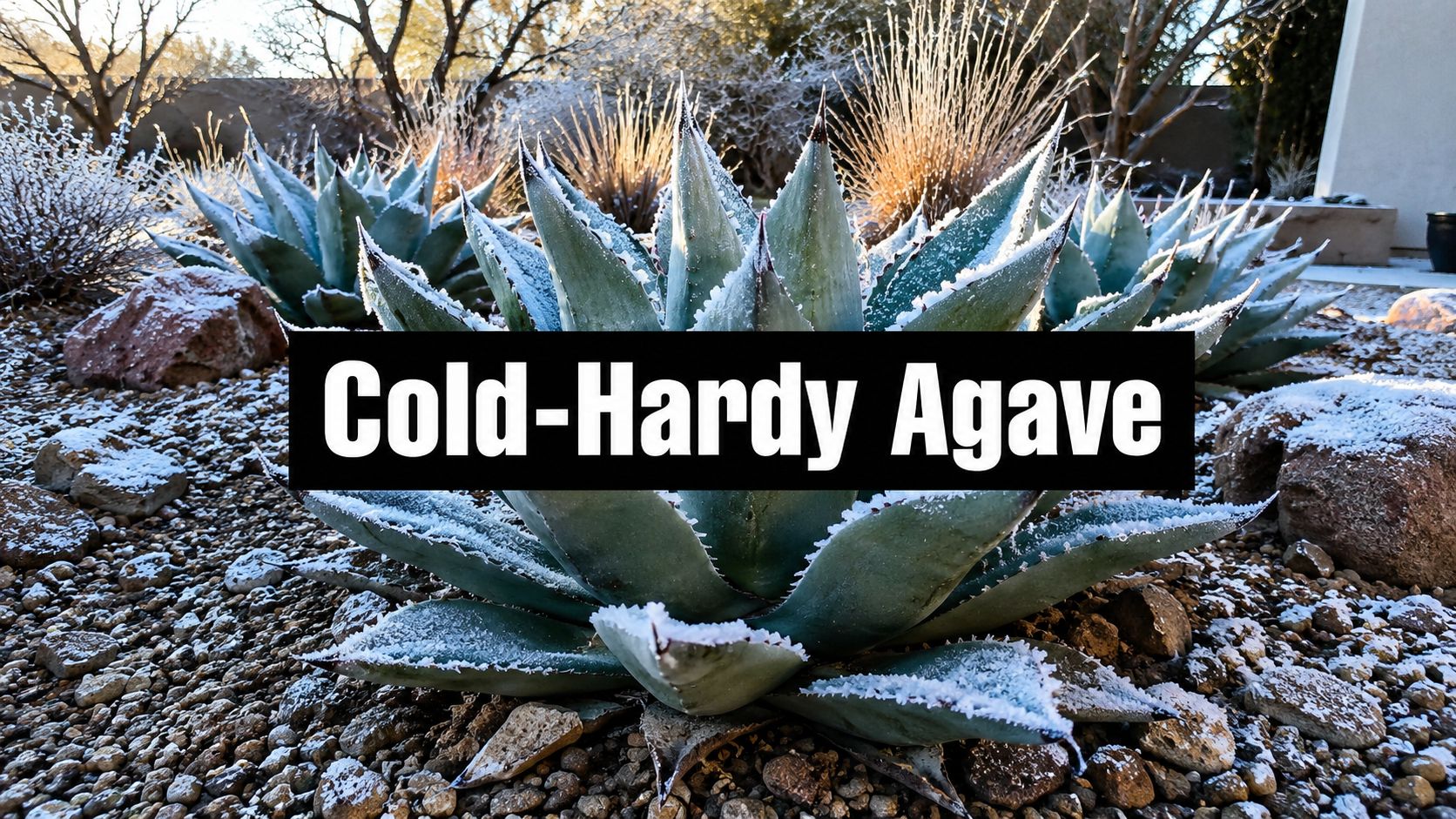

The plant most likely to kill an agave in a cold climate isn't always the one exposed to the lowest temperature. Winter moisture is often the more serious threat. A hardy rosette can tolerate severe cold when its roots and crown stay dry, while a less extreme freeze combined with wet soil can cause damage that a USDA zone label won't predict.
Agaves are no longer confined to frost-free deserts. The genus ranges from tender plants that fail in light frost to exceptionally hardy selections that can handle temperatures as low as -20°F, according to published landscape guidance on agaves for cold conditions. For buyers, the best agave for cold climates is therefore not one universal species. It's the plant whose cold tolerance, mature size, drainage needs, and planting location match the site.
The Reality of Growing Agaves in Cold Climates
Cold-hardy agaves can reach USDA Zone 5 when the planting site is managed for winter moisture, not temperature alone. A zone number describes expected cold, but it does not account for clay soil, trapped snow, or water sitting around the crown. Those conditions can kill a plant that otherwise tolerates severe frost.
The genus includes tender plants and exceptionally durable northern-desert forms. This overview of agave types places Agave americana near 15°F, Agave americana marginata around 20°F, Agave colorata around 15°F, and Agave ovatifolia around 5°F. It also notes that some cultivated agaves can withstand temperatures as low as -20°F. The spread is wide enough that appearance alone is a poor basis for a cold-climate purchase.

A short list beats a broad label
For a freezing-prone site, begin with Agave parryi-type plants, Agave ovatifolia, Agave utahensis, Agave havardiana, and Agave neomexicana. These northern-desert taxa share traits that suit cold conditions, including tight rosettes, waxy cuticles, and drought-adapted tissue. Those features can limit water held in the leaves and reduce ice-related injury, but they do not make wet soil safe. Use raised, sunny, fast-draining beds, and stop winter irrigation.
A compact rosette is usually a better starting form than a loose, open one. Snow and ice have fewer paths into the crown, while less tissue remains exposed to repeated freeze-thaw cycles. That helps explain why Agave parryi performs so consistently in colder inland and high-desert sites.
Why the planting site matters as much as the plant
Hardiness belongs to the species. Survival belongs to the combination of species and site. Flat clay, a low pocket, or a bed where melting snow gathers can rot the crown even when the air temperature stays within the plant's published range. A sunny slope with sharply drained soil may give the same agave a much better chance.
Mature size also affects winter risk and placement. Agave americana can reach roughly 6 to 10 feet tall and 10 to 13 feet wide, with cold tolerance around 15°F. A compact, exceptionally hardy agave may measure about 1.5 feet by 2 feet and tolerate -20°F. That published cold-tolerant agave guide helps buyers compare temperature tolerance with the space a mature specimen will occupy.
Practical rule: Choose a species rated for at least one USDA zone colder than your site's historical minimum, then improve drainage before relying on the label.
A cold-hardy agave can become a permanent architectural feature outside traditional desert regions. Select by cold tolerance, mature scale, exposure, and winter moisture together, then plant the specimen where water leaves the crown quickly.
Species Comparison: Selecting the Right Hardy Agave
Agave parryi is usually the strongest candidate for severe cold, provided winter moisture is controlled. The University of Arizona Campus Arboretum reports tolerance down to -5°F and lists it for USDA Zones 5a to 11 in this cold-hardy agave guide. Missouri Botanical Garden guidance, summarized by Southwest Gardener's Parry's agave profile, lists reliable hardiness in USDA Zones 7 to 10, with survival down to -20°F in Zone 5 when conditions are dry rather than wet.
Those figures describe different conditions, not a contradiction. Parry's agave forms a compact, tight rosette that sheds snow and limits ice penetration into the crown. That shape suits exposed beds, rock gardens, patios, and containers where a moderate specimen is more useful than a giant plant.
Cold-Hardy Agave Species Quick Comparison
| Species | Cold Tolerance | Mature Size | Best Use |
|---|---|---|---|
| Agave parryi | Down to -5°F in University of Arizona reporting, with dry-condition survival reported to -20°F in colder settings | About 1.5 to 2 feet tall and 2 to 3 feet wide | Compact specimen, patio container, foundation bed, rock garden. See the cited profiles above for context. |
| Agave utahensis | About -15°C when kept dry in winter (Tropical Britain) | About 15 to 25 cm tall and 20 to 30 cm wide | Small container, alpine-style bed, tight rock garden |
| Agave ovatifolia | Around 5°F (Central Texas Gardener) | Mature dimensions vary by selection | Milder cold zones, open ornamental beds, architectural focal point |
| Agave americana | Around 15°F | About 6 to 10 feet tall and 10 to 13 feet wide | Large open planting, dramatic specimen, broad hardscape bed |
| Agave americana marginata | Around 20°F, with the variegated form noted as capable of burning without protection at 25°F | Large, with mature size dependent on growing conditions | Milder climates, protected display, seasonal container culture |
Agave utahensis fits sites where floor space is limited. Its eventual height of 15 to 25 cm and spread of 20 to 30 cm, along with reported survival to about -15°C when winter-dry, make it useful for containers and small rock gardens. It will not provide the visual scale of a large americana, and that restraint is often an advantage on a narrow patio or in a compact raised bed.
Agave ovatifolia sits between the smallest species and the large forms. Its reported tolerance around 5°F gives it more cold capacity than tender agaves, while its broad blue-gray rosette creates stronger presence than a miniature species. Persistent winter rain remains a serious risk, so the plant belongs in a position where water drains away quickly.
Agave americana is a space decision rather than a default choice for cold sites. Its mature dimensions can overwhelm a patio or foundation bed, and its reported tolerance around 15°F places it behind Parry's agave during severe freezes. Use it in a spacious, sunny outdoor area, or keep it as a container specimen where winter protection is available. The variegated Agave americana marginata needs more caution because cold can burn its leaves even in conditions that do not kill the plant.
Match the species' form to the site: compact rosettes for exposed or confined positions, broader plants for open beds, and tender selections only where protection is practical. For a wider planting palette, pair agaves with plants from this resource on winter interest plants for Minnesota yards so the garden retains structure after surrounding vegetation goes dormant. Before buying, review how to grow agave plants, then judge the specimen by its actual winter moisture, drainage, exposure, and mature spread rather than by a zone label alone.
Planting Techniques That Protect Agaves in Winter
Cold tolerance matters only after the planting site handles winter water. The safest position is a raised bed, berm, or naturally fast-draining slope, not the lowest part of a flat bed. Elevation moves melting snow and rain away from the crown, where many winter failures begin.
Visit the site after a wet spell. Standing water, slow-draining soil, or runoff from a downspout are warning signs. If the area stays wet, changing the planting position usually works better than trying to correct the entire soil profile with amendments.
Build a dry winter position
Use a raised or sloped site whenever possible. A south-facing wall can provide reflected warmth and reduce cold-wind exposure. A stone patio or masonry edge can also release stored heat after sunset. These microclimates will not make a tender agave hardy, but they can reduce stress when a suitable species is planted near its tolerance limit.
Set the agave with the crown sitting slightly above the surrounding soil. The crown is the central growing point where the leaves emerge. Burying it creates a wet pocket that dries slowly, while a raised crown lets runoff move away from the plant instead of collecting between the leaves.
Containers give marginal sites more control. You can choose a sharply draining substrate and move the plant beneath a roof, into a sheltered entry, or to another protected position when prolonged rain threatens. The trade-off is faster temperature change. Container roots have less surrounding soil for insulation, so a potted agave needs more deliberate winter placement than an established plant in the ground.

Use protection that keeps the crown dry
In wet-winter regions, an overhead rain shield can help more than heavy wrapping. Prop a clear panel above the plant to block direct precipitation while leaving space for air movement. The goal is to stop repeated saturation of the crown and leaves, not to seal the agave inside a damp enclosure.
Reduce winter watering sharply. Established outdoor plants should not receive routine irrigation while cold conditions prevent the root zone from drying. Around the crown, use inorganic materials such as gravel or decomposed granite instead of moisture-holding organic mulch.
The best winter protection is often invisible. It's the slope, the exposed crown, and the dry soil beneath the plant.
Avoid planting a cold-hardy agave immediately before a wet winter if the site drains poorly. Newly planted roots are still establishing, and cold saturated soil leaves little margin for recovery. Use a container first when the location remains questionable. Portability gives the plant an escape route that an in-ground specimen lacks.
For sudden freezes, follow these frost protection practices for plants. Apply protection before damaging weather arrives, keep coverings from pressing condensation against the crown, and remove them when conditions moderate.
Why Wet Freezes Are the Real Agave Killer
USDA zone labels are useful for narrowing a purchase, but they don't describe every winter a plant will experience. A zone rating focuses on temperature history. It doesn't fully explain whether the agave will face wet soil, saturated foliage, heavy snow sitting in the rosette, or repeated freeze-thaw cycles.
Agaves evolved around drought. Cold tolerance depends partly on keeping tissue water content low and maintaining thick epidermal barriers, including waxy cuticles. These features can slow the movement of ice through cells, but they work best when the plant enters winter relatively dry.
What freezing water does inside the plant
When water inside plant cells freezes, it forms ice and expands. That process can damage membranes and cellular structure. Repeated thawing and refreezing adds mechanical stress, especially when the plant's tissues and surrounding soil remain saturated.
Wet soil creates a second problem. It holds cold around the roots and crown for longer, while poor drainage prevents the plant from returning to a dry dormant state. Even if the air temperature stays within a published tolerance range, the combination of cold and water can produce soft tissue, crown injury, and root failure.
Research on Agave americana shows why growing conditions matter. One model placed its minimum cold-tolerance threshold near -10°C in suitable regions, while experimental work found a minimum tolerance near -7.4°C at the point of 50% cell death, with the result shifting according to growing conditions. The comparative research available through Semantic Scholar also identifies Agave sisalana as the most freeze-sensitive species in the comparison and Agave vilmoriniana as the next most sensitive, while americana still showed damage in colder field sites.
The buying lesson is straightforward. Don't ask only, “Will this agave survive my zone?” Ask whether it can survive my zone with my winter moisture pattern.
Dry cold and wet cold are different tests
A dry freeze on a raised, sunny site gives a hardy agave a much better chance than a milder freeze after prolonged rain. The thermometer doesn't tell you how quickly the soil drains or whether water has collected in the rosette.
For contractors and homeowners, evaluate the site through four questions:
- Soil: Does water leave the root zone quickly?
- Exposure: Does the planting receive winter sun and avoid the coldest wind?
- Crown: Can the center stay dry during rain and melting snow?
- Selection: Is the species rated for conditions colder than the site's typical minimum?
A plant that survives one cold snap may still fail after a long wet season. That's why dry-winter performance deserves more weight than a broad hardiness label.
Choosing the Right Agave for Your Space
The right cold-climate agave is chosen by winter moisture, mature footprint, and site exposure, not appearance alone. A blue-gray rosette may suit the design, yet heavy soil or runoff can make that purchase fail. Map the yard before selecting the plant.
Match form to the microclimate
A south- or west-facing wall can provide reflected heat and shelter from winter wind. North-facing beds usually receive less winter sun, while low areas collect cold air and stay damp longer. Place a hardy agave where the crown gets morning-to-afternoon light and nearby paving or masonry can release stored warmth after sunset.
For severe cold on a dry, exposed site, Agave parryi remains a practical first candidate. Its compact form suits rock gardens, smaller foundation spaces, patio containers, and areas where a broad plant would obstruct movement. Agave utahensis fits tighter designs, with reported dimensions of 15 to 25 cm tall and 20 to 30 cm wide. Use it for a gravel composition or small pot only where winter moisture stays controlled.
In milder cold zones, Agave ovatifolia provides a broader architectural shape, with reported tolerance around 5°F. Give it enough visual and physical clearance for its mature spread, especially beside paths or seating areas. The listed dimensions for Agave americana, roughly 6 to 10 feet tall and 10 to 13 feet wide, place it in open gardens rather than compact beds.
Measure the space in three dimensions
Check the mature diameter, leaf reach, and spine clearance. A plant that fits its nursery pot can still crowd a walkway, cover a window, or press against neighboring plants as it grows. Leave maintenance access around the rosette, not just planting-room for the roots.
Use this buying filter:
- Small patio or container: Start with Agave utahensis or Agave parryi.
- Compact foundation bed: Choose a moderately sized parryi-type specimen with clearance around the spines.
- Open architectural design: Consider Agave americana where its scale fits the setting.
- Massed dry garden: Repeat compact hardy forms instead of forcing a large species into a tight grid.
- Uncertain winter conditions: Choose a movable container only if its material and weight allow safe relocation.
For cold climates, thick-walled resin or frost-resistant ceramic containers are easier choices than thin decorative pots that can crack during freezing. Dark paving can add warmth, but it cannot compensate for a crown that stays wet. The final match is between hardiness, mature size, and mobility. If the site fails one of those tests, change the plant or the design before purchasing.
Sourcing Quality Cold-Hardy Agaves Online
A cold-hardy label does not make an online purchase safe. Inspect more than the product photograph, and verify the exact species before purchasing. Generic listings often misidentify agaves that can tolerate cold but fail in wet winter soil.
Look for a firm rosette, intact leaves, a healthy root system, and clear size information. Avoid a soft crown, collapsing foliage, or signs of prolonged saturation. Ask the nursery how the plant was grown, whether it was containerized or recently dug, and how it will be protected during shipping. Rigid spines and brittle leaves need packaging that prevents movement inside the box.
Acclimation starts when the plant arrives. A specimen raised under shelter should move gradually into stronger light, wind, and cold. Let it settle before placing it in a marginal winter site, and keep the crown protected from rain while it adjusts.

Before placing an order, check:
- Plant identity: Confirm the species or selection, not merely “hardy agave.”
- Mature scale: Match the listed dimensions to the bed, patio, and hardscape.
- Root condition: Reject plants showing crown softness or persistent wetness.
- Shipping preparation: Confirm that spines and leaves will be secured.
- Placement plan: Decide whether the plant will use a raised bed, fast-draining container, or sheltered microclimate.
- Support: Choose a nursery that answers questions about the specimen and its arrival condition.
The Cactus Outlet offers agaves and other desert plants online. Review its large agave plants for sale resource, then compare each listing with your winter drainage plan and available clearance.
A healthy specimen cannot overcome a wet planting hole. Give the plant dry winter soil, a raised position, and protection from standing moisture. Choose a species suited to conditions colder and wetter than your usual minimum, because survival depends on both temperature tolerance and how quickly the crown dries.
The Cactus Outlet also provides product information for buyers comparing agaves for patios and containers. Visit The Cactus Outlet to review available plants and select a specimen that fits your space and winter setup.