
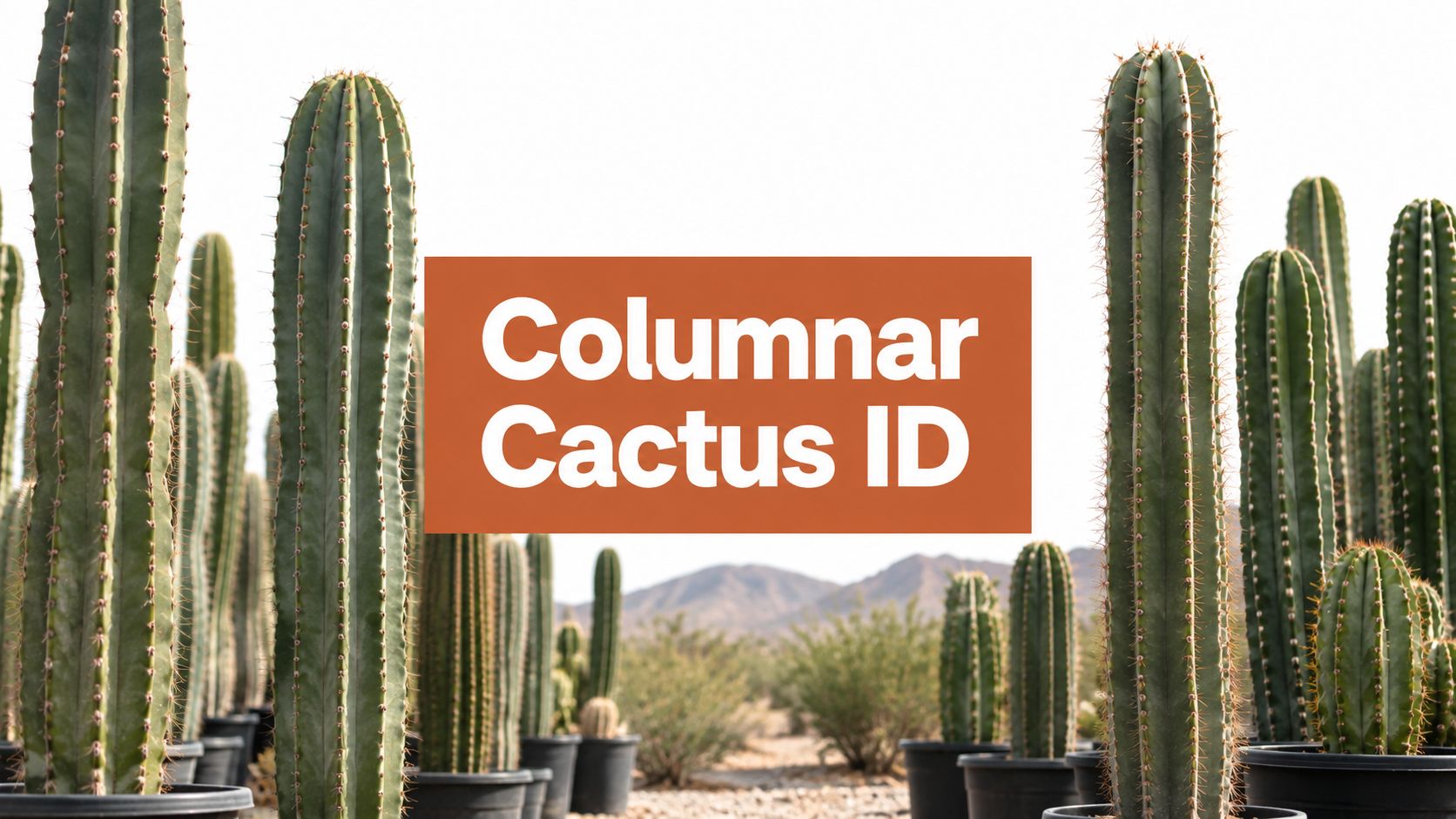

You've inherited a tall, ribbed cactus in a new yard, or you're looking at an online listing described only as a “large columnar cactus.” The plant looks impressive, but its label doesn't tell you whether it's a saguaro, Peruvian apple cactus, San Pedro, Mexican Fence Post, or something else entirely. Without a reliable identification, it's difficult to judge where the plant belongs, how it may branch, or which growing conditions suit it.
Columnar cactus identification becomes much easier when you stop relying on silhouette alone. Use the same sequence a careful grower uses in a nursery yard: confirm the areoles, assess the upright habit, study the ribs, inspect the spines, record the branching pattern, and use flowers or fruit when they're available. This approach works better than guessing from color or a single photograph, especially when the plant is young, stressed, or sold without a flower.
Why Tall Spiny Plants Are So Easy to Misidentify
“Columnar cactus” describes a growth form, not one single evolutionary group. Cacti have developed many body shapes, including columnar, arborescent, globular, epiphytic, and shrubby forms, so tall upright plants can belong to different lineages. A recent cactus database divided cactus growth into nine forms, including columnar, which illustrates why the label alone doesn't identify a species (research on cactus growth forms).
A young plant creates another problem. A single upright stem may eventually develop arms and become tree-like, while another species may remain a solitary pillar. The boundary between columnar, tree-like, and shrubby growth can be difficult to define when a specimen hasn't reached its mature architecture.
The label tells you less than the plant
A saguaro, cardon, Peruvian apple cactus, San Pedro, and Mexican Fence Post cactus may all look like ribbed green columns at a distance. Up close, however, their rib depth, areole spacing, spine arrangement, and branching habits can differ substantially. Flower color alone rarely helps a buyer evaluating a flowerless specimen online.
That difference matters outdoors. The identity of a cactus influences how you think about placement, spacing, container selection, watering, and protection from unsuitable conditions. A large specimen also needs to be evaluated as a living structure, not just as a decorative vertical shape.
Practical rule: Treat “columnar” as your starting category, not your final identification.
The useful question isn't “What cactus does this resemble?” Ask instead, “Which objective traits can I verify?” That shift turns a vague visual comparison into a repeatable process. Begin with the feature that separates true cacti from upright lookalikes, then narrow the possibilities one trait at a time.
Confirming You Are Looking at a True Cactus
Before comparing genera, make sure the plant is a cactus. Many upright succulents have thick stems, sharp projections, and desert-style forms, but those similarities don't prove cactus identity.
Find the areoles first
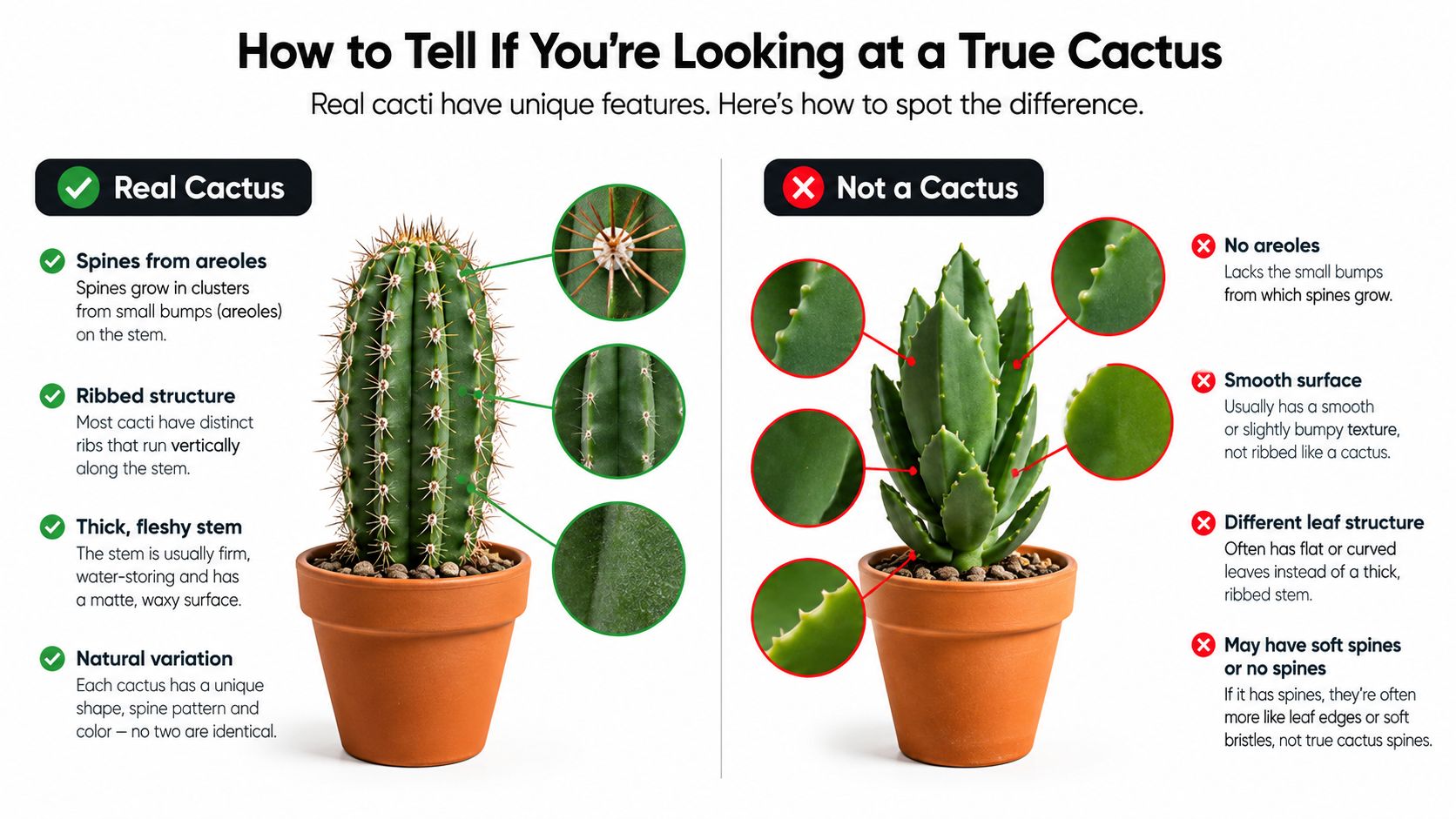
An areole is a small, regularly arranged structure on the cactus surface. Areoles commonly sit along ribs or at tubercles, and they're the points from which spines, hairs, flowers, and new branches arise. Botanical references identify areoles as the defining short shoots of the cactus family, making them a stronger diagnostic feature than a plant's general spiny appearance (Cactaceae identification traits).
Look closely at the base of a spine cluster. You're searching for a consistent pad, nub, or slightly woolly point that repeats along the stem. On a ribbed column, the areoles often form a visible line down each rib. They may be woolly or nearly bare, depending on the plant.
Separate cacti from lookalikes
Euphorbias can develop thick, upright stems with ridges and paired thorns. Agaves may form rigid architectural leaves with sharp tips or toothed margins. Other succulents can also look columnar, especially when viewed in a low-resolution listing photo. These plants may look cactus-like, but they don't have cactus areoles.
Spines alone are an unreliable test. Some true cacti have reduced or absent spines, and spine expression can change with environmental conditions or stress. Conversely, a non-cactus can have intimidating projections that resemble spines from a distance.
Don't damage an unfamiliar specimen to inspect it. Use a close photograph, a flashlight, and a safe viewing angle instead. If handling is necessary, protect your hands and avoid contact with sap or sharp structures.
Use the one-minute pass or fail test
- Choose a mid-stem area. Don't inspect only the growing tip, where features may be immature.
- Look for repeated points. Check whether small areoles appear at regular intervals along ribs or tubercles.
- Trace what emerges from them. Spines, wool, flowers, or branches should be associated with those points.
- Stop if no areoles are visible. Classify the plant as an upright succulent lookalike until better evidence becomes available.
If you can confirm areoles, continue with columnar cactus identification. If you can't, don't assign a cactus genus based on thorns, ridges, or a tall silhouette alone.
Reading the Morphology That Actually Narrows It Down
Once the areole check passes, work from large structures toward small details. The order matters because each observation removes possible matches. Trying to identify a plant from spine color first often leads to a familiar-looking but incorrect name.
Start with the stem architecture
A columnar cactus generally has erect, cylinder-shaped stems. It may stand as one pillar, form a tight cluster, or branch into a candelabra-like structure. Some columnar plants branch without a sharp trunk-to-branch boundary, so note how the arms emerge rather than looking for a conventional woody trunk.
Stand back and record three things:
- Main habit: Is it a single pillar, a group of stems, or a tree-like plant with arms?
- Stem profile: Are the columns narrow, thick, slightly tapering, or noticeably unequal?
- Branch position: Do branches begin near the base, midway up, or high on the main stem?
Young plants can hide their eventual architecture, so write down what's visible rather than predicting a mature form from a juvenile specimen.
Move to ribs and areoles
Count the prominent ribs on a representative mid-stem section. You don't need perfect botanical equipment, but you do need a consistent viewing area. Note whether the ribs are sharply raised, rounded, shallow, widely spaced, or closely packed.
Then inspect the areoles along one rib. Record their spacing over a known section of stem, and note whether they're woolly, colored, recessed, or nearly bare. The combination of stem architecture, ribs, and areoles is more useful than any one of those traits alone. A study of columnar cactus biomechanics examined 60 columnar cactus species within the subfamily Cactoideae, underscoring how broadly this form occurs and why comparative morphology matters (columnar cactus anatomy and biomechanics).

Finish with the spine pattern
At one or more areoles, record:
- Number: How many spines emerge from each areole?
- Arrangement: Do shorter radial spines surround a distinct central spine?
- Length and color: Are the spines uniform, or does the central spine stand out?
- Shape: Are they straight, curved, hooked, fine, or stout?
- Orientation: Do they point outward, lie close to the stem, or project in several directions?
Use a mid-stem section instead of relying only on new growth. A practical identification guide recommends combining rib prominence, areole spacing, woolliness, spine counts, and hooked or straight spine forms before attempting genus-level placement (stepwise cactus identification guidance).
For a broader reference on the same process, compare your notes with this cactus identification guide. The most dependable conclusion usually rests on at least three matching data points, such as upright habit, rib structure, and spine arrangement.
Telling the Common Columnar Genera Apart
The cacti buyers and landscapers commonly encounter can overlap in general appearance. A useful comparison starts with the plant's overall form, then checks ribs and spines, and finally considers branching. Don't wait for flowers before making a careful preliminary identification, but treat flowers and fruit as valuable confirmation when they appear.
| Plant | Growth Form | Ribs and Spines | Branching Habit |
|---|---|---|---|
| Saguaro, Carnegiea gigantea | Tall, upright column that may become tree-like | Ribbed stems with areoles and prominent spines | Characteristic raised arms on mature-looking plants, though young plants may be solitary |
| Cardon, Pachycereus pringlei | Large, strongly columnar form | Compare rib prominence, areole spacing, and spine details closely | May develop substantial branching architecture |
| Peruvian apple cactus, Cereus repandus | Upright, robust columnar stems | Rib-and-areole pattern varies by specimen, so inspect spine arrangement | Can form a branching, candelabra-like structure |
| San Pedro, Trichocereus pachanoi, also sold as Echinopsis pachanoi | Upright column with a comparatively smooth visual rhythm in some specimens | Use rib count, areole spacing, and spine expression rather than silhouette alone | Often produces multiple upright stems or branches |
| Mexican Fence Post cactus | Narrow, vertical, fence-like appearance | Look closely at rib edges, areoles, and reduced or visible spines | Commonly read as a repeated pillar or clustered screen form |
| Stenocereus-type plants | Upright columns that may vary from slender to robust | Spine length, color, curvature, and areole arrangement are important | Branching varies, so document the whole plant |
Names help, but the table isn't a substitute for examining the specimen. A listing photograph may flatten rib depth, hide areoles, or make a cluster appear solitary. Compare several views whenever possible, including a full-plant image and a close-up from the middle of the stem.
Use regional clues carefully
San Pedro is a useful example of why geography can support, but not replace, morphology. It's a fast-growing Andean columnar cactus native to Ecuador and Peru, and it's typically reported from about 2,000 to 3,300 meters in elevation (San Pedro background and identification). That highland origin helps explain its tolerance for cooler highland conditions compared with many desert cacti, but a regional clue alone doesn't prove a plant's identity.
Flower position and floral structure can substantially improve accuracy. If a flower is present, document where it emerges on the stem, how it relates to the areoles, and its structure. Avoid identifying a flowerless cactus from bloom color remembered from a website, since flowers are rarely present when buyers evaluate large plants.
For a closer comparison of two upright forms, use this guide to Totem Pole cactus versus Organ Pipe cactus. The same disciplined method applies, habit first, then ribs, areoles, spines, and branching.
Why Young and Stressed Plants Fool Everyone
Most buyers don't evaluate a perfectly mature cactus in peak condition. They see a juvenile plant, a specimen photographed from one angle, or a recently shipped bare-root plant adjusting after transport. Those conditions can hide the traits people expect to see in an identification guide.
A young cactus may have a simple solitary stem even if it later develops branches. A stressed plant may show altered spine expression, uneven color, or a less vigorous growing tip. Environmental conditions can affect whether spines are prominent, reduced, or expressed differently, so a fixed mental picture can mislead you.
Trust the structures that persist
The most useful clues across growth stages are areoles, branching points, and flower position when available. The areole remains the place where cactus spines, flowers, and new stems originate, even when the spines themselves are sparse. Branching habit also provides information over time because it shows how the plant adds new stems, not just how it looks in one season.
Don't reject a cactus because it doesn't match an adult photograph exactly. Instead, separate stable observations from variable ones:
- More dependable: Areole placement, rib arrangement, stem architecture, and the location of branches.
- More variable: Spine prominence, spine color, surface fullness, and the apparent vigor of the growing tip.
- Helpful when present: Flowers and fruit, especially when their position and structure can be documented.

Bare-root shipping changes the first impression
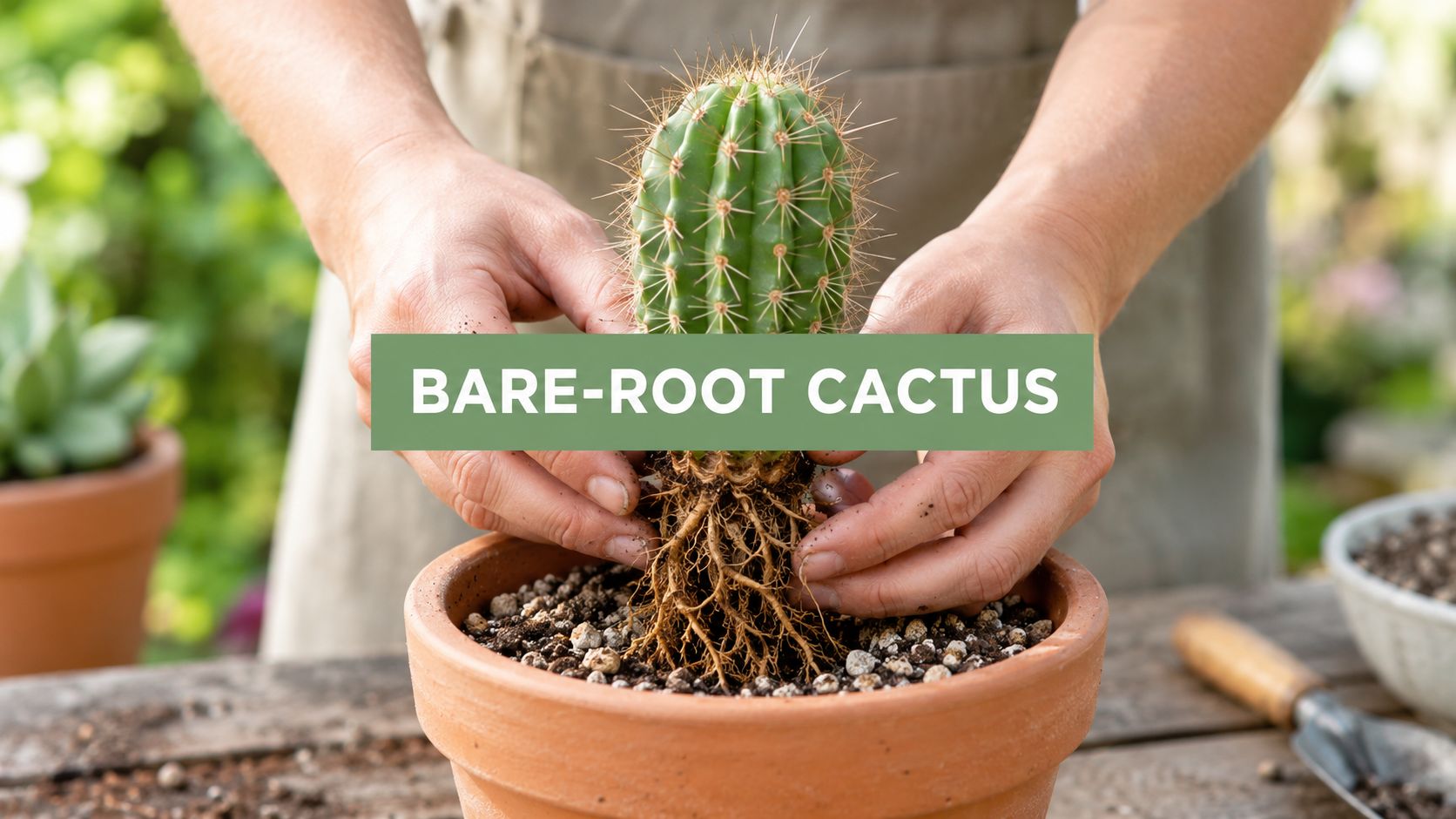
Large cacti and succulents may be carefully packaged for nationwide shipping without arriving in nursery pots. A bare-root specimen can look different when it reaches you than it did in a listing photograph. Roots may be wrapped for transit, and the stem may not have the same visual fullness or orientation you saw in the nursery.
That first impression shouldn't override the identification record. Photograph the plant as received, retain the label and packaging information, and compare the stem, ribs, and areoles with the original listing. During acclimation, avoid making a quick genus judgment from temporary stress alone.
The same caution applies to retail labels. A plant marketed as “columnar cactus” may be accurately placed at the growth-form level without being identified to species, or it may be an upright non-cactus succulent. If you can't locate areoles, keep the identification provisional until the seller provides clearer evidence.
How to Document and Evaluate a Specimen Before You Buy
A good photograph can answer identification questions that a close crop or ornamental garden image can't. Ask for views that show the entire plant and the structures that separate one columnar cactus from another.
Build a useful photo record
Request or take these images:
- Whole-plant view: Show the full height, overall width, solitary or clustered habit, and any arms.
- Mid-stem close-up: Capture the ribs, areoles, and surface texture without relying on the growing tip.
- Spine detail: Include a scale reference so spine length and arrangement can be judged.
- Branching point: Photograph where an arm or new stem joins the main column.
- Flower or fruit, if present: Record its position and structure, not only its color.
The same record helps when you're comparing a large specimen with a collection listing or asking a nursery to verify a label. A clear mid-stem photograph is usually more useful than a heavily edited full-yard image.

Ask questions that affect planting
Ask the seller for the botanical name, the level of certainty behind the identification, and whether the specimen is nursery-grown or field-grown. Also ask how the plant will ship. For bare-root shipping, confirm that the roots are protected for transit and that planting guidance is provided for the specimen you're receiving.
When evaluating a large cactus, look for firm stems, consistent color, intact ribs, and no soft patches. These observations don't identify a genus by themselves, but they help you decide whether the specimen has been presented clearly and whether it's worth requesting additional photographs.
Correct identification supports better placement decisions. A cactus that remains a single pillar may serve a different design purpose from one that develops broad arms. Container selection, spacing, and the choice between in-ground planting and a movable container all depend on the plant's form and your growing conditions.
For a purchasing-focused checklist, use this guide to buying a columnar cactus online. Treat the seller's description as one source of information, then compare it with the visible traits in the photographs.
Putting the Identification Workflow to Work
Use the sequence until it becomes automatic:
- Confirm areoles. If you can't find them, don't call the plant a cactus yet.
- Score the habit. Record whether it's a solitary pillar, cluster, or branching form.
- Study the ribs. Note their prominence, spacing, and count on a representative section.
- Inspect the areoles and spines. Record spacing, woolliness, spine number, color, length, and curvature.
- Document branching. A candelabra pattern and a single pillar point toward different possibilities.
- Use flowers or fruit last. They can sharpen an identification, but they shouldn't be your only evidence.
The name matters because it turns a visual guess into a planting decision. It helps you set realistic expectations for form, choose a suitable location, select a container when needed, and develop a soak-and-dry watering approach based on climate, soil, pot size, season, and drying conditions. Any cactus mix should drain completely, and water should be allowed to exit the drainage holes before the soil dries again, rather than leaving roots in standing water (cactus watering and drainage guidance).
Apply the sequence to the next unlabeled plant you encounter. Areoles first, habit second, ribs and spines next, branching after that, and flowers as confirmation is a far more dependable routine than matching a silhouette to a photograph.
The Cactus Outlet offers large outdoor cacti and succulent specimens, including columnar cacti and saguaros, with product information that can help you compare form before planting. Visit The Cactus Outlet to review available specimens and use this identification sequence when evaluating your next garden or container plant.