
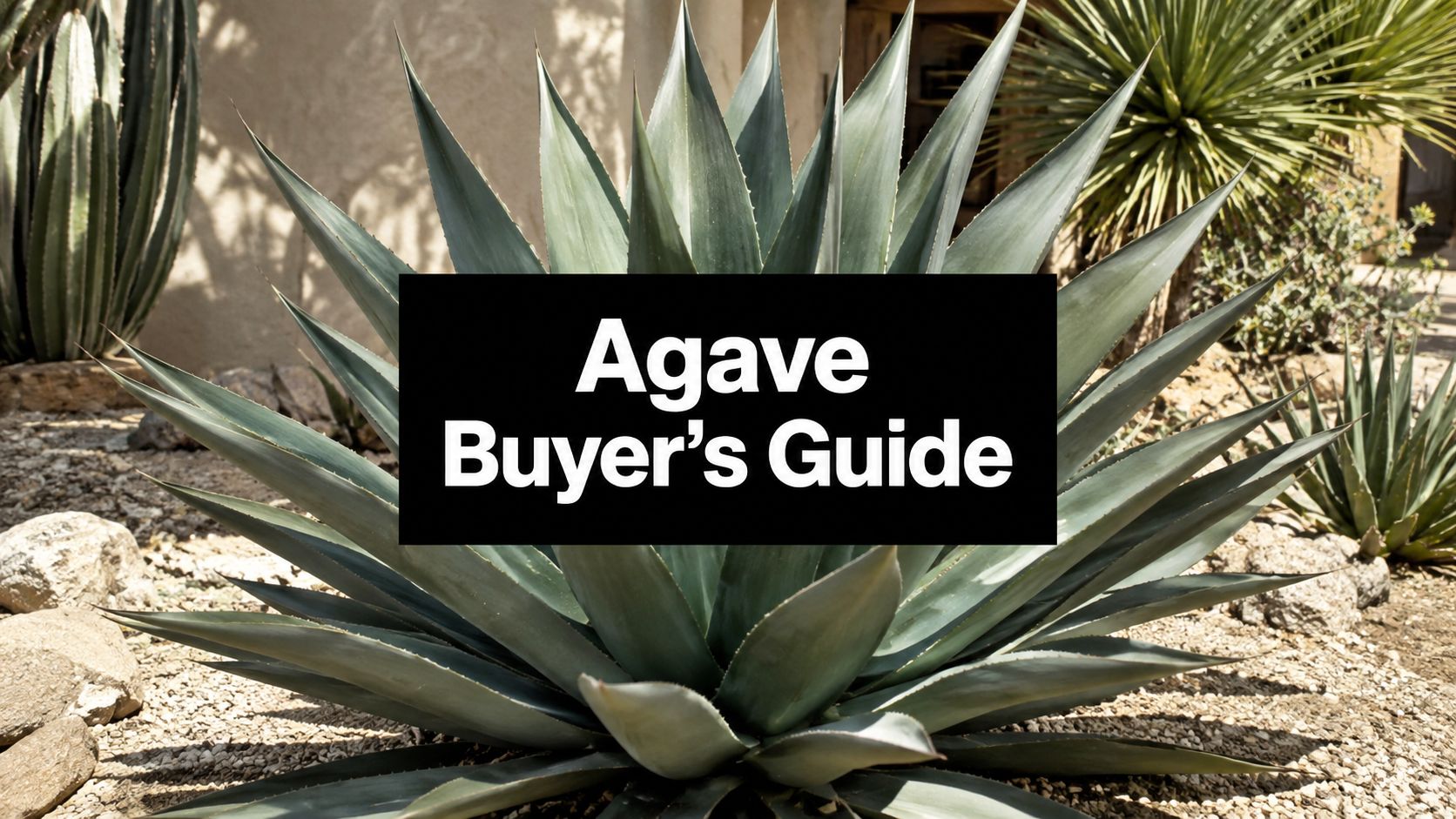

You're standing at the checkout page, staring at a large agave that costs real money and takes real space, and the question isn't whether it looks good. The question is whether it will fit your site, survive your winter, and arrive in one piece without turning your patio crew into a cautionary tale.
For buyers who want large agave plants for sale, the smartest move is to treat the purchase like a logistics decision first and a style decision second. A mature agave can solve a design problem fast, but only if you know what you're buying, how it ships, and where it belongs once it lands.
Why Buying a Large Agave Is a Different Decision
A small starter agave is a plant. A mature specimen is closer to outdoor furniture with roots. Once a plant crosses into the large category, you're no longer shopping for color and form alone, you're buying weight, spacing, transport, and the ability to place a spiny object where people walk.
That shift matters because the premium on big plants comes from scarcity and age, not just size. For Agave tequilana, maturity typically takes 8 to 12 years (source), so a nursery-grown specimen represents a long production cycle before resale. That's why the plant you're considering isn't interchangeable with a cheap pup.
Practical rule: if the listing doesn't tell you what happens after delivery, you're not looking at a complete product page, you're looking at a photo.
For garden buyers, the appeal is immediate structure. A large agave can anchor a bed, hold a corner of a courtyard, or give a container the kind of weight younger succulents can't fake. But the same size that makes the plant visually powerful also makes placement unforgiving, especially near paths, doors, and pool edges.
If you're comparing options on the Large Agave Plants for Sale collection at The Cactus Outlet, think in terms of site fit first. Ask yourself whether you need a showpiece now, or whether a smaller plant would give you the same effect with less handling risk and less winter stress.
Large Agave Species and Mature Sizes Worth Knowing

The best large agave for sale is the one that matches your climate and your layout, not the one with the flashiest photo. Buyers usually narrow the field fastest by looking at mature rosette size, growth habit, and how aggressively the leaves and spines project into space.
The main species buyers actually compare
Agave americana is the broad, dramatic one. Mature plants can form rosettes about 6 to 12 ft wide and 5 to 10 ft tall, with flowering stalks rising to 20 to 30 ft or more (source). It works as a bold anchor or a large-scale focal point, but it needs room and respect.
Agave ovatifolia and Agave x pseudoferox are smarter picks when cold tolerance matters more than spectacle. North Carolina Extension lists agave as hardy in USDA Zones 5 to 11, while a retail guide identifies Agave americana only in Zone 9a and south, Agave x protamericana with some clones surviving in Zone 7b, and Agave x pseudoferox as a hardy form of Agave salmiana var. ferox (source). That zone split should guide the shortlist.
Agave tequilana is the premium blue agave buyers often know by name, and its long production cycle is part of why larger specimens command attention. For a deeper species-specific buying angle, see our internal guide on blue agave for sale.
Agave angustifolia and Agave attenuata show up in patio-oriented searches because they read well in containers and softer modern plantings. Agave salmiana leans larger and heavier in form, which suits permanent ground planting more than frequent repositioning.
Agave americana also has a distinctly practical downside, its monocarpic life cycle. It flowers once and dies afterward, often leaving offsets behind (source). If you want a specimen that behaves like a long-term architectural object, that life-cycle detail matters.
The infographic below is the kind of quick quality check serious buyers should use before they click buy.
Species comparison at a glance
| Species | Mature scale | Best use | Climate takeaway |
|---|---|---|---|
| A. americana | Very large rosette, tall flower stalks | Anchor plant, open beds | Better for warmer sites |
| A. ovatifolia | Large, broad, sculptural | Modern focal point | Better for colder gardens |
| A. x pseudoferox | Large and structural | Statement planting | Useful in colder zones |
| A. attenuata | Large but softer form | Patio container, low-traffic areas | Less rigid, more forgiving visually |
For species-specific shopping, the right question is not “which one is prettiest?” It's “which one fits my winter, my footprint, and my traffic pattern?”
How to Evaluate Quality Before You Buy

A good listing tells you what the plant is. A good buyer figures out what the photos are hiding. Start with the rosette itself, because leaf posture tells you more than the seller copy ever will.
What to inspect in the photos
Look for vibrant, turgid leaves, not limp or collapsed inner growth. Check that spine tips are intact, because broken tips often mean rough handling. Clean, healed cuts are fine, but fresh wounds and soft tissue are not. A symmetrical rosette usually signals better handling and steadier growth than a plant leaning hard to one side.
You should also look at the pot and the plant as separate objects. If the container looks large but the rosette is modest, you may be paying for pot space rather than plant mass. If the listing says the plant is field-grown or container-grown, that matters, because root structure and shipping prep are different.
What the listing text should answer
Does it describe the root ball, or only the top growth? Does it say whether the plant is established, newly potted, or recently shifted into a larger container? If the shipping weight is mentioned, read it as a handling clue, not just a freight number. Heavy, well-rooted plants are harder to move, but they usually arrive with more substance.
If you want a straight-shopping comparison tool, the printed mailing bags buyer's guide from MSP Packaging is a useful reminder that packaging details matter when products travel. The same logic applies here, except the package is a living plant with spines.
I also recommend watching this before you compare listings:
Quick quality checklist
- Leaf condition: firm, evenly colored, and not wrinkled.
- Spines: intact and unbroken.
- Cut marks: healed, dry, and not soft.
- Root system: established, not just recently tucked into a pot.
- Rosette shape: balanced, with no major collapse in the center.
That checklist keeps you from overpaying for a plant that looks big in a photo but hasn't been handled well.
What Drives Large Agave Pricing
The pricing spread on large agaves is wide for a reason. Independent market guidance places large agave plants at $50 to $500+, with rare forms sometimes reaching $1,000 or more, while mature pups may sell for only $5 to $40 depending on size and location (source). That isn't random pricing, it's a ladder.
What pushes the price up
Age is the first driver. Slow-growing agaves take years to develop the size buyers want, and that long cycle ties up nursery space and labor. Size matters too, but only because large plants are harder to produce, harder to hold, and harder to move.
Root development is the hidden premium. A six-foot plant with an established root mass is a different product from a top-heavy specimen that was recently shifted into a pot. Buyers pay for transplant readiness because it lowers the odds of a failed install.
Rarity changes the math again. If a form is hard to source, distinctive in color, or sought after by collectors, the price climbs faster than the plant's physical size would suggest. A mature agave can command more because it's already solved the years-long waiting problem.
Large agaves cost more when they've already done the slow work for you.
How to read price brackets
A lower price often means a smaller specimen of a common species, or a plant that still needs more establishment. Mid-range pricing usually points to mature, field-grown stock that's ready for real use. The top end generally signals a pristine specimen, an uncommon cultivar, or a plant whose age and root quality are doing most of the value work.
One more market reality matters here. Large agave plants can range from $50 to $500+, and extra-large or rare forms can move beyond that into collector pricing (source). If a listing looks cheap for its size, ask what's missing before you celebrate the bargain.
If you're shopping with a budget, match the price to the outcome you want. Pay less if you can wait for the plant to fill in. Pay more only when you need instant impact, established roots, and the confidence that comes with a specimen that's already substantial.
Planting and Acclimating a Newly Delivered Agave
A newly delivered agave needs a calm first day. Open the box carefully, keep your hands away from the leaf edges, and check the plant before you rush to place it. If the root ball has shifted in transit, handle it gently and avoid disturbing the roots more than necessary.
The most important decision is drainage. Large agaves are drought-adapted succulents with shallow, fibrous roots, and they decline quickly if the soil stays wet. They do best in fast-draining, sandy or rocky mixes and in full sun once they've adjusted (source). That means the pot or bed should shed water fast, not hold it.
First-week handling
- Inspect the root ball: Look for firmness and signs the plant was set well before shipping.
- Choose the container carefully: Upsizing too far is a mistake, because oversized pots hold moisture longer.
- Water lightly: Give enough to settle the root zone, not a soak that leaves the mix saturated.
- Set the plant where it can breathe: Good airflow helps the soil dry and lowers rot risk.
The biggest error buyers make is giving a large agave a pot that looks generous but behaves like a sponge. Bigger is not better if the mix stays wet for days. If you're unsure, go with a slightly snug container and a very free-draining soil blend.
For a broader cultural reference on potting and placement, the how to grow agave plants guide is worth keeping open while you work. Use it as a companion, not a substitute for the plant's actual drainage needs.
Acclimation without sunburn
Move the plant into stronger light gradually over two to four weeks. That slow ramp matters because a nursery-grown specimen can scorch if it jumps straight into harsh afternoon sun. Start with morning light, then extend exposure little by little until the plant is settled.
Once it's planted, stop fussing. Water only after the mix dries, keep the crown dry, and let the plant do what agaves do best, settle in and hold its shape.
Cold Hardiness and Overwintering for Large Specimens
Cold-climate buyers need a harder question than “will it survive?” They need to ask whether they can manage the plant through winter. A one-foot agave is movable. A five-foot agave can become a storage problem.
Read the zone limits honestly
Independent nursery guidance says potted agaves must be brought indoors when temperatures get too cold, and it gives clear cutoff points for in-ground plants. Zone 9/10 agaves should come inside before the mid-30s F, about 2 C. Zone 8 plants are generally only fine to the mid-20s F, about -4 C. Zone 7 or colder plants should not go below 20 F, about -6 C (source).
That's the buying filter. If your site drops into those ranges, the plant choice has to match both the climate and your willingness to move it.
The local nursery rule is simple. If a big agave is in a container, you need a winter plan before purchase, not after the first freeze.
The specimen size problem
Large plants are harder to overwinter because their containers are heavier and indoor space is limited. The bigger the rosette, the more awkward the move, especially if the plant has spines that complicate gripping and turning. A colder zone can make a beautiful species a practical headache.
You can solve that problem in two ways. Buy a cold-tolerant species, or buy a borderline-hardy showpiece only if you're willing to overwinter it with care. The first option is cleaner. The second option is a commitment.
For a focused species comparison, our cold hardy agaves guide is the place to start if winter is your biggest constraint. It's better to buy for your real zone than to gamble on a plant that looks good in July and becomes unmovable by November.
Landscape and Patio Uses for Large Agaves
A large agave earns its keep when it solves a design problem, not when it just fills space. In a xeric bed, it works as an anchor that holds the eye while lighter textures move around it. Near an entry, it becomes a sculptural focal point that looks intentional even when the rest of the planting is still young.
Courtyards are where large agaves make the most sense. You get year-round structure, dry-air performance, and a plant that can stand up to modern architecture without looking fussy. In a pool deck or gravel garden, the sharp silhouette gives the whole space a cleaner edge.
The better-looking installations usually respect traffic flow. If a walkway brushes a leaf tip every time someone passes, the plant is in the wrong place. Give spiny agaves room, especially where kids, guests, or crews will move through the space daily.
Where they earn the most value
- Entryway anchors: A single specimen can replace cluttered clusters.
- Privacy-friendly side yards: Pair one with gravel and upright companions for a tight, dry composition.
- Oversized patio containers: Great when you need an architectural object, not a soft filler plant.
- Structural contrast: They offset grasses and rounded succulents without competing.
If you're planning a hardscape refresh around an outdoor kitchen or dining area, a container solution can help you place the plant without crowding the workflow. The planter for outdoor kitchen spaces from urbanmancaves.com is a useful example of the kind of container that can support that role.
A large agave is not subtle, and that's the point. Put it where the geometry matters and where the spines won't become a daily nuisance.
Questions Smart Buyers Ask Before Clicking Buy
Buyers get in trouble when they focus on the rosette and ignore the logistics. The first question is always total delivered weight and whether the plant can reach the planting site. A front walk, side gate, or rooftop patio can turn a great-looking specimen into a bad purchase if access is tight.
The second question is life cycle. Several agaves are monocarpic, which means the original rosette flowers once and dies afterward. That doesn't make them poor buys, it means you should plan for offsets or replacement rather than expecting the same stem to last forever (source).
The questions I'd ask every seller
- How will it be delivered? Ask about access, weight, and whether the plant needs special handling.
- What's the spine situation? Don't assume a photo makes the plant family-safe.
- What happens after flowering? Know whether offsets are expected.
- What condition does arrival need to meet? Get the nursery's answer before the truck is on the road.
- What's the replacement path? If the main rosette dies, who sources the next plant?
That last point matters more than most listings admit. A mature agave is a long-term investment, not a one-season impulse buy. If you want the long view, ask the seller how the plant fits into a site plan over time, not just how it looks on day one.
For a broader lens on site selection and plant choice, Shopifarm's native plant tips can help you think in terms of placement and ecosystem fit. That mindset is useful even when you're buying a specimen agave, because the right plant still has to work where you live.
If you're ready to buy a specimen agave, start with the plants that match your zone, your site, and your willingness to handle a heavy, spiny plant properly. Visit The Cactus Outlet to browse large agave plants for sale and compare options that are sized for real yards, patios, and collector spaces.