

You bought a cactus for the patio, set it beside the Chicago garage, and expected winter to be the easy part. Then rain settles into the pot, the first hard freeze arrives, and the plant fails even though its species is labeled cold hardy. That outcome is common because outdoor-pot survival depends on both temperature and winter moisture, not a zone number alone.
The best cold hardy cactus for outdoor pots combines a strong cold tolerance with a root system that can stay dry through freeze-thaw weather. Opuntia, Echinocereus, Escobaria, and Pediocactus are the most useful starting points, but the right choice still depends on your USDA zone, pot material, drainage, plant size, and whether you can provide winter shelter.
What Cold Hardy Actually Means for a Potted Cactus
A cactus that survives cold in the ground may struggle in a container. Open soil surrounds the root system with a large, relatively stable thermal mass. A pot has far less protection, and its root zone can follow ambient air temperature much more closely. The smaller the pot, the faster it swings from mild to freezing.
That distinction matters in USDA zones 3 through 8, where gardeners often choose hardy genera such as Opuntia and related cacti for outdoor growing. University of Nevada, Reno and horticultural guidance identify several hardy cactus varieties for cold regions, with some Opuntia species reported to tolerate roughly -20°F to -45°F depending on species and clone. Those figures describe plant potential, not a guarantee for an exposed root ball in a thin clay pot.

Think beyond the label
Treat cold hardiness as a three-part rating:
- Minimum temperature: The lowest temperature the species or clone may tolerate under suitable conditions.
- Exposure duration: A brief cold snap is different from prolonged freezing.
- Winter moisture: Wet roots and a damp crown are much more vulnerable than a plant entering winter dry.
A clay pot also creates a practical problem. Clay breathes during the growing season, but it can conduct cold rapidly and may crack during hard freezes. A raised, frost-resistant container gives the roots a better chance than a pot sitting in a saucer full of water.
Working definition: A cold-hardy potted cactus is one whose plant tissue, root zone, and winter moisture conditions can all withstand your site's coldest exposure.
Use that definition when comparing plants for sale. A cactus with an impressive minimum-temperature claim isn't automatically the best purchase for a wet patio, balcony, or uncovered entryway.
The Two Variables That Decide Winter Survival
The two variables that decide winter survival are lower temperature and root-zone moisture. Both must align for a potted cactus to persist through hard freeze, especially in an exposed clay pot where roots cool quickly and wet mix drains slowly.
Echinocereus reichenbachii provides a useful benchmark. Brooklyn Botanic Garden reports this species as hardy to about −25°F and describes it as the least sensitive to excess moisture among hardy cacti. That combination of deep cold tolerance and relatively low moisture sensitivity makes Echinocereus reichenbachii a strong technical choice for outdoor pots.

Temperature is only the first test
A potted cactus must pass three practical tests:
- Cold exposure: Can the species tolerate the expected minimum?
- Root-zone dryness: Does water drain quickly enough to keep the root ball from staying saturated?
- Dormancy: Can the plant remain cool and dry long enough to stay physiologically prepared for winter?
Dormancy often determines the outcome. Hardy cacti need a genuine cold, dry rest. Keeping one in a warm room encourages weak, stretched growth rather than compact dormant tissue. Heated indoor air also makes it difficult to reproduce the dark, dry conditions the plant experiences outdoors.
RHS guidance emphasizes drying hardy cacti before winter protection and identifies winter wet as a major risk. The Royal Horticultural Society recommends protection strategies that keep hardy cacti dry and recognize that pots freeze more severely than ground soil.
A species may tolerate severe cold on a dry slope and still rot in a damp container. Compare its temperature tolerance with its ability to handle your pot's winter moisture.
For outdoor pots, the practical choice depends on manageable size, reliable dormancy, and a workable method for keeping roots dry. The lowest advertised temperature matters, but it cannot compensate for saturated mix or a container exposed to repeated freezing and thawing.
Top Cold Hardy Genera Worth Growing in Outdoor Pots
The following comparison is a buying screen, not a promise that every named species or cultivar will perform identically in every container. Clone, maturity, acclimation, exposure, and winter wet can change the result substantially.
The source material verifies particularly strong cold-region candidates including Escobaria vivipara, Opuntia erinacea, Pediocactus simpsonii, and Echinocereus triglochidiatus. The broader names below are useful categories for shopping, but specific minimum temperatures and cultivar availability should be confirmed with the seller before ordering.
| Genus | Key Species | Min Temp (°F) | Mature Pot Size | Pot Suitability | Notable Cultivar |
|---|---|---|---|---|---|
| Echinocereus | reichenbachii, viridiflorus, triglochidiatus | About −25°F for E. reichenbachii | Small clumps to medium specimens | Excellent when kept dry | ‘Inermis' |
| Escobaria | vivipara, missouriensis | Species and clone dependent | Compact, low mounds | Excellent for small patios | Species selections |
| Opuntia | humifusa, fragilis, polyacantha | Roughly −20°F to −45°F for some species and clones | Low mats to spreading clumps | Very strong, but can sprawl | ‘Major' |
| Pediocactus | simpsonii, knowltonii | Species and clone dependent | Small, solitary or clustered plants | Good in sharply mineral media | Species selections |
| Coryphantha | vivipara allies | Species and clone dependent | Compact globes or clumps | Good where winter rain is controlled | Species selections |
| Yucca | filamentosa, glauca | Borderline as a cactus companion | Medium to large rosettes | Good in large frost-proof containers | ‘Color Guard' |
| Agave | parryi, neomexicana | Species and clone dependent | Medium rosettes, eventually larger | Useful for architectural displays | Species selections |
How the trade-offs play out
Echinocereus is often the most balanced choice for a collector who wants flowers, compact growth, and serious cold performance. Escobaria and Pediocactus suit smaller containers and tight patio compositions, but they demand mineral-heavy media and careful rain management.
Opuntia gives you the broadest practical safety margin among the hardy candidates, especially when you choose a proven clone. The trade-off is form. Opuntia fragilis is notably brittle and can drop pads when handled or disturbed, while more vigorous prickly pears may outgrow a narrow patio pot.
Yucca and Agave aren't cacti, but they earn a place in the comparison because buyers often want a cold-tolerant desert focal point rather than a botanical category. Their rosettes create more vertical structure, though larger specimens need heavier containers that won't tip in wind.
Don't buy from a generic “cold hardy” label alone. Ask for the exact species or clone, the seller's tested temperature guidance, and whether the plant has been acclimated to outdoor conditions.
Matching Species to Your USDA Zone
USDA zones provide a starting point, not a container guarantee. Your patio may be colder than a protected garden, and a wet winter can defeat a plant that handles lower temperatures in a dry site. Use the table to narrow the field, then choose the most sheltered placement and driest pot system available.
| USDA Zone | Species / Cultivar | In-Pot Min °F | Winter Cover Needed? | Pot Suitability |
|---|---|---|---|---|
| 3 to 5 | Escobaria vivipara | Clone dependent | Yes in exposed sites | Excellent, compact |
| 3 to 5 | Opuntia humifusa ‘Major' | Clone dependent | Yes during severe exposure | Excellent, spreading |
| 3 to 5 | Echinocereus triglochidiatus | Species and clone dependent | Recommended | Very good, clumping |
| 6 to 7 | Echinocereus reichenbachii | About −25°F | Cover mainly for wet weather | Excellent |
| 6 to 7 | Coryphantha sulcata | Confirm with seller | Recommended | Good in mineral media |
| 6 to 7 | Opuntia ‘Pinta' | Confirm with seller | Recommended in wet winters | Good, allow spread |
| 8 | Cylindropuntia imbricata | Confirm with seller | Rain cover may matter most | Good in large pots |
| 8 | Echinocactus texensis | Confirm with seller | Recommended during wet weather | Good with fast drainage |
Zone 3 through zone 5
Begin with Escobaria vivipara if you need a compact plant for a smaller pot. Opuntia humifusa ‘Major’ is a better choice when you want a spreading prickly pear display, while Echinocereus triglochidiatus offers a more upright, clumping silhouette.
Zone 6 through zone 7
This is the sweet spot for Echinocereus reichenbachii, especially in a frost-proof container protected from prolonged rain. Coryphantha and Opuntia selections can also work, but drainage becomes more important than chasing a lower temperature rating.
Zone 8
Choose Cylindropuntia imbricata or Echinocactus texensis for a warmer-zone architectural display. Zone 8 growers shouldn't become casual about winter moisture. Mild temperatures can keep soil wet for long periods, which is exactly the condition that turns a hardy cactus into a failed container plant.
Potting Mix, Container Choice, and Planting
Build the container from the outside in. Start with a pot that can tolerate winter exposure, then create a mineral root zone that drains before cold weather arrives.
Unglazed terracotta is a risk in colder conditions, particularly where repeated freezing can crack the pot. For a more dependable outdoor setup, choose frost-proof stoneware, cast concrete, or a thick hypertufa trough. Independent garden guidance specifically identifies stone-like materials such as hypertufa and frost-proof stoneware as suitable choices for hardy cacti in containers because they help protect roots from freezing damage. Brooklyn Botanic Garden's guidance on hardy cacti supports these container materials.
Assemble the container
- Match the pot to the root mass: Leave about 1 to 2 inches of sidewall beyond the root mass. An oversized pot holds unnecessary moisture.
- Provide real drainage: Use at least one 3/4-inch drainage hole, and keep it clear of blocked saucers or compacted debris.
- Use a mineral-forward mix: A practical blend is 60% crushed pumice or lava rock, 30% pine bark, and 10% coarse sand. This ratio is a working recipe, not a universal formula.
- Avoid peat-heavy soil: Peat and bagged garden soil can retain moisture around the crown during cold weather, which is the opposite of what a dormant cactus needs.
For a deeper look at choosing components and managing drainage, use this guide to the best soil for potted cactus.
Plant without trapping moisture
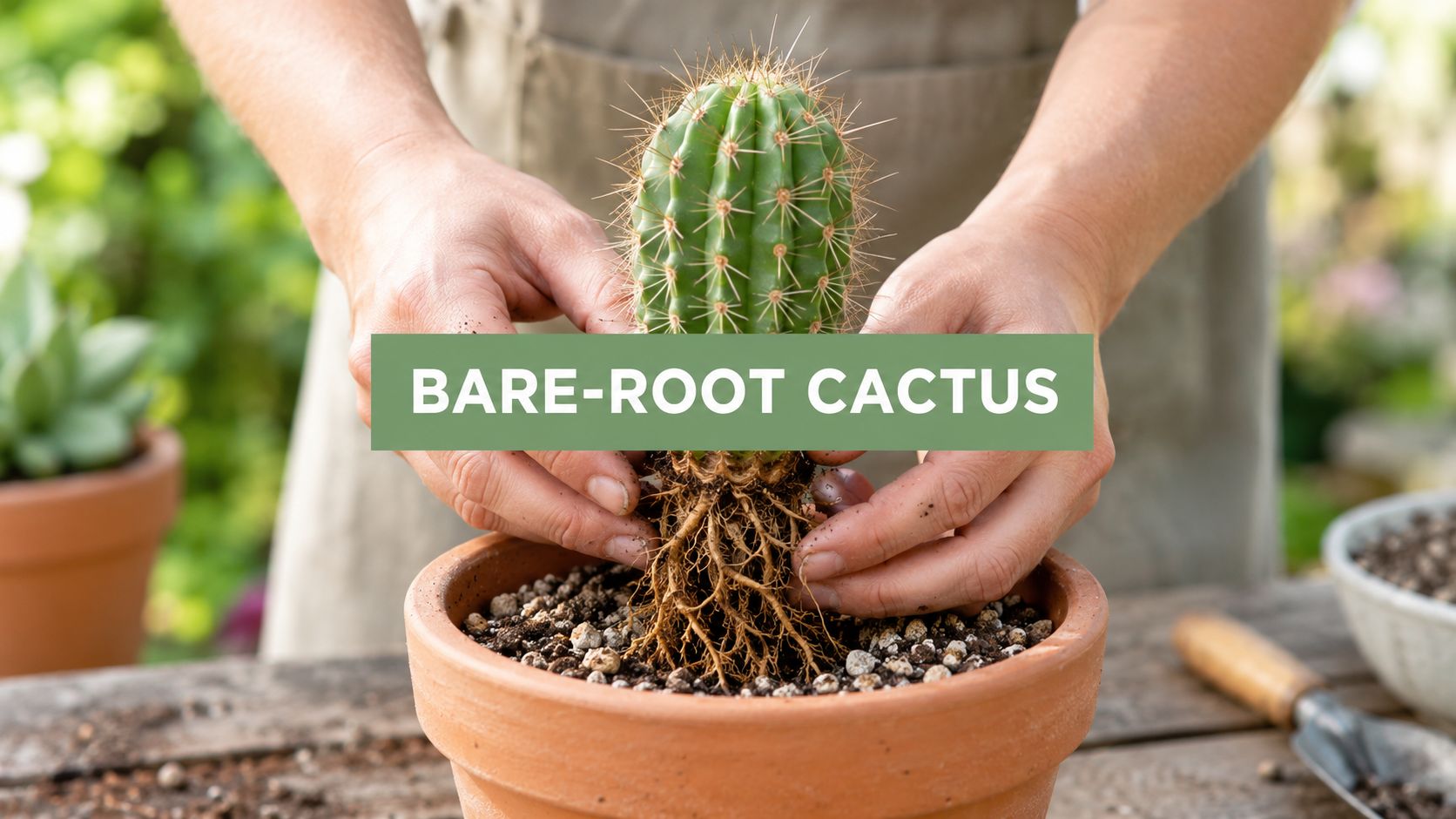
If you're planting in autumn, dry-root the cactus for a week before potting. Set it at the original nursery depth, backfill without burying the crown, and add a 1/2-inch gravel top-dressing to keep the base clean and reduce splash.
Don't water the plant in after autumn planting. Let the roots settle into a dry dormant period and wait until spring growth begins. A pot system that looks slightly too dry in November is safer than one that feels damp when freezing weather arrives.
Overwintering Outdoor Pots Step by Step
Overwintering depends on the relationship between your zone, the plant's tolerance, drainage, and the shelter you can provide. Choose one of four paths rather than applying the same treatment to every pot.
Leave the pot in place
This works in zones 7 to 9 only when the site drains quickly and the species' rating exceeds the local all-time low by at least 10°F. Tilt the pot so it can't collect water in a saucer, place it against a south-facing wall, and keep a gravel top-dressing exposed so rain sheds away from the crown.
Insulate the container
For zones 5 to 6, insulating in place is the usual approach for plants rated to about 0°F. Wrap the container in bubble wrap or burlap packed with dry leaves, cluster several pots together against a wall, and cover the group during wet weather without sealing in condensation.
If you need to move multiple heavy containers, sturdy moving house boxes and supplies can help organize protective materials and relocation equipment. Use them for handling and storage, not as a substitute for breathable winter shelter around the plants.

Shelter the plant
An unheated garage, cold frame, or shed is appropriate when temperatures remain between 20 and 40°F. Withhold water entirely from November through March, then check monthly for excessive shriveling. A slight reduction in fullness is normal during dormancy.
The following video demonstrates the kind of seasonal handling and protection decisions that matter for container-grown cacti.
A heated room is usually the wrong destination. Warm conditions break dormancy, and the plant can become etiolated within two months. Reserve heated indoor space for tropical Opuntia types rather than hardy outdoor selections.
For broader seasonal guidance, see winter cactus care from The Cactus Outlet. If your zone is colder than the species rating allows even with insulation, move the plant.
Troubleshooting Rot and Freeze Damage
Winter failure usually follows one of two paths. The first is cold-wet rot, where saturated soil damages roots and the crown. The second is true freeze injury, where sustained temperatures fall below the plant's tolerance.

Identify the texture first
Rot typically begins at the base or root crown. Look for blackened or brown tissue that feels mushy, smells sour, and pulls away from the soil line. That combination points to prolonged wetness, not a simple cold blemish.
Freeze damage looks different. Tissue may become translucent, collapsed, bleached, or papery, but the affected area remains firm and dry. Damage often appears on the exposed side, while the plant's center may remain viable.
Take the correct action
For rot, unpot the cactus and inspect the roots and base. Cut back to clean white tissue with a sterile blade, dust the cut with sulfur, and reroot the plant in a dry mineral mix. The cactus root rot treatment guide provides additional handling guidance.
For freeze injury, don't cut immediately. Leave damaged tissue intact so it can dry and callus, move the plant to a sheltered location, and wait for new growth to reveal whether the meristem survived. Watering a damaged plant too soon can turn cold injury into rot.
If it is wet and soft, suspect rot. If it is dry and collapsed, suspect cold.
Buying and Placing Your Cold Hardy Cactus
Source matters because a broad “cold hardy” label doesn't tell you which species, clone, or growing history you're buying. Specialist nurseries such as Mesa Garden, Cold Hardy Cactus, and High Country Gardens are useful reference points for comparing field-grown stock and stated zone guidance. Ask the seller whether the plant has been grown outdoors, how it was acclimated, and what protection the nursery recommends for container culture.
Buy in spring or early fall so the cactus has time to establish before its first major stress test. A recently shipped plant needs gradual acclimation to full sun and outdoor exposure. Don't place a large specimen directly into a freezing, rain-exposed position just because the species is listed as hardy.
Placement can improve the odds without changing the plant:
- Use full sun with afternoon shade in zones 7 and 8 when intense summer exposure can stress a newly shipped plant.
- Set pots beside south- or west-facing walls to capture radiant heat and reduce exposure to open wind.
- Raise containers on feet or a bench so water drains beneath the pot and the crown stays above soggy ground.
- Group containers together so one breathable wrap can protect several plants and reduce exposed surface area.
The Cactus Outlet sells a broad range of large cacti and succulents online, including plants intended for container displays, with product descriptions and care information that help buyers compare options before ordering. For a cold-climate purchase, confirm the exact plant's outdoor suitability and winter handling requirements before checkout.
A well-chosen species in the right pot, placed against a thermal wall and sourced from a grower who provides clear cold guidance, will outperform the same cactus left in a wet container under a vague garden-center label.
Choose a species that fits your USDA zone, pair it with a frost-proof pot and mineral-heavy mix, and plan its winter location before it arrives. Visit The Cactus Outlet to compare container-ready cacti and succulents, then contact the nursery with your site and winter conditions so you can select a plant suited to your patio rather than relying on a generic cold-hardy label.