
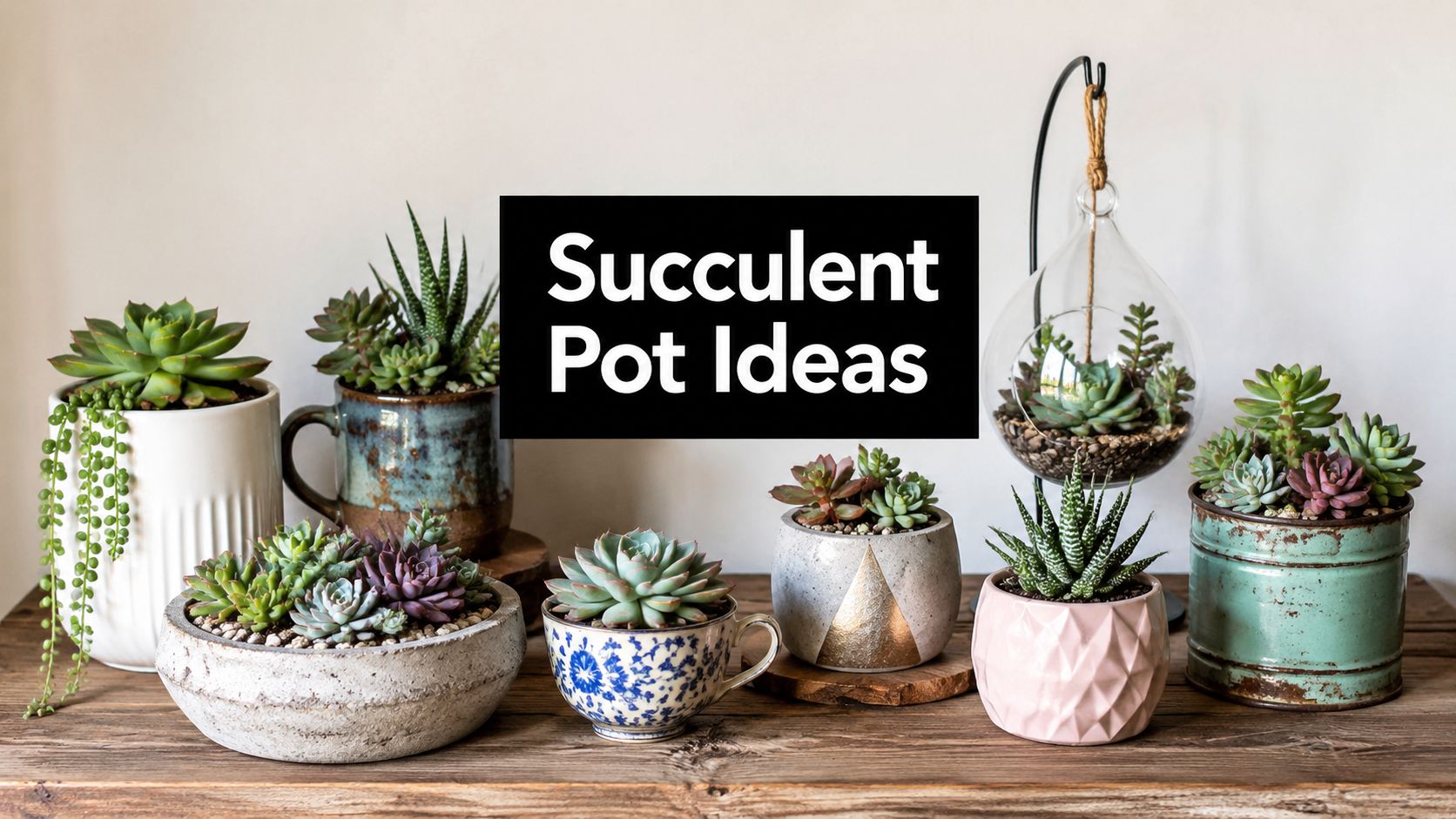

Tired of looking at a healthy little succulent and thinking, “Why does the pot make it look forgettable?” That's usually the moment people start searching for better succulent pot ideas. The plant is fine. The container is what's holding the display back.
A good succulent pot does two jobs at once. It supports the plant's actual needs, especially fast drainage and a root zone that doesn't stay wet, and it contributes something visually. Succulents don't need deep containers. Expert guidance notes that most do best with only 6 to 8 inches of soil depth, with shallow pots and small diameters often preferred for compact-rooted varieties. That single detail explains why some arrangements thrive in simple bowls while others collapse in oversized decorative pots.
Style matters, but so do trade-offs. Heavy concrete looks amazing and can hold a specimen cactus securely, but it's a pain to move. Glazed ceramic can enhance a rare Euphorbia, but if the pot lacks drainage, beauty won't save the roots. Even the most creative recycled container needs a practical fix before planting.
These eight ideas aren't just pretty options for a shelf or patio. They're workable setups, with honest pros and cons, pairing suggestions, and care notes that make the difference between a display that lasts and one that turns mushy.
1. Concrete and Cement Planters

Concrete is the pot I use when I want a succulent or cactus to feel anchored. It has visual weight, literal weight, and a clean architectural look that makes bold plants look even stronger. For a Saguaro or Peruvian Apple cactus, that stability matters. Tall plants in lightweight pots are easy to tip, especially on patios and entryways.
Concrete troughs also work well for grouped Agave plantings. The look is sharp, but the bigger advantage is space. You can spread plants apart instead of cramming them into a bowl where they'll compete too early.
What works and what doesn't
Concrete works best outdoors or in bright, airy spaces where the container can dry properly between waterings. It's less forgiving indoors if you tend to overwater, because a large heavy pot often gets watered “just in case” and then left too wet.
Practical rule: If a concrete planter doesn't have a drainage hole, it's a decorative sleeve, not a planting pot.
A few pairings that usually look right and grow well:
- Saguaro in a tall, broad-based concrete planter: Best where you need wind resistance and a strong focal point.
- Peruvian Apple cactus in a rectangular cement box: Good for modern patios and narrow outdoor runs.
- Agave in a low concrete trough: Best when you want spacing, gravel topdressing, and a sculptural silhouette.
Care details that matter
Seal concrete if you want to reduce moisture absorption and surface staining. If you're pouring your own planter, let it cure fully before planting. Use a lightweight succulent mix so the finished container doesn't become impossible to reposition.
For larger pieces, add a wheeled base from the start. People skip that step, then realize they've built a permanent object instead of a movable planter.
2. Terracotta and Clay Pots

A sunny kitchen sill with a row of clay pots is still one of the easiest succulent setups to keep alive. Terracotta solves a problem many growers create for themselves. The pot breathes, the mix dries faster, and roots sit in less stagnant moisture. For Aloe, Echeveria, Haworthia, and small mixed plantings, it remains the most forgiving starting point I recommend.
It also earns its place on looks alone. Plain clay works in old houses, modern apartments, greenhouse benches, and Mediterranean-style patios without feeling forced. If you want deeper guidance on choosing sizes and styles, this ultimate guide to pots for succulents is a useful companion read.
Why clay works so well for succulents
Terracotta helps correct one of the most common care mistakes: soil that stays wet too long. Unglazed clay pulls moisture from the mix and releases it through the pot wall, which gives succulent roots more air between waterings. That matters most with rosette types and compact species that resent heavy, damp soil.
Pot size matters just as much as material. Succulents usually prefer containers that are only a bit wider than the root ball, and many varieties do better in shallower pots than people expect. The University of Minnesota Extension notes that cacti and succulents grow best in containers with drainage and in potting media that dry readily between waterings, which is one reason small clay pots are such a reliable fit for these plants: growing cacti and succulents indoors.
A few pairings that consistently work:
- Echeveria in a shallow terracotta bowl: Good airflow around the crown and enough width for offsets.
- Haworthia in a small clay pot: Better moisture control indoors, especially on bright desks and shelves.
- Aloe juveniles in standard terracotta nursery pots: Easy to up-pot as they gain size without leaving roots wet for too long.
If you enjoy arranged plantings with a handmade, earthy look, some of the same design logic carries over to succulent terrarium ideas for layered, textural displays.
The trade-offs
Clay is forgiving, but it is not low-attention in every climate. In hot, dry, windy spots, terracotta can dry so fast that small offsets and fresh cuttings need closer watching. Outdoors in peak summer, a tiny clay pot can go from properly moist to bone dry in a day.
Clay is also breakable and heavier than plastic. That sounds obvious, but it matters on shelves, window ledges, and crowded plant stands. A dropped terracotta pot usually shatters. A plastic one usually bounces.
White mineral marks on clay are normal. They come from hard water and fertilizer salts, and they wipe or scrub off if you want a cleaner finish.
For readers drawn to handmade surfaces and natural variation, the appeal overlaps with the material character shown in this comprehensive cement tile resource. Succulents usually look better in containers with texture and visible age than in glossy pots that fight for attention.
Soak a brand-new terracotta pot for a short time before planting if you want to slow how quickly it pulls moisture from fresh soil. Always use a drainage hole, and add a saucer indoors or pot feet outdoors so the base can dry properly after watering.
3. Geometric and Architectural Planters
Geometric planters are for people who want the pot to read as part sculpture, part container. Cubes, hexagons, faceted bowls, asymmetrical wall forms, and stacked towers all push a display toward design rather than simple gardening. With succulents, that often works because the plants themselves already look sculptural.
The key is restraint. A dramatic planter plus a wildly mixed planting usually feels busy. A dramatic planter with one specimen Euphorbia or a tight grouping of similar rosettes feels intentional.
Matching the planter to the plant
Plant shape matters more here than in a standard round pot. A minimalist cube suits upright Euphorbia. A low hexagonal bowl suits rosette-forming Echeveria. A triangular corner planter can make a single Aloe look sharper than a mixed arrangement ever could.
If you're drawn to composed, decorative plant displays, some of the same visual principles show up in succulent terrarium ideas. Repetition, spacing, and negative space matter just as much as the plants.
A few pairings I like:
- Single Euphorbia in a matte cube: Clean, gallery-like, strong in offices.
- Echeveria group in a shallow faceted bowl: Works when the rosettes are similar in scale.
- Compact Aloe in a hexagonal planter: Good for shelves where a round pot looks too soft.
The common mistake
Many geometric pots are designed by people who care more about silhouette than drainage. That's the whole problem. A beautiful faceted planter with no exit for water is often the wrong home for a succulent.
Buy geometric planters with the same skepticism you'd use for furniture. Look at the joinery. In pots, that means drainage, planting depth, and base stability.
Use neutral finishes if you want flexibility. White, charcoal, sand, and muted concrete tones make it easier to swap plants later without rethinking the whole room.
4. Hanging and Mounted Wall Planters

Hanging planters solve one problem immediately. They free the shelf. That makes them useful in apartments, offices, narrow porches, and anywhere horizontal space disappears fast.
They also suit trailing succulents better than standard tabletop pots. String of Pearls, trailing Sedum, and certain rosette types that spill over the edge all look more natural when allowed to hang instead of bunching on a sill.
Good-looking isn't always practical
Macramé holders, wall baskets, and mounted grids all have one hidden issue. Water has gravity on its side, and your drywall doesn't. If the setup doesn't control drainage, you're building a stain machine.
Mounted succulent displays also need enough light. That sounds obvious, but it gets overlooked constantly. Vertical setups are often placed where they look good, not where plants will stay compact and healthy. Guidance tied to vertical succulent arrangements warns that plants in dark rooms or spaces with blinds shut won't keep well, which makes placement critical for wall-mounted designs (Garden Answer vertical arrangement post).
Best uses for hanging succulent pots
- Macramé with trailing succulents: Best near bright windows where the strands won't block plant growth.
- Floating shelves with small pots: Easier to maintain than true wall-mounted pockets.
- Metal grid with removable containers: Best if you want flexibility and easier watering.
One practical note matters more than the style choice. Water hanging planters where runoff can drain safely, then return them to their display spot. That single habit prevents a lot of indoor mess and root trouble.
There's also a real limitation with side-pocket vertical pots. Plants installed at an angle can struggle if roots never settle firmly. In practice, choose compact, shallow-rooted types and avoid species that get top-heavy quickly.
5. Recycled and Upcycled Planters
A flea market tin, an old drawer, or a chipped teacup can make a succulent display feel far more personal than anything pulled off a store shelf. The catch is simple. Salvaged containers rarely come ready for plants, so the good ones succeed because the setup is edited for drainage, heat, and weight before a single cutting goes in.
That trade-off is what makes upcycled planters worth discussing beyond the usual inspiration photos. They give you more character, more freedom with scale, and often lower cost. They also ask for better judgment. A container that looks great on a shelf can still cook roots in afternoon sun, stay soggy at the base, or rot after one wet season outdoors.
Best uses for recycled succulent planters
The strongest upcycled designs start by matching the container material to the plant's habits.
- Teacups and sugar bowls: Best for very small haworthia, gasteria, or rooted offsets. Use them as cachepots unless you can drill clean drainage holes.
- Wooden drawers and boxes: Good for shallow mixed arrangements with echeveria, graptopetalum, and sedum. Line lightly so water can still escape and keep them under cover in rainy climates.
- Tin cans and metal baskets: Better for short-term displays, party tables, or mild-weather patios. Pair with sun-tolerant plants like jade cuttings or compact aloe where heat buildup is less likely to scorch roots.
- Vintage ceramic finds: Useful when the shape is attractive but drainage is questionable. Drop in a nursery pot rather than planting directly.
I use thrifted vessels most often as outer containers, not true planters. That one decision solves a lot. You keep the look, protect the object, and can pull the plant out to water and inspect roots without guessing what is happening at the bottom.
The container can be unusual. The root environment still needs to be predictable.
If you already like repurposing home pieces, the same practical mindset applies here as it does in these easy furniture upcycling tips. Good upcycling is partly style and partly restraint.
Pros, cons, and care points people miss
Recycled planters offer more design personality than standard nursery pots, and they can tie a planting to the age or style of a room. They are also useful for small collections because no two pieces need to match perfectly.
The downsides are material-specific. Wood breaks down over time. Thin metal heats fast and can rust. Containers without drainage demand much tighter watering control than porous clay or nursery pots. Weight matters too. A solid drawer planted directly with soil gets heavy fast, especially after watering.
A few care rules make these containers more reliable:
- Drill drainage whenever the material allows it.
- Keep a gritty succulent mix, especially in non-porous vessels.
- Raise wood and metal planters slightly off the ground so water does not sit under them.
- Use plastic nursery pots inside valuable or awkward thrifted pieces if you want easier maintenance.
- Rotate displays for even light, since decorative groupings often end up pushed into dim corners.
Making mismatched pieces look intentional
Color discipline does more work here than perfect symmetry. The Better Homes & Gardens guide to using color effectively in container gardens is useful because the same basic schemes apply to succulents. Repeated pot tones, limited plant colors, and one clear focal point keep a recycled collection from looking accidental.
Try one of these combinations:
- weathered wood with blue-green echeveria and trailing string of pearls
- white or cream vintage ceramics with dark haworthia and pale sedum
- faded tins with red-edged kalanchoe or coppery graptoveria for contrast
The best upcycled succulent planters look collected, but they are still edited. Limit the palette, repeat one material or finish, and let one or two unusual containers carry the display instead of cramming every thrift-store find into the same arrangement.
6. Ceramic and Glazed Porcelain Planters
If terracotta is the practical workhorse, glazed ceramic is the dressed-up version. It's the pot I'd use for a rare Euphorbia on a console, a special Agave on a patio table, or a gift plant that needs to look finished the minute it arrives.
Glazed planters can be glossy, crackled, hand-painted, minimalist, or highly patterned. That variety is the appeal. They can support the room's palette instead of disappearing into it.
Where premium pots are worth it
A valuable specimen deserves a container that looks intentional. A white porcelain cylinder can make a single blue-toned succulent look crisp and expensive. A hand-painted ceramic vessel can turn a compact Aloe into a tabletop centerpiece.
The caution is simple. Many decorative ceramics are sold for interiors first and plants second. Always check whether there's a real drainage hole, not just a pretty basin shape.
A few strong pairings:
- Rare Euphorbia in matte white ceramic: Best when the plant form is the star.
- Agave in a low glazed bowl: Strong on outdoor dining tables or entry consoles.
- Aloe in a patterned ceramic pot: Good when you want the pot and plant to share attention.
The downside people notice late
Glazed surfaces don't breathe like unglazed clay. That's not automatically bad, but it means your watering habits matter more. If you use a dense soil mix and a sealed pot, moisture lingers.
Clean the exterior regularly, especially on light-colored glazes where mineral residue shows. Use saucers indoors, and don't be afraid to keep the actual planting simple. One excellent plant in one beautiful pot usually beats a crowded “designer” arrangement.
7. Fabric Raised Beds and Planter Bags
Fabric planters surprise people. They don't look like something you'd pair with succulents until you start using them for propagation, nursery holding, or broad outdoor groupings. Then they make a lot of sense.
They drain fast, they're easy to move while empty, and they're useful when you need temporary planting space without committing to heavy permanent containers. For growers handling many offsets or cuttings, fabric beds can be practical workstations.
Best uses for succulent growers
I wouldn't choose fabric bags for a formal living-room display. I would absolutely use them behind the scenes, or in casual outdoor settings where utility matters more than polish.
They work well for:
- Propagation beds: Especially when rooting multiple cuttings or offsets.
- Contractor staging: Holding stock plants before installation.
- Seasonal display zones: Flexible arrangements that may be changed later.
The trade-off is appearance. Fabric isn't elegant on its own. It needs either a hidden location, a sleeve, or a design context where “working garden” looks appropriate.
Watering and structure
Fabric drains quickly, which helps avoid soggy roots but means the root zone can dry out faster in heat and wind. That's manageable if you monitor conditions, but it's less forgiving than clay for inattentive summer care outdoors.
Use support for taller cacti or top-heavy succulents. Soft-sided containers don't brace a plant the way rigid walls do. Keep the planting broad and low unless the bag sits inside a sturdier outer container.
8. Self-Watering and Hydroponic Planters
Self-watering pots sound like the wrong tool for succulents, and sometimes they are. That's the honest answer. Succulents don't want constant moisture around the roots, so a reservoir system can become a problem if the potting mix is too fine or the owner treats the reservoir like a tank that should always stay full.
Still, some people need lower-maintenance setups for desks, offices, or rooms where watering gets forgotten. In those cases, a carefully managed self-watering pot can work better than erratic soaking.
A short visual overview helps here:
When these systems make sense
They're most useful for growers who understand restraint. The system shouldn't keep the mix wet. It should prevent severe neglect. That's a different goal.
Use a gritty cactus and succulent mix, and pay close attention to the right soil for succulent plants. Soil choice matters more in self-watering pots than in standard ones because the system changes how moisture moves and lingers.
A few cautious pairings:
- Compact Haworthia in a small self-watering desk planter: Better than a thirsty tropical, but still monitor closely.
- Small Aloe in a controlled reservoir pot: Acceptable if light is strong and soil is very fast-draining.
- Hydro-style decorative setup for short-term display: Fine as a temporary design piece, not my first choice for long-term health.
A pairing mistake to avoid
Mixed succulent arrangements often fail in shared containers because the plants don't grow at the same pace. One verified survey-based finding reports that mismatched growth rates caused 68% of failed indoor succulent arrangements in a 2025 survey of 1,200 home gardeners, while only 12% of popular pot-idea guides addressed compatibility. That problem gets worse in self-watering setups because vigorous plants take advantage of steady moisture faster than slower companions.
If two succulents won't want the same pace of moisture and won't grow at a similar speed, don't put them in the same reservoir-fed pot.
Clean the wick or water pathway regularly. Empty stagnant water when needed. Treat the reservoir as a tool, not a guarantee.
8 Succulent Planter Ideas Compared
| Planter Type | Implementation Complexity 🔄 | Resource Requirements ⚡ | Expected Outcomes ⭐ | Ideal Use Cases 💡 | Key Advantages 📊 |
|---|---|---|---|---|---|
| Concrete and Cement Planters | Medium–high: pouring, curing and sealing required | High: heavy materials, molds, sealers, possible professional labor | High-quality: extremely durable, excellent drainage and thermal regulation | Large specimen cacti, outdoor landscapes, contemporary installations | Stable for large plants, long-lasting, low maintenance |
| Terracotta and Clay Pots | Low: ready-made, minimal prep (soak new pots) | Low: inexpensive, widely available; occasional sealers | Reliable: breathable, promotes drying to reduce root rot | All succulents, beginners, rustic displays and propagation | Excellent drainage, cost-effective, classic aesthetic |
| Geometric and Architectural Planters | Medium: may need custom drainage and plant pairing | Medium–high: designer pieces, variable materials and cost | High visual impact: striking displays; can limit planting options | Interior decorators, social-media displays, design-forward collectors | Bold focal points, unique sculptural designs |
| Hanging and Mounted Wall Planters | Medium: mounting, reinforcement and drainage planning | Low–medium: mounting hardware, lightweight pots, liners | Effective: maximizes vertical space, improves visibility and airflow | Apartments, offices, vertical gardens, trailing succulents | Space-saving, dynamic layered displays, accessible maintenance |
| Recycled and Upcycled Planters | Low–medium: DIY modification (drill, line, seal) | Low: repurposed materials, basic tools, liners | Variable: unique and sustainable displays; durability varies | Eco-conscious gardeners, DIY projects, community gardens | Low-cost, highly customizable, environmentally responsible |
| Ceramic and Glazed Porcelain Planters | Low: ready-made but verify drainage | Medium–high: premium cost, heavier, careful handling | High-quality: decorative, consistent moisture retention when glazed | Showcasing rare specimens, upscale interiors, gifts | Elegant finishes, showcases plants, durable decorative option |
| Fabric Raised Beds and Planter Bags | Low: simple setup; adjust watering routine | Low: lightweight fabric, soil, optional supports | Effective for root health: superior drainage and air-pruning | Bulk propagation, nurseries, mobile urban gardening | Portable, promotes healthy roots, scalable and affordable |
| Self-Watering and Hydroponic Planters | Medium–high: system setup and periodic maintenance | Medium–high: reservoirs, wicks/pumps, monitoring, higher cost | Consistent moisture: reduces watering but risks overwatering for succulents | Busy owners, offices, beginners, indoor displays | Automated watering, precise moisture control, lower daily effort |
Choosing Your Perfect Succulent Pot
You spot a great pot, bring it home, and only then realize it has no drainage, dries too slowly, or disappears visually once the plant goes in. That is usually where succulent displays go wrong. The right choice starts with how the plant grows, how the material handles moisture, and how much maintenance you will keep up with.
Start with function, then judge the look. Shallow-rooted rosettes, compact cacti, and small aloes usually perform best in containers that drain fast and do not hold excess soil around the roots. If you tend to water a little too often, terracotta and fabric give you more margin for error because they dry faster. If you want a heavy outdoor focal point that will not tip in wind, concrete is often the better fit than a light decorative bowl.
Placement matters almost as much as material. Debra Lee Baldwin's deck garden is a useful example because the pots are arranged at different heights instead of all sitting flat on the floor. In practice, that approach improves airflow, keeps small specimens visible, and makes a collection feel designed rather than crowded. Baldwin's work on container displays has long emphasized grouping, repetition, and viewing angle, and those choices often matter more than buying a rare planter shape.
Match the pot to the plant's habit. A columnar cactus or young Saguaro looks grounded in concrete because the container has enough visual weight and physical stability. Small Aloe, Haworthia, and many echeverias are often easier to manage in terracotta because the root zone dries out faster. Glazed ceramic suits gift plantings and indoor rosette arrangements where finish and color matter as much as performance. String of Pearls, Burro's Tail, and trailing rhipsalis need a hanging planter or wall-mounted setup that gives the stems room to spill.
Then check the room, patio, or balcony where the pot will live. Clean-lined interiors usually handle geometric planters, concrete, and simple glazed ceramic well. Relaxed outdoor spaces often look better with clay, troughs, weathered bowls, or repurposed pieces that have some texture. Eclectic rooms can carry upcycled containers successfully, but the planting should stay controlled so the display does not feel messy. If your style leans vintage, the same instincts used for styling unique retro pieces can help here. Choose containers with character, then repeat plant forms or pot colors so the grouping still feels intentional.
Maintenance is the last filter, and it is the one people skip.
Hanging planters dry faster and are harder to water thoroughly without dripping. Upcycled containers often need drilling, sealing, or a nursery pot liner before they are safe to use. Self-watering systems can work for some growers, but they demand restraint with succulents because steady moisture is not always an advantage. A beautiful pot that fights your habits will usually become a problem.
Choose the container that gives roots the conditions they need and gives the plant enough presence in the space. When those two parts match, even a simple planting looks considered.
Ready to put these succulent pot ideas into practice? Explore the plant selection at The Cactus Outlet for Saguaro, Peruvian Apple, Euphorbia, Agave, Aloe, and more, then match your favorite specimens to a pot that helps them thrive.