

You want privacy, but you don't want a hedge that looks thirsty, bulky, or out of place in a desert yard. That's the whole appeal of a cactus privacy screen, it gives you height, structure, and a real visual barrier without turning the yard into a maintenance project. The trick is choosing the right species, because the wrong cactus can become a hazard, outgrow the site, or stay too small to matter.
| Species | Mature Height | Growth Rate | Thorniness | Cold Hardiness |
|---|---|---|---|---|
| Peruvian apple cactus (Cereus repandus) | Up to 30 feet | Fast enough to become screening material much sooner than slow ornamentals | Moderate, with a strong upright form | Best in warm, dry climates |
| Mexican fence post cactus (Pachycereus marginatus) | Tall enough for living boundary use | Fast enough for repeated-row planting | Moderate to high, depending on age and handling | Best in warm, dry climates |
| Organ pipe cactus | About 30 feet | Suited to screening when space allows | Thorny, with a large footprint over time | Warm-climate plant |
| Tall Euphorbia | Tall architectural form, but not a cactus | Varies by species | Can be a safety concern because of sap and spines | Depends on species and site |
The question isn't which plant looks tallest in a photo. It's which one will still work as a screen after it settles in, gets wider, and starts interacting with walkways, neighbors, and winter weather. For that reason, I'd start with the Peruvian apple cactus for height, the Mexican fence post cactus for a straight row, and a tall Euphorbia only if you already know the site and the plant's handling risks.
Why Cacti Make Excellent Privacy Screens
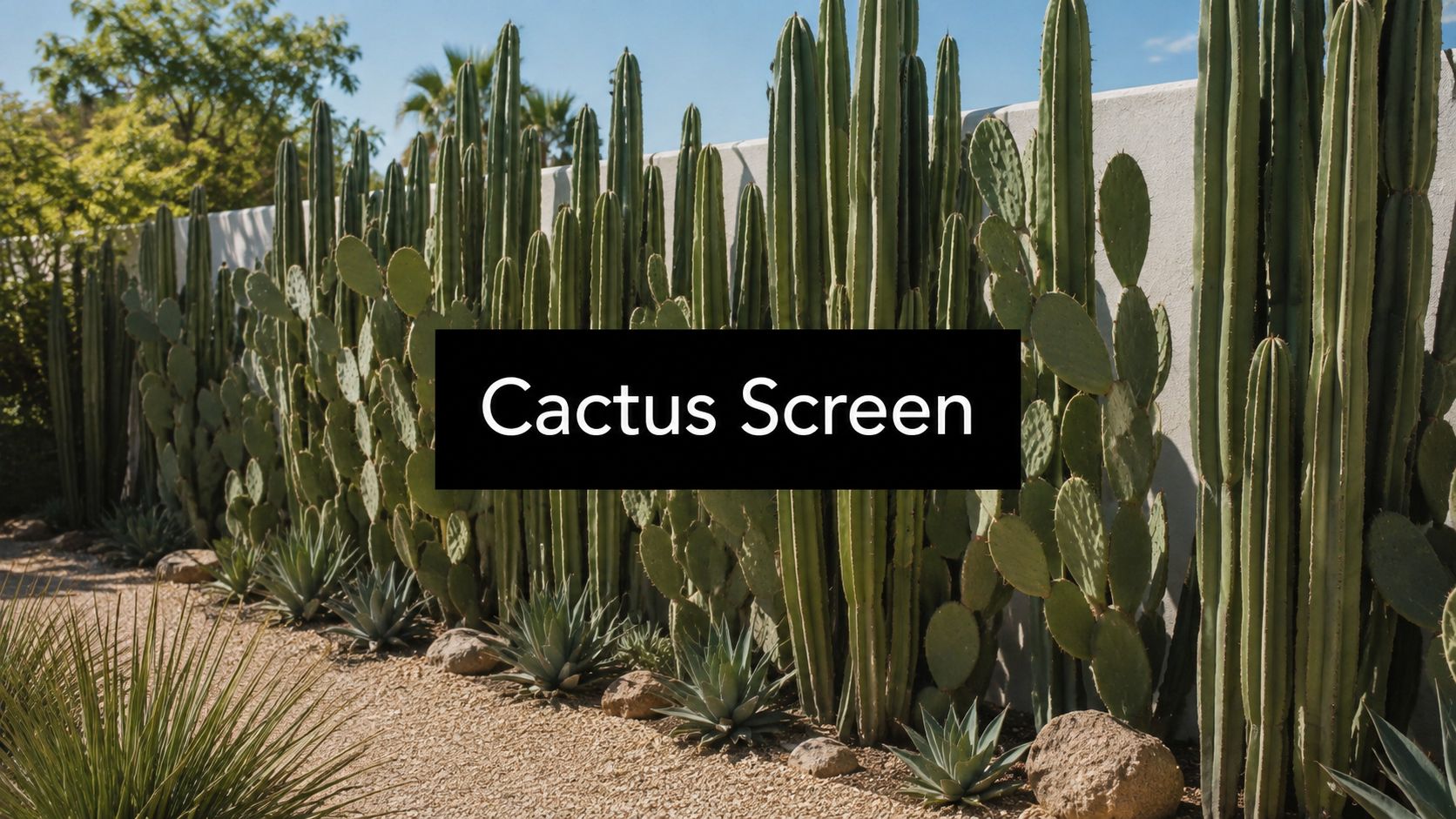
A homeowner in a dry neighborhood usually wants two things at once, privacy and an outdoor space that still feels intentional. A row of clipped shrubs can solve the first problem, but it often creates the wrong look for a modern desert yard. A tall cactus row does both jobs better when the site is sunny, dry, and built for low-water planting.

The right kind of height matters
A privacy screen has to block views after the plants settle in, not just look tall in the nursery. Continuous vertical coverage is what matters, and that usually means choosing columnar or upright cacti that keep their form as they mature. The Peruvian apple cactus is a strong candidate because it can reach up to 30 feet tall and be grouped into a hedge-like barrier (Greenthings AZ). In a real yard, that kind of growth gives you line-of-sight blocking above fence height and along property edges.
The same logic applies to other tall, upright cacti. A low barrel cactus may look clean in a bed, but it will not hide a patio chair from a neighbor's second-story window. If the goal is screening, the plant has to earn space with actual height and a strong vertical habit.
Why dry-climate homeowners lean on cacti
A privacy screen has to match the site or it becomes expensive to maintain. Mature height and mature width both matter, because a screen that is too narrow never closes in, and one that is too wide crowds the yard. That spacing principle is the reason cactus screens work best when you plan for the plant's finished size from the start. The Cactus Outlet's guide to fast-growing cactus is useful here, because growth rate only helps if the species also fits the available space.
Dry-climate homeowners also get a practical advantage. Cacti bring the height needed for privacy without asking for the water routine that many hedge plants require. They suit xeric planting, hold their form in heat, and keep the yard visually consistent with the rest of the space.
Privacy screening still comes down to a simple rule. If the cactus will not grow above the sightline in your actual site conditions, it is not a privacy screen, no matter how good it looks in a product photo.
Key Criteria for Choosing Privacy Screen Cacti
Mature height and mature width come first
If privacy is the goal, buy for the finished plant, not the nursery pot. Screen plants need enough height to block sightlines and enough density to avoid gaps, and privacy guidance from CuerpoMente points to tall, full-growing plants rather than compact ornamentals. For cacti, that means most short, decorative types fail the job unless you are building a layered screen with more than one planting tier.
Width matters just as much. A cactus that tops out at the right height but never fills laterally will leave you staring through holes for years. The safest spacing rule is to plan around mature spread, not the tag on the pot, because a hedge only closes in once the plants have room to branch and knit together. Missouri Botanical Garden recommends setting plants a little closer than their full-grown width so the screen fills sooner, which is the right approach for cactus rows as well.
Growth habit and light exposure decide screen quality
A cactus can be tall and still screen poorly if its growth habit is loose or the site is too dim. The mono-tail cactus (Cleistocactus colademononis) has been described as a “wonderful hanging privacy screen” for a bright window (Farbio). That example shows the key rule: dense growth depends on strong light, and weak light turns a potential screen into a thin, stretched plant. If you want a cactus to block views, choose one that stays upright and compact in the light you have.
That is also why fast growers deserve a closer look, but only if the growth habit matches the site. A species can size up quickly and still miss the mark if it leans, sprawls, or needs more sun than your fence line gets. This guide to fast-growing cactus options is useful because it keeps the focus on speed and form together, which is how you judge whether a plant will become a screen instead of just a tall specimen.
Thorniness, maintenance, and safety should shape the shortlist
A privacy screen has to work in a real yard, not just in a photo. If people need to brush past it, prune around it, or open a gate beside it, sharp spines and messy growth become a problem fast. Dense thorn cover can help block access along a boundary, but it also limits where you can safely place the row, especially near walkways, patios, and play areas.
Spacing and upkeep matter here too. One practical guide recommends placing cactus plants about 2 to 3 feet apart, with full sun, well-drained soil, and regular pruning to keep the fence compact (GardenBix). That spacing only works if the species stays orderly over time. If the plant throws wide arms or spreads in a way you cannot control, it stops being a privacy screen and starts becoming a maintenance headache.
The best cactus for privacy is the one that fits the site, closes the view, and stays safe to live with.
Top Cactus Species for Privacy Screens Compared
Homeowners usually ask for the best cactus for a privacy screen as if there were one clear answer. There isn't. The right plant depends on what the screen has to do, a narrow side yard needs a different cactus than a long fence line, and a patio planting has its own limits.
| Cactus Species Comparison for Privacy Screens | Species | Mature Height | Growth Rate | Thorniness | Cold Hardiness |
|---|---|---|---|---|---|
| Peruvian apple cactus (Cereus repandus) | Up to 30 feet | Strong vertical grower for screening | Moderate | Best for warm climates | |
| Mexican fence post cactus (Pachycereus marginatus) | Tall enough for a living boundary | Suited to repeated rows | Moderate | Best for warm climates | |
| Organ pipe cactus | About 30 feet | Effective where space allows | Thorny and substantial | Warm-climate plant | |
| Tall Euphorbia | Varies by species | Depends on the exact type | Can be a handling concern | Species dependent |
Peruvian apple cactus
The Peruvian apple cactus is one of the strongest all-around screening choices in the group. It can reach up to 30 feet tall, it works in grouped plantings, and desert landscaping guidance describes it as a plant that can be used for a privacy screen or hedge when it is planted in clusters (Greenthings AZ). That gives it real value for homeowners who need more than a decorative column.
It fits best where a dry-climate planting needs height, structure, and a solid visual barrier. If you want the row to read like a wall, this is the one to put near the top of the list.
Mexican fence post cactus
The Mexican fence post cactus is the specialist for a clean, repeating boundary. The Cactus Outlet's fence post cactus guide says that if the goal is “a straight, repeating row that can mature into a living boundary,” the plant usually recommended is Pachycereus marginatus. That is the clearest species-specific signal here.
Its strength is form. It stays upright, keeps a crisp profile in sequence, and suits homeowners who want the planting to look intentional instead of loose or sprawling. For a tidy boundary line, it is hard to beat.
Organ pipe cactus
The organ pipe cactus belongs on the shortlist because it can reach about 30 feet and provide screening where the site has room. It is a strong choice only when the property can handle its footprint. On smaller lots, or anywhere close to a walkway or gate, its size becomes the problem.
This is a plant for open ground and warm climates. It gives you height and presence, but it asks for space in return.
Tall Euphorbia
A tall Euphorbia can create strong vertical impact, but I would not put it at the center of a privacy screen purchase. It is not a true cactus, and the handling risk depends on the exact species. That makes it a narrower choice, better for specific design situations than for a general screening row.
If you want a true cactus boundary, the clearer buys are the Peruvian apple cactus, the Mexican fence post cactus, and, on larger sites, the organ pipe cactus. Use the Euphorbia only if you know the exact species and are comfortable with its handling concerns.
Planting and Designing Your Cactus Privacy Screen
Start with the site, not the plant. A privacy screen fails when the row sits too close to a path, feels cramped at maturity, or lands in soil that stays wet after rain. As noted earlier, the right cactus has to fit the space it will occupy, tolerate the moisture already on site, and leave enough room for healthy root competition.

Build the row for long-term shape
For spacing, use the guidance from the earlier species discussion and match the row to the cactus's mature width instead of forcing a tight, temporary fit. A straight line works best for a screen, but only if each plant has enough room to hold its form without turning into a dense, awkward mass at the base.
One practical guide from GardenBix recommends a compact fence-like look, and that is the right design goal. I still favor a cleaner, more deliberate line, especially if the screen runs near gates, windows, or side yards where maintenance access matters.
Use drainage as a design feature
Cacti need a very free-draining substrate, so do not force them into heavy soil or containers that trap water. Build the planting system to do the work, with gravel mulch, a soil profile that sheds water quickly, and deep containers where in-ground planting is not realistic. That makes the screen look intentional and keeps the plants healthier over time.
The Cactus Outlet also has a useful guide on planting succulents outdoors, which fits this same approach for anyone planning a row or mixed succulent edge.
Container screening is the right move in some sites
Patios, balconies, and narrow side yards often need a screen that can move or be staged instead of planted permanently. A tall cactus in a large, deep container can filter views without locking you into an in-ground boundary, and it gives you more flexibility if access rules or circulation paths are tight.
The best design is the one you can live with, not the one that only looks good on day one.
Common Mistakes to Avoid with Cactus Privacy Screens
The worst mistake is buying a cactus for the photo, then trying to force it into a site it cannot handle. A plant can look strong and architectural in a nursery listing and still fail in a narrow lot, a path edge, or a yard that freezes hard in winter. Buy for mature width and your actual climate, not for the first season's shape.

Don't ignore the site's climate and access
Cold exposure ruins a lot of cactus screening plans. A cactus that performs well in a warm, dry region can be a poor buy if winter cold is routine where you live, and a thorny row beside a walkway can make basic access unpleasant every time you trim, water, or clean up dropped debris.
General privacy advice still points many buyers toward evergreens like Thuja Green Giant, Leyland cypress, and American holly in places where a cactus is less dependable (Homes & Gardens). That is the right call in many yards. A cactus is a specialized screen, not a universal one.
Don't crowd the plants
Crowding looks efficient on planting day and expensive later. As the row matures, crowded plants fight for water, nutrients, and light, and that weakens the screen over time (University of Maryland Extension). With cacti, tight spacing also makes routine inspection harder and turns simple maintenance into a scrape against spines.
Practical rule: If you cannot inspect the base of each plant without leaning into spines, the row is too tight.
Don't use the wrong maintenance model
A cactus hedge still needs real planning. It needs a drainage-friendly setup, occasional pruning, and a clear understanding of how wide the mature plants will spread. The wrong soil, or a container without proper drainage, can push a strong screening plant into decline fast.
Skip those mistakes and the rest gets simpler. Choose a species that fits the site, give it room, and let the plant do its job.
When to Choose Cacti Over Traditional Privacy Plants
Choose a cactus when the site is hot, sunny, dry, and you want the screen to feel like part of a desert setting. In that kind of yard, a Peruvian apple cactus or Mexican fence post cactus gives you upright structure and a harder, more architectural edge than most shrubs can offer.
Use traditional evergreens when the climate turns colder, the space is tight, or the planting strip sits too close to a walkway. Evergreen shrubs and trees still make more sense in many yards, especially where a cactus would be awkward to maintain or unsafe to pass by. A cactus is a specialized screen, and that is the point.
For mixed plantings, use cacti as the vertical backbone and put lower plants in front of them. That gives you year-round structure without asking one species to do every job. If you are buying online, focus on mature specimens that already have real screening height. Tiny starters look promising, but they do not give privacy for years.
Site fit, not cactus design, determines whether this approach works.
Final Recommendations and Buying Tips
If you want the strongest all-around screening cactus, buy Peruvian apple cactus for height and hedge potential. If you want a formal living boundary, choose Mexican fence post cactus. If your site is narrow or highly exposed, keep the design simple and avoid any species that will push beyond the available width.
For most homeowners, the best buying strategy is to start with the mature look, then work backward to spacing, container size, and drainage. A mature specimen gives you immediate structure, which matters more for privacy than saving a little upfront. A good cactus screen is a design decision first and a plant purchase second.
The Cactus Outlet carries large cacti and related desert plants for homeowners building privacy screens, patios, and dry-climate yards. If you're ready to buy a mature plant online, visit The Cactus Outlet and look for specimens that fit your site, your climate, and the amount of privacy you need.