

You've got a bare yard, a tired patio corner, or a privacy gap that's begging for structure, and you don't want to spend years babying a plant that still looks small. That's exactly where a columnar cactus earns its keep. The right one gives you vertical form, low water demand, and a long-lived anchor that can stand in the outdoor design for decades, not seasons. Mature columnar cacti commonly reach about 3 to 16 m (10 to 52 ft) tall, can grow up to 75 cm (30 in) in diameter, and often live 150 to 200 years source. That's not filler, that's a structural decision.
Why a Columnar Cactus Might Be Your Best Landscape Investment
A flat, empty yard feels larger than it is, and it still looks unfinished. If you are trying to solve that with a hedge, a row of thirsty shrubs, or a pile of decorative rock that still reads as sparse, a columnar cactus is usually the cleaner choice. It grows up, not out, so you get height, shadow, and a strong silhouette without giving up precious ground space.
That is why columnar cacti work so well in xeriscapes, entry plantings, and patio displays. They bring the kind of architectural presence people usually try to get from hardscape, but they do it with a living plant that can stay put for a very long time. In major desert regions such as the U.S. Southwest, a single specimen can hold a corner for decades with minimal replanting source.
The trade-off you need to accept
The first trade-off is patience. Some columnar species add only 1 to 2 inches per year for their first two decades, while faster growers such as Cereus peruvianus can add 12 to 24 inches annually in optimal conditions source. If you want an instant wall of green, buy something else. If you want a plant that settles into a site and earns its room, slow growth is part of the deal.
The second trade-off is size at maturity. A plant that looks modest in a nursery pot can become a serious vertical object later, which is why placement matters more than impulse buying. A column that fits the site at full size beats a fast plant you will regret near a wall, window, or utility line.
Practical rule: Buy for the finished garden, not for the empty hole. A slow column that fits the site at full size is a better buy than a plant that outgrows the spot.
What Makes a Cactus Columnar
Columnar cacti are defined by their upright, column-shaped growth. They're not barrel cacti, and they're not sprawling pad forms. That single growth habit drives most of their landscaping value, because it gives you a narrow footprint, a strong vertical line, and a silhouette that reads clearly from a distance.
They also tend to work like living sculpture. A tall ribbed stem can mark an entry, frame a path, or anchor a corner without blocking the whole view. That's a big reason homeowners use them when they want privacy-screen effect, statement-plant impact, or just a stronger sense of structure in a bare yard source.

Don't confuse silhouette with category
A plant can look columnar and still not be a cactus. Euphorbia trigona is the classic look-alike people confuse with columnar cacti, especially in retail photos, but it belongs to a different plant group. That matters when you're shopping online, because appearance alone won't tell you how a plant handles sun, drainage, or cold.
The other thing that separates this group from most outdoor plants is lifespan. Many columnar cacti are built for the long haul, which is why buying a seedling is almost never the smartest route for homeowners. If you're designing a real yard, you want a specimen that already carries visible form and doesn't ask you to wait half a lifetime for impact.
Growth rate tells you the design role
Slow growers belong in permanent focal points where permanence matters more than speed. Faster growers make sense where you need vertical fill sooner, especially in open beds or larger properties. The gap between those two outcomes is why the category needs to be judged by more than “looks cool.”
Buyer's filter: If a retail listing doesn't clearly show mature architecture, skip it. Columnar cacti are sold for their final shape, not for their first-year size.
Top Columnar Species Worth Buying
Some columnar cacti earn a place in a yard. Others belong only in collections or on very large properties. If you want the best columnar cactus for landscaping, rank each plant by site fit first, then by appearance.
| Species | Mature Height | Growth Rate | Design Role | Best For |
|---|---|---|---|---|
| Saguaro (Carnegiea gigantea) | Up to 40 ft source | Very slow, about 1 to 2 inches per year in early decades source | Iconic focal point | Large desert yards, collectors, long-view gardens |
| Mexican Fence Post (Pachycereus marginatus) | Tall columnar form | Not specified in VERIFIED DATA | Clean architectural screen | Entry lines, property edges, narrow beds |
| Pachycereus pringlei | Massive specimen scale | Not specified in VERIFIED DATA | Statement specimen | Large spaces that can handle size |
| Cereus peruvianus | Tall and upright | 12 to 24 inches annually in optimal conditions source | Fast vertical fill | Homeowners who want height sooner |
| Peruvian Apple Cactus | Tall and upright | Fast in suitable conditions source | Modern vertical accent | Patios, walls, contemporary desert beds |
| Trichocereus, Echinopsis types | Sculptural columns | Rapid growth, low water demand, high adaptability source | Adaptable structure | Mixed climates, bioarchitecture, quicker impact |
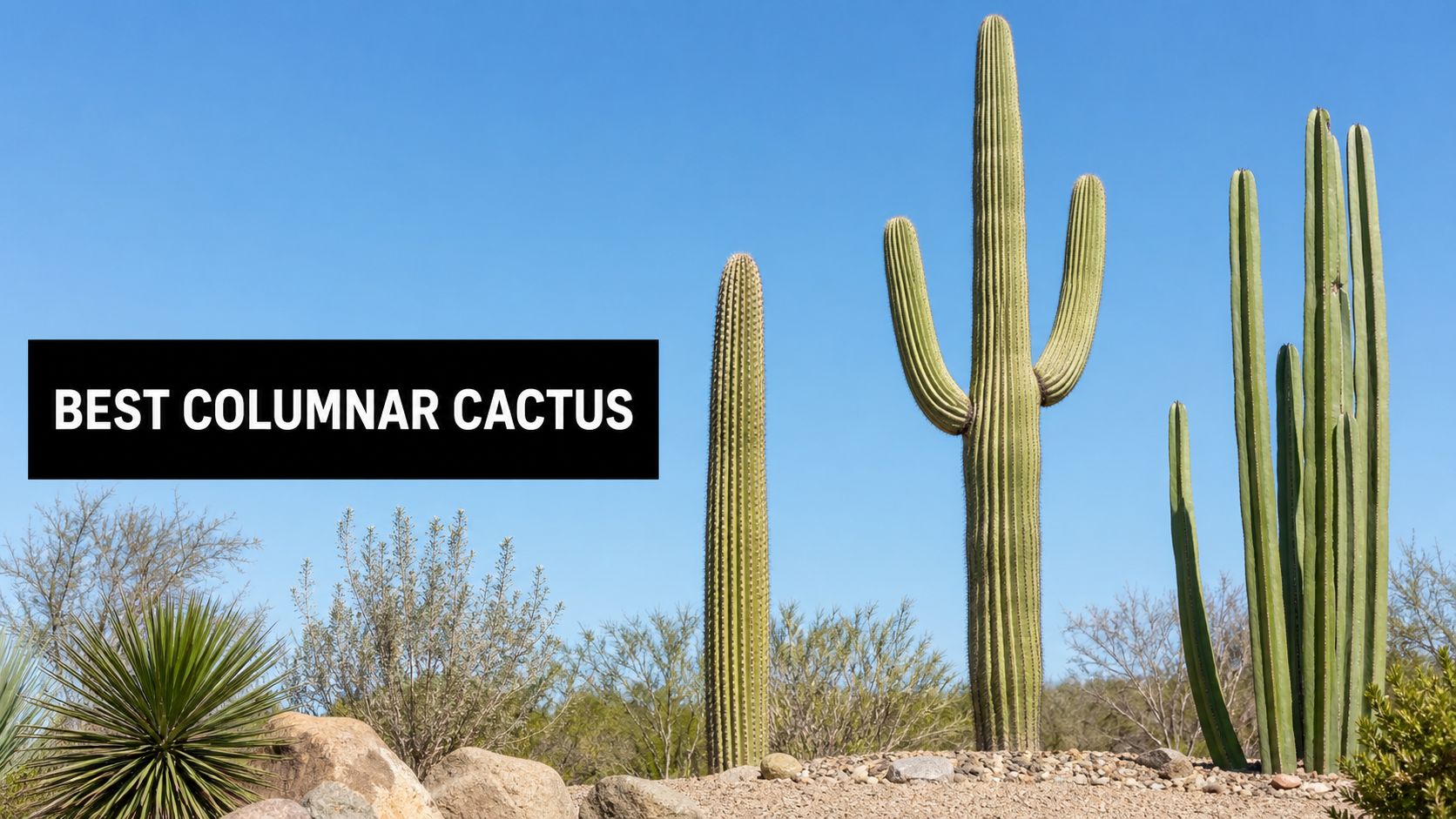
The Saguaro is the reference plant. It is the columnar cactus most envision when they want a true desert silhouette, and it reaches up to 40 feet source. That makes it a long-view purchase, not a fast answer for an empty yard. Buy it only if you have the space and the patience to let it become what it is meant to be.
Mexican Fence Post is the cleaner choice for structure. It gives repeated vertical lines without the clutter of a dense shrub mass, which makes it useful for entries, edges, and narrow planting strips.
Pachycereus pringlei belongs in big, open spaces. It carries serious mass and scale, and that size is exactly why it should never be squeezed into a tight patio or a small courtyard. Give it room or skip it.
Cereus peruvianus and Peruvian Apple Cactus are the practical picks for homeowners who want height without waiting forever. Their faster growth makes them useful in new plantings where you need vertical presence sooner, especially around walls, patios, or wide beds. If your goal is visible progress, these are easier to justify than a very slow giant.
The Trichocereus/Echinopsis group is the most flexible option for mixed conditions, because it combines sculptural form with rapid growth, low water demand, and adaptability source. For homeowners comparing larger specimens, the Cactus Outlet's types of large cactus plants guide is a useful way to sort through the big choices before you commit.
A fast shortlist
- For permanence: Saguaro
- For clean structure: Mexican Fence Post
- For sheer scale: Pachycereus pringlei
- For faster vertical fill: Cereus peruvianus
- For adaptable modern use: Trichocereus and Echinopsis types
Matching the Right Cactus to Your Site
The right columnar cactus is the one that fits the site cleanly after it reaches maturity. Start with USDA zone, sun exposure, drainage, overhead clearance, and the practical limits people ignore until a plant is already in the ground, such as balconies, walls, and utility lines.
A tall cactus can look right in a nursery lot and still fail at home. A balcony under eaves can rule out taller growers, and power lines can rule them out outright. Buyer guidance from source says to verify zone first, then check container limits and vertical clearance, because tight sites near walls, balconies, or lines can rule out taller columnar types such as Stenocereus or Neobuxbaumia. That is the right order. Fit first, style second.

Climate margin beats wishful thinking
A cactus that holds up in Phoenix can struggle in a humid Southeast yard. That is not a flaw in the plant, it is a bad match for the site. The test is whether it will establish, stay upright, and avoid rot when winters are wetter or colder than classic desert conditions.
Trichocereus/Echinopsis-type columns earn attention in marginal climates because they combine fast growth, low water demand, and strong adaptability source. For yards with inconsistent sun or colder winter swings, they make more sense than chasing a giant that will sulk for years. They also give homeowners a workable vertical plant when they need height without betting the whole yard on a species that only thrives in perfect desert conditions.
Use the site checklist before you buy
- Check your zone: Heat tolerance does not cover winter lows.
- Measure vertical clearance: Eaves, wires, and upper stories matter.
- Watch drainage: If water lingers, choose a different plant.
- Map sun exposure: Full sun in one corner does not mean full sun everywhere.
- Think container limits: Patio pots change the rules fast.
A cactus that fits today but crowds tomorrow is a bad purchase, even if it was cheap.
For homeowners planning a broader outdoor refresh, it helps to see how a real design team thinks about circulation, seating, and plant placement. If you are trying to plan your backyard design in Boston, that kind of layout thinking translates well to cactus-heavy spaces too.
Landscape Design Tips That Actually Work
The easiest way to make columnar cacti look expensive is to stop treating them like isolated ornaments. They work best when they're given a job, either as a focal anchor, a repeated screen, or a vertical counterpoint to softer plants. Put them where the eye needs direction, not where there's just empty soil.

Use repetition instead of clutter
A single tall specimen can anchor a bed, but repeated columns often do more work. A row of evenly spaced Mexican Fence Posts, for example, reads like a built-in boundary line, not a random collection of plants. That's how you get a privacy effect without building a wall.
Odd-number groupings also help the composition feel intentional. Three columns usually look more natural than two, and five can work when the bed is deep enough to handle the rhythm. Staggering heights adds movement, especially when you mix a very tall plant with shorter companions.
Place them where they won't hurt you or the house
Keep columnar cacti away from windows, narrow walkways, and spots where spines can brush skin. Don't jam them under trees that dump debris on top of them either. These plants need air around them, and they need room to be seen.
For patio and container work, taller columns can become statement pieces if the container is stable and the siting is honest about scale. If you're designing a larger outdoor space and want to compare layout ideas, it's worth looking at how a professional plans an entire yard before deciding where the cactus goes.
A useful reference point is column, contrast, and calm. One upright specimen, one softer companion, and one clean surface material can do more than a crowded bed full of random plants. If you're building a palette around cacti, agaves, aloes, and other low-water succulents usually round out the composition without stealing the scene.
Halfway through the day, once the sun drops a little, lighting changes everything. Columnar forms cast longer shadows than rosettes, and that's why they're so effective near paths and patios. The right plant becomes part of the nighttime design, not just the daytime one.
Planting and First-Year Care
The first year decides whether your cactus becomes a structure or a problem. Get the planting mix wrong, water too often, or rush it into full sun, and you'll spend months trying to undo the damage. Get the start right, and the plant settles in with far less drama.
Start with drainage, not decoration
For in-ground planting, the point is to keep roots dry enough to breathe. For patio containers, the rule is even stricter, because water has nowhere to hide if the pot holds it. Use a container with real drainage holes, not a decorative shell pretending to be a planter.
The best planting window in most climates is spring, once the ground is warming up and the plant can push roots before heat or cold stress stacks up. For Trichocereus in architectural planting, one source recommends a 60 to 80% mineral substrate such as pumice, pozzolana, volcanic gravel, or expanded clay, plus a 20 to 40% stable organic fraction, with planting in spring-summer after substrate temperatures are above 15°C to reduce root stress and support fast establishment source. That's a smart formula for fast, stable rooting.
Acclimate the plant before it faces full sun
A nursery-grown cactus that came from shade or filtered light can burn if you throw it straight into the hottest exposure. Ease it into stronger light over time. That's especially important for patio specimens, where reflected heat off walls and paving can be harsher than the open bed suggests.
The first-year watering schedule should stay conservative. Water to establish roots, then let the substrate dry back before watering again. The point is to avoid the wet, shallow root pattern that creates rot and weak anchoring.
Practical rule: If the soil is still damp, don't water just because the calendar says it's time.
Brace tall plants if the site gets windy
Large columns can lean before they're fully anchored, especially in exposed yards. A simple brace or staking setup during the first windy season can prevent movement from loosening the roots. That's not pampering, it's protecting the investment while the plant builds its underground support.
For a broader outside-planting walkthrough, the outdoor succulent planting guide is a useful companion.
By year one, expect establishment, not drama. By year three, you should see stronger form and more confident presence. By year ten, the plant should be starting to behave like the permanent architectural element you bought it to be.
Choosing the Right Specimen and Where to Buy
If you want a real statement plant in a desert or Southwest yard, buy a mature Saguaro or a large Pachycereus. That choice makes sense only when the space can hold a plant that is meant to settle in and stay put for the long haul. A slow giant is the wrong answer for a rushed makeover.
If your site sits near the edge of your cold range and you still want strong vertical structure, choose Trichocereus, Cereus peruvianus, or Peruvian Apple Cactus. Those are the better buys when winter stress, occasional wet weather, or container growing are part of the equation. They give you height without asking the site to be perfect.
For a patio or container accent, a Mexican Fence Post or another mid-size columnar specimen is the cleaner choice. You get upright form without committing to a plant that will crowd the space before you're ready. Buy for the space you have now and the mature size you can live with later.
Check the plant before you pay for it. The specimen should have firm tissue, a straight habit, and no softness near the base. Bigger helps with instant impact, but only if the plant is healthy and suited to the site. Buying a mature plant is usually the smarter route for this group, because you are buying the finished structure, not a long wait for one.
Use the columnar cacti collection to compare upright species side by side. That kind of focused selection is useful when you are sorting out a desert focal point, a patio feature, or a screening planting, because it keeps you in the right plant group instead of burying you in a generic cactus catalog.
For shipping stock, look for clean stems and no collapsed sections, bruising, or rot at the crown. If the plant looks dehydrated but still firm, that can be acceptable. Softness, dark patches, or a base that gives under light pressure are reasons to pass. A columnar cactus should arrive ready to root, not already failing.
Ask how the plant was grown and handled before shipment. A cactus raised in brighter conditions and moved with care will adapt better than one that was stretched in shade and rushed out the door. That kind of handling matters more than a sales pitch.
A strong specimen saves you from starting over. It also reduces the odds that you will spend the first season nursing rot, sunburn, or a crooked plant that never settles into the role you bought it for.