

You've found the perfect prickly pear for a sunny patio, then realized the same plant may be completely wrong for the clay slope behind the house. A compact, spineless specimen can look polished beside a grill, while a low, spiny native selection may be the better answer for a bank that dries quickly and faces winter cold.
That's the central buying decision with prickly pear cactus varieties for landscaping. Opuntia isn't one interchangeable plant. The group includes low groundcovers, spreading border plants, shrub-like forms, tree-form specimens, colorful focal points, edible cultivars, and spineless selections that still may carry irritating glochids. Match the plant to the site first, then choose the pad color and flower display you like.
Why Your Yard Needs the Right Prickly Pear Variety
A homeowner shopping for a large cactus often starts with appearance. The blue pads of Santa Rita, the soft shape of Beavertail, or the clean outline of a spineless Opuntia can make an immediate impression. But a nursery buyer should start with four harder questions: How cold does the site get, how wet is the soil, how much room does the plant have, and will people brush against it?
Consider two planting locations. Near the patio, a spineless Opuntia in a container can provide structure without turning a dining area into a defensive zone. On a hillside, that same choice may struggle if the soil stays wet or if the selected cultivar belongs to a warmer climate. A spreading, spiny native prickly pear can perform better on the slope, provided the bank drains and the plant has room to expand.

Choose the job before the cultivar
For colder gardens, I favor Opuntia humifusa and Opuntia phaeacantha over showier Mexican selections. Eastern prickly pear, O. humifusa, is listed for USDA zones 4 to 9 and can tolerate temperatures as low as 10°F (-12°C), making it a practical choice for colder outdoor markets (Gardenia's Opuntia humifusa guide). The broader group also includes cold-tolerant types such as O. polyacantha, O. fragilis, and O. macrorhiza, which are useful when winter reliability matters more than tropical color.
In a desert yard, Santa Rita and Beavertail earn their space because they supply strong architectural form and seasonal color. For a privacy barrier or edible garden, tree-form Opuntia ficus-indica is the more logical direction. Horticultural references list these cacti in forms ranging from low, spreading plants to shrub-like and tree-like specimens, including O. polyacantha at roughly 12 inches tall with a 6 to 9 foot spread, O. phaeacantha reaching up to 8 feet, and some O. ficus-indica cultivars reaching about 12 feet (Florida Entomologist landscape reference).
Nursery rule: Never buy a prickly pear by pad color alone. Buy it for the role it must perform.
What Counts as a Landscaping Prickly Pear
In general terms, Opuntia means a cactus with flattened pads, technically called cladodes. Each pad contains areoles, the small points where new pads, flowers, spines, and glochids emerge. Glochids are tiny, irritating bristles, and they're the reason a plant sold as “spineless” still deserves careful placement.
A true species has a recognized botanical identity, such as Opuntia humifusa, O. phaeacantha, or O. engelmannii. A cultivar is a selected form within a species, such as O. cacanapa ‘Ellisiana’, a spineless selection. Hybrids and named selections can offer particular colors, pad shapes, or growth habits, but marketplace labels aren't always precise. Ask for the full botanical name before checkout, especially when the listing uses only “prickly pear cactus.”
Separate dependable landscape types from novelty plants
The reliable landscape workhorses include O. humifusa, O. phaeacantha, O. engelmannii, O. santa-rita, O. basilaris, and O. ficus-indica. Those names correspond to different jobs. Beavertail, O. basilaris, suits a compact desert accent, while O. ficus-indica belongs where a buyer wants a much larger, upright plant.
Novelty crosses, including names such as ‘Fred's Red’ or ‘Imgratin’, may appeal to collectors, but I wouldn't specify one for a major garden installation without confirmed climate and size information. Also keep Cylindropuntia, commonly called chollas, in a separate buying category. They share the cactus family and may be called prickly pear informally, but their cylindrical stems create a different visual and safety profile.
| Species | Habit | Spines/Glochids | Primary Landscape Role |
|---|---|---|---|
| Opuntia humifusa | Low, sprawling | Spines and glochids may occur | Cold-region groundcover and slope planting |
| Opuntia polyacantha | Low, upright to spreading | Spiny | Hardy border, bank, or windbreak |
| Opuntia phaeacantha | Shrub-like and spreading | Spiny | Xeric massing and slope coverage |
| Opuntia engelmannii | Broad, upright-spreading | Spiny | Large desert border or acreage planting |
| Opuntia basilaris | Compact, low form | Spines and glochids vary | Beavertail accent and container display |
| Opuntia santa-rita | Sculptural, colorful pads | Spines and glochids vary | Desert focal point |
| Opuntia microdasys | Compact, branching | Glochids are a concern | Patio container or protected accent |
| Opuntia ficus-indica | Upright, shrub-like to tree-like | Spineless forms available | Large specimen, hedge, or edible landscape |
Matching Climate, Soil, and Sun to the Right Opuntia
Hardiness is where generic plant lists fail buyers. Opuntia humifusa is listed for USDA zones 4 to 9, while ornamental forms such as ‘Purple' Opuntia rufida, ‘Albaspina' O. microdasys, and ‘Burbank Spineless' O. ficus-indica are listed for warmer ranges, generally zones 8b to 10 or 9 to 10, depending on the selection (Prickly pear hardiness overview). Those differences determine whether a plant belongs in an inland cold garden, a warm coastal yard, or a desert installation.
The freezing response also varies within the genus. A peer-reviewed study found that the Opuntia varieties Duraznillo and Tapón Aguanoso showed no freeze injury, while Amarilla CE, Amarilla SM, Morada SM, Camuezo, and Zarquita showed only slight damage, recorded as 0% to 10% in that study (freezing-tolerance study). That doesn't make drainage optional. Winter moisture can cause root or pad rot even when temperatures are within a cultivar's tolerance.
The soil trap that ruins hardy plants
Full sun and sharply drained soil are essential for most Opuntia. Eastern types such as O. compressa, O. macrorhiza, and O. humifusa handle colder or more variable conditions better than many desert-only cacti, but they still need roots that don't remain saturated. USDA-based guidance specifically warns that Eastern prickly pear roots must stay dry in winter to prevent rot (drought-tolerant prickly pear guidance).
For heavy clay, plant on a mound or slope rather than setting the root ball into a basin. Use a mineral-heavy cactus medium and review this practical guide to making cactus soil. If you're planning a broader climate-resilient planting, a guide to climate-friendly garden shrubs can help you build companion layers around the Opuntia without choosing plants that need incompatible moisture.
| Variety | USDA Zones | Soil Tolerance | Sun | Established Water Needs |
|---|---|---|---|---|
| O. humifusa | 4 to 9 | More tolerant of cold and variable conditions, drainage still essential | Full sun | Very limited irrigation once established |
| O. phaeacantha | Broad regional use, commonly associated with cold-hardy landscapes | Dry, well-drained soil | Full sun | Infrequent watering |
| O. polyacantha | Cold-hardy selections available | Rocky or sharply drained soil | Full sun | Drought-adapted |
| O. santa-rita | Warm-climate ornamental use | Fast-draining soil | Full sun and reflected heat | Limited irrigation |
| O. basilaris | Warm, dry landscape use | Mineral, well-drained soil | Full sun | Limited irrigation |
| O. ficus-indica | Commonly listed for warm zones, with cultivar variation | Dry soil, raised planting in clay | Full sun | Limited irrigation after establishment |
Size, Form, and Color in the Landscape
The pad you see in a shipping photo isn't the finished design. Mature spread determines whether an Opuntia reads as a neat accent or becomes an obstacle. Low forms work well along banks and at the front of a xeric border. Upright forms need a deeper visual field, especially when they're placed beside walls, gates, or large agaves.
O. humifusa is commonly described as a low, sprawling groundcover, while O. polyacantha can serve as an upright-spreading border or windbreak. Planning references give examples such as O. humifusa at about 6 to 12 inches tall and 2 to 3 feet wide, O. fragilis at roughly 4 to 6 inches tall and 12 to 24 inches wide, and O. polyacantha at about 6 to 12 inches tall and 24 to 36 inches wide (landscape size comparison). By contrast, shrub-like O. phaeacantha and tree-form O. ficus-indica need substantially more clearance.
Read color as a design tool
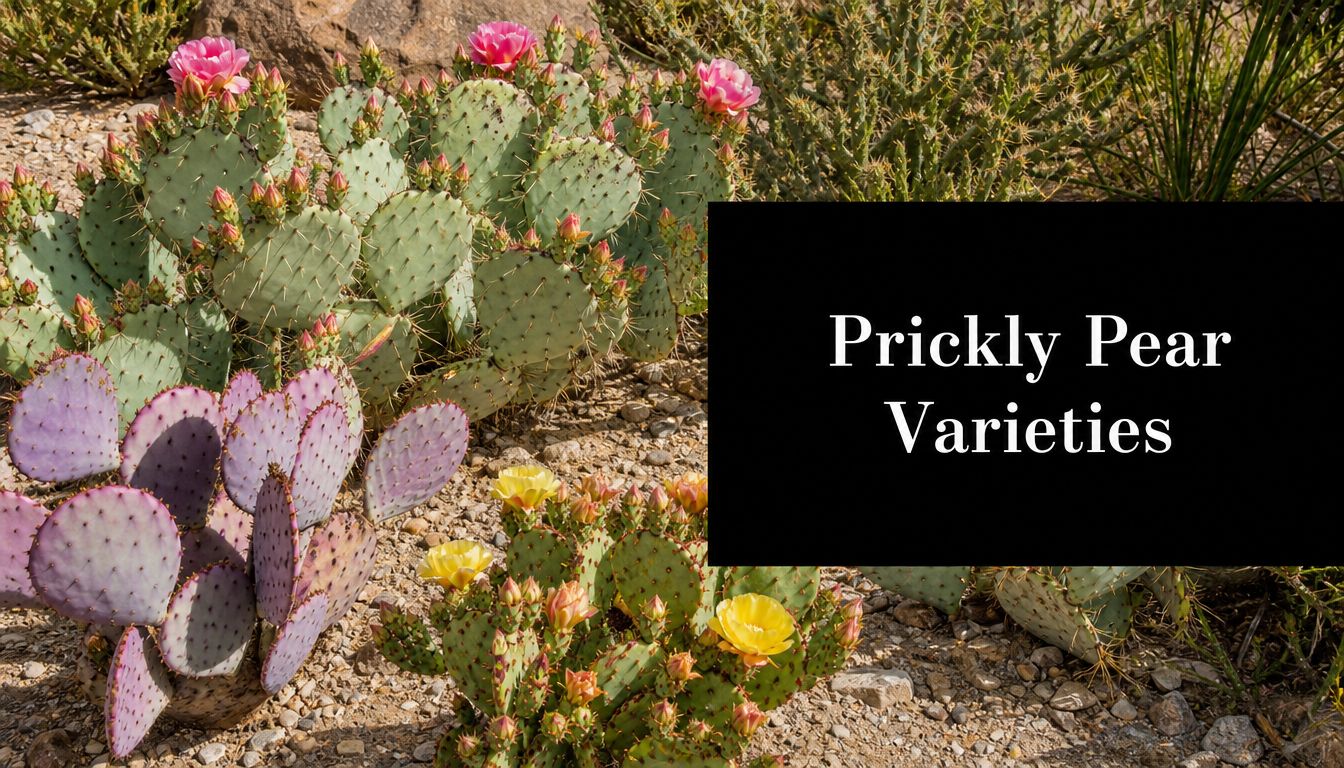
For a restrained desert palette, blue-green pads on Engelmann prickly pear provide mass without dominating nearby plants. Santa Rita brings purple-tinged pads and works best where the color can contrast with gray agaves, green grasses, or pale gravel. Young O. microdasys pads can offer bright lime tones, but its glochids make it a poor choice beside busy walkways.
Flowers expand the palette beyond the pads. Depending on the variety, blooms may be yellow, orange, magenta, or red. Fruit can also vary in color, size, and edibility, with O. ficus-indica especially relevant to buyers planning an edible outdoor space. Don't promise fruit performance from an unnamed plant. Confirm the cultivar and its intended use.
| Variety | Mature Height x Spread | Pad Color | Flower Color | Form |
|---|---|---|---|---|
| O. humifusa | About 6 to 12 inches x 2 to 3 feet | Green | Variety-dependent | Low, sprawling groundcover |
| O. fragilis | Roughly 4 to 6 inches x 12 to 24 inches | Green to blue-green | Variety-dependent | Very low, compact spreader |
| O. polyacantha | About 6 to 12 inches x 24 to 36 inches in cited landscape examples | Green to blue-green | Yellow or other variety-dependent shades | Upright-spreading |
| O. engelmannii | Larger, broad-spreading form | Blue-green to green | Yellow, orange, or other selection-dependent shades | Architectural border plant |
| O. basilaris | Low to moderate, compact habit | Blue-green or gray-green | Magenta or pink-toned flowers | Beavertail accent |
| O. santa-rita | Shrub-like ornamental form | Purple-tinged | Yellow or selection-dependent shades | Sculptural focal point |
| O. microdasys | Compact branching form | Bright lime on young pads | Yellow | Container or protected accent |
| O. ficus-indica | Up to about 12 feet in some cultivars | Green | Yellow, orange, or selection-dependent shades | Upright, tree-like specimen |
Use one large O. ficus-indica as a focal point, mass low humifusa across a slope, or layer Beavertail beneath taller agaves. Keep spiny forms away from paths, seating, and play areas. For spacing, follow the mature spread rather than the plant's shipped width, and allow extra clearance where people must pass.
Best Varieties by Landscaping Role
A strong garden design plan assigns each prickly pear a job. I wouldn't use a compact Beavertail where a privacy screen is needed, and I wouldn't place a tall O. ficus-indica beside a narrow patio just because the young plant looks manageable.
Match the plant to the installation
For a focal point, choose Opuntia ficus-indica or ‘Burbank Spineless’ when the climate supports warm-zone planting. Their upright structure gives a large yard visual weight that a low groundcover can't provide. Keep them away from tight pedestrian routes, even when the selection is described as spineless, because glochids and pad edges still affect placement.
For barriers, dense and thorny growers such as O. lindheimeri or Santa Rita can define a property edge. They're a poor pairing with children's paths, outdoor dining zones, or narrow service corridors. For slopes, I prefer low, spreading choices such as O. humifusa, O. phaeacantha, and named forms such as ‘Fresa’, but the soil must drain quickly. A wet bank defeats the purpose of a drought-adapted plant.
Cold-zone buyers should look first at O. fragilis, ‘Crystal Tide’, and O. polyacantha, then verify the specific plant's hardiness rather than assuming every prickly pear shares the same tolerance. The genus includes selections with minimum-temperature references ranging from 0°F for O. macrorhiza and O. santa rita to 10°F for O. cacanapa ‘Ellisiana' and selected O. engelmannii forms, and 15°F for O. microdasys var. rufida (cold-hardy cactus reference).
Patio buyers should keep the selection compact. O. microdasys and ‘Santa Rita Baby’ suit containers where their form can be viewed closely, but neither belongs where guests brush past the pads. For edible designs, consider O. ficus-indica and O. cochenillifera only after confirming the plant's purpose and climate suitability.
| Landscaping Role | Recommended Variety | Hardiness Zone | Why It Works |
|---|---|---|---|
| Large focal point | O. ficus-indica or ‘Burbank Spineless' | Warm zones, commonly 9 to 10 for ‘Burbank Spineless' | Upright, tree-like presence |
| Color accent | O. santa-rita | Warm-climate ornamental use | Purple-tinged pads provide contrast |
| Hedge or barrier | O. lindheimeri or Santa Rita | Verify cultivar and local conditions | Dense, defensive structure |
| Slope stabilizer | O. humifusa or O. phaeacantha | O. humifusa is listed for zones 4 to 9 | Low, spreading coverage |
| Cold-climate border | O. fragilis or O. polyacantha | Selection-dependent, with cold-hardy forms | Compact, hardy structure |
| Patio container | O. microdasys or ‘Santa Rita Baby' | Warm zones, verify local winter exposure | Compact visual scale |
| Edible landscape | O. ficus-indica or O. cochenillifera | Warm zones, verify cultivar | Upright form and relevant fruit use |
For a social yard, pair prickly pears with seating, lighting, and circulation decisions covered in these design tips for hosting-ready backyards. The plant should frame the activity, not invade it. For more detail on the larger edible form, see Opuntia ficus-indica.
Buying Large Prickly Pears Online and Planting Them Right
Buying a mature, large prickly pear online makes sense when you need immediate structure. A well-established specimen gives a new garden a finished focal point or visible border while smaller plants are still building their root systems. The tradeoff is that large pads require careful handling, accurate labeling, and packaging that protects the plant from crushing.
Before checkout, verify the botanical name, mature dimensions, hardiness information, pad condition, root establishment, and shipping format. Request current photos when the listing doesn't show the actual size or form. Don't choose a bargain lot with scarred or collapsed pads, and be cautious with bare-root delivery during winter when cold and wet handling can compound stress.

Plant for drainage before appearance
Choose full sun and a location where water moves away from the crown. In clay, build a raised or mounded bed rather than improving only a small planting hole that can collect water. Backfill with cactus soil or mineral soil, avoid moisture-retaining organic amendments, water once to settle the roots, and then withhold irrigation unless the site experiences an extended dry period.
Give the plant time to acclimate. Protect a newly delivered specimen from abrupt exposure changes, orient the pads toward the strongest light, and don't crowd the plant against a walkway. A mature prickly pear can look safely distant on delivery day but occupy much more space as new pads develop.
Use this guide to buy prickly pear cactus online when comparing listings and preparing questions for a nursery. The Cactus Outlet offers a dedicated prickly pear collection alongside its broader selection of large cacti and succulents, so buyers can compare forms while checking the details provided for each plant.
Choosing Your Prickly Pear With Confidence
Use this short rubric before you buy:
- Cold site: Start with O. humifusa, O. fragilis, or O. polyacantha, then verify the selected plant's hardiness.
- Warm desert yard: Consider Santa Rita, Beavertail, or O. engelmannii for color and structure.
- Large screen or edible planting: Choose O. ficus-indica only when you have room for its eventual upright form.
- Slope or broad acreage: Favor low, spreading native selections, including O. humifusa and suitable O. phaeacantha forms.
- Tight patio: Use a compact container specimen such as Beavertail or Santa Rita, positioned away from contact points.
The two key factors are sharp drainage and strong sun. Match the USDA zone, soil behavior, mature height and spread, and garden role before comparing pad color. Never buy based only on the size shown at shipping, because the mature plant may need far more clearance.

The Cactus Outlet offers a dedicated prickly pear collection with garden-oriented choices such as Purple Santa Rita, Nopal, Cowboy Prickly Pear, and Beavertail-related hybrids. Visit The Cactus Outlet to compare available specimens, review plant details, and choose a prickly pear that fits your site rather than buying on impulse.