

“Spray it with fungicide and water less” is incomplete advice for agave leaf spot disease. A product won't restore dead leaf tissue, and reducing root-zone watering won't solve foliage that stays wet overnight beneath a crowded patio roof. Start with sanitation, then work out what's keeping the leaves wet.
For a large agave in the garden, placement can matter more than the watering schedule. An open bed with moving air and soil-level irrigation presents a different problem from a shaded courtyard where fog, rain or sprinklers leave moisture trapped between the leaves.
What Agave Leaf Spot Is and Which Fungi Cause It
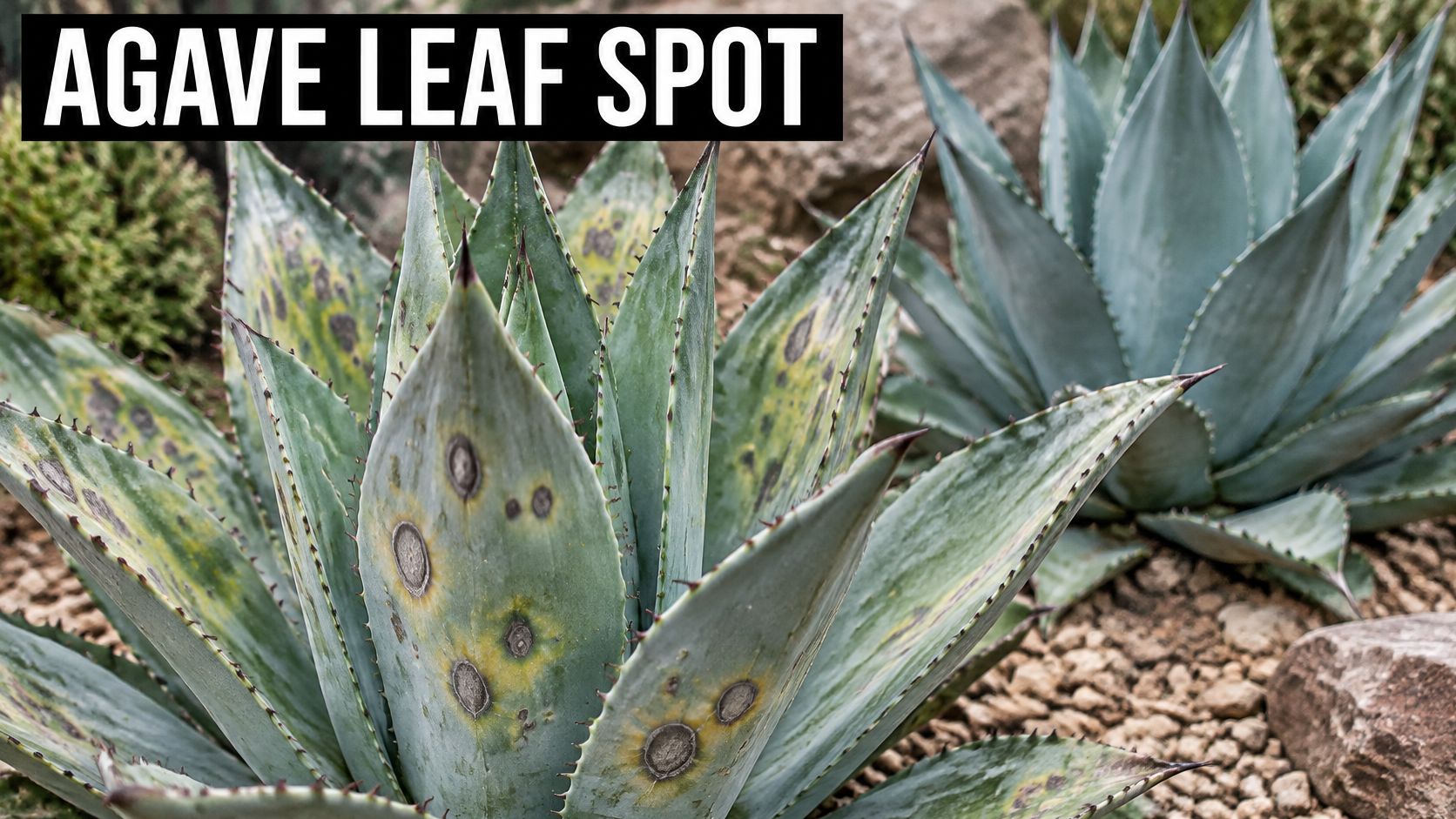
Agave leaf spot is a symptom complex, not a single-pathogen disease. Several fungi can produce similar brown or gray lesions, so appearance alone cannot reliably identify the organism. Risk also depends on placement: foliage that stays wet in humid patios, fog-prone coastal sites or transitional weather has more exposure than foliage in an open, well-ventilated garden bed. Drought adaptation does not prevent leaf spot when moisture lingers on the leaves.
A study published in Agronomy identified 26 fungal isolates representing nine species from Agave salmiana and A. lechuguilla. In greenhouse pathogenicity tests, Curvularia verruculosa, Alternaria alternata, Bipolaris zeae and Fusarium lactis were identified as major contributors. The researchers combined field sampling, molecular identification and inoculation tests, which offers stronger evidence of causation than finding fungi on damaged leaves alone.
Documented Agave Leaf Spot Pathogens and Hosts
| Pathogen | Host where documented | Setting or significance |
|---|---|---|
| Cercospora agavicola and related Cercospora species | Blue agave and related hosts | Gray spot associated with prolonged leaf wetness |
| Bipolaris zeae | Agave salmiana | Major contributor in greenhouse pathogenicity tests; documented cause of leaf spot in Mexico |
| Lasiodiplodia theobromae | Agave sisalana | Documented cause of leaf spot in Guangxi, China |
| Curvularia verruculosa, Alternaria alternata and Fusarium lactis | Agave salmiana and A. lechuguilla | Major contributors in greenhouse pathogenicity tests |
| Curvularia lunata, Epicoccum sorghinum, Penicillium diversum and other isolates | Agave salmiana and A. lechuguilla | Recovered in the study, but not singled out as major contributors |
Most published work concerns hosts other than the ornamental agaves commonly chosen for patios and desert settings. These documented pathogens help describe leaf spot, but the table cannot diagnose a brown mark on Agave americana, Blue Glow agave, Whale's Tongue agave or Parry's agave.
Finding a fungus is different from showing that it caused the damage. Fungi may colonize leaves after another injury, so laboratory results need to be interpreted alongside symptoms and growing conditions.
Buyer's takeaway: Pathogens vary by host and region. Similar-looking spots do not automatically call for the same treatment.
Telling Leaf Spot From Look-Alike Leaf Damage
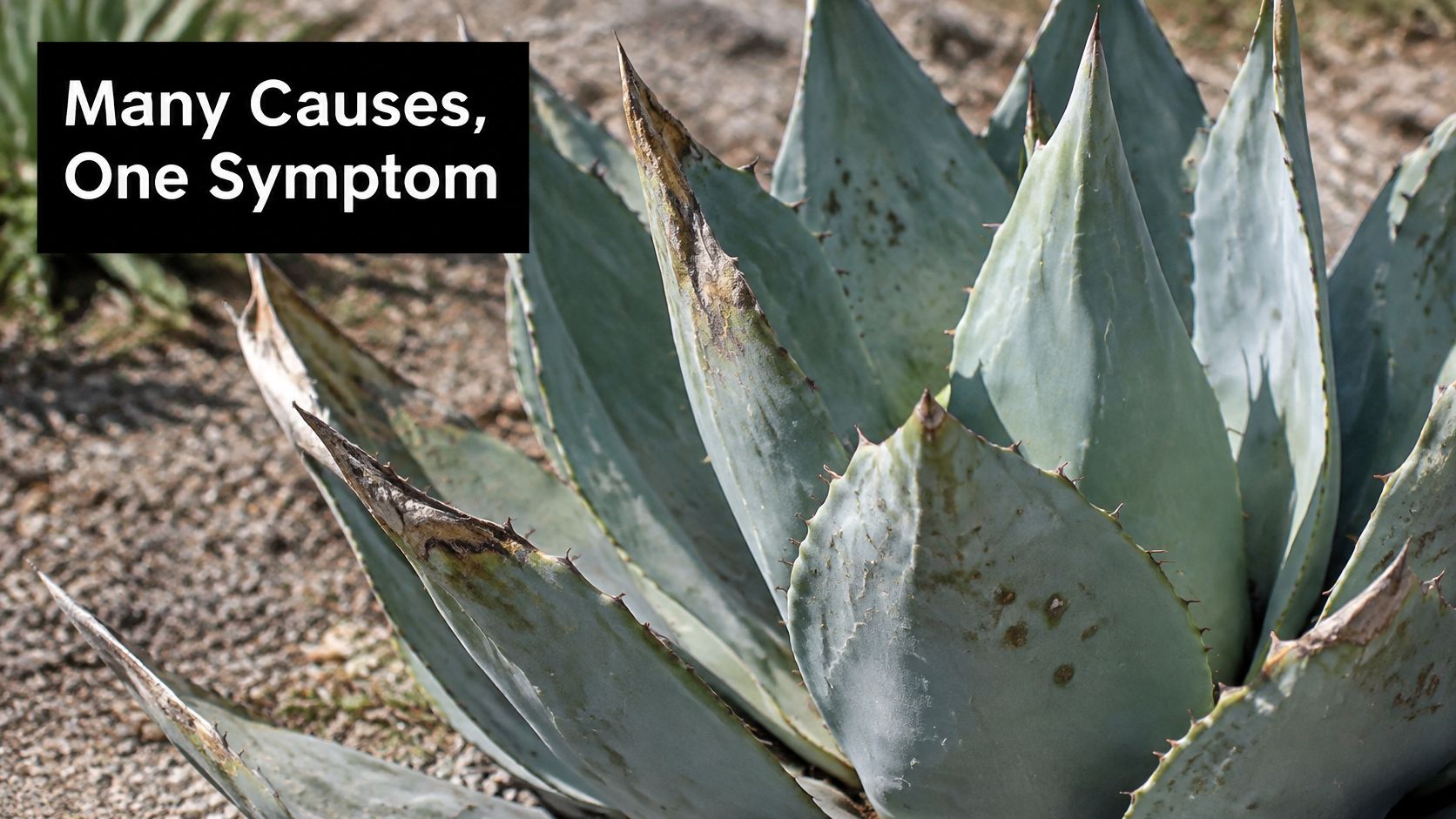
Sun scorch, shipping damage and fungal spotting can all leave brown tissue. Their distribution and progression provide useful clues, although none of these patterns replaces a diagnosis.
Leaf Symptoms, Likely Causes and First Actions
| Visible symptom | Most likely cause | First action |
|---|---|---|
| Small gray to light-brown oval spots with a yellow halo that enlarge and join after wet weather | Gray spot or another leaf spot fungus | Keep foliage dry, remove clearly affected leaves where practical, and check the central rosette |
| Spots advancing toward the center over several weeks | Suspected active fungal infection | Isolate the plant and begin sanitation |
| Tan, papery patches on sun-exposed outer leaves after a light or heat change | Sun or heat scorch | Review recent exposure; reassess if spots spread or develop halos |
| Dry brown tips or edges after shipping or relocation | Possible transit or transplant stress | Check moisture and light exposure; watch for new lesions |
| Soft, water-soaked tissue that enlarges quickly | Possible rot, including a non-fungal cause | Isolate the plant and request laboratory diagnosis |
A scorched patch generally corresponds to exposed tissue. A handling injury may follow a crease, scrape or pressure point. Neither should automatically trigger a fungicide application.
New lesions on previously clean leaves deserve more attention than an old, stable mark. If the base is soft or the plant becomes unstable, investigate agave root rot rather than assuming every symptom begins in the foliage.
Judge the Planting, Not Just the Leaf
The SENASICA phytosanitary monitor describes a November 2023 outbreak on Agave sisalana in Guangxi, China, where approximately 50% to 60% of 200 surveyed plants showed obvious symptoms and affected plants had spots on more than 70% of their leaves. Laboratory identification and pathogenicity testing supported Lasiodiplodia theobromae as the cause, rather than a diagnosis based on appearance alone.
That outbreak illustrates why counting affected plants matters as much as counting spots. A single damaged outer leaf and similar lesions appearing across neighboring agaves call for different responses.
Walk the whole bed or container group. Note whether affected plants share a sprinkler zone, sit beneath dripping eaves or occupy the same still-air corner. Those details help separate an isolated injury from a planting-wide exposure problem.
How to Confirm a Diagnosis Before Treating
Confirm the diagnosis before choosing a fungicide. Start sanitation immediately. Removing fallen debris and separating a suspect container don't require knowing the pathogen's name.
The UC Agriculture and Natural Resources agave fungal disease guide.pdf) identifies prolonged leaf wetness as a major environmental predictor and prioritizes scouting near the central rosette. For homeowners, that means recording both the lesions and the conditions that preceded them.
Build a Useful Diagnostic Record
- Inspect the central rosette. Work in bright shade or use a flashlight to examine leaves near the head without forcing them apart. Record whether the youngest visible tissue is clean, spotted or soft.
- Map the affected leaves. Note their position, approximate age, lesion color and margins, then inspect neighboring plants. A hand lens may reveal tiny dark structures inside lesions, but those structures alone don't identify the fungus.
- Review recent conditions. Look back over rain, fog, sprinkler use, humid weather and nitrogen feeding. Include a recent move from an exposed nursery setting to a sheltered patio, because the drying conditions may have changed substantially.
- Photograph progression. Place a ruler beside the lesion and repeat the photograph from the same angle every few days. Compare the lesion boundary, not just its color, to see whether it enlarges or joins nearby spots.
- Check competing explanations. Review changes in sunlight and heat, shipping abrasions and signs of insect feeding. A stable injury following a clear exposure event warrants a different response from continuing lesions on sheltered leaves.
- Arrange sampling before cutting. Contact a university extension office or plant diagnostic laboratory for its submission instructions. It may request symptomatic leaves or sections containing both healthy and affected tissue, packed in clean paper and labeled with plant identity, collection date and treatment history.
- Choose the next action from the findings. Keep a stable, limited problem under observation; escalate spreading or central symptoms for testing. Ask whether the laboratory can culture or molecularly identify the organism and whether additional sampling is needed.
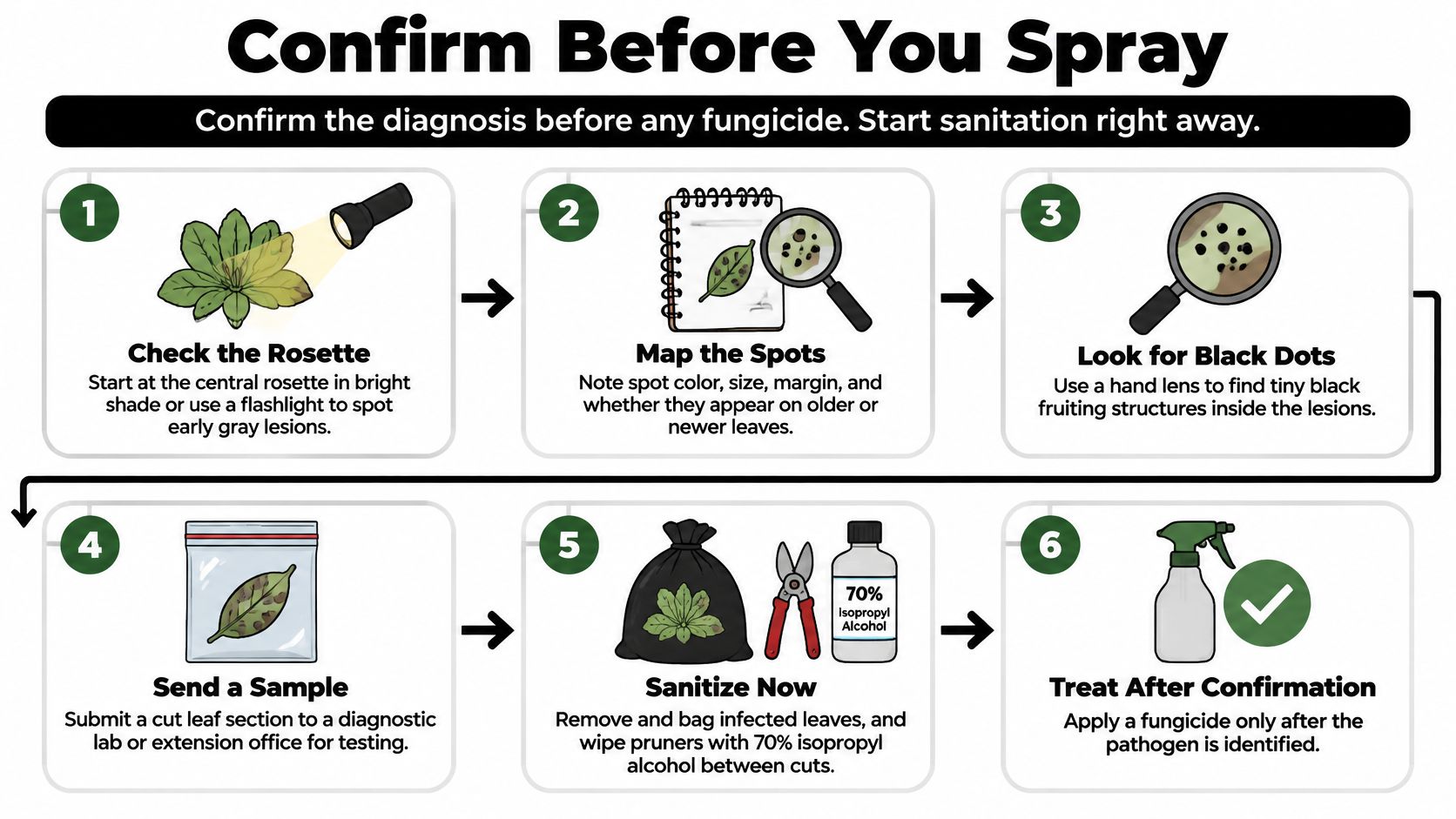
Know What Confirmation Means
Enlarging lesions, merging spots and progression following wet weather support a working diagnosis of fungal leaf spot. They don't establish a species-level diagnosis.
A useful laboratory conclusion connects the organism to the disease pattern, rather than merely listing fungi recovered from a leaf. Tell the diagnostician about any fungicide already applied, since treatment can affect what the laboratory recovers.
Cultural Controls That Slow an Active Infection
Work on a dry plant with sharp bypass pruners or a pruning saw suited to the leaf thickness. Wear gloves, long sleeves and eye protection, and plan where each cut leaf will go before starting.
Work From Removal to Site Correction
- Remove symptomatic leaves carefully. Cut accessible affected leaves near their attachment without gouging the central head. If removing every spotted leaf would strip most of the plant, stop and reassess its viability rather than turning sanitation into severe defoliation.
- Bag tissue as you cut. Keep a disposal bag beside the plant so infected material doesn't land among healthy containers. Don't leave cut leaves beneath the rosette.
- Disinfect tools between cuts and plants. Remove sap and visible debris first, then use isopropyl alcohol or an appropriate tool disinfectant according to its directions. Keep alcohol away from flames and hot equipment.
- Clear the base. Lift out fallen leaves, dead debris and wet organic mulch touching the plant. Avoid scraping healthy leaf surfaces or damaging roots while cleaning.
- Redirect irrigation. Replace overhead wetting with drip emitters or a hose directed at the soil. If foliage gets wet accidentally, irrigate early enough that it can dry before evening.
- Open the surrounding space. Separate crowded containers, raise pots off persistently wet paving with stable pot feet, and thin neighboring vegetation where appropriate. For Irish gardens, ShamFix's shrub pruning guidance for Irish homeowners can help plan that neighboring shrub work without applying agave leaf-removal methods to woody plants.
- Pause nitrogen feeding. Don't try to replace damaged foliage by pushing soft growth with fertilizer. Resume feeding only when the plant is stable and its growing conditions justify it.
- Recheck weekly during the following weeks. Compare photographs and examine adjacent plants for fresh lesions. Continuing damage means the moisture source, diagnosis or removal decision needs another look.
Make the Fix Fit the Plant
For a large specimen, moving the agave may be less practical than moving a sprinkler head or pruning an overhanging shrub. The Agave americana care guide provides broader context for maintaining the plant after the immediate cleanup.
Work on suspect plants last. Splashing water, contaminated tools and handling can move infectious material locally.
These measures can reduce opportunities for spread, but they can't restore tissue already lost. Keep hands, gloves and the work surface clean before returning to healthy plants.
Fungicide Timing and Other Treatment Options
Fungicide is most useful when healthy foliage needs protection during wet weather. It will not repair spotted or dead leaves, and it should follow sanitation and moisture management rather than replace them. The key trade-off is whether the plant has healthy tissue worth protecting while foliage is likely to stay wet.
| Situation | Treatment priority | What a fungicide can reasonably do |
|---|---|---|
| Clean foliage before a forecast wet spell | Finish sanitation and assess preventive treatment | Protect susceptible healthy tissue |
| Few early spots with a sound center | Correct wetting and airflow, then consider a diagnosed treatment | Help protect remaining foliage |
| Persistent disease-favorable weather | Maintain protection only as permitted by the product label | Protect new growth during continuing exposure |
| Advanced symptoms with heavy leaf loss | Assess removal rather than repeated spraying | Won't rebuild dead leaves |
| Unknown cause or soft decay | Obtain diagnosis | An unsuitable fungicide may provide no benefit |
Protect Healthy Tissue Rather Than Chase Old Spots
The UC Agriculture and Natural Resources Spanish-language fungal disease guide.pdf) recommends preventive applications before rainy periods or high humidity, with repeats every 10–14 days if wet conditions persist. It also emphasizes that fungicides protect healthy tissue rather than eliminate established infections. Follow the product label if its directions differ from that interval.
Old lesions remain visible even after conditions improve. Judge whether disease is continuing by looking for expanding lesions or damage on new growth, not by expecting brown tissue to turn green. A spray aimed at scars alone will not restore the leaf.
University of Arizona guidance notes that thiophanate-methyl may help prevent new infections during wet weather, but its effectiveness for this use hasn't been established (University of Arizona agave disease guidance). Treat it as an option to discuss with a local adviser, not as a proven cure or a blanket recommendation. Wet foliage and slow drying remain the conditions to address.
Check the Product and the Site
- Registration: Confirm that the product is permitted for the crop or ornamental use and the planting site in your jurisdiction.
- Application: Follow the label's rate, protective equipment, coverage instructions and restrictions.
- Timing: Ask a local extension office which options suit the diagnosed disease and regional weather.
- Expectations: Look for clean new growth and no expanding lesions, rather than a change in old brown tissue.
Avoid improvised household mixtures on a premium specimen. They can injure foliage and complicate diagnosis without addressing the infection. Put sanitation and control of prolonged leaf wetness first; use a fungicide only when the diagnosis, site and label support it.
Preventing Leaf Spot in Landscapes, Containers and Shipped Plants
Drought tolerance isn't immunity to moisture-driven foliar disease. Root-zone dryness and leaf-surface dryness are different conditions, so a plant can receive little irrigation yet remain exposed to prolonged fog or humid, still air.
The University of Arizona agave disease guidance identifies humidity, rain, shade and overhead irrigation as disease-favorable conditions. Choose placement by how readily the foliage dries, not just by whether the bed looks like a desert garden.
Leaf Spot Risk and Prevention by Planting Setting
| Setting | Main risk | Prevention focus |
|---|---|---|
| In-ground landscape in open sun | Generally lower risk unless irrigation wets foliage or rain lingers | Soil-level or drip watering and room for leaves to dry |
| Container on a covered patio | Still, humid air and wet foliage after rain | Porous pot, fast-draining mix and better airflow |
| Shaded courtyard or north-facing bed | Foliage stays wet longer | Thin neighboring plants or relocate where suitable light and air allow |
| Coastal or fog-prone region | Frequent leaf wetness | Water early and inspect the central rosette after fog |
| Monsoon or end of rainy season | Transitional conditions favorable to gray spot | Prepare before weather changes and inspect after rain |
| Newly arrived bare-root shipment | Abrupt transfer into a humid, poorly ventilated setting | Inspect on arrival and acclimate gradually |
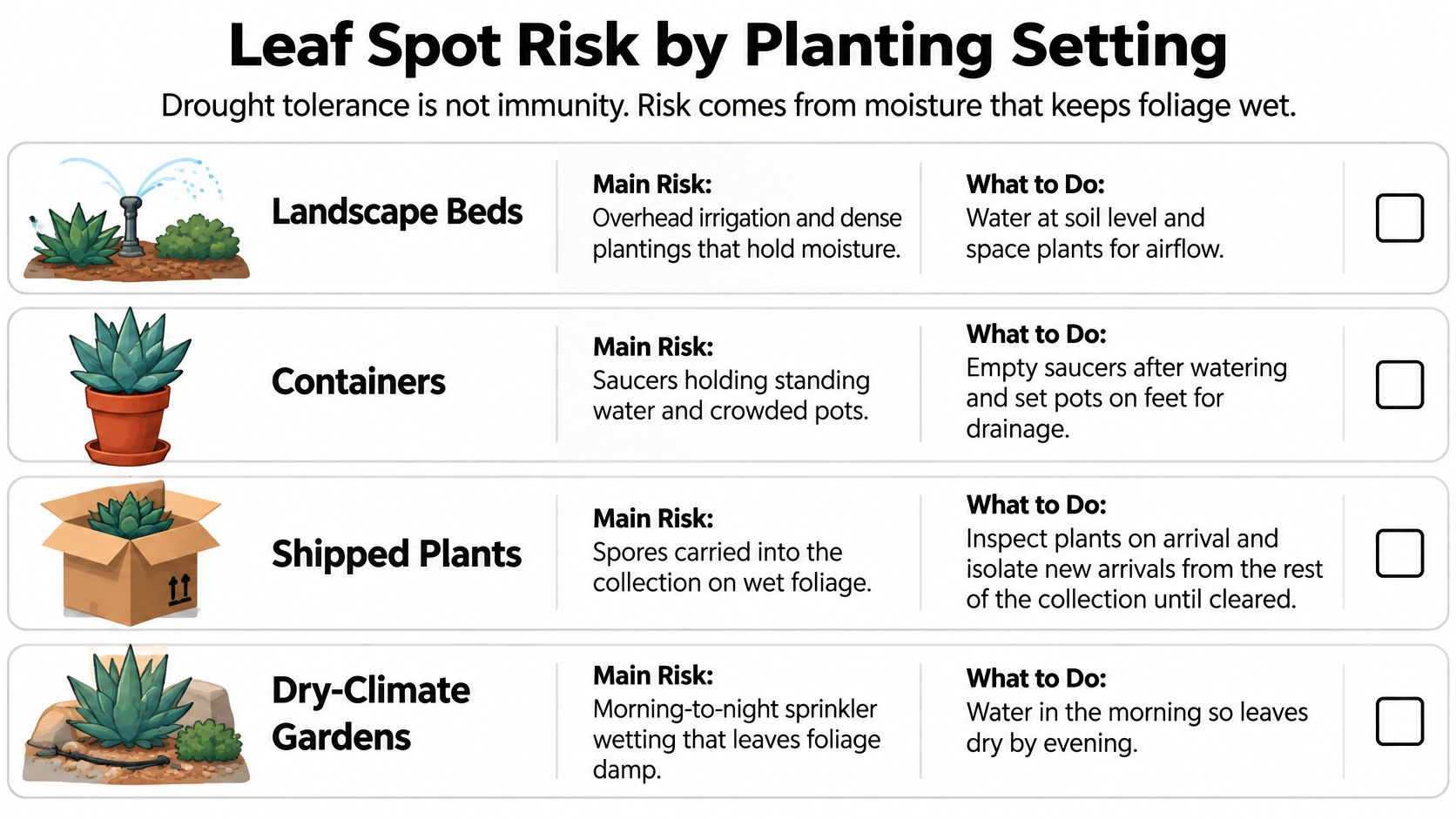
Prepare the Destination Before Delivery
Agaves ship bare root, not in nursery pots. Unpack promptly, inspect leaves and roots, and keep a suspect arrival separate while you assess it.
Choose a ventilated acclimation position with appropriate protection from abrupt sun exposure. Don't leave a newly unpacked specimen in a damp, enclosed corner, but don't try to dry it by immediately placing it in intense sun either.
For an established container plant, use soak-and-dry watering based on soil condition, season and climate rather than a fixed calendar. A porous container can help, but drainage holes and an unobstructed outlet remain essential; the guide to whether succulents need drainage explains that container decision.
Large specimens need space around their leaf mass, not merely around the pot. When comparing Agave americana, Blue Glow agave, Whale's Tongue agave and Parry's agave in the agave collection, match the selected plant's stated dimensions to the actual placement available.
Frequently Asked Questions for Agave Growers
Are All Agaves Equally at Risk?
No. Published disease reports concern particular host-pathogen combinations, including Agave salmiana, A. lechuguilla, A. sisalana and blue agave. They don't establish a susceptibility ranking for Agave americana, Blue Glow agave, Whale's Tongue agave or Parry's agave, so don't interpret limited evidence as immunity.
Is Laboratory Testing Worth It for a Small Collection?
It's most useful when lesions approach the central rosette, spread rapidly across several plants or influence a decision about fungicide treatment. For an isolated, stable mark on an outer leaf, photographs and careful monitoring may be the more proportionate starting point.
Spending priority: Correct an obvious sprinkler or placement problem before paying for a product chosen from a photograph.
Will Leaf Spot Spread From Agaves to Other Succulents?
Cross-infection to other plant families isn't established by the agave reports discussed here. That uncertainty doesn't justify treating every neighboring aloe, cactus or Euphorbia, but it does justify separation during handling, clean tools and advice about other species sharing the bed.
Can I Skip Prevention in a Dry Climate?
Low rainfall doesn't remove exposure from irrigation, sheltered patios or occasional fog. Check the plant after unusual wet weather and watch the places where leaves overlap or air movement is restricted.
A dry regional forecast also doesn't describe conditions beneath a leaking gutter. Base your response on the plant's immediate surroundings rather than the climate label alone.
Deciding to Isolate, Remove, Discard or Treat
Use the central rosette to set the response. A sound center leaves room for recovery, while damage advancing into it calls for faster action than a stable scar on an outer leaf. Also consider how long the foliage stays wet. An agave in a humid patio, coastal fog or transitional weather may remain exposed longer than one in an open, well-ventilated spot.
Isolation, Removal and Discard Criteria
| Condition | Action | Reason |
|---|---|---|
| Few spots with a clean central rosette | Keep the plant if separation is adequate, sanitize and monitor weekly | Limited disease may be manageable without removing the plant |
| Spots reaching the central rosette | Isolate promptly and request laboratory diagnosis | Damage to the central head threatens continued growth |
| Widespread defoliation or a large share of leaves lost | Remove and destroy the plant outside the growing area | This reduces infected material near healthy plants |
| Soft decay at the base or core | Discard the plant, remove old medium and clean the container before reuse | The decay may involve more than leaf spot |
| Neighboring plants showing lesions | Separate the group and review spacing and watering | Shared exposure or local spread needs attention |
| Clean new growth and lesions no longer expanding | Keep the plant under the improved conditions and monitor | Healthy central tissue supports recovery |
Can It Recover, and Is It Contagious?
Damaged leaf tissue will not grow back. Recovery means new growth is healthy and existing lesions stop expanding; old scars remain.
Infectious leaf spot can spread locally through splashing water or contaminated tools and handling. Do not compost suspect infected tissue. Bag it and follow local disposal or green-waste requirements. If a container plant has decay, discard its potting mix rather than trying to disinfect and reuse it at home.
Take the Next Step in Order
For limited spots and a clean center, sanitize and correct the plant's placement, then check it weekly. Reduce the time foliage stays wet by addressing overhead watering and restricted airflow. If lesions advance or reach the center, arrange laboratory sampling and discuss protecting remaining healthy tissue before the next wet period.
Before contacting a nursery or diagnostic service, prepare photographs with a ruler for scale, the plant's size, whether it is container-grown or in the ground, your watering method and recent weather. Send those details to The Cactus Outlet support team for care guidance. Use a diagnostic laboratory for pathogen confirmation.
Large outdoor agaves, specimen cacti, aloes and selected Euphorbia are available from The Cactus Outlet, with bare-root plants packaged for nationwide shipping. Browse the Cactus Outlet agave collection to compare plants for your garden or container space, and choose a placement that gives the foliage room to dry.