

You've found two barrel cacti that look close enough to be interchangeable in an online nursery listing. One has the classic green globe and gold spines you've seen in photos. The other has a blue-gray body and a cooler, more architectural presence. If you're buying a large specimen for a patio, xeric border, or permanent garden, the choice isn't cosmetic. Cold exposure, mature footprint, drainage, and placement will determine which plant remains a focal point after winter.
The practical answer is simple. Choose the golden barrel cactus for the iconic specimen form and maximum visual impact. Choose the blue barrel cactus when your site runs colder, your space is tighter, or you want a less conventional blue-green silhouette. The comparison below gives you the decision points before you order.
| Attribute | Golden Barrel Cactus | Blue Barrel Cactus |
|---|---|---|
| Scientific name | Echinocactus grusonii, also classified as Kroenleinia grusonii in some references | Ferocactus glaucescens |
| Mature landscape footprint | About 3 feet tall and 3 feet wide, with some references describing about 2 feet in height and 2.5 feet in diameter | Typically up to about 2 feet tall and wide, with stems around 22 inches tall and 20 inches in diameter |
| Stem color | Bright green | Blue-green or blue-gray |
| Spine appearance | Golden-yellow, generally straight | Pale yellow and straight |
| Cold guidance | Common references place it near about 20°F to 24°F | Frequently described as the more cold-tolerant option, with guidance ranging from about 14°F to USDA zones 9 through 11 |
| Best role | Large focal specimen, premium patio feature, xeric grouping | Smaller landscape accent, border planting, container, colder inland site |
Why the Right Barrel Cactus Choice Matters
A homeowner in a warm inland neighborhood recently chose a golden barrel because it looked perfect beside a blue barrel in the product photos. The golden specimen was the more recognizable shape, so the decision felt obvious. After the first hard cold spell, the issue wasn't appearance. The plant had been placed in an exposed container where its root mass cooled faster than the surrounding ground, while the blue barrel nearby had a more protected position.
That's the kind of mistake this golden barrel cactus vs blue barrel cactus comparison is meant to prevent. Buyers often spend real money on established cacti, then discover that the plant's mature size, exposure, or winter placement doesn't match the site. A barrel cactus isn't a temporary accent you can casually move once it becomes a substantial garden anchor.
Start with the site, not the photograph
Golden barrel is the stronger design choice when you want a bright, unmistakable focal point. Its rounded green stem and yellow spines read clearly from a distance, which makes it effective near an entry, in a gravel courtyard, or at the center of a small xeric grouping. Blue barrel has a cooler color palette and a smaller stated footprint, so it works better when the planting needs contrast without overwhelming the surrounding agaves, aloes, or low-growing succulents.
Climate changes the recommendation. Both are sun-loving desert cacti, but available cold-hardiness guidance repeatedly places blue barrel ahead of golden barrel in marginal conditions. That distinction matters more than a subtle difference in color when the cactus will remain outdoors year-round.
The buying decision has several parts
Before adding a specimen to your cart, check:
- Identity: Confirm the scientific name, not just “barrel cactus.”
- Mature scale: Reserve enough room for the eventual width, especially around paths.
- Winter exposure: Separate a sheltered ground bed from a raised, exposed container.
- Drainage: Treat wet soil as a serious risk, particularly during cool weather.
- Design role: Decide whether you need a statement specimen or a smaller structural accent.
A large cactus also demands a realistic delivery and placement plan. Choose the planting location before the plant arrives, clear the route, and make sure the container or bed can support a long-term specimen. The right barrel is the one that fits your site five winters from now, not merely the one that looks most striking on a product page.
Telling Golden Barrel and Blue Barrel Apart
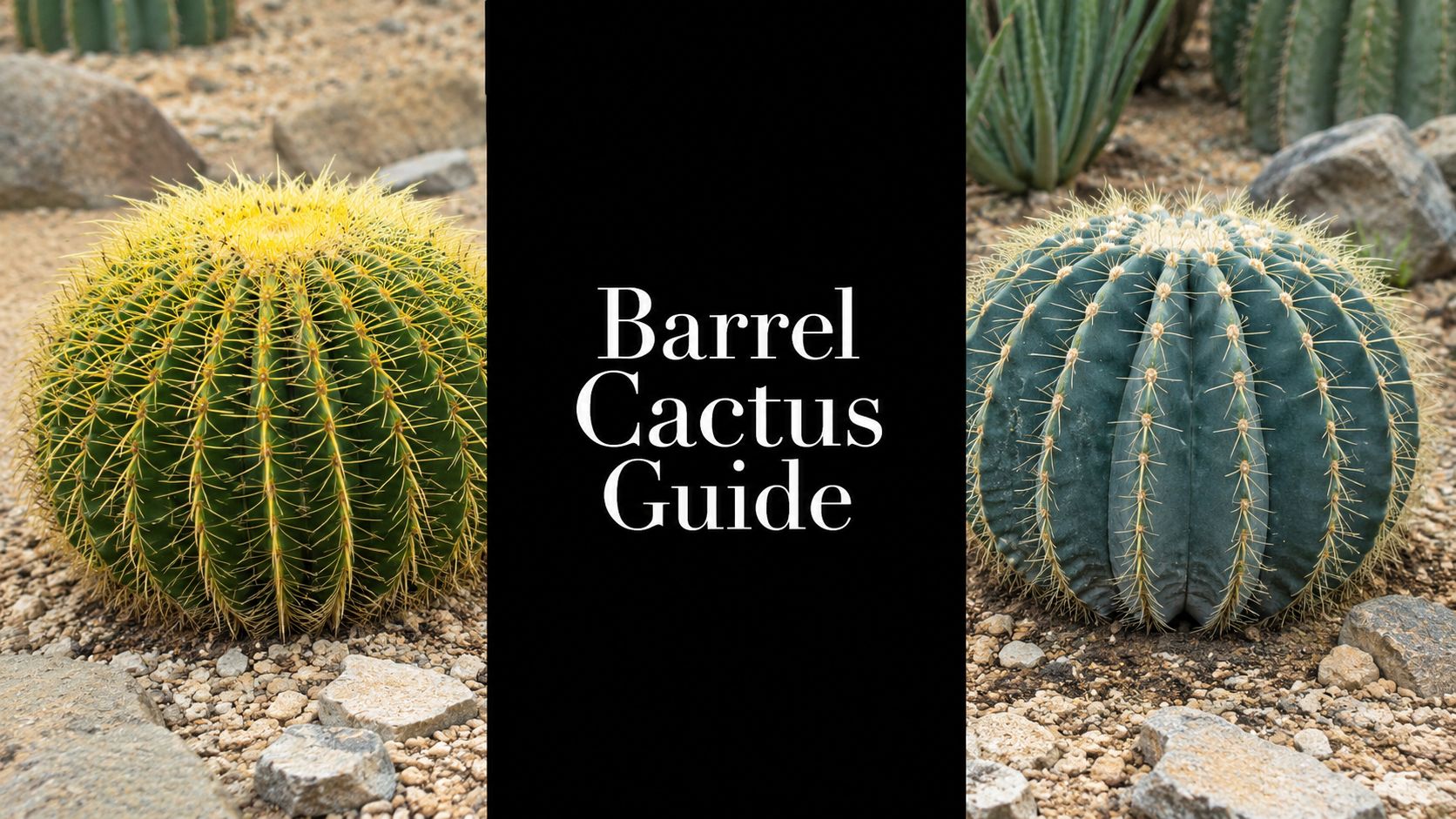
The first reliable distinction is the stem color. Golden barrel has a bright green stem covered with golden-yellow spines. Blue barrel has a blue-green stem and straight, pale yellow spines. The species also belong to different genera, which makes this more than a color variation. Golden barrel is identified as Echinocactus grusonii, while blue barrel is Ferocactus glaucescens, as documented in this barrel cactus variety comparison.
The fastest visual test: Look at the stem color first, then confirm the spine form. Bright green with golden-yellow spines points to golden barrel. Blue-green with pale yellow, straight spines points to blue barrel.
Golden barrel's body has the familiar luminous green appearance that makes its spine color seem almost metallic. The spines create a dense, uniform halo around the ribs, reinforcing the plant's formal, spherical character. Blue barrel has a powdery blue-green or gray-green appearance that creates stronger contrast with pale spines and surrounding dark foliage.
Why genus matters at the point of purchase
A scientific name protects you from vague marketplace language. “Blue barrel” can be used casually for several blue-toned cacti, and photographs can shift color depending on sunlight, camera settings, and surrounding stone. A listing that identifies Ferocactus glaucescens gives you a much safer basis for comparing plants than a common name alone.
Genus also signals that you're comparing plants with different visual habits. Golden barrel is the formal, iconic choice. Blue barrel has the distinct blue-green coloration that makes it useful as a contrast plant in a collection or drought-tolerant border. Spine form should still be checked closely, especially if the cactus will sit near a walkway or patio seating.
How to inspect online product photos
Look for several views rather than relying on a single close-up. A golden barrel should show a consistent bright green stem across the body, while blue barrel should retain a blue-green cast even when photographed from the side. Don't judge color from the spines alone, since golden-yellow and pale yellow can look similar under warm lighting.
Also check whether the product description provides the botanical name. The Cactus Outlet's own barrel cactus comparison article is useful background when you're comparing the two forms before purchasing. For a premium specimen, identification should be clear before you start planning the planting hole.

Mature Size and Growth Rate Expectations
Golden barrel needs a permanent location, even when the young plant looks easy to fit. It grows slowly but can reach about 3 feet tall and 3 feet wide, taking up to 20 years to fully mature in cultivation, according to cultivation guidance for barrel cactus species. Buy an established specimen if you want immediate impact. For a smaller purchase, reserve enough space for its eventual footprint before planting.
An Oklahoma State University description lists golden barrel at about 2.5 feet in diameter and 2 feet in height, which supports the same placement decision. Treat it as a substantial specimen, not a small accent that will vanish among low plantings.
Match the footprint to the design role
Blue barrel takes up less room. NC State's Plant Toolbox describes Ferocactus glaucescens as typically reaching about 2 feet tall and wide. Another succulent reference gives mature stem dimensions of about 22 inches tall and 20 inches in diameter. That smaller form fits a narrow bed, a structured patio container, or a border where several plants must share space.
| Placement | Better fit | Why |
|---|---|---|
| Entry focal point | Golden barrel | Its bright color and rounded form command attention |
| Narrow xeric border | Blue barrel | The smaller footprint leaves more room for companion plants |
| Large gravel courtyard | Golden barrel | It can anchor the composition as a substantial specimen |
| Patio container | Depends on exposure and space | Blue barrel is easier to scale, while golden barrel makes a stronger statement |
| Collector's display | Both | The contrasting stem colors create a deliberate side-by-side composition |
For a container, size the pot around the mature plant and its root mass, then confirm that the site can support the cactus through seasonal exposure. Blue barrel is easier to keep proportionate on a patio. Golden barrel delivers more presence, but it demands more floor space and a container that will remain stable as the plant grows.
Plan groupings before planting
Small groupings look deliberate when each cactus remains visible. Do not place young golden barrels close to a path just because they appear compact. Leave access around the mature footprint, and account for spines at hand and shoulder level.
Blue barrel supports a closer visual rhythm, but close spacing still needs restraint. Set the composition by mature dimensions, then fill open areas with stones, gravel, agaves, or low succulents. If the arrangement depends on matching forms, buy established specimens with similar scale instead of expecting young plants to grow at the same pace.
Cold Hardiness and Climate Thresholds
Zone 9 winter exposure makes species selection a survival decision. Blue barrel is generally the safer choice for a colder inland site, while golden barrel remains the more iconic option and needs a warmer microclimate with less direct frost exposure.
One source lists Texas blue barrel to about 14°F and golden barrel to about 24°F. Other references place golden barrel near 20°F, while they place blue barrel within USDA zones 9 through 11. Another gives blue barrel a range of 9b through 11b. These figures come from different references, so they cannot guarantee survival for every plant, container, or weather event. They still provide a better buying guide than the vague label “cold hardy.”
Cold hardiness at a glance
| Attribute | Golden Barrel | Blue Barrel |
|---|---|---|
| Frequently cited lower threshold | About 20°F to 24°F, depending on the reference | About 14°F in one Texas blue barrel reference |
| USDA zone guidance | Often treated as a warm-climate garden cactus | USDA zones 9 to 11, with one reference listing 9b to 11b |
| Best marginal-climate use | Protected ground planting or sheltered patio | Outdoor candidate for colder inland locations |
| Main caution | Less forgiving in exposed frost-prone containers | Still needs excellent drainage and a suitable microclimate |
Ground planting versus containers
Ground planting usually gives roots more thermal buffering than a raised container, but the planting site still controls the outcome. A barrel in saturated soil during a cold spell faces greater risk than one in gritty, fast-draining soil. Containers expose the entire root zone to air temperatures, and a small patio pot can cool quickly.
For golden barrel, choose a south-facing wall, covered courtyard, or another warm microclimate when frost occurs regularly. Blue barrel gets the edge in colder inland markets. Its relative advantage does not make poor exposure acceptable.
Know when the patio needs protection
If the forecast approaches the lower end of the relevant threshold, move a container to a protected location before the cold arrives. Large specimens can be difficult to relocate, so select a permanent container position with winter protection in mind. For ground planting, keep the cactus away from low spots where cold air and water collect.
The buying rule is direct: buy blue barrel for the safer outdoor margin, and buy golden barrel for the look only when you can provide the better site.
Light, Water, and Soil Needs Compared
Both cacti need a bright, dry setup, but the routine starts before you water. Give each plant full sun, fast drainage, and enough space for air to move around the body. Central Texas Gardener specifically notes full sun for golden barrel, along with its use as a specimen or small grouping near other xeric plants, as reflected in this golden barrel plant profile.
A newly delivered cactus shouldn't go straight from a protected nursery environment into the harshest afternoon exposure. Acclimate it gradually to stronger light, watching the stem rather than forcing a fixed schedule. Blue barrel's blue-green coating suits hot, reflective settings visually, but neither species benefits from careless placement in wet soil.
Build drainage into the planting decision
For containers, use a cactus mix amended with mineral material such as pumice or perlite, and choose a pot with a real drainage opening. Avoid oversized containers that hold damp soil around a relatively small root system. The container should be stable enough for the specimen and positioned where runoff won't collect beneath it.
In the ground, don't treat heavy native soil as acceptable just because the site receives strong sun. Create a raised or sharply draining planting area where needed, and keep the cactus crown above the surrounding grade. A sunny bed with poor drainage is still a poor cactus site.
Water deeply, then wait
Water thoroughly only when the growing medium has dried, then allow excess water to drain completely. During cooler conditions, reduce watering because the plant and soil dry more slowly. Frequent small sips are a poor substitute for a deliberate soak-and-dry routine.
The mistake that kills more barrels than frost: watering on a calendar instead of checking whether the soil has dried completely.
For a fuller routine on placement and seasonal handling, use this golden barrel cactus care guide. The core principle remains the same for blue barrel. Keep the roots dry between thorough waterings, protect the plant from abrupt exposure after delivery, and never let a decorative container turn into a reservoir.
Best Uses for Patios, Containers, and Landscapes
Golden barrel is the statement plant. Its strong spherical outline and bright spine color make it a natural focal point near an entry, in a gravel courtyard, or at the center of a small xeric composition. Central Texas Gardener identifies it as a full-sun specimen that also works in small groupings with other xeric plants, so it earns a prominent position rather than being buried in a mixed border.

Choose by buyer and setting
A homeowner decorating a sunny patio should choose golden barrel when the goal is one unmistakable sculptural centerpiece. Use a substantial, stable planter, keep the cactus away from the main traffic line, and confirm that the container can be protected during unusually cold weather.
Blue barrel fits the patio buyer who wants a cooler color and a less dominant silhouette. Its smaller stated mature scale makes it easier to pair with other container plants, while its relative cold advantage is useful when the patio sits in an exposed inland position.
Designers specifying a drought-tolerant border can use blue barrel as a blue-green counterpoint to warm gravel and green agaves. Golden barrel works better where the design needs a repeated focal rhythm or a bright visual anchor. For clients planning ways to save water with these plants, both choices belong in a broader planting plan built around appropriate exposure and drainage.
Treat spines as a circulation issue
A cactus beside a walkway needs more than attractive spacing. Place the plant where mature growth won't force people to brush past it, and avoid locations beside children's play areas or narrow seating paths. Golden barrel's formal shape can tempt designers to place it too close to an entry, especially when the young specimen looks smaller than its eventual footprint.
Collectors have more freedom. A side-by-side display of green-and-gold golden barrel with blue-green blue barrel can create deliberate contrast without relying on flowers or seasonal color.
Situational insight: Put golden barrel where people stop and look. Put blue barrel where its color can work as structure across the planting bed.
Which Barrel Cactus to Buy for Your Project
There isn't one universal winner. Golden barrel is the better purchase for the buyer who wants the classic premium specimen, especially in a protected area with full sun, sharply draining soil, and enough room for a large rounded form. Its restricted wild distribution also adds conservation significance. The IUCN-estimated extent of occurrence is about 4,500 km², with only 2 to 4 known locations, which is why the species is listed as Endangered; independent references estimate about 11,000 wild individuals and note that only 6% of its historical range remains intact, with 5% inside protected areas and less than 1% outside protected areas. Those conservation figures are summarized in this golden barrel cultivation reference.
Blue barrel is my recommendation for a colder inland setting, a tighter border, or a patio where the plant needs to coexist with other specimens. Its blue-green body gives you stronger color contrast, and the available hardiness guidance gives it the practical edge when winter exposure is the deciding factor.
Use this purchase checklist
- Choose golden barrel for an iconic focal point, generous planting space, and a protected winter position.
- Choose blue barrel for a smaller footprint, blue-green contrast, or a colder inland site.
- Choose a container carefully when the cactus will remain on an exposed patio through winter.
- Choose an established specimen when you want immediate visual impact instead of waiting years for slow growth.
- Choose the location first so delivery, unloading, planting, and future access are planned before the cactus arrives.
For buyers comparing established options online, buying a barrel cactus online is the right starting point. Review the botanical name, stated size, intended placement, and winter exposure before ordering. The Cactus Outlet's barrel cactus collection and large cactus selection support buyers who are planning around delivered specimens rather than starting with small plants.

Choose the golden barrel if your project needs a signature specimen and you can provide full sun, drainage, space, and winter protection. Choose the blue barrel if survivability in a colder or tighter site matters more than the traditional golden look, then visit The Cactus Outlet to compare available barrel cactus specimens for your patio or garden.