

A friend once showed me a tray of cactus seedlings that had collapsed in a sunny window. He thought he'd failed at watering. The harder truth was that he was trying to raise desert babies without the desert shelter they evolved to need.
That's what makes the life cycle of a cactus so fascinating. A cactus does not just sprout, grow, and bloom. It survives a long sequence of hazards, pauses, and slow decisions written into its biology.
A Survivor's Journey The Life Cycle of a Cactus
The most dramatic cactus story belongs to the Saguaro. It can produce up to 40 million seeds in its lifetime, yet only one typically survives to become a fully grown cactus because it needs a nurse tree, such as palo verde, to protect it from sun, freezes, and predators during its fragile seedling stage, as explained in this Saguaro survival overview.
That single fact changes how you see every cactus on a shelf or windowsill. You're not looking at an easy-care ornament. You're looking at the winner of an almost impossible contest.
Why beginners get confused
Most new growers focus on the visible parts of the life cycle. Seed. Tiny plant. Larger plant. Flowers, maybe. What's easy to miss is that the most dangerous stage happens before the cactus looks like a cactus at all.
A seedling in habitat often survives because another plant acts like a bodyguard. It softens the sun, buffers temperature swings, and gives the seedling time to establish. Indoors, people often try to replace that with brighter light, more airflow, or stricter watering. Those choices can make a fragile young cactus fail faster, not grow better.
Practical rule: The youngest cactus in your care usually needs protection before it needs intensity.
That's why many home growers have more success starting with an established plant instead of seed. A rooted juvenile or mature specimen has already passed the most brutal checkpoint in the life cycle of a cactus. It has stored water, stronger skin, and a better chance of tolerating mistakes.
What this means for you
If your cactus isn't growing quickly, that doesn't mean it's unhappy. If a seedling dies, that doesn't always mean you watered wrong. Sometimes the issue is that you were trying to skip the protective stage nature normally provides.
Think of cactus growing less like pushing for fast growth and more like helping a survivor keep its advantage. The best growers don't fight the cactus's pace. They learn why the pace is slow in the first place.
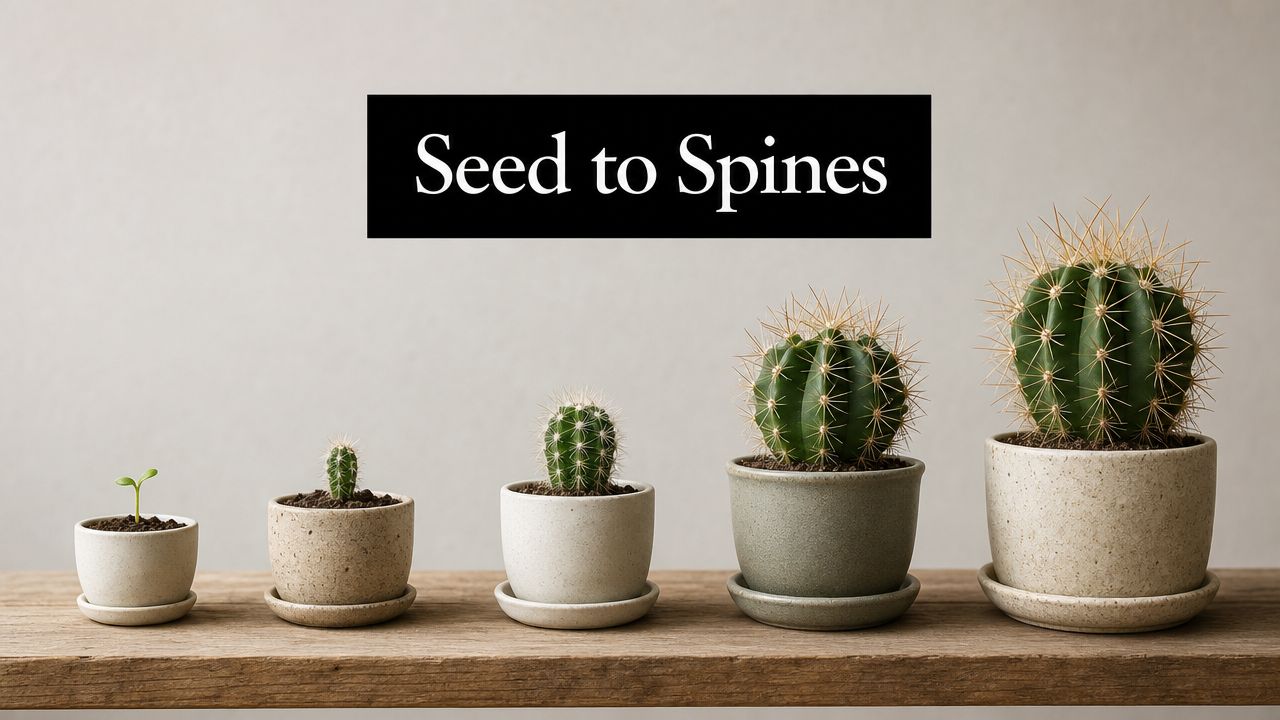
From Seed to Senior The Seven Stages of a Cactus Life
A cactus life is easiest to understand if you stop looking for steady, visible progress and start looking for jobs. At each stage, the plant is solving a different survival problem. First it has to wake up. Then it has to stay alive long enough to store water, harden its skin, reproduce, and age.

If you like seeing plant development as a sequence, this overview of plant growth cycles is a useful companion. Cacti follow the same broad pattern as other plants, but they stretch each phase into a slower, harsher story.
Stage one to three
-
Seed
A cactus starts as a tiny survival capsule. The seed carries a food reserve and a genetic plan for roots, ribs, spines, flowers, and fruit. In habitat, huge numbers of seeds never get any farther than this. That brutal math is part of why raising cactus seedlings at home can feel less like standard gardening and more like assisting a rescue mission. -
Germination
Germination begins when moisture, warmth, and oxygen line up well enough for the seed to break dormancy and send out its first root. Germination timing varies widely by species and conditions. The Missouri Botanical Garden's cactus overview notes the family's wide range of forms and adaptations, which helps explain why no single timetable fits every cactus seed you sow. -
Seedling
This is the most unforgiving stage. A new seedling is soft, small, and poorly equipped for the heat and drying conditions that an older cactus can handle. Growers often expect “desert plant” to mean full sun from day one, but a seedling usually needs filtered light, steady moisture, and protection. In nature, that protection often comes from a nearby shrub or tree acting like a nurse plant. At home, you have to play that role.
A seedling behaves more like a damp green sprout than a miniature adult cactus.
Stage four to five
-
Juvenile
The juvenile cactus starts building its long-term defenses. The root system expands. The stem thickens. Areoles, ribs, tubercles, and spines become more defined. Growth can still look slow, but the plant is putting energy into structure, storage, and toughness. This is the stage many beginners skip by buying an already rooted plant, and there is good sense in that choice. A juvenile has already survived the life cycle's most lethal bottleneck. -
Mature
Maturity means the cactus has enough stored energy and enough physical stability to reproduce. In many species, that is when flowering begins. It is also when one of the cactus family's best water-saving tools matters most. Many cacti use CAM photosynthesis, a system in which stomata open mainly at night so the plant can take in carbon dioxide while losing less water, as explained by the Arizona-Sonora Desert Museum's guide to cactus adaptations. A good beginner comparison is a shop that does deliveries after dark to avoid the midday heat. The work still gets done, but with fewer losses.
Stage six to seven
The final stages focus on reproduction and age.
| Stage | What the cactus is doing | What you'll notice |
|---|---|---|
| Fruiting | Developing seeds after successful pollination | Flowers fade and fruits begin to swell |
| Senior | Slowing, repairing less efficiently, and aging through old tissue | Slower growth, corking, scars, or collapse in older parts |
-
Fruiting
Fruiting is the cactus's second attempt at beating impossible odds. A flower has to open at the right time, attract the right visitor, receive compatible pollen, and then mature seed before drought, heat, or animals interrupt the process. The U.S. Forest Service overview of cactus ecology and pollination describes how bees, bats, birds, moths, and other pollinators help different cactus species reproduce. For a home grower, this stage explains why a cactus can bloom beautifully and still produce no fruit. -
Senior
An older cactus slows down, but age is not a sign that you failed. Senior plants often show corking, weathered skin, and less vigorous growth because they have spent years surviving stress, storing water, and repairing damage. In habitat, reaching old age is an achievement. In a pot, it is a reminder that the plant on your windowsill comes from a lineage built to endure losses on a scale most gardeners never see.
Cactus Timelines Fast Growers and Slow Giants
A beginner buys a young cactus, sets it on a bright windowsill, and waits for the dramatic growth they know from basil, pothos, or tomatoes. Months pass. The plant looks almost the same. With cacti, that stillness is often the story of success, not failure.
That slow pace makes more sense once you remember what a cactus is built to survive. In habitat, the odds are brutal. Out of millions of seeds, only a tiny fraction ever become established plants. A cactus does not grow like a plant expecting comfort. It grows like a plant expecting loss, storing resources, protecting tissue, and waiting for rare chances to expand.

That is why timelines vary so much by species. Some cacti are sprinters by cactus standards. Others are living monuments.
If you want a plant that shows visible progress in a home setup, this fast-growing cactus guide is a useful place to compare species before you buy.
A giant that measures life in decades
The saguaro teaches patience better than any care manual. The National Park Service overview of saguaro growth and lifespan notes that saguaros can live well over a century, and young plants grow very slowly for years. In the wild, many seedlings survive only because a shrub or tree acts as a nurse plant, shading them from deadly sun and buffering temperature swings.
For a home grower, that detail matters. A tiny cactus is not a miniature adult that wants maximum heat and exposure at all times. Early on, it often needs the kind of protection nature usually provides under a nurse tree. That is one reason growing from seed can be rewarding but impractical for many beginners. Starting with an established plant means you skip the most fragile stretch of the journey.
Arms on a saguaro also come late. The famous silhouette people picture belongs to an old plant, not a young one. Waiting for that form is like planting an oak and expecting the shape of a century-old tree in a few seasons.
Smaller species can reward you sooner
Prickly pears live by a different clock. The University of Arizona Cooperative Extension guide to prickly pear cactus describes Opuntia as a faster-growing group that can establish and reproduce much sooner than slow columnar giants under the right conditions.
That does not make them easy in the careless sense. It makes them more practical for gardeners who want to observe clear progress. Pads multiply, clumps form, and flowering can arrive on a timeline a person can witness without waiting decades.
The difference is useful because it resets expectations before frustration takes over.
| Type of cactus timeline | What it feels like to the grower | Best mindset |
|---|---|---|
| Fast grower | Noticeable change within a reasonable home-growing span | Watch for seasonal growth and new segments |
| Moderate grower | Small but visible progress over time | Track firmness, color, and shape |
| Slow giant | Long quiet periods with little obvious change | Measure success in years |
A healthy cactus often changes in subtle ways first. Firmer tissue, steadier color, tighter spine growth, or a new areole can matter more than height.
This is also why cactus growing overlaps so naturally with dry-climate design. In larger plantings, patience and species choice matter just as much as watering habits. If you are curious how that thinking scales up outdoors, this guide to commercial xeriscape savings shows how drought-adapted plants are used with long-term expectations in mind.
The main lesson is simple. Match the plant to your time horizon. If you want to witness the full drama of establishment, flowering, and maturity, choose a smaller or faster species. If you choose a slow giant, respect what you are really buying. A survivor shaped by harsh odds, built to endure more than to perform on command.
How to Care for Your Cactus at Every Stage
A cactus in your home is playing a much easier game than a cactus in the wild. That matters, because the care makes more sense once you remember what the plant is built to survive.
Out in habitat, a cactus seed is up against brutal odds. Most never become established plants at all. A grower at home is trying to do what nature only rarely does. You are standing in for the patch of shade, the protective rock, or the nurse shrub that lets a young cactus survive its weakest years.

Young plants need protection, not toughness
Beginners often expect a baby cactus to enjoy harsh sun and long dry spells right away. That is adult cactus care applied to a plant that has not earned those defenses yet.
A seedling works more like a patient recovering under supervision than a hardened desert veteran. Its roots are small, its skin is thin, and its water reserves are limited. Give it conditions that reduce stress while it builds strength.
- Use bright, softened light so the tissue can photosynthesize without scorching.
- Keep the mix lightly moist, not soggy because tiny roots can dry quickly but also rot quickly.
- Use small, breathable pots such as terracotta when the species dislikes staying wet around the roots.
- Avoid abrupt changes in light, heat, or watering. Young cacti handle consistency better than correction.
At this stage, survival is the win. Slow, steady establishment matters more than visible size gains.
Established plants need wet-dry cycles
Once a cactus is rooted and developed, the care pattern changes. Mature stems store water well, and many species are adapted to conserve moisture by handling gas exchange at night rather than in the daytime, as noted earlier. That is why frequent tiny drinks can backfire. They keep the soil too active while never fully soaking the root zone.
A better pattern is simple. Water thoroughly, let excess drain, then wait until the mix dries appropriately for that species and season.
Grower's shortcut: Check the plant and the soil together. Firm tissue and damp mix usually mean wait.
This is one reason outdoor dry-climate planting works best when the surroundings match the plant's natural habits. If you want to see how that logic applies on a larger scale, this guide to commercial xeriscape savings gives helpful context for why desert-adapted plants perform best when their surroundings support their natural habits.
Stage-by-stage care in plain language
| Stage | Main risk | Best care focus |
|---|---|---|
| Seed and germination | Drying out or fungal problems | Even moisture, warmth, and protection |
| Seedling | Sun stress and dehydration | Filtered light and careful watering |
| Juvenile | Sudden care changes | Gradual increases in light and longer dry periods |
| Mature | Chronic overwatering | Full soak, full drainage, then patience |
| Flowering and fruiting | Stress from relocation or inconsistent care | Stable light, steady routine, minimal disturbance |
| Senior | Weaker roots and slower recovery | Conservative watering and close inspection |
The pattern is easy to miss because the same plant needs different treatment over time. A seedling needs you to act like a nurse tree. A mature cactus needs you to stop hovering.
When starting with a bigger cactus is the smarter choice
Buying an established cactus is not cheating. For many home growers, it is the most practical way to succeed.
A rooted juvenile or mature plant has already passed the stage where one bad watering decision, one hot afternoon, or one damp week can end the story. It can tolerate brighter light, longer dry intervals, and ordinary beginner mistakes far better than a seedling can. If your goal is to learn how a cactus lives over time, an established plant often teaches more because it stays alive long enough for you to observe real change.
That practical choice fits the larger truth of cactus survival. In nature, very few seeds make it. At home, good care means lowering those odds by giving young plants shelter and by respecting when an older plant wants distance.
The Overlooked Key to Health Cactus Dormancy
A lot of cactus advice says winter care is simple. Water less and wait. That's incomplete.
Many cacti need a real dormant period, not just neglect. They undergo true dormancy from October to March, and they need temperatures near 45°F with minimal water to reset their internal clock. Without that rest, they may fail to produce flowers or new growth even when general care seems good, according to this cactus dormancy guidance.
Why room temperature can confuse a cactus
A cactus reads its environment through combined signals. Cooler temperatures, shorter days, and reduced moisture tell it to slow down. If you keep it warm, dim, and occasionally wet all winter, the plant can get stuck in a bad middle ground. It isn't fully growing, but it isn't properly resting either.
That's when growers say things like “It's alive, but it never does anything.”
Winter rest isn't punishment. It's part of the annual cycle that helps many cacti return to active growth well.
A simple winter-rest approach
You don't need a laboratory setup. You do need consistency.
- Move it to a cooler space if your species tolerates that and your home allows it.
- Reduce watering sharply so the roots aren't sitting in cold, wet mix.
- Keep light available because dormancy doesn't mean total darkness for a potted cactus on a shelf or windowsill.
- Resume active care gradually when warmer, brighter conditions return.
Indoor growers often miss the temperature part because “don't overwater” gets repeated more than “provide the right winter signal.” If your cactus hasn't bloomed or seems stalled year after year, dormancy is one of the first things to rethink.
One caution for beginners
Not every succulent sold beside cacti follows the same winter pattern. Always identify what you have before forcing a cool rest. But for true cacti that expect dormancy, this seasonal pause is not optional if you want the plant to stay on its natural schedule.
Creating New Life Cactus Propagation Methods
If starting from seed feels daunting, propagation is the friendlier route. It lets you begin with plant material that has already moved past the most delicate part of the life cycle of a cactus.

For growers who still want to experiment with early-stage plants, this guide to growing succulent seeds offers a useful starting point.
The easiest methods for home growers
Cacti are propagated in two ways:
-
Offsets or pups
Some cacti produce small side growths that can be separated and rooted. -
Stem cuttings
Columnar or pad-forming types, such as prickly pear, are often propagated from a healthy section of stem.
The big advantage is resilience. A cutting is not as vulnerable as a seedling. It already has stored moisture and mature tissue.
How to root a cactus cutting
- Take a clean cutting with a sterile knife or pruners.
- Let the cut surface dry and callous before planting. This step matters because a fresh wound placed straight into soil is more likely to rot.
- Set the cutting into a gritty, fast-draining mix in a stable pot.
- Hold back on heavy watering at first while roots begin to form.
- Increase normal care gradually after the cutting anchors and shows signs of establishment.
Here's a visual walkthrough of the process in action:
Propagation works because you're starting with stronger material, not because cacti are effortless.
If you want the satisfaction of creating a new plant without gambling on extremely fragile seedlings, propagation is often the smartest entry point.
Embracing the Slow and Steady Cactus Journey
The life cycle of a cactus rewards a different kind of attention. Noticing it means caring about small changes, long pauses, and stage-specific needs instead of expecting constant visible growth.
A cactus begins as a vulnerable seed, passes through a precarious young phase, settles into a slow-building juvenile period, and eventually reaches maturity, flowering, fruiting, and old age. Along the way, its needs change. Young plants need shelter. Established plants need restraint. Many species need a proper winter rest to stay on schedule.
That opening image of a Saguaro producing vast numbers of seeds while only one usually reaches full maturity gives the whole subject its proper scale. A cactus is not casual life. It is concentrated persistence.
When you keep one well, you're not forcing it to grow faster than nature intended. You're helping it move through a long story with fewer avoidable setbacks. That mindset makes cactus growing calmer, more observant, and much more rewarding.
If you're ready to start with a healthy, established plant rather than the riskiest stage of the journey, The Cactus Outlet is a practical place to explore a wide range of cacti and succulents for home collections, gifts, and garden projects.