

You're probably here because you want a cactus that looks great on a shelf or windowsill, asks for very little, and doesn't leave you guessing every time you hold a watering can. Then you start shopping and run into a wall of names, shapes, spines, and advice that seems to contradict itself.
That confusion is normal. “Cactus” sounds like one simple category, but indoor cactus plants types cover everything from round, spiny desert classics to soft, trailing holiday bloomers that barely look like a typical cactus.
I talk to new plant buyers about this all the time in nursery settings. One person wants a small cactus for a bright office. Another wants something sculptural for a living room corner. A third wants a plant that feels collectible without becoming fussy. The right choice depends less on picking the prettiest plant in the lineup and more on matching the plant to your light, your routine, and your goal.
Choosing Your First Indoor Cactus
A customer once stood in front of a bench of cacti for ten minutes, then finally said, “I want the easiest one, but I also want it to look interesting.” That sums up most first-time buyers perfectly.

The first good decision isn't choosing a species. It's deciding what job you want the cactus to do in your home. Are you a beginner who wants a forgiving starter plant? A decorator who wants shape and texture? A collector who enjoys differences in form, spines, and growth habits? Once that's clear, the choices get much easier.
If you want a simple starting point, a nursery guide to best cactus for indoors can help you narrow the field before you buy. It's much better to shortlist a few suitable plants than to bring home something dramatic that doesn't fit your room.
Start with your real-life goal
Most buyers fit into one of these groups:
- Beginner: You want a cactus that stays manageable, tolerates the occasional missed watering, and won't demand constant monitoring.
- Decorator: You care most about shape, silhouette, and how the plant works with furniture, pottery, and sunlight in the room.
- Collector: You notice details. Ribbing, pads, spine patterns, and unusual growth forms matter to you.
Practical rule: Don't buy your first cactus by name alone. Buy it by matching its growth style to your space and your habits.
What usually confuses new owners
People often assume all cacti like exactly the same care. They don't. Some want hard sun and very dry soil. Others prefer bright filtered light and a different watering rhythm. That's why one person says cacti are effortless and another says theirs always stretches or rots.
The easiest way to remove that confusion is to learn the two big cactus worlds first. Once that clicks, the rest starts to make sense.
Understanding the Two Worlds of Cacti
The cactus family is huge. The Cactaceae includes about 127 genera and roughly 1,750 known species, according to Wikipedia's cactus overview. For indoor growers, the most useful shortcut isn't memorizing all those names. It's learning the split between desert cacti and jungle cacti.

Desert cacti
Think of desert cacti as sunbathers. These are the classic forms often pictured first. Round barrels, upright columns, ribbed stems, and noticeable spines all fit here.
Examples often recommended for homes include Prickly Pear (Opuntia), Barrel Cactus (Ferocactus), Saguaro (Carnegiea gigantea), Golden Barrel Cactus (Echinocactus grusonii), and Bunny Ears Cactus (Opuntia microdasys). They usually store water in thick stems and prefer conditions that feel bright, dry, and airy.
Desert types tend to work well for:
- Sunny windowsills
- Minimalist interiors
- People who tend to over-care for leafy houseplants and want something slower
Jungle cacti
Jungle cacti are the surprise category for many beginners. They're still cacti, but they don't always look like the stereotype. Their stems can appear flatter, softer, or more segmented.
The best-known example indoors is Christmas Cactus (Schlumbergera). It belongs to the cactus family, but visually it feels closer to a hanging plant than a desert specimen. That's why new owners often care for it better by accident. It doesn't look like something that wants blazing sun all day.
Jungle cacti break the “all cacti are spiny desert plants” myth. Once you know that, many care instructions stop sounding contradictory.
Why this split matters in a home
If you put a desert cactus in a dim corner, it often starts stretching toward light and loses its compact form. If you treat a jungle cactus exactly like a harsh-desert specimen, you can stress it in a different way. The point isn't that one is hard and one is easy. The point is that each type comes from a different setting.
Another helpful detail is size and form. Indoor and ornamental cacti can range from tiny globe-shaped plants to columnar species that become tall outdoors. Some stay compact enough for a shelf for a long time, while others are better thought of as long-term statement plants.
A simple way to remember it
Use this nursery shorthand:
- Desert cactus: built like a water tank
- Jungle cactus: built like a forest hanger or branch dweller
That one distinction helps you choose more intelligently than any label that just says “cactus.”
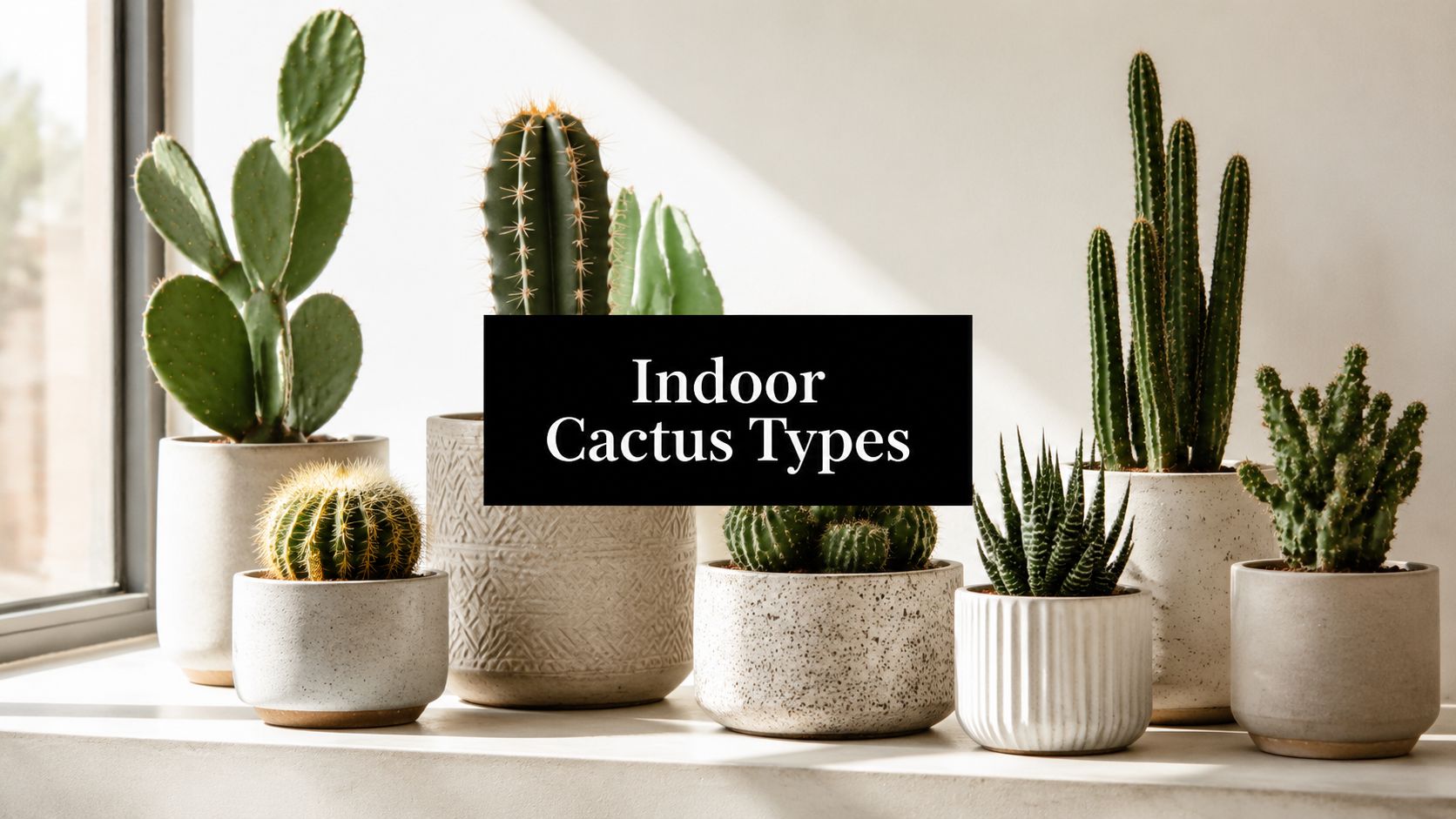
Popular Indoor Cactus Types for Your Home
Once you know the two broad groups, choosing among indoor cactus plants types becomes much less random. Instead of shopping by impulse, you can shop by purpose.
Best options for beginners, decorators, and collectors
Some plants earn their place because they're straightforward. Others are popular because they create a strong visual line in a room. A few appeal most to people who enjoy variety and subtle differences.
Here's a quick comparison first.
Quick Guide to Popular Indoor Cacti
| Cactus Name | Light Needs | Watering | Best For |
|---|---|---|---|
| Bunny Ears Cactus (Opuntia microdasys) | Bright spot with lots of sun | Let soil dry well between waterings | Beginners who want a playful shape |
| Golden Barrel Cactus (Echinocactus grusonii) | Very bright light | Infrequent watering | Decorators who want a sculptural look |
| Barrel Cactus (Ferocactus) | Bright, sunny placement | Sparse watering | Buyers who like a classic cactus form |
| Prickly Pear (Opuntia) | Strong light | Water, then let dry thoroughly | Collectors who enjoy pad growth |
| Christmas Cactus (Schlumbergera) | Bright, gentler light | More regular than desert types | Homes with filtered light |
| Saguaro (Carnegiea gigantea) | Very bright light | Infrequent watering | Collectors and long-term growers |
Bunny Ears Cactus
This one is memorable right away. The pads grow in pairs, so the plant looks cheerful and slightly cartoonish. It's a natural pick for people who want a cactus with personality.
For a beginner, Bunny Ears often works because its shape tells you a lot. If the pads are compact and balanced, the plant is usually happy. If growth starts leaning or spacing out, it's asking for better light.
Best fit:
- Sunny desk or kitchen sill
- Small apartments
- Gift giving
A caution from nursery life: people focus on the cute shape and forget the tiny glochids. Those fine bristles can be irritating, so place it where hands won't brush it casually.
Golden Barrel Cactus
Golden Barrel is one of the cleanest design plants in the cactus world. It's round, ribbed, and symmetrical, with a strong visual rhythm. In a simple ceramic pot, it can carry a whole tabletop arrangement.
This is often the decorator's cactus. It brings structure without looking busy. It also reads clearly from a distance, which matters in larger rooms.
Best fit:
- Modern interiors
- Minimal styling
- People who want one plant with strong form
A good design plant doesn't need to be large. A compact Golden Barrel can still anchor a vignette if the pot and light placement are right.
Barrel Cactus
“Barrel cactus” is a broader look as much as a single shopping idea. These plants have the familiar round-to-cylindrical form many buyers expect. They feel classic, sturdy, and unmistakably cactus-like.
Choose this type if you want the textbook desert aesthetic. It works especially well in terracotta, stoneware, or any pot that complements a dry, sun-loving look.
Best fit:
- Traditional cactus lovers
- South- or west-facing windows
- People who prefer simple care rhythms
Prickly Pear
Prickly Pear has a bolder, more architectural look than many small rounded cacti. The pads stack and branch in a way that feels lively, even when the plant is young.
Collectors often like Opuntia because each plant develops character over time. Decorators like it because the silhouette is easy to read from across the room. Beginners can grow it too, as long as they respect the spines or glochids and don't crowd it into a dark corner.
Best fit:
- Statement shelves
- Bright entry areas
- People who enjoy watching visible new growth
Christmas Cactus
Christmas Cactus is the odd one out in the best way. It softens the whole idea of cactus ownership. Instead of hard spines and a desert look, you get segmented stems and a more relaxed feel.
This is often the right plant for someone who says, “I like cacti, but my home doesn't get hard sun all day.” It also suits people who want something with a friendlier look on a side table or hanging planter.
Best fit:
- Filtered-bright rooms
- Holiday gifting
- People who prefer softer plant shapes
Saguaro
Saguaro carries a lot of visual history. Even in small form, it gives a strong desert identity. Indoors, it appeals most to collectors and patient growers who enjoy iconic species and understand that dramatic outdoor stature isn't the same thing as indoor life.
This isn't usually the first recommendation for a casual buyer. It's more of a “grow with it over time” plant.
Best fit:
- Collectors
- Brightest available space
- Long-term plant keepers
Essential Cactus Care and Soil Needs
Good cactus care is less about doing a lot and more about doing a few things correctly. Most failures come from one mismatch. Too little light, soil that stays wet too long, or watering on a fixed schedule instead of checking the plant first.

Light
Most indoor cacti need serious brightness. A helpful guide from Gardenia on indoor cactus varieties notes that most indoor cacti thrive with at least 6 hours of sun daily and prefer temperatures around 60°F to 80°F. The same guide explains that low light often causes etiolation, where the plant stretches unnaturally toward a light source.
In plain terms, a cactus in weak light doesn't stay neat and compact. It starts reaching. That's the plant telling you the location is wrong.
A practical habit helps a lot:
- Use your brightest window: Desert types want the strongest light you can give them.
- Rotate the pot: Weekly rotation helps prevent one-sided leaning.
- Watch the body shape: New growth should look sturdy, not thin and drawn out.
Here's a helpful video if you want a visual refresher on care basics.
Water
Cacti don't want “no water.” They want the right pattern of water. For desert types, the safest rhythm is a soak-and-dry approach. Water thoroughly, then wait until the mix has dried well before watering again.
Jungle cacti don't follow that exact script. They still need drainage, but they usually appreciate a less severe dry-down than a desert cactus. That's why people get mixed results when they treat every cactus the same.
Grower's note: If you're unsure whether to water today or wait a bit longer, waiting is usually safer for a desert cactus in a pot.
Soil
Soil is where many new owners lose otherwise healthy plants. Regular potting soil can stay wet too long around cactus roots. What you want instead is a mix that drains quickly and holds air.
A detailed guide to best soil for potted cactus is worth reading before you repot. You don't need to make cactus growing complicated, but you do need to respect drainage.
Look for these qualities:
- Gritty texture: The mix shouldn't feel dense or muddy.
- Fast drainage: Water should move through instead of lingering.
- Stable structure: The plant should sit firmly without the mix compacting into a heavy mass.
Potting and temperature
Pot choice matters almost as much as the mix. A pot with drainage is the default. Without it, you're trying to grow a drought-adapted plant in a trap for excess moisture.
Many indoor cacti sold for home use are kept in small pots, and that suits them well. A cactus usually does better slightly snug than swimming in a large container full of wet soil. Keep temperatures steady, avoid abrupt cold drafts, and pay attention to seasonal slowdowns rather than forcing year-round growth.
Finding the Perfect Spot in Every Room
Placement is where plant care becomes interior design. A cactus can survive in one room and look at home in another. Those aren't always the same thing, so it helps to think about both.

Living room
A bright living room is where taller or more sculptural cacti make sense. This is the room for strong silhouette. A columnar cactus or a well-grown barrel type can act almost like living sculpture near a bright window.
Use a heavier pot if the plant has visual height. It improves both stability and style. If the room is bright but not harshly exposed all day, a Christmas Cactus can also work on a side table where you want a softer shape.
Kitchen
Kitchens often have excellent windowsills because the windows are unobstructed and easy to access. Small desert cacti do especially well here if the light is strong. Bunny Ears and compact barrel forms fit naturally into this space.
Good kitchen cactus spots share a few traits:
- Bright sill space: The plant gets real sun, not just ambient room brightness.
- Safe distance from traffic: You don't want spines catching sleeves while cooking.
- Easy visibility: A cactus in a kitchen is easier to monitor because you see it every day.
Bedroom and office
Bedrooms and offices need more honesty. If the light is weak, a desert cactus usually isn't the right choice, even if the decor would look great with one. In those cases, it's smarter to choose from other easy care low light house plants rather than forcing a sun-loving cactus into a dim setup.
If your office has a sunny window, though, a compact cactus is excellent. It stays tidy, doesn't ask for much, and adds structure without feeling leafy or overgrown.
The best room for a cactus isn't the room where you want one most. It's the room where the plant can keep its natural shape.
Bathroom
This surprises people, but some bathrooms can suit jungle cacti well if there's bright light. A Christmas Cactus often feels more at ease there than a desert cactus would, especially if the room gets filtered brightness and a bit more ambient moisture.
Bathrooms without a good window are a different story. In that case, treat the room as decoration space, not cactus space.
How to Propagate and Grow Your Collection
Once your first cactus settles in, it's hard not to want another. Propagation is a satisfying next step because it turns one healthy plant into several, and it teaches you how the plant grows.
Propagating from pads
Opuntia types, including Bunny Ears and many Prickly Pears, are the easiest to understand because the pads almost explain the process on their own. You remove a healthy pad, let the cut dry and callus, then place it in a suitable rooting medium.
The callusing step matters. Planting a fresh, wet cut too soon invites problems. Patience here is part of the job.
A simple sequence looks like this:
- Choose a healthy pad: Avoid damaged or stressed growth.
- Let the cut dry: Give it time to form a dry callused surface.
- Set it into a well-draining mix: Keep conditions bright and stable while roots develop.
Separating offsets
Some cacti produce offsets, often called pups. These are small side growths that can eventually become independent plants. When they're developed enough to handle on their own, you can separate them carefully and pot them up.
This method feels less intimidating because you're not making a cutting from scratch. You're dividing a plant that has already started forming its own body.
If you want a fuller walkthrough, this guide on how to propagate cactus from cuttings lays out the process clearly.
Propagation rewards restraint. Most mistakes happen because people rush the cut, the potting, or the first watering.
Growing your collection with intention
Try not to collect the same form over and over unless that's your hobby on purpose. A more satisfying home collection usually includes contrast:
- One rounded cactus for compact shape
- One pad-forming cactus for character
- One jungle cactus for a softer texture
That mix gives you a fuller feel for the range of indoor cactus plants types without turning your home into a guessing game of identical care labels.
Troubleshooting Common Cactus Problems
A cactus usually tells you what's wrong with its body shape before it declines completely. If you learn to read those signs, you can correct course early.
Stretching and leaning
If a cactus starts looking thin, pale, or stretched, light is the first suspect. This kind of growth is often called stretching or etiolation. The plant is trying to reach for stronger light and losing the compact shape you wanted.
Move it to a brighter location and rotate it consistently. Weak growth rarely firms back up, but healthier new growth can improve the overall shape over time.
Mushy base or yellowing
This usually points to too much water, slow-draining soil, or a pot that holds moisture too long. Many indoor cacti are sold in small 2-inch to 4-inch pots, and they do well with infrequent watering. A useful indoor care guide from Joy Us Garden also recommends a winter rest with night temperatures around 46-50°F and minimal water to prevent weak, leggy growth.
If the base is soft, act quickly. Stop watering, check the root zone, and repot if the mix is staying wet. If the damage has gone too far, propagation of healthy parts may be the best recovery move.
Shriveling or stalled appearance
A cactus that looks deflated may need water, but don't jump too fast. Shriveling can mean underwatering, though root trouble can create a similar look because the plant can't take up moisture properly.
Check the mix, the pot weight, and the roots if needed. Healthy cactus care is never just “water more” or “water less.” It's matching water to light, soil, season, and plant type.
Winter confusion
A slower cactus in winter isn't always a sick cactus. Seasonal rest is normal. What gets people into trouble is continuing summer habits when light is lower and growth has slowed.
If your cactus looks stable, firm, and compact, doing less is often the right move.
If you're ready to choose a cactus that fits your room and your routine, The Cactus Outlet offers cactus plants, care supplies, and species information that can help you compare options before you buy. It's a practical place to browse whether you want a compact indoor plant, a larger statement cactus, or the basics for potting and care.