
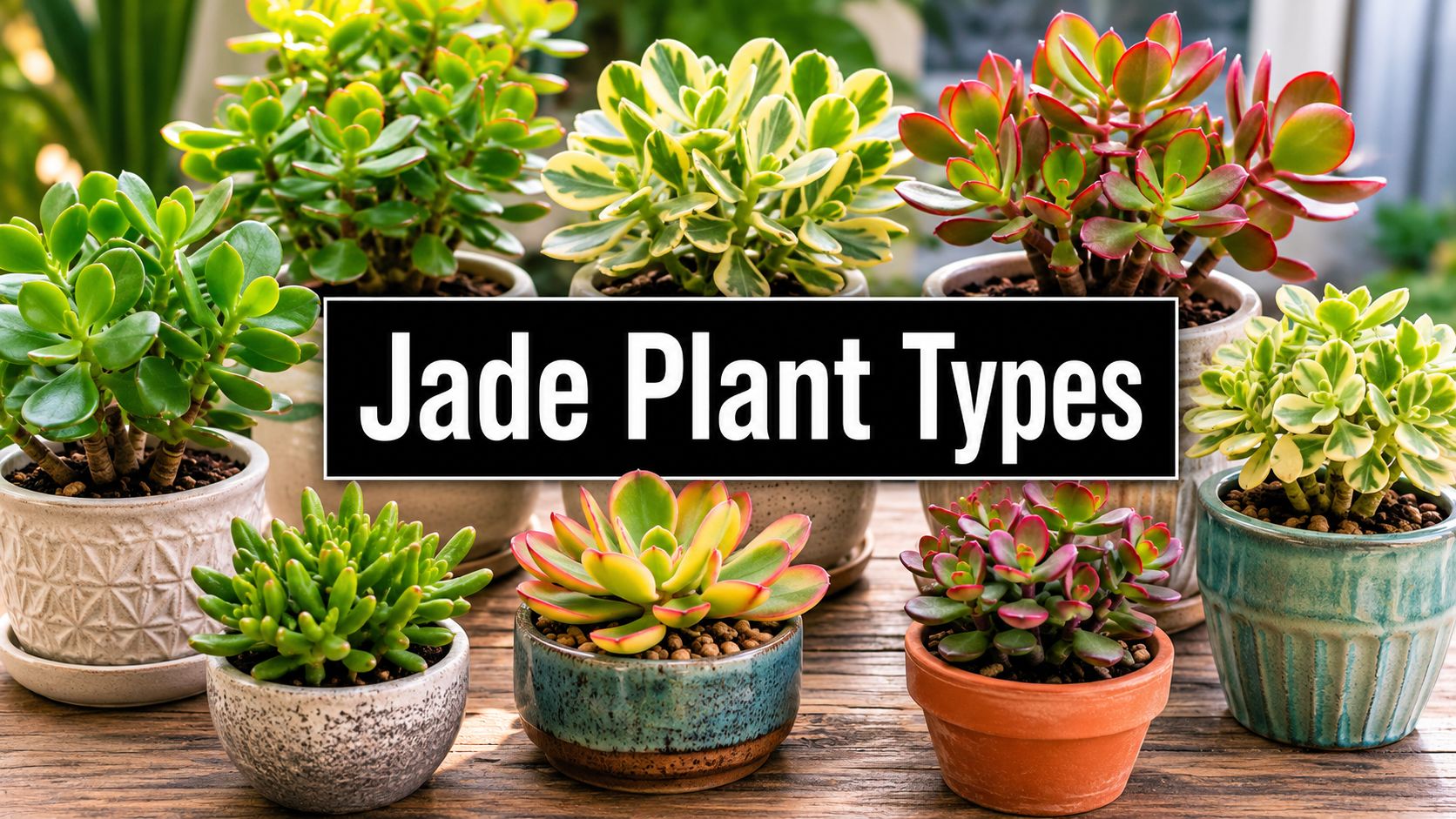

Think all jade plants look the same? That assumption causes more bad buys than bad watering. People shop for “a jade plant,” bring home whatever's in stock, then wonder why one stays compact, another stretches, and a third never develops the color that made it attractive in the first place.
Crassula ovata is a single species, but it sits inside a much larger Crassula genus that botanical references describe as containing about 300 species, and the plant itself has produced a deep bench of cultivars and sports rather than one uniform market form, as noted in the Crassula ovata overview. That distinction matters. When comparing crassula ovata varieties, you're usually not choosing different basic care systems. You're choosing different shapes, sizes, color responses, and display roles.
Most roundups list names, but they don't help you decide which one is best for your shelf, your patio pot, your bonsai bench, or your bright window. So this guide does exactly that. It focuses on seven standout crassula ovata varieties and pairs each one with a practical use case, from bonsai training to small-space growing to color-first collecting. If you're styling a room and want companion greenery that works with your furniture as well as your light, these Gates Home Furnishings plant recommendations are a useful place to start.
1. Crassula ovata ‘Hummel's Sunset' (Golden Jade)
Best for buyers who want the strongest leaf color response from a jade and have the light to support it.

Want a jade that does more than stay green? ‘Hummel's Sunset' is the one I point buyers toward when the goal is color first, especially for a south-facing window, bright sunroom, or patio container that gets real sun.
Reputable nursery references describe ‘Hummel's Sunset' as a named cultivar with green leaves that develop yellow to gold tones and red edging under strong light, which gives it a much broader color range than standard jade, as described in this named jade cultivar guide. In plain terms, this is the best choice in the lineup for buyers who want their plant to change character with the season and exposure.
Light decides whether this cultivar earns its spot. In bright conditions, the foliage picks up the warm gold-and-red contrast that makes people buy it in the first place. In average indoor light, it usually settles back toward greener growth and looks much closer to a standard jade.
That trade-off matters.
If the plant will live on a dim desk, skip this one and buy a green cultivar that keeps its shape without depending on stress color. If the plant will sit where it gets strong sun for part of the day, ‘Hummel's Sunset' is often worth the premium.
I also like it for growers who want to shape a colorful specimen over time. It keeps the woody branching and sturdy framework that make jade useful for training, and it roots readily from pruned pieces if you want to start backups or make more plants. For that, a practical guide to growing succulents from cuttings helps.
Where ‘Hummel's Sunset' earns its place
This is not the best pick for the lowest-maintenance corner of the house. It is one of the best picks for a bright spot where color is part of the job.
Practical rule: Buy ‘Hummel's Sunset' for high light and color payoff. Buy plain green jade for lower-light reliability.
Real trade-offs
- Best use: Bright windows, sunny entryways, and color-focused container displays where warm foliage tones stand out.
- What works: Strong light, restrained watering, and occasional pruning to keep growth compact and the branching attractive.
- What doesn't: Dim placement or heavy watering if your goal is dense growth and clear yellow-red contrast.
- Outdoor note: Treat it as a tender succulent unless your climate stays warm and frost-free.
2. Crassula ovata ‘Gollum' (Tolkien Group)
Best for a sculptural, modern look in containers.

Need a jade that reads more like a piece of design than a traditional houseplant? ‘Gollum' is usually the right answer. The tubular leaves, narrowed tips, and upright branching give it a clean, graphic look that standard jade rarely matches.
This cultivar earns its keep in rooms where shape matters more than fullness. On a shelf, console, or patio table, it has presence even before it gets large. I recommend it to buyers who want one plant to act as a focal point rather than background greenery.
Why buyers choose ‘Gollum'
Among crassula ovata varieties, ‘Gollum' stands out for form first. The care is still straightforward jade care, but the visual effect is completely different. You get a plant that looks deliberate in simple pots and pairs especially well with modern interiors, gravel top dressing, and restrained container groupings.
There is a trade-off. ‘Gollum' usually stays more open and linear than classic green jade, so it does not build that broad, heavy canopy as quickly. For some growers, that is the whole appeal. For others, it can read sparse unless the plant gets enough light and occasional pruning.
If your plan is to shape a specimen over time, this one is satisfying to work with. It develops woody stems, responds well to tip pruning, and pruned pieces are easy to root if you want extras. A practical succulent propagation guide from cuttings is useful if you want to turn one plant into several.
Best fit and limits
- Best for: Modern containers, statement plants, and growers who want unusual leaf form over a classic jade silhouette
- What works: Bright light, careful watering, and selective pruning to keep the shape compact and the red leaf tips more visible
- What doesn't: Low light or a goal of fast fullness. Standard green forms usually look denser sooner
- Care reality: It is still a tender succulent. Protect it from frost and cold, wet conditions
3. Crassula ovata ‘Hobbit'
Best for bonsai style in a small indoor footprint.

‘Hobbit' sits close to ‘Gollum' in the market, but they don't perform quite the same visually. ‘Hobbit' has spooned, curled, concave leaves rather than the more trumpet-like tubes of ‘Gollum'. That gives it a denser, more compact appearance, especially in smaller pots.
For buyers who want something quirky but still tree-like, ‘Hobbit' is often the better call. It develops woody structure with age and responds well to shaping, so it suits people who want a bonsai feel without starting with a difficult species.
Why I'd pick ‘Hobbit' over ‘Gollum' in some rooms
Some spaces need a plant that reads softer and fuller. ‘Gollum' can be almost coral-like. ‘Hobbit' usually feels more rounded and grounded.
That difference matters on desks, side tables, and mixed succulent displays where balance is more important than novelty. Planet Desert's general care summary also describes Crassula ovata as a woody, multi-stemmed succulent with a mature size around 6 feet tall by 3 feet wide, USDA hardiness in zones 9 to 12, and dormancy in fall and winter, which helps explain why even compact cultivars eventually benefit from pruning and thoughtful placement, as outlined in this jade plant care and growing guide.
Keep expectations realistic. Compact doesn't mean permanently tiny. It means slower, tighter, and easier to style in a pot.
Trade-offs that matter
- Best for: Windowsills, bonsai trays, and buyers who like the Tolkien-group look but want a denser silhouette.
- What works: Bright light and occasional pruning to maintain a miniature-tree form.
- What doesn't: Dim placement for long stretches. Like other selected forms, color and compactness soften when light drops.
- Buying note: This one is common enough to find easily, which is helpful if you want to compare several starter plants in person.
4. Crassula ovata ‘Crosby's Compact'
Best for small spaces that still need a classic jade look.

A lot of people searching crassula ovata varieties don't want novelty. They want the familiar look of a jade plant, just in a form that won't outgrow a tabletop quickly. That's where ‘Crosby's Compact' earns its place.
This cultivar keeps the broad identity of classic jade, but with a dwarf, tighter habit and proportionally smaller leaves. It looks tidy sooner and asks for less corrective pruning than standard green forms.
The quiet advantage of a compact classic
Not every room benefits from a dramatic cultivar. In traditional interiors, offices, or mixed succulent bowls, ‘Crosby's Compact' often fits better because it doesn't dominate. It behaves like a restrained version of the jade people already know.
The practical upside is maintenance. Compact branching means fewer awkward gaps, fewer long internodes, and less waiting for the plant to “look finished.”
- Best for: Tabletops, narrow shelves, and miniature bonsai displays where proportion matters.
- What works: Using standard jade care while taking advantage of a naturally denser structure.
- What doesn't: Expecting fast size. A compact form usually trades speed for neatness.
- Buyer caution: Availability can be inconsistent, so it's worth buying when you see a well-shaped specimen.
Who should skip it
If your goal is a large statement plant, this isn't the right route. Start with a standard jade or a stronger upright selection instead. ‘Crosby's Compact' is about discipline, not scale.
5. Crassula ovata ‘Variegata' (Tricolor / Variegated Jade)
Best for statement foliage in bright interiors.

Want the jade variety that reads as décor even before it puts on size? ‘Variegata' is usually the one.
Cream, yellow, and blush-pink tones break up the heavy green look of standard jade, so the plant stands out on a shelf or console table without needing a large pot or an elaborate container. For buyers choosing between novelty and everyday performance, this is one of the clearest trade-offs in the group. You get stronger visual contrast, but you give up some toughness and speed.
Why ‘Variegata' suits display-first growers
This cultivar is best bought for placement, not potential. A well-colored, well-shaped plant already looks finished, which matters because variegated jades usually grow more slowly and can lose impact fast in poor light. I recommend it for bright rooms where the foliage can stay crisp and the pink edging has a chance to show.
Light quality matters more here than with solid green forms. Bright exposure keeps the color defined, but harsh reflected afternoon heat can mark the pale sections first.
Grower's note: If the cream areas start looking dull and the stems stretch, the plant is telling you it wants more light. If the pale patches look scorched or papery, back it off the hottest window.
If you're building around one showpiece plant and want easy companions that won't compete with it, this guide to easy indoor succulents for bright homes is a useful next read.
Best uses and drawbacks
- Best for: Accent pots, bright entry tables, and collectors who want color contrast more than fast bulk
- What works: Strong light, careful placement, and buying a specimen with a good branch structure from the start
- What doesn't: Dim rooms, neglected rotation, or intense window heat on summer afternoons
- Growth reality: It usually fills in more slowly than green jade, so paying more for a nicely shaped plant often makes sense
6. Crassula ovata ‘Minima'
Best for desks, gift plants, and low-pruning miniature form.

‘Minima' is the answer when the full-size species feels too big and even compact forms still look a bit bulky. The leaves are noticeably smaller, the internodes stay tighter, and the plant reads like a scaled-down jade without a lot of intervention.
For gift shoppers, this is one of the more useful crassula ovata varieties because it naturally suits small containers. It looks finished in a modest pot instead of looking like a cutting waiting to grow up.
Why ‘Minima' works in real homes
Many people want a bonsai-like jade but don't want to prune constantly. ‘Minima' gets you closer to that miniature-tree effect by default. In bright light, it can also develop red edging, which gives it enough color interest without pushing fully into variegated-territory sensitivity.
This is also a cultivar where naming confusion matters. Online sellers sometimes blur true Crassula ovata dwarfs with other small succulents that get marketed as “mini jade.” Verify the botanical name before buying.
- Best for: Desktop pots, small terracotta planters, and neat giftable arrangements.
- What works: Bright light and patience. This is a plant for controlled form, not fast volume.
- What doesn't: Assuming every “mini jade” listing is the same plant.
- Practical upside: It usually needs less clipping to keep a miniature silhouette.
One buying habit that saves frustration
Always compare leaf shape and branching pattern against the seller's listing photos and name. With small jade types, mislabeling is common enough that careful buyers avoid a lot of disappointment just by checking the botanical tag before checkout.
7. Crassula ovata ‘Botany Bay'
Best for a classic jade specimen with stronger red edging.

If you like the traditional jade silhouette but want more color response and better branching, ‘Botany Bay' is a smart middle ground. It keeps the recognizable money-tree profile while showing vivid red margins in bright light and cooler conditions.
That makes it especially useful for patio containers, entry pots, and larger indoor specimens where you want a classic look with a little extra definition.
Where ‘Botany Bay' beats trendier cultivars
This isn't the cultivar people buy for novelty. They buy it because it looks like a refined version of the jade plant they already trust. Strong branching gives it a more finished specimen quality than many starter plants sold under the generic “jade” label.
The bigger issue with this one isn't care. It's availability. ‘Botany Bay' is less universally stocked than ‘Gollum' or ‘Hobbit,’ so larger, well-shaped plants tend to move fast when they appear.
A practical point often overlooked in jade buying is outdoor placement. Authoritative horticultural guidance describes Crassula ovata as a tender succulent that reliably grows outdoors only in frost-free warm areas, and plants may need acclimation to avoid sunburn while overwatering can lead to leaf drop or rot, as explained in the NC State Extension plant profile for Crassula ovata.
Don't buy ‘Botany Bay' for year-round outdoor use unless your climate and microclimate genuinely support tender succulents.
Who it suits best
- Best for: Specimen containers, patios in mild regions, and buyers who want a polished classic jade.
- What works: Bright exposure, careful acclimation, and a pot that gives the branching room to show.
- What doesn't: Cold, wet outdoor placement in winter.
- Good reason to choose it: It looks traditional without looking plain.
Comparison of 7 Crassula ovata Varieties
| Plant Variety | Care complexity (🔄) | Resource needs (💡) | Growth speed (⚡) | Expected appearance & impact (📊) | Key advantages (⭐) |
|---|---|---|---|---|---|
| Crassula ovata ‘Hummel's Sunset' (Golden Jade) | Low, forgiving; good for beginners | Bright light for golden color; warm, not frost-hardy (USDA ~9–10) | Moderate, roots quickly from cuttings | Golden-yellow leaves with red margins in strong sun; winter blooms | Reliable indoor performer; strong ornamental color |
| Crassula ovata ‘Gollum' (Tolkien Group) | Low, easy houseplant | Bright light for tip reddening; compact space needs; frost-tender | Slow to bulk up vs. standard jades | Tubular, suction-cup tipped leaves; architectural, quirky look | Unique form for containers/bonsai; budget-friendly |
| Crassula ovata ‘Hobbit' | Low, tolerant of lower indoor light | Accepts lower indoor light better than many succulents; frost-tender | Moderate | Spoon-shaped, concave leaves with red-tipped margins | Compact, bonsai-friendly; widely available |
| Crassula ovata ‘Crosby's Compact' | Low, very manageable | Standard jade culture; stays small in pots | Slow | Dwarf, neat classic jade appearance; fine branching | Naturally compact, minimal pruning for tabletop use |
| Crassula ovata ‘Variegata' (Tricolor) | Moderate, needs careful light management | High ornamental light to maintain variegation; prone to sunburn | Slow | Cream/green variegation with pink blush in strong light, high visual impact | Striking accent specimen for containers/interiors |
| Crassula ovata ‘Minima' | Low, easy to care | Bright light for red edges; ideal for 4–6" pots; verify ID when buying | Slow | Very small rounded leaves; true dwarf bonsai look | Excellent for desktop/small-planter bonsai; low pruning |
| Crassula ovata ‘Botany Bay' | Low–Moderate, benefits from cool, bright conditions | Bright/cool conditions enhance red margins; available in larger sizes seasonally | Moderate | Tidy upright habit with vivid red leaf edges in cool light | Strong branching and specimen presence; good landscape/container sizes |
How to Choose the Right Crassula Ovata Variety
The easiest mistake with crassula ovata varieties is buying for the photo instead of the placement. Most of these plants share the same broad jade fundamentals. They like strong light, dislike staying wet, and reward patience. The main difference is how each cultivar uses that light and space.
If you want vivid foliage, start with ‘Hummel's Sunset'. It's the clearest color-first option in this group, but only if you can give it the bright exposure that keeps the gold and red tones active. If your room is decent but not exceptional for light, the standard green type or a compact green selection will usually satisfy you longer than a stressed color cultivar.
For unusual form, ‘Gollum' and ‘Hobbit' are the obvious picks, but they serve different tastes. ‘Gollum' is sharper, stranger, and more architectural. ‘Hobbit' is denser and more tree-like. If you're planning a bonsai-style plant for a windowsill, I'd usually lean ‘Hobbit'. If you want a conversation piece in a clean modern pot, ‘Gollum' has more visual punch.
Space should drive the next cut. ‘Crosby's Compact' and ‘Minima' are the practical answers for desks, shelves, and small containers. They don't ask you to fight the plant's genetics just to keep it in scale. That's a major advantage over buying a standard jade and pruning it constantly.
Variegated jade is the right choice when contrast matters more than speed. It can be one of the most attractive forms in a bright room, but it's not the one I'd hand to someone who forgets placement and rotates plants into darker corners. ‘Botany Bay' suits buyers who want a more traditional specimen with improved color edging and a stronger finished structure.
Crassula ovata itself is widely grown worldwide as a houseplant because of its low-water needs and tolerance of indoor conditions, and mature plants can live for a very long time, which is part of why the best specimens become long-term fixtures rather than disposable décor, as noted earlier in the linked botanical references. That's the right mindset for choosing one. Don't pick the most unusual cultivar by default. Pick the one you'll still enjoy after the novelty wears off and the plant settles into your actual growing conditions.
At The Cactus Outlet, healthy structure matters as much as the label. A well-grown jade with the right form for your space will usually outperform a trendier cultivar chosen for the wrong conditions.
If you're ready to add one of these crassula ovata varieties to your collection, browse The Cactus Outlet for quality succulents, larger statement plants, and practical care resources that help you choose the right jade for your light, space, and style.