

A lot of homeowners in hot, dry climates start in the same place. The lawn looked good for a season or two, then summer hit hard, the irrigation bill climbed, and the grass began doing that familiar patchy fade from green to tan. You water more, mow more, reseed more, and still end up with a yard that feels like work.
That's usually the moment desert garden design starts to make sense. Not as a fallback, and not as a yard full of gravel and one lonely cactus, but as a better design choice for the climate you live in. A strong desert design has shape, contrast, bloom cycles, wildlife value, and a calmer maintenance routine. It can look sharper in July than a lawn ever will.
Beyond the Lawn Embrace a Thriving Desert Landscape
Step outside in late July. The sun is hard, the pavement is throwing heat, and a tired lawn looks like it is losing an argument with the climate. A well-planned desert yard handles that same afternoon with stronger structure, better seasonal color, and far less upkeep.
That is why more property owners in hot, dry regions are replacing turf with desert-adapted planting. The goal is not sacrifice. It is a better-looking yard that fits the place, holds up through summer, and avoids wasting water on plants that were never suited to the site. Choosing non-invasive species matters too. A plant that behaves well in a nursery pot can become a maintenance problem, or an ecological problem, once it escapes into washes and open ground.

What replaces the lawn
A good desert yard uses shape, spacing, and texture to do the work grass never could. An agave can hold the center of a bed. Low shrubs soften the edges. Grasses add movement. Flowering perennials bring short bursts of color right where people will notice them from the walk, patio, or front windows.
What tends to work best in dry climates:
- Strong forms like agave, yucca, sotol, and columnar cacti that give the yard structure all year
- Blue, gray, and silver foliage that reads clean in bright sun and pairs well with stone and gravel
- Seasonal bloomers that deliver color in waves instead of demanding a constant show
- Mineral-based finishes such as boulders, decomposed granite, and crisp edging that make the planting look settled and intentional
Practical rule: The best desert plants for landscaping do more than tolerate heat. They look right in it.
A common assumption is that a desert yard will feel empty. That usually comes from bad plant spacing, too much bare rock, or a random plant mix with no repetition. The best ones feel calm, sculptural, and finished. They also age better than turf-heavy yards because the bones of the planting stay visible even between bloom cycles.
Why this approach lasts
Turf demands constant correction. Desert planting rewards planning.
The trade-off is simple. You spend more time choosing the right plants, placing them well, and setting up irrigation correctly at the start. After that, the routine gets lighter. Maintenance usually means selective pruning, occasional cleanup, and checking that emitters are delivering the right amount of water. It does not mean chasing a green lawn through extreme heat.
Plant choice is what separates a good result from a disappointing one. Native and climate-adapted plants usually settle in faster, need fewer interventions, and support a yard that belongs in the region. For a closer look at how plant selection should match heat, drought, and local conditions, see this guide to choosing plants for climate adaptation.
Done well, a desert yard is not a compromise. It is a sharper, more resilient way to build a beautiful living area in a dry climate.
Matching Plants to Your Climate and Soil
Buying plants before reading your site is where most desert planting projects go off track. A plant can be healthy at the nursery and still fail in your yard if the winter lows, reflected heat, drainage, or irrigation pattern don't match what it needs.
The first job is to look at your property like a contractor would. Not as one big yard, but as several smaller conditions.

Read the site before you shop
Use this short checklist before you buy anything:
- Climate zone: Know your USDA hardiness zone or local equivalent. Heat tolerance alone isn't enough if a plant can't handle your winter lows.
- Sun exposure: Track which areas get full sun, filtered light, or reflected afternoon heat from walls and pavement.
- Drainage: Desert plants usually tolerate poor soil better than wet soil. Slow drainage is a significant danger.
- Water grouping: Put plants with similar irrigation needs together so one valve doesn't overwater half the bed.
- Microclimates: The west side of the house, a courtyard, and the north fence line can behave like different gardens.
A fast way to check drainage is a simple percolation test. Dig a hole, fill it with water, and watch what happens. If the water lingers far too long, that area needs a different plant choice, grade adjustment, or soil strategy before you install anything sensitive to wet feet.
For a broader look at how plant choice changes by region and weather pattern, this guide to climate adaptation for cacti and succulents is a useful planning reference.
Soil matters more than people think
Most failed desert plantings aren't caused by heat. They're caused by roots sitting in soil that stays wet too long. That's especially common in amended planting holes that act like bowls, low spots that collect runoff, and heavy clay that was never addressed.
If your soil drains slowly, don't assume you can fix everything by adding more organic matter. For many desert species, the better move is to improve grading, avoid over-digging, and choose plants that can live with your actual soil conditions instead of the conditions you wish you had.
Wet roots kill more desert plants than dry weather does.
Choose plants that fit your region, not just your taste
This is the part many plant guides skip. Some desert-looking ornamentals behave well in one climate and become a problem in another. According to this desert native landscaping overview, recent studies from the International Union for Conservation of Nature indicate that some widely used ornamental succulents and cacti, including certain Opuntia and Agave species, have become invasive in places like Australia and southern Europe, where they outcompete native flora.
That doesn't mean you should avoid all non-natives. It means you should verify the exact species or cultivar against regional invasive-plant databases before planting at scale.
A responsible shortlist looks like this:
- Confirm the species name: “Prickly pear” or “agave” is too broad to assess risk.
- Check local watch lists: Regional guidance matters more than general internet advice.
- Avoid impulse mass planting: A plant that spreads aggressively in one district can become expensive to remove.
- Favor regionally proven options: If a species has a long, stable record in local outdoor settings, that's useful information.
The best desert plants for landscaping should solve two problems at once. They should fit your yard, and they shouldn't create a future ecological mess outside it.
Building Your Landscape with Plant Layers
The easiest way to build a desert garden that looks finished is to stop thinking in single plants and start thinking in layers. Every strong garden layout has a floor, a middle, and a set of focal points. When those layers are missing, the yard usually looks scattered no matter how good the individual plants are.
Start with the ground plane
Groundcovers and low-spreading plants tie the whole design together. They also reduce the amount of bare open soil that tends to collect weeds and make a bed look unfinished.
Good choices for this role include:
- Ghost Plant for pale rosettes and a softer, trailing habit in protected spots
- Echeveria where you want tidy geometry in containers or smaller garden pockets
- Desert Marigold if you want a looser, more naturalistic look with seasonal color
Use low growers in drifts, not dots. One plant repeated several times usually looks stronger than six unrelated small plants scattered through gravel.
Add structure in the middle layer
Many outdoor designs either gain depth or fall flat here. Mid-height plants create the visual bridge between groundcovers and larger accents.
Reliable middle-layer options often include:
- Red Yucca for arching foliage and flower spikes that break up rigid shapes
- Texas Sage when you need a shrub that reads as a mass rather than a specimen
- Brittlebush for silver foliage and a softer rounded form against angular succulents
This layer does a lot of design work. It hides irrigation lines, softens boulders, and gives your eye a place to rest between stronger forms.
Use accent plants sparingly
Accent plants are the punctuation marks of a desert environment. They don't need to be everywhere. In fact, overusing dramatic plants is one of the fastest ways to make a yard look chaotic.
The strongest accents are usually:
- Agave for broad, sculptural rosettes
- Yucca for upright, spiky structure
- Barrel Cactus for compact geometry and visual weight
- Peruvian Apple Cactus when you want vertical emphasis
Place these where they can be seen from key angles. Entry walks, the end of a path, or a view from inside the house usually matter more than filling every empty corner.
Use screening plants with discipline
For privacy or background structure, shrubs and small desert trees do more than cacti alone. A hedge or screen should look calm and repeated, not like a collector's shelf.
Better screening usually comes from:
- Texas Sage in repeated rows or staggered groupings
- Ocotillo where a lighter, more transparent screen fits the style
- Desert Willow if you want shade, movement, and a more open tree form
Top Desert Plant Picks by Landscape Use
| Plant Name | Type | Mature Size | Sun Needs | Water Needs |
|---|---|---|---|---|
| Agave | Accent specimen | Medium to large rosette | Full sun | Low |
| Barrel Cactus | Accent specimen | Compact to medium | Full sun | Low |
| Peruvian Apple Cactus | Vertical accent | Tall and upright | Full sun | Low |
| Red Yucca | Mid-layer perennial | Clumping, medium height | Full sun | Low |
| Texas Sage | Shrub or screen | Medium to large shrub | Full sun | Low |
| Brittlebush | Mid-layer shrub | Medium shrub | Full sun | Low |
| Ghost Plant | Groundcover succulent | Low and spreading | Full sun to part sun | Low |
| Echeveria | Groundcover or container | Small rosette | Bright light to sun | Low |
| Desert Marigold | Flowering ground layer | Low to medium | Full sun | Low |
| Desert Willow | Small tree or backdrop | Small tree form | Full sun | Moderate once establishing |
A desert landscape usually looks expensive when the plant palette is restrained, not when it's crowded.
What usually doesn't work
A few combinations routinely disappoint:
- Too many isolated specimens: Every plant competes for attention and the bed loses rhythm.
- All spikes, no softness: Agaves and cacti need contrast from mounding shrubs or finer foliage.
- Tiny nursery plants spaced too far apart: The yard can look empty for years unless you plan for mass and scale.
- Random plant collecting: Interesting species don't automatically create a good composition.
When people ask for the best desert plants for landscaping, they're often really asking which plants help a yard feel coherent. The answer is almost always tied to function and placement, not just species.
The Stars of the Show Choosing Cacti and Succulents
Cacti and succulents do something most plants for outdoor areas can't. They create form that reads clearly from a distance. A lawn fades into the background. A strong agave, a barrel cactus, or a columnar cactus shapes the entire scene.
That's why these plants carry so much of the visual identity in dry-climate gardens.

Saguaro for permanence
The Saguaro is less a filler plant and more a long-view decision. It lends an outdoor space instant regional character and works best where there's room to respect its scale. It shouldn't be crowded by busy companion planting.
Use it as a landmark. One well-sited Saguaro has more impact than a cluster of unrelated accents.
Peruvian Apple Cactus for vertical drama
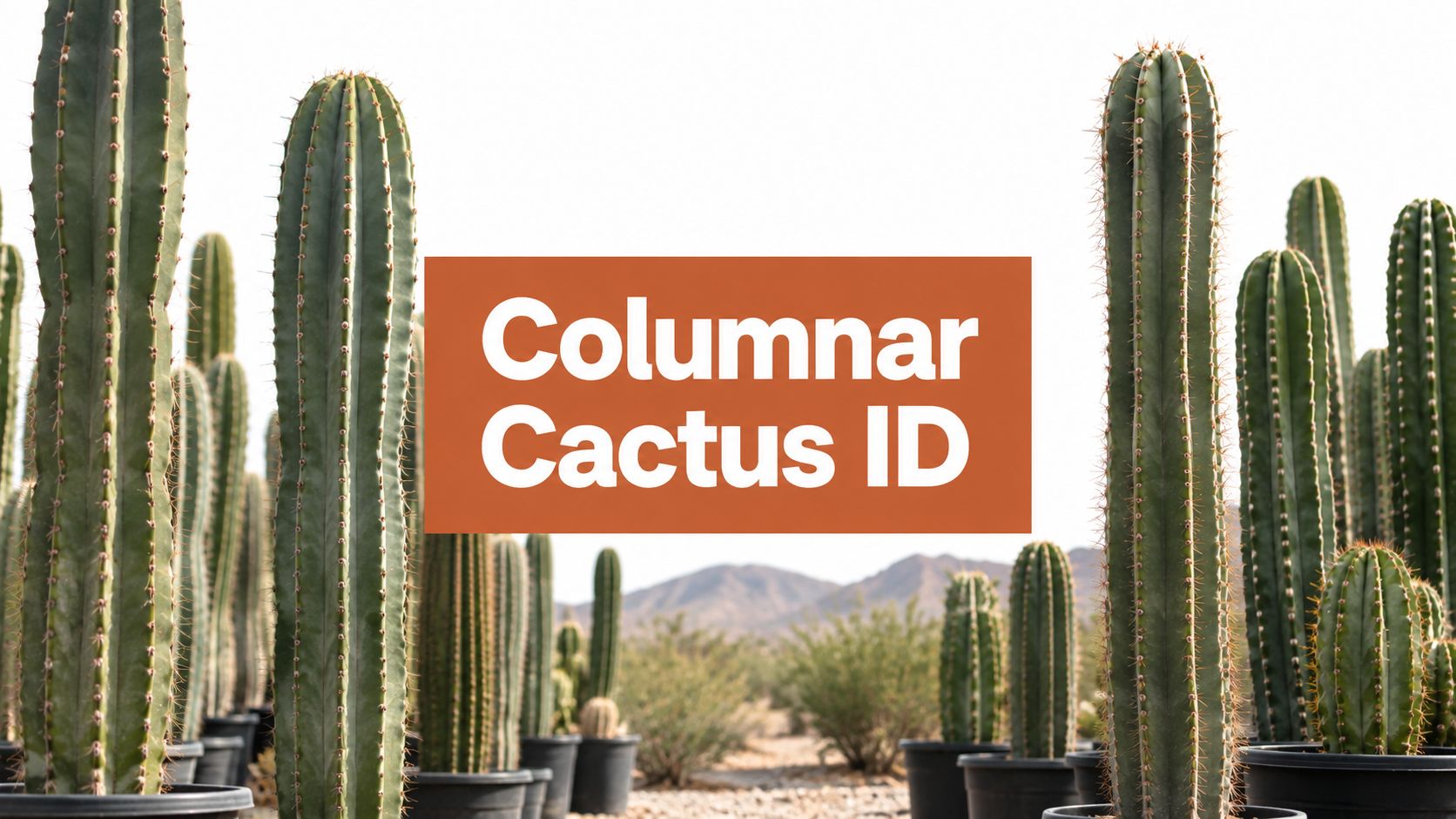
If you want height faster and a cleaner modern silhouette, Peruvian Apple Cactus is often easier to work into residential design. It adds upright rhythm near walls, gates, and corners where the eye needs a vertical line.
It also pairs well with broad rosettes. That contrast between column and disc is one of the most reliable combinations in desert design.
Agave and Aloe for sculpture
Agave gives you discipline. The geometry is sharp, the rosette is readable from every angle, and the plant anchors gravel gardens beautifully. Aloe softens the mood a bit. It still has structure, but many aloes bring a more relaxed leaf line and can work especially well near patios, entry courts, and containers.
For gardeners comparing shapes, growth habits, and design roles, this overview of types of succulents and cacti is a practical place to narrow the options.
Match the form to the job
A simple way to choose among iconic plants:
- Choose columnar cacti when the space needs height, direction, or a visual stop.
- Choose agaves when the bed needs a focal point with year-round definition.
- Choose barrel cacti when you want compact repetition and strong foreground form.
- Choose aloes near living areas where a slightly softer look fits better.
Here's a useful visual example of how those forms come together in a cactus-focused garden:
What to watch before planting
Not every striking succulent belongs everywhere. Some agaves are all structure and no forgiveness near a walkway. Some cacti are perfect in open gravel beds but awkward next to seating areas or pool decks. Scale matters too. A dramatic specimen can disappear in a large yard or overwhelm a small courtyard.
The safest approach is to choose one dominant architectural type per bed, then support it with contrasting but quieter plants. That keeps the composition clean and gives your eye a clear focal point.
Desert Garden Design and Inspiration
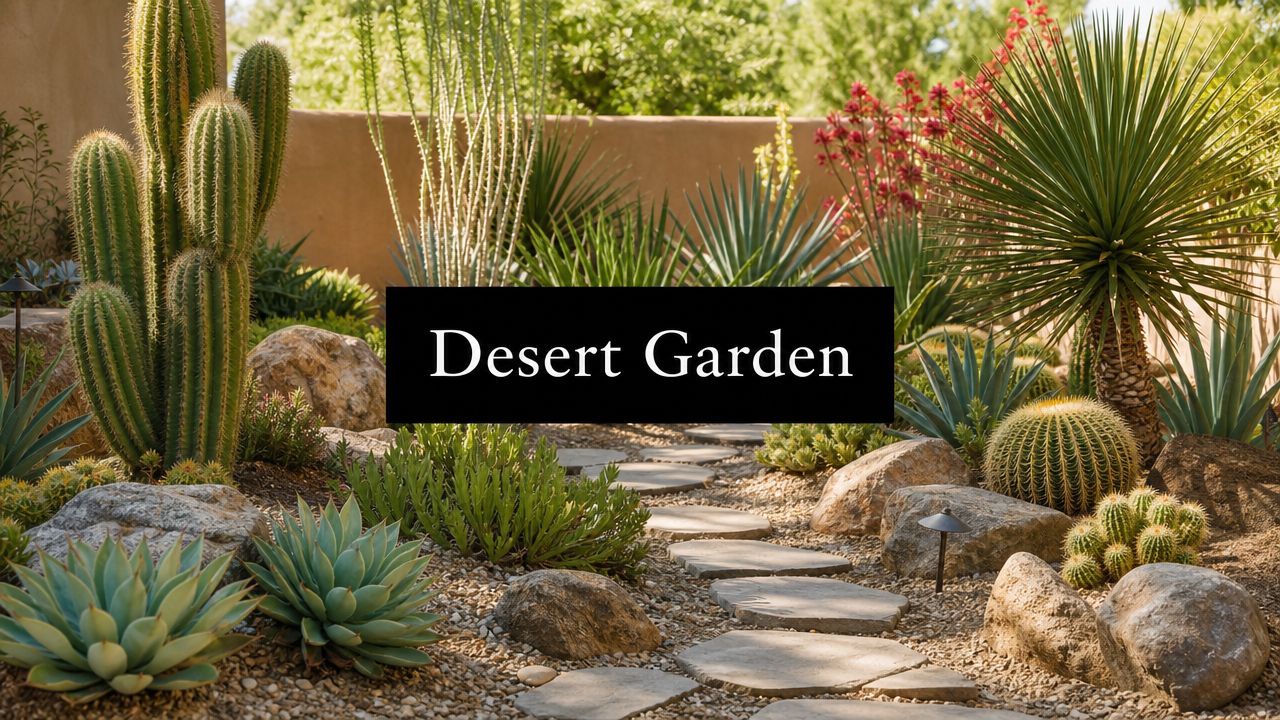
A desert area gets interesting when you treat it like outdoor design, not plant storage. The same species can feel modern, natural, lush, or restrained depending on how you group them, what surface materials you use, and how much empty space you leave.

The modern minimalist yard
This style uses fewer plants, but each one carries more weight. Think bold agaves, one or two columnar cacti, clean gravel planes, and sharp path lines. Boulders are used sparingly. Repetition matters more than variety.
This look works best when the planting palette is disciplined. Too many species breaks the effect.
The lush oasis look
Some homeowners want desert performance without the sparse aesthetic. That's where layered planting earns its keep. Use larger shrubs, repeated succulents, and flowing forms to create fullness while still respecting water use and heat tolerance.
A lush-feeling desert yard often includes:
- Strong foreground plants with sculptural leaves
- Mounding fillers that soften edges and blur hard transitions
- Flowering perennials placed in concentrated pockets rather than sprinkled everywhere
- Shade moments created by small trees, walls, or overhead structures
Soft texture next to a spiny focal plant is one of the oldest tricks in desert design, and it still works.
The native meadow approach
This style feels looser and more seasonal. Instead of a formal arrangement, it leans into rhythm, movement, and bloom cycles. Native shrubs, desert wildflowers, and natural stone can make the space feel tied to the surrounding environment rather than imposed on it.
This is also where planning tools help. If you're trying to visualize layout options before planting, ai landscape design software can help you test pathways, plant massing, and overall style direction before you commit to materials and spacing.
The non-plant details that finish the job
The best desert plants for landscaping need a setting that supports them. Bare rock alone won't do it.
Use these elements with purpose:
- Decomposed granite paths to direct movement and define usable space
- Boulders to ground the planting and create scale transitions
- Low lighting to cast shadows across agaves, cacti, and textured walls
- Simple edging so the design looks deliberate instead of drifting into the hardscape
A desert yard becomes memorable when the forms, materials, and spacing all agree with each other.
Planting and Caring for Your Desert Garden
Plant selection gets the attention, but installation determines whether the garden settles in or struggles. Most desert plants don't want pampering. They want correct planting depth, oxygen around the roots, and a watering pattern that teaches them to grow into the site.
Planting without creating problems
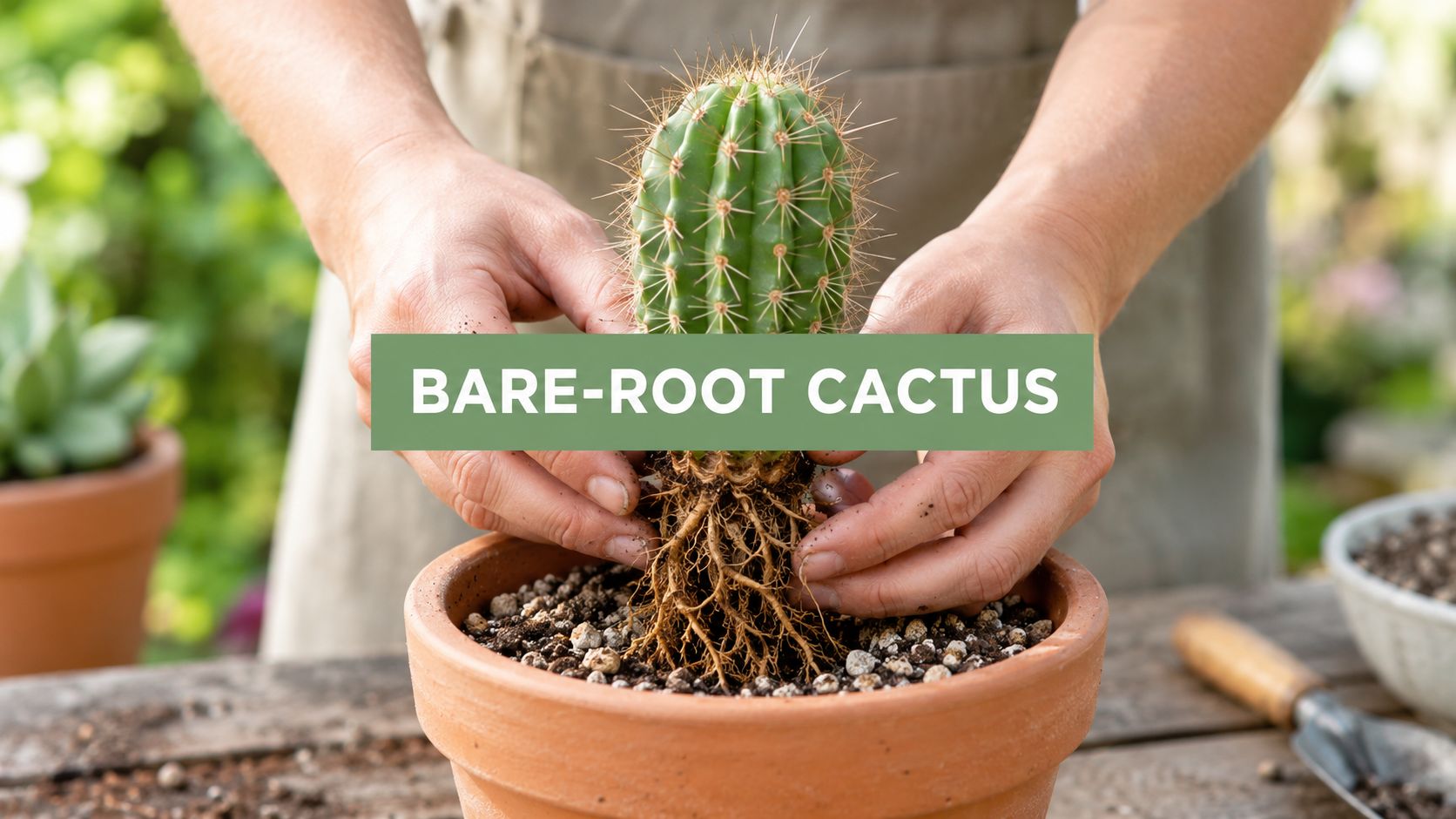
Dig the hole wider than the root ball, but not deeper. If the plant sinks below grade, water collects where the stem meets the soil, and that's a common starting point for decline. Keep the crown slightly proud of the surrounding soil if your drainage is even mildly questionable.
Avoid turning the planting hole into a pocket of soft amended soil surrounded by harder native ground. That can trap moisture right where you don't want it. In many desert sites, simple backfill and good grading beat over-correction.
For step-by-step outdoor installation basics, this guide on how to plant succulents outdoors is a useful companion.
Water deeply, then back off
This is the habit that separates resilient desert plantings from stressed ones. According to this desert plant irrigation guidance, research on Sonoran desert shrubs shows that deep, infrequent irrigation during establishment, such as every 7–14 days in summer, promotes deep root growth, while shallow, frequent watering creates weak surface roots and more drought stress. The same source notes that properly established desert natives can reduce overall water demand by 30–50%.
That pattern makes sense in the ground. If you water lightly every day, roots stay near the surface where soil dries fastest. If you water thoroughly and let the soil cycle down, roots move outward and deeper.
Move irrigation away from the trunk as the plant matures. Water where the roots are going, not just where the plant started.
Routine care that actually helps
Once the garden is in, the maintenance list is shorter than many people expect:
- Prune selectively: Remove damaged growth, shape lightly, and avoid turning natural forms into tight balls.
- Go easy on fertilizer: Many desert plants don't need rich feeding to look good.
- Watch for overwatering signs: Yellowing, limp new growth, and constantly damp soil are more concerning than a brief dry spell.
- Adjust emitters over time: Mature root systems spread beyond the original root ball, so irrigation should spread too.
What usually kills desert plants
The usual culprit is root rot, not neglect. It often starts with one of three mistakes. Planting too deep, watering too often, or placing a drainage-sensitive species in the wrong soil. Gardeners sometimes react to a stressed plant by watering more, which speeds up the decline.
If a plant looks tired, check the soil before you touch the valve. In desert environments, restraint is often better care than intervention.
Sourcing Your Plants and Getting Started
A desert yard usually succeeds or fails before planting day. The biggest difference is often plant sourcing. Good design depends on getting the right species, the right size, and clean identification, especially if you want a yard that looks intentional, holds up in heat, and does not create future problems with invasive plants.
Generic garden centers can work for basics, but they often fall short on desert material. Labels may be broad, stock may be pushed for quick sale, and two plants with similar form can have very different cold tolerance, mature size, or drainage needs. I would rather see a homeowner buy fewer plants from a desert-focused supplier than fill a yard with mismatched material they will be removing in two years.
A specialist nursery is often the better choice for columnar cacti, mature agaves, large aloes, and other structural plants that set the tone of the space. Those plants are not just decoration. They establish scale, create rhythm, and give a desert garden the strong character that makes it feel better than a thirsty lawn, not like a compromise.
For online sourcing, a retailer like The Cactus Outlet carries large cacti and succulent plants, including familiar choices for desert outdoor spaces such as Saguaro, Peruvian Apple, Euphorbia, Agave, and Aloe. A focused catalog makes it easier for homeowners, designers, and contractors to choose plants that fit a real plan, while staying mindful of long-term performance and ecological responsibility.
Start small if needed. A few well-placed, climate-appropriate plants in the right soil will outshine a rushed install every time.