

How do cacti survive in the desert? It really comes down to mastering three core tactics: hoarding water in specialized stems, defending it fiercely with sharp spines, and breathing at night to prevent moisture loss. This triple-threat strategy makes them the ultimate desert survivalists, perfectly equipped for some of the harshest environments on Earth.
Unpacking the Cactus Survival Blueprint
Think of a seasoned survivalist getting ready for a trip through an unforgiving landscape. They’d bring a huge canteen, wear protective gear, and have a smart plan for conserving every drop of energy and every last resource. That’s pretty much how a cactus operates, using a whole suite of highly specialized adaptations to conquer extreme heat and drought.
Where other plants might shrivel up and die within days of the last rain, cacti are built for the long haul. Their entire structure is a masterclass in water conservation, from their roots all the way up to their skin. When you start to understand this blueprint, you see not just a tough plant, but a brilliant piece of natural engineering.
Let’s break down the key elements of their survival strategy:
- Ingenious Water Storage: We'll look at how their fleshy, pleated stems act like living accordions, expanding to hold incredible amounts of water.
- Fortified Defense Systems: You'll see how spines and waxy skin team up to guard precious moisture from thirsty animals and the scorching sun.
- Strategic Night Breathing: We’ll uncover the unique process of CAM photosynthesis, a clever trick that lets cacti breathe without drying out.
The diagram below really brings these three pillars of cactus survival—water management, defense, and respiration—to life.
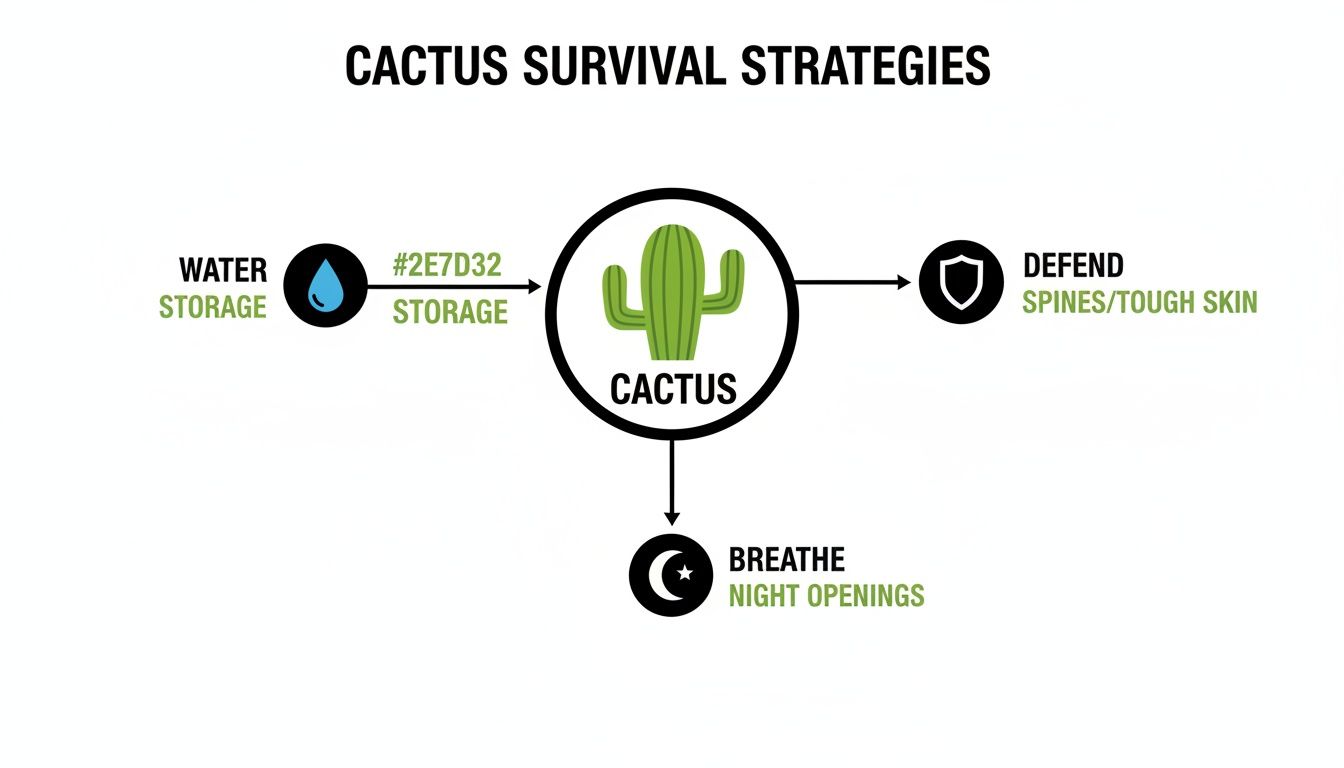
As you can see, each function—storing water, defending that water, and breathing efficiently—is deeply interconnected. Together, they form a complete system for thriving where little else can.
Cactus Survival Mechanisms at a Glance
To give you a quick overview, the table below summarizes the core survival mechanisms we'll be diving into. Think of it as a cheat sheet for appreciating the genius of cactus design. Each adaptation plays a vital role, contributing to the plant's incredible resilience. For a deeper look at specific examples, you can learn more about the amazing cacti of the Sonoran Desert and see these principles in action.
Key Insight: A cactus isn’t just about a single trick; it's a collection of interlocking systems. Its ability to store water would be almost useless without the spines and waxy skin to protect it from thieves and the elements.
| Adaptation | Primary Function | Example Species |
|---|---|---|
| Pleated Stems | Expandable water storage, allowing the plant to swell after rainfall. | Saguaro (Carnegiea gigantea) |
| Waxy Cuticle | A thick, waterproof skin that seals in moisture and prevents evaporation. | Prickly Pear (Opuntia) |
| Spines | Defend against thirsty animals and create a layer of still air to reduce water loss. | Golden Barrel (Echinocactus grusonii) |
| CAM Photosynthesis | A metabolic process that allows the plant to absorb CO2 at night to minimize water loss. | Most cacti, including Organ Pipe (Stenocereus thurberi) |
| Shallow Root System | Spreads wide to quickly absorb water from even the lightest rainfall. | Fishhook Barrel (Ferocactus wislizeni) |
Each of these features is a testament to millions of years of evolution, perfectly honed for life in the desert.
The Living Accordion: A Cactus's Secret to Storing Water
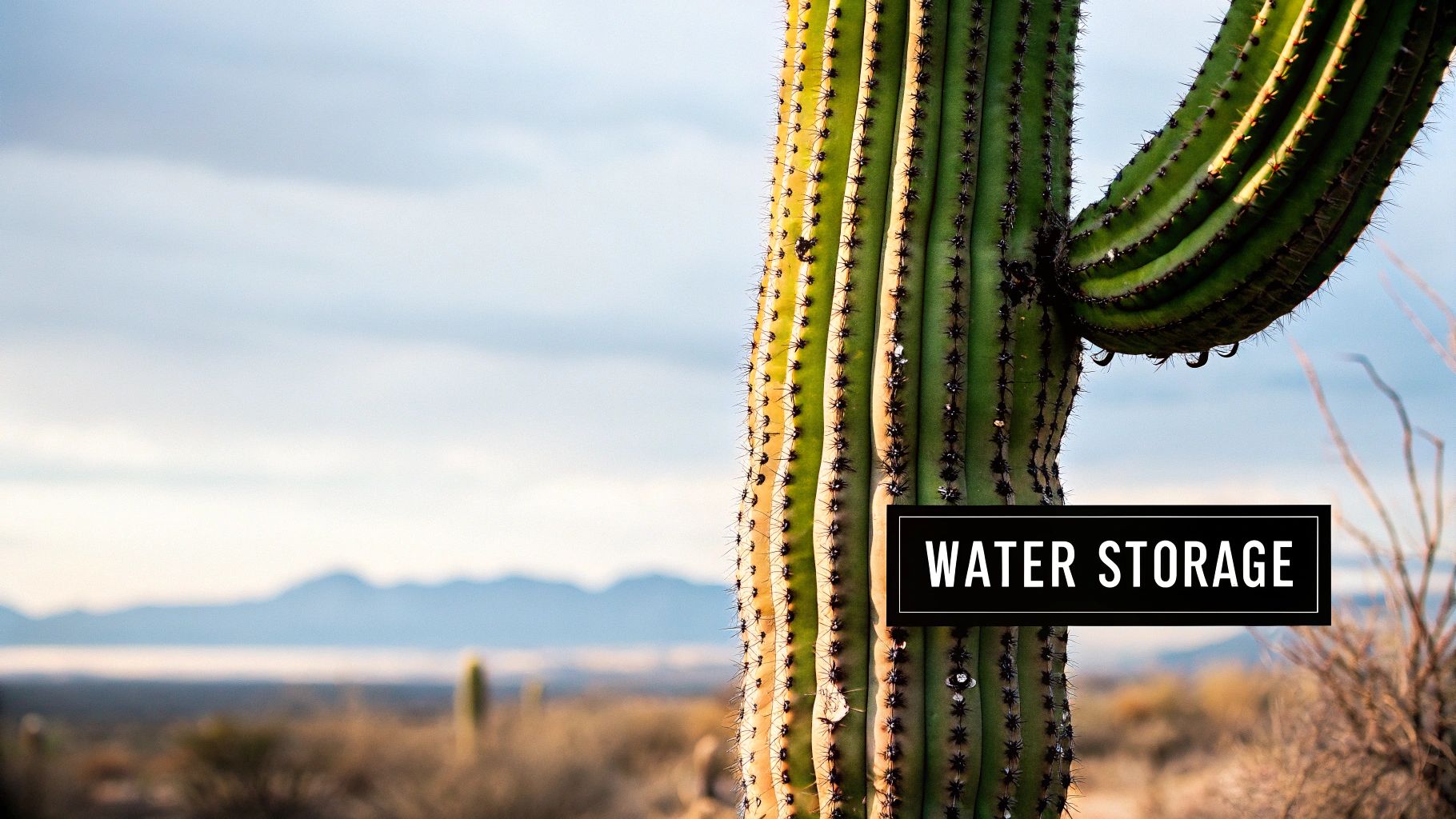
When you ask how a cactus survives in the desert, the first thing that comes to mind is water storage. But it's so much more clever than just being a simple tank. Cacti are dynamic, living reservoirs, masterpieces of hydraulic engineering built to seize the rare opportunity of a desert downpour.
The real secret is in the ribs. Many cacti, like the iconic Saguaro or barrel cactus, have those distinctive pleats running down their stems. They aren't just for looks—they're expansion joints.
Think of the stem as a biological accordion. During a long drought, the cactus sips from its internal reserves, and the whole stem shrinks, making the pleats look deeper. But when a sudden rainstorm hits, those pleats allow the stem to swell dramatically, soaking up a huge amount of water without bursting its skin. This incredible flexibility is the key to its survival.
The Spongy Interior: Nature’s Own Hydrogel
The magic continues on the inside. The fleshy stem is packed with a special tissue called parenchyma, which has one job: hold water. But it's not like filling a bucket. The cells are full of a slimy, gel-like substance called mucilage.
This mucilage is a natural hydrogel—a chain of sugar molecules that clings tightly to water, turning it from a sloshing liquid into a thick gel. This brilliant trick serves two critical purposes:
- It drastically slows down internal evaporation, locking moisture in place even when it's scorching hot outside.
- It acts as a natural antifreeze, preventing water from freezing and destroying the cells during frigid desert nights.
In short, the mucilage turns the cactus's core into a super-efficient, stabilized sponge, making sure every drop it absorbs is protected for the long, dry months ahead.
A cactus doesn't just hold water; it chemically binds with it. The mucilage-filled cells create a powerful bond, making the water less available to the desiccating forces of the desert heat and wind, which is a key reason how a cactus can survive in the desert for so long between rains.
The Saguaro: A Monumental Reservoir
To really appreciate this water-storing ability, just look at the titan of the Sonoran Desert: the Saguaro (Carnegiea gigantea). These colossal plants are the ultimate living canteens, perfectly designed for a climate where rain is a rare and precious event.
Picture a fully grown Saguaro, towering up to 45 feet tall. After a single good rain, it can soak up and store hundreds of gallons of water. When it’s full, a single foot of its trunk can weigh over 90 pounds, and a mature Saguaro can tip the scales at more than a ton—around 2,000 pounds! Almost all of that weight is water, locked away in its spongy core, ready to sustain it through years of potential drought. You can find more incredible details about these desert giants by exploring five interesting facts about Saguaros on dbg.org.
Lessons for Your Home Garden
Understanding this accordion-like system has very direct implications for how you care for your own cacti. It explains why they are so tough, yet so vulnerable to the classic mistake: overwatering.
A cactus is built for a "boom-and-bust" water cycle. It's designed to drink deeply and then slowly use that water over a long, dry spell. Watering it a little bit all the time messes with this natural rhythm, keeping its cells constantly swollen and waterlogged. This is a fast track to root rot, which is almost always fatal for a desert plant.
This brings us to the golden rule of cactus care: water deeply, but rarely. Let the soil become bone-dry between waterings. This mimics the long droughts and sudden downpours of their native habitat, encouraging the healthy cycle of expansion and contraction that has allowed them to master some of the toughest environments on Earth.
Defensive Armor for Preventing Water Loss
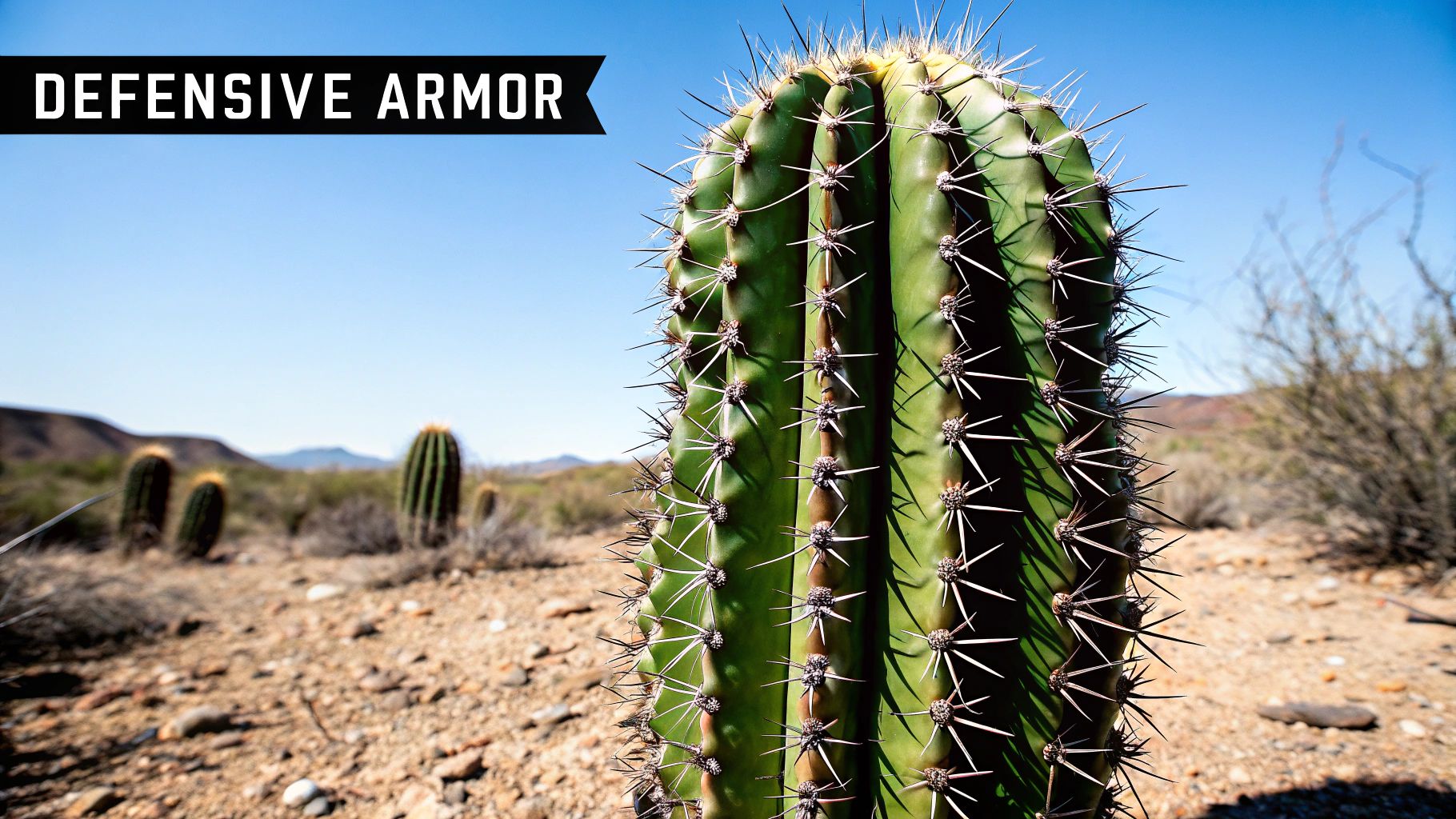
Holding onto a massive amount of water is one thing; protecting it from the brutal desert environment is another challenge entirely. A cactus is essentially a living fortress, and its exterior is a masterclass in defense, designed to keep every precious drop locked inside. This armor is a two-part system: a shield of sharp spines working in concert with a tough, waterproof skin.
Most people see cactus spines and think "keep away." While they're certainly great at deterring thirsty animals, their primary job is much more sophisticated. These modified leaves are experts at controlling the microclimate right at the plant's surface. Think of them as a natural windbreaker.
Together, the spines create a dense mesh that breaks up the flow of hot, drying desert winds. This traps a thin, still layer of air against the cactus stem, acting like a down jacket. This insulating layer dramatically slows down evaporation, preventing the sun and wind from wicking away the cactus's life-sustaining water reserves.
Spines That Do More Than Defend
Beyond just trapping air, these spines are multi-functional tools critical to a cactus's survival strategy.
- Built-In Shade: A dense network of spines casts a surprising amount of shade on the cactus's skin. This acts like a tiny, built-in parasol, lowering the surface temperature and reducing the stress of intense solar radiation.
- Water Funnels: When a rare rain shower or a heavy dew arrives, the spines serve as tiny channels. They guide water droplets down toward the base of the plant, right where the shallow roots are waiting to drink.
- Harvesting Fog: Some species have taken this to a whole new level. Cacti don't just store water—they can literally pull it from thin air. On species like the prickly pear (Opuntia ficus-indica), the spines have microscopic grooves that capture airborne moisture from fog and dew, channeling it to the stem in seconds. It’s an incredible water-harvesting phenomenon detailed at PMC.
The Waterproof Seal of Waxy Skin
The second part of this defensive system is the cactus's skin, or cuticle. This isn't your average plant epidermis. It's incredibly thick and covered in a heavy layer of wax, acting like a high-end waterproof sealant. This waxy coating creates an impermeable barrier that locks moisture in.
This is absolutely essential for stopping transpiration—the process where plants lose water vapor from their surfaces. While most plants lose a significant amount of water this way, the waxy cuticle of a cactus cuts this loss down to almost nothing. It's what keeps the tank full.
Key Takeaway: A cactus's skin isn't just a covering; it's a waterproof shield. The combination of a waxy cuticle and very few stomata creates an almost airtight seal against the desiccating desert environment.
As a final trick, the cactus minimizes its weak points. All plants have tiny pores called stomata for breathing in carbon dioxide, but these are also prime spots for water to escape.
Cacti have evolved to have far fewer stomata than other plants. And just as importantly, they keep these pores sealed tight during the blistering heat of the day. They only open them in the relative cool of the night to "breathe." This clever timing is one of the most crucial adaptations for desert survival, which we'll dive into next.
The Hidden Network of Cactus Root Systems
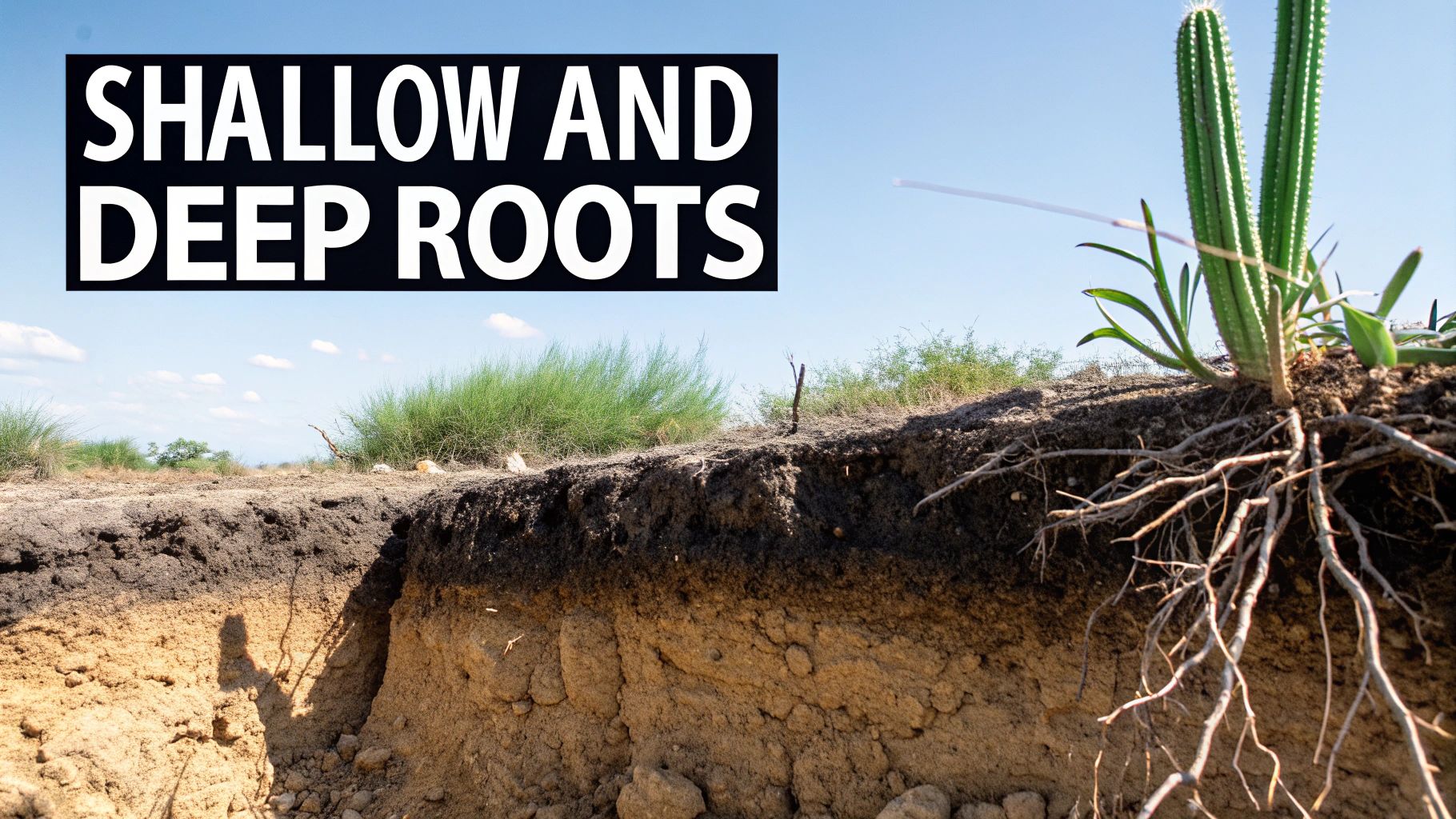
While we marvel at a cactus's pleated stem and thorny armor, an equally brilliant survival story is unfolding completely out of sight. The real secret to "how do cactus survive in the desert" is as much about what’s happening underground as what we see above it. The root system is the plant's hidden architecture, an incredible piece of engineering designed for one primary mission: to capture every last drop of water.
To pull this off, many cacti employ a clever two-part strategy. They don't just dig deep; they also spread incredibly wide. This dual approach ensures they can take advantage of any water the desert offers, whether it's a brief, passing shower or moisture buried far beneath the scorched earth.
Think of it like having two different kinds of fishing gear. One is a massive, fine-meshed net cast just below the surface, ready to catch anything that falls. The other is a deep-sea fishing line, dropped way down to find the reliable, hidden reserves that most other plants can't even reach.
The Shallow Fibrous Root Web
The first part of this system is a vast, sprawling network of fibrous roots. These roots spread out horizontally, often for surprising distances, but stay extremely close to the surface—sometimes just an inch or two deep. They form a dense mat that acts like a highly efficient sponge, perfectly positioned to absorb water from even the briefest desert downpours.
When a rare storm finally arrives, this shallow web springs into action. It soaks up moisture before it has a chance to evaporate under the brutal sun or sink uselessly into the sand. This rapid-response system is absolutely critical for survival where rain is both fleeting and unpredictable.
This is also why having the right soil is non-negotiable for cacti in pots. To learn how to get this right at home, check out our guide on how to make cactus soil that helps their roots do what they do best.
The Deep Taproot Anchor
Working in tandem with this shallow web is the second part of the strategy: the taproot. While not all cacti have a massive one, many larger species grow a thick, primary root that plunges straight down. This root is on a completely different mission—it’s searching for stability and long-term hydration.
The taproot has two main jobs:
- Anchoring: It provides a powerful anchor, holding the heavy, water-filled cactus firmly in place against strong desert winds.
- Deep Water Access: More importantly, it seeks out deep, consistent underground water tables that aren't affected by surface heat and evaporation.
This deep-reaching root is the plant's ultimate insurance policy, a lifeline that keeps it going through long droughts when the surface is bone-dry.
The mighty saguaro is a master of this dual-root system. Its main taproot can drive more than 5 feet deep to find groundwater, while its shallow network can spread out in a radius of up to 100 feet. This incredible underground web is so effective it can absorb enough water to help the cactus outlast droughts that kill 70-80% of competing plants. You can find more details about this amazing adaptation on nps.gov.
This combination of a wide-reaching surface net and a deep-diving anchor gives the cactus an unmatched ability to find and store water. It’s a beautifully efficient system that maximizes every opportunity while minimizing risk, allowing these incredible plants to thrive where others would quickly perish. This underground network is the true foundation of their resilience.
Breathing at Night with CAM Photosynthesis
While a cactus’s physical armor is impressive, its most ingenious survival tactic is completely invisible. It's a chemical trick that rewrites the basic rules of plant life, allowing it to "breathe" without losing precious water. This metabolic superpower is called Crassulacean Acid Metabolism, or CAM photosynthesis.
To really get what makes this so brilliant, you first have to know how most other plants operate. They open tiny pores on their leaves, called stomata, during the day to pull in carbon dioxide (CO2). They need that CO2 for photosynthesis—the process of turning sunlight into fuel. The downside? Every second those pores are open, water vapor escapes.
In a mild climate, that's no big deal. But in the desert, opening your pores in the blistering midday sun is a death sentence. A plant would shrivel up in no time. This is the exact dilemma CAM photosynthesis solves, and it's the secret to how a cactus survives with such incredible efficiency.
Flipping the Day-Night Cycle
Instead of following the standard plant playbook, cacti do the complete opposite. They keep their stomata sealed shut all day, locking in moisture and creating a waterproof barrier against the dry, scorching air.
Then, under the cover of darkness when the desert finally cools down, the cactus opens its pores. It spends the entire night collecting CO2 from the atmosphere. The catch is, without sunlight, it can't actually use the CO2 for photosynthesis just yet.
So, what does it do with all that gas it just collected?
The cactus cleverly converts the CO2 into an organic acid, specifically malic acid. It then stores this acid inside its cells' vacuoles—think of them as tiny biological storage tanks—and waits for sunrise. This nighttime chemical conversion is the heart of the CAM process.
Photosynthesis Behind Closed Doors
When daylight returns, the cactus once again seals its stomata tight. Now, safely protected from the heat, it gets to work. Inside its tissues, it begins breaking down the stored malic acid, re-releasing the CO2 it gathered all night.
This captured CO2 is then used to perform photosynthesis as usual, harnessing the sun's energy to create the sugars it needs to live and grow. In essence, the cactus performs photosynthesis with its doors locked, never having to expose its moist interior to the harsh daytime environment.
This two-step process is a remarkable evolutionary solution. It separates the two key parts of photosynthesis in time, allowing the plant to get what it needs without the massive water loss that would otherwise be unavoidable. It’s a patient, water-wise strategy that makes life in the desert possible.
Applying Desert Wisdom to Your Home Garden
If you want to understand how to make a cactus thrive in your home, just look to the desert. The same survival tactics that let a Saguaro dominate the Sonoran landscape are your best guide for a successful care routine. By simply trying to mimic their natural habitat, you can sidestep the common mistakes that trip up so many new cactus owners.
The biggest lesson the desert teaches us is about water. Cacti are perfectly designed for a "boom and bust" cycle—think rare, torrential downpours followed by long, dry spells. They are not built for small, frequent sips. Their entire system, from roots to stem, is engineered to drink up a huge amount of water at once and then hold onto it for a very long time.
Replicating the Desert Downpour
To keep your cactus happy, your job is to recreate this natural rhythm. That means watering deeply but not very often. When it's time to water, give the pot a complete soaking until you see water running freely from the drainage holes. This mimics a desert flood and encourages the roots to grow deep and strong, searching for moisture just like they would in the wild.
After that good, long drink, the drought period begins. You have to let the soil dry out completely before you even consider watering it again. For most cacti, this might be weeks or even a month between waterings, depending on your home's climate, the pot size, and the season. For a more detailed walkthrough, our guide to watering cactus plants has you covered.
The Golden Rule: When in doubt, don’t water. Overwatering is the number one killer of cacti. It quickly leads to root rot, a death sentence for a plant that evolved to stay dry.
Setting the Stage for Success
Watering is only half the battle; the right foundation is everything. A cactus will not last long in standard potting soil, which holds onto moisture for far too long. They need a gritty, fast-draining mix that lets air get to the roots and prevents water from hanging around.
Light is just as important. Most species need at least six hours of bright, direct sunlight every single day to flourish, making a south-facing window a perfect spot. If you're thinking bigger and want to bring these resilient principles outdoors, looking into desert landscaping can give you some incredible ideas.
To help you get started, here's a quick cheat sheet for a few of the most common types you'll find.
Cactus Care Cheat Sheet for Popular Species
This table breaks down the specific needs for a few popular varieties, since not all cacti are created equal!
| Cactus Type | Watering Frequency | Soil Preference | Light Needs |
|---|---|---|---|
| Golden Barrel (Echinocactus grusonii) | Every 3-4 weeks in summer; very little in winter. | Extremely gritty mix with excellent drainage. | Full, direct sun. |
| Prickly Pear (Opuntia) | Every 2-3 weeks during growing season; less in winter. | Tolerant of various soils, but must be well-draining. | Full sun for at least 6-8 hours. |
| Christmas Cactus (Schlumbergera) | More frequently; when top inch of soil is dry. | Richer organic soil that still drains well. | Bright, indirect light. |
As you can see, even the "Christmas Cactus," a true cactus, has wildly different needs because it comes from a tropical forest, not a desert. Knowing where your plant comes from is the real secret to helping it feel at home.
Answering Your Top Cactus Questions
Even after exploring all their incredible survival skills, a few questions always seem to come up. Let's tackle some of the most common curiosities to help you get a complete picture of these amazing plants.
Think of this as pulling back the curtain on the finer details of what makes cacti so special in the plant world.
How Long Can a Cactus Actually Live?
This is a great question, and the answer is surprisingly broad—it can be anywhere from a decade to a couple of hundred years. It really depends on the species.
Smaller, faster-growing types, like the popular Pincushion Cactus, often have a shorter run, typically living for about 10 to 15 years. They mature quickly, put on a big flower show, and wrap up their life cycle relatively fast.
On the other end of the spectrum, you have the absolute giants of the desert. A Saguaro cactus, for example, can easily live for 150 to 200 years, and some old-timers are believed to have seen their 300th birthday. Their slow, deliberate growth is the secret sauce to their longevity, allowing them to patiently conserve every drop of water and nutrient in a place where you can't afford to waste anything.
Key Insight: A cactus's lifespan is directly linked to its size and growth strategy. The big, slow-growing ones are the marathon runners, built for endurance over centuries.
Are All Succulents Cacti?
This is a classic mix-up, but the distinction is actually pretty straightforward. Here’s the simple rule: all cacti are succulents, but not all succulents are cacti.
"Succulent" is just a general description for any plant that stores water in thick, fleshy leaves or stems. It's a huge category that includes plants you probably know, like aloes, agaves, and jade plants. Cacti are just one specific family inside that massive group.
So, what's the one thing that makes a cactus a cactus?
- Areoles: Cacti have unique, small, fuzzy-looking bumps on their stems called areoles. These are the specialized spots where everything grows from—spines, flowers, and even new branches. If a plant doesn't have areoles, it's not a true cactus.
How Can I Tell if My Cactus Is Thirsty?
It can be tough to spot dehydration in a plant that’s a master of surviving drought. A thirsty cactus won't dramatically wilt like a fern or a basil plant. Instead, it starts drawing on its internal water reserves, and you have to know what to look for.
Keep an eye out for these subtle clues:
- Shrinking or Wrinkling: The body of the cactus might start to look a little deflated, puckered, or develop noticeable wrinkles. This happens as its internal water pressure drops.
- Leaning or Softening: The plant might begin to lean over or feel a bit soft and squishy when you gently press it. This loss of firmness, or turgidity, means it's running low on stored water.
Don't panic if you see these signs! It just means the plant is doing exactly what it evolved to do—using its emergency stash. It’s simply your cue to give it a good, thorough drink.
At The Cactus Outlet, we provide healthy, thriving plants that bring the resilience of the desert into your home. Explore our collection of beautiful cacti and succulents. https://www.cactusoutlet.com