

You're staring at three barrel cactus listings that all look almost identical. One is a little cheaper, one has prettier photos, and one says “mature” without saying much else. That's where most bad purchases start, because the plant you get is only part of the deal. The product is the seller's judgment, the listing's honesty, and the way the cactus is packed, shipped, and handled after arrival.
The online cactus market is no longer a niche side alley. A broader cactus-and-succulent e-commerce category was valued at about USD 5.18 billion in 2023, rose to USD 6.85 billion in 2024, and is projected to reach USD 15.08 billion by 2031, according to a retailer-published industry summary cited in the brief source. That matters because shoppers now expect comparison photos, shipping detail, and care context as standard, not as extras.
If you want a clean decision process, use the same logic a working buyer would use for a wholesale order. If you want a quick refresher on how people evaluate online purchases, the practical format used in these how to guides is a useful companion. For barrel cactus, the checklist is simple. Verify the species, verify the seller, verify the shipping terms, then verify that you can keep the plant dry long enough to settle in.
Why Buying a Barrel Cactus Online Is Worth Doing Carefully
You've probably got three tabs open right now. Each listing says “barrel cactus,” each photo shows a round spiny plant, and the price gap is enough to make you wonder if one seller knows something the others don't. That hesitation is healthy. With live plants, the visible part is only half the story, and the half you can't see is usually where the loss happens.
A barrel cactus can be a long-term garden piece, not a seasonal accent. The golden barrel cactus can live over 100 years and, in some cases, 150 years or more, and it's considered endangered in its native Mexico because of habitat destruction even though cultivated stock is sold online source. That's why the buy decision deserves more attention than the watering schedule. You're not just picking décor, you're choosing a plant that may sit in a patio container, front yard bed, or collector display for decades.
Practical rule: treat the listing like a contract. If it doesn't tell you what species you're getting, how it was propagated, and how it ships, skip it.
The online market makes this easier and harder at the same time. Easier, because you can compare specimens side by side. Harder, because the same generic name can hide very different plants, and the cheapest option is often the one most likely to fail in transit or arrive mislabeled.
The rest of the decision comes down to process. First, match the species to your project. Then read the listing like a buyer, not a browser. Finally, plan for the first two weeks after delivery, because that's when weak plants and weak sellers reveal themselves. If you get those steps right, buying online is the smartest way to find a larger barrel cactus than you'll usually see at a local garden center.
Choosing the Right Barrel Cactus Species for Your Project

Start with the plant you need, not the generic name in the listing. A barrel cactus can be a compact patio feature, a collector's plant, or a long-term specimen, and the wrong species will waste money fast. North Carolina State University's Plant Toolbox places Echinocactus in the Southwestern United States and Mexico, says these plants perform best in full sun with some shade tolerance, and lists the golden barrel under the updated scientific name Kroenleinia grusonii source. That is the level of specificity you want before you buy.
The species buyers run into most often
The golden barrel cactus is the first option many shoppers see, and it makes sense for a patio container, xeriscape border, or a clean focal planting. If you want to verify the differences among the common forms before committing, use this barrel cactus species guide from The Cactus Outlet and compare it against the seller's wording. For cultivated stock, the golden barrel remains the standard choice, and that is the one I'd trust over a vague “mixed barrel” label source.
Ferocactus gracilis, often sold as fire barrel, is the choice for buyers who want a heavier spine display and are comfortable with a more collector-leaning plant. Ferocactus cylindraceus also shows up in online catalogs, and it usually makes more sense for buyers comparing desert-use forms than for someone who just wants a single accent pot. These are not interchangeable purchases. A seller who collapses them into one generic barrel cactus listing is asking you to guess.
Loose listings are where trouble starts. If a shop cannot tell you whether the plant is Echinocactus grusonii, Ferocactus gracilis, or Ferocactus cylindraceus/v. lecontei, you are buying blind source. The label should match the plant, and the plant should match the project.
Match species to buyer type
| Species | Mature Size | Best Use | Buyer Profile |
|---|---|---|---|
| Kroenleinia grusonii | Long-lived specimen with slow, substantial presence | Patio container, xeriscape, focal planting | Homeowner or designer wanting a classic barrel |
| Ferocactus gracilis | Strong vertical presence with prominent spines | Collector display, bold accent planting | Buyer who wants a more dramatic specimen |
| Ferocactus cylindraceus | Landscape-friendly barrel form | Drought-tolerant garden, larger outdoor compositions | Buyer comparing regionally appropriate forms |
| Echinocactus hybrids | Varies by listing | Mixed use, only if the seller is explicit | Buyer who's comfortable vetting labels carefully |
For buyers who want the safest path, search by the scientific name first and the common name second. That keeps you from paying for a photo that looks right but a plant that does not fit the site, the container, or the climate.
Inspecting a Barrel Cactus Listing Before You Click Buy
A serious listing gives you enough information to judge the actual plant, not just admire it. Start with the photos. You want multiple angles, and one of them should show the base or root crown. If the seller only shows a top-down glamour shot, I treat that as a warning sign. Stock photos are worse, because they hide whether the cactus you'll receive is the one in the picture.
What the photos should show
Look for the rib structure, the spine pattern, and the base. Mature golden barrel specimens are commonly described as having roughly 21 to 37 evenly spaced ribs, with a firm, non-wobbly base and deep olive-green to sage-gray stem color source. That's useful because it tells you the plant is structurally sound enough to handle shipment better than a soft or distorted specimen. If the listing doesn't show ribs clearly, or the color looks washed out in a way that suggests stress, move on.
A good photo set makes the seller look slightly boring. That's a compliment. Honest sellers don't need dramatic crop jobs to hide the plant's shape.
What the description must include
The listing should state the exact species, current container size, approximate height, and whether the plant is rooted, seed-grown, or otherwise propagated. It should also say whether the photo is of the exact plant or a representative example. A nursery that can't give you that basic information is not selling with enough discipline for a live plant.
Pricing matters too. An independent nursery price guide shows golden barrels commonly priced at $15 for 1-gallon plants, $35 to $45 for 5-gallon containers, $75 to $120 for 15-gallon containers, and $175 to $225 for 24-inch boxes source. I'd use those figures as a sanity check. A large specimen priced suspiciously low is where you should stop and ask why.
Red flags I'd skip without second thoughts
- Stock photos only, because they hide condition and size.
- No container size or height, because you can't compare value without scale.
- Mature plant at bargain pricing, because that often points to stress, mislabeling, or bad sourcing.
- Missing propagation detail, because wild-collected or poorly rooted plants are harder to establish source.
A strong listing reads like a plant record. A weak one reads like a marketing page.
Vetting the Seller and Asking the Right Questions
A polished storefront doesn't matter if the seller can't explain where the plant came from. I'd rather buy from a plain nursery page that answers questions cleanly than from a slick site that hides behind vague copy. The fastest way to reduce risk is to vet provenance first, then packaging, then policy.
The three-stage seller check
Start with origin. Ask whether the plant is seed-grown, nursery propagated, or wild-collected. The brief flags wild-collected barrel cacti as a conservation risk and notes that seed-grown or transparently propagated stock is the safer choice source. If the seller dodges that question, stop there. Don't reward vagueness.
Next, look for business legitimacy. A real nursery usually gives you a business name, traceable contact details, and some proof that the seller handles plants rather than just relists them. Then read recent reviews with a narrow focus, shipping damage, base rot, mislabeled plants, and whether people received the exact specimen shown. Generic praise means little. Photos and specific delivery comments mean more.
Best question to ask before checkout: “Is this the exact plant, and how was it propagated?”
What confident sellers answer quickly
A seller who really knows the stock can tell you the current pot size, whether the cactus was recently repotted, and how it's being kept before shipment. They can also explain whether the listing photo is the exact plant or representative stock. If you ask one question and get a canned paragraph back, that's not confidence. That's a deflection.
What the policy should make clear
You want a written live-plant guarantee, a clear DOA window, and an actual path to replacement if the plant arrives damaged. A guarantee that only offers store credit, or one that excludes anything the seller can call “transit shock,” doesn't protect you very well. On live plants, clarity matters more than wording that sounds generous.
A quick message before purchase usually tells you enough. Ask about origin, last repot, and shipping schedule. If the seller answers plainly, that's a good sign. If they hurry you to pay before you ask follow-ups, skip the listing and keep looking.
Shipping Policies That Protect a Live Barrel Cactus
A barrel cactus can stay dry for a while, but it can't sit in a hot or freezing box and come out unchanged. Shipping is where live-plant buying either works or fails. I'm much more interested in how a seller manages transit than in how bright the plant looked in the listing photo.

What good packing looks like
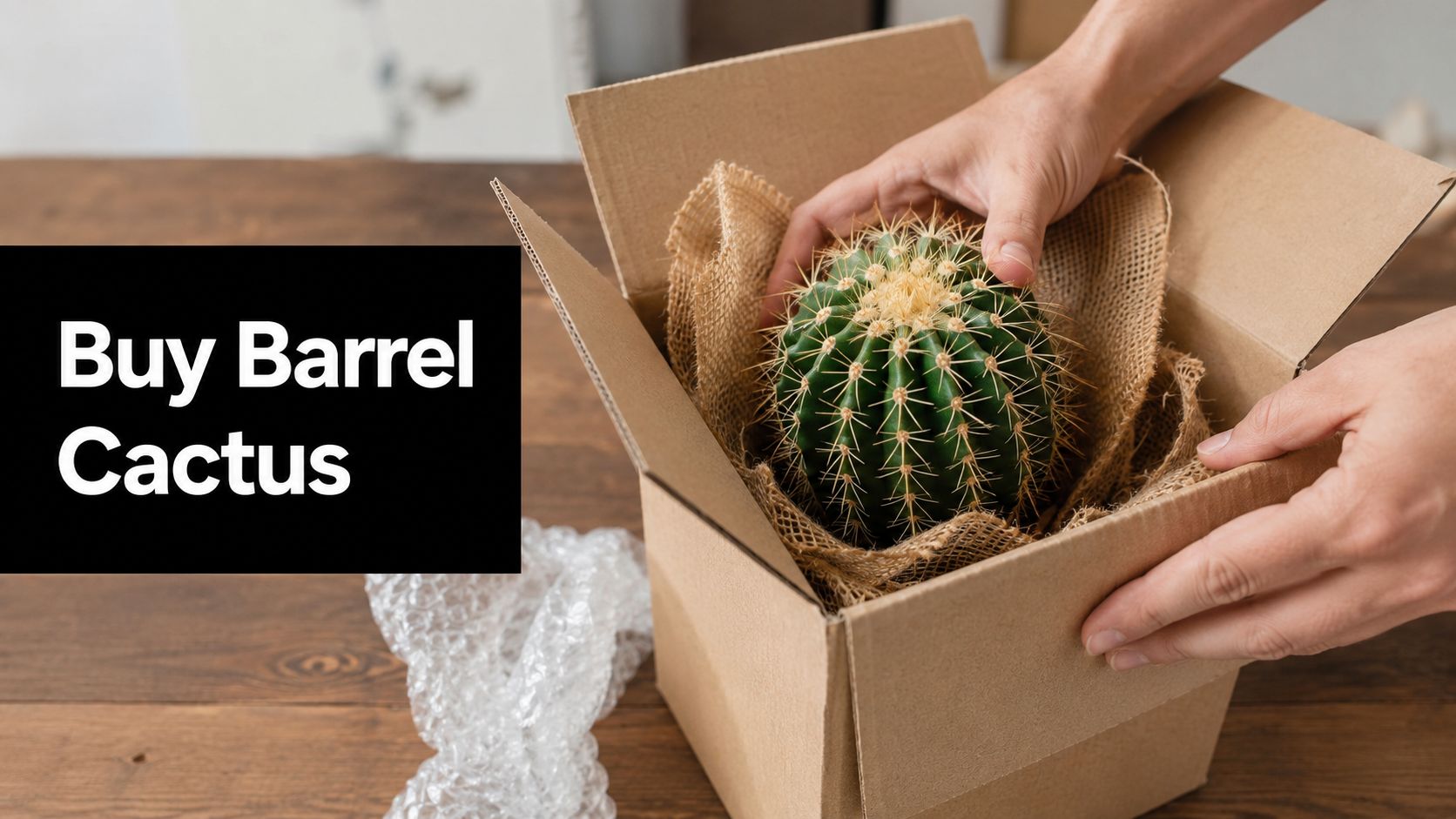
For cacti, dry and immobilized is better than damp and loose. The plant should be stabilized so it can't bang around in the box, and the seller should use packaging that keeps the cactus from rubbing through the skin or bouncing against the sides. If the plant is big enough to need more protection, ask how it's boxed or crated. The answer should be practical, not vague.
A good shipping policy also tells you whether the seller uses weather holds, heat packs, or cold packs. If you're buying in a season where temperatures are extreme, those details are not optional. You can learn a lot from the seller's shipping language, and the principles in top shipping tips for online retailers are a useful way to think about timing, insulation, and delivery expectations from the buyer side.
Read the dispatch language closely
“Ships in 1 to 3 business days” is not the same thing as “ships from our greenhouse on Monday.” The second version suggests a controlled workflow. The first can mean almost anything. For live cacti, I prefer the seller who ships early in the week and avoids weekend stalls. If the policy says signature-required delivery, that's often worth it for a larger specimen because it cuts down on porch exposure.
The Cactus Outlet's own shipping and returns information is worth checking if you're comparing live-plant service terms, because the policy language tells you how the nursery handles transit and claims.
Questions that protect your claim
- What proof is required on arrival? Ask whether photos of the box, label, and plant are enough.
- How long is the damage window? Short windows can be a problem if you're at work when the package arrives.
- Is replacement available, or only store credit? That changes the value of the guarantee.
- What happens if weather delays the shipment? Some sellers hold orders. Others ship anyway.
If the seller won't explain the policy in plain language, assume the policy won't help you when it matters.
Unboxing and the 14-Day Acclimation Window
The first two weeks are where a good barrel cactus either settles in or starts declining at the base. Don't rush it. The instinct to water immediately is what ruins a lot of online purchases, especially when the plant was already stressed in transit.
Day one means documentation first
Open the box in dry light and photograph everything before you touch the plant too much. That includes the outer box, packing, label, and the cactus from several angles. If the seller shipped a damaged plant, those photos are what support the claim. If the plant looks intact, the photos still give you a baseline for the next two weeks.
A short video can help you remember the sequence later. This one is useful if you want a visual reset on the unboxing flow.
Keep it dry while it settles
Place the cactus in bright indirect light, not harsh direct sun, for the first stretch after arrival. The safest approach is a dry rest of about 14 days before the first deep soak, then check the root zone with a dowel or skewer to make sure it's dry before watering. Water should run through the drainage holes, and the saucer should be emptied immediately afterward source. Moisture mismanagement in the first two weeks causes more trouble than the species itself.
The internal guide on barrel cactus care pairs well with this phase if you want a simple reference point after the plant is indoors or on the patio.
Normal stress signs: slight wrinkling, a bit of spine shedding, and a slower look while the plant adjusts. Softness at the base is a different problem.
When to repot and when to wait
Wait unless the current medium is clearly wrong. If the root ball is sitting in dense, wet, or sour-smelling material, I'd move it sooner. If the plant came in a dry, stable mix and looks firm, leave it alone until it has settled. The point of quarantine isn't to punish the cactus. It's to keep you from creating a second problem while the first one is still unresolved.
The buyer who stays patient usually wins here. The buyer who waters on day two usually doesn't.
Add Ons Worth Buying With the Plant
A barrel cactus fails more often because of the pot and soil than because of the species. Ordinary potting mix holds too much water against the root crown, and that is where rot starts. If you are going to buy once and do it right, order the pot and medium at the same time as the cactus.

Buy the right soil, not the nearest bag
For barrel species, a mineral-heavy, fast-draining mix is the standard I would stick to. The right mix uses coarse sand, pumice or calcined clay, and crushed granite or lava rock in a gritty blend that drains fast and stays airy around the roots. That kind of medium keeps water from sitting against the base the way regular potting soil does. If you are trying to save money, do not cut corners here. A cheap soil mix can turn into an expensive plant loss fast.
Choose the pot for drainage first
Terracotta and glazed pots can both work, but drainage holes are required. If a pot does not drain, skip it. Terracotta has the practical advantage of drying faster, which suits barrel cactus culture well. A decorative outer cachepot is fine only if the plant sits inside a draining liner that gets emptied after watering.
Top-dressing helps too. Decorative gravel or lava rock keeps the surface stable and makes it easier to see when the medium is dry. It also gives the base a cleaner look on a patio or entryway. I would buy that with the plant instead of trying to improvise later.
Do not ignore the policy layer
A reputable live-plant guarantee usually covers dead on arrival or obvious transit damage within a defined window. It does not cover mistakes after you water too early, repot badly, or leave the cactus in unsuitable conditions after delivery. That is fair. The seller owns packing and transit risk, and you own acclimation and aftercare once the plant is in your space.
If the species has any state-level restrictions, confirm them before you order. The buyer is responsible for checking what is legal to receive where they live. I would also send a brief thank-you email with the arrival photo and keep one follow-up check-in around a month later. That kind of paper trail makes it easier to resolve issues if they come up later, and it keeps your order visible with the nursery.
For shoppers comparing complete setups, The Cactus Outlet offers a Barrel Cacti collection alongside other large cacti and succulents, which makes it easier to compare plant size with container readiness before checkout.
If you want a barrel cactus that arrives ready for a patio, container, or xeriscape project, shop The Cactus Outlet and compare the listed species, sizes, and shipping details before you buy. You will make a better decision when the plant, pot, and packing standards are all visible in one place.