

The most common advice about Euphorbia is also the most misleading: “Just treat it like a cactus.” That shortcut kills a lot of good plants.
Yes, many Euphorbias look like cacti. They grow ribs, spines, columns, and odd sculptural forms that fit right into a desert collection. But in real-world euphorbia cactus care, the details matter. Watering, propagation, sap handling, and even light tolerance can change depending on whether you're growing a green African milk tree or a heavily variegated form that burns if you give it the same exposure as a true sun-hungry cactus.
At a nursery bench, the same mistakes come up over and over. People water too often because the plant looks “tropical.” They pot into dense soil because the stems seem sturdy. They take a cutting, stick it right into mix, and wonder why it turns to mush. Those aren't beginner failures. They're the result of bad generic advice.
The Cactus Impostor Understanding Your Euphorbia
A Euphorbia isn't a cactus, even when it looks exactly like one from across the room. That's not botanical trivia. It's the reason generic cactus advice often falls apart.
What confuses people is convergent evolution. Euphorbias and true cacti developed similar survival shapes because both had to cope with dry conditions. So you get ribbed stems, spines, and chunky water-storing bodies in both groups. But they didn't come from the same plant family, and that difference shows up fast once you start handling them.

The two easiest tells
The first tell is milky latex sap. Nick a Euphorbia stem and you'll usually see white sap. That sap can irritate skin and is a real hazard around eyes and pets. If you grow firestick types or other sap-heavy species, it's worth understanding the risks before pruning. The firestick plant toxicity guide is a useful reference for that side of handling.
The second tell is anatomical. True cacti produce spines from areoles, those little cushion-like spots on the stem. Euphorbias don't have areoles. Their spines emerge differently, and once you know to look for that, the “cactus impostor” label makes sense.
Most Euphorbia problems start with misidentification. People think “cactus,” then overapply cactus rules without noticing the plant in front of them.
Why this changes care
The practical takeaway is simple. Euphorbia care works better when you respect the plant's own physiology instead of forcing it into the cactus category.
That matters most in four places:
- Sap handling: Broken stems aren't just messy. They require careful cleanup and skin protection.
- Propagation: Fresh cuttings need drying time before planting.
- Light decisions: Some forms, especially variegated ones, scorch faster than growers expect.
- Watering judgment: Euphorbias store water well, but they also fail quickly when roots stay airless and wet.
If you start with the idea that Euphorbia is its own thing, your care gets sharper right away.
Light Water and Soil Your Euphorbia Craves
Strong growers usually get Euphorbia care wrong in the same way. They hear “cactus,” then default to harsh sun, random drought, and whatever gritty mix is on hand. Euphorbia responds better to a more precise setup: bright light matched to the species, a fast-draining root zone, and watering that follows the pot's drying speed instead of the calendar.
A healthy plant should stay firm, upright, and evenly colored. If it stretches, softens at the base, or starts dropping leaves out of season, check light first, then the potting mix, then your watering interval.

Light that keeps stems compact
Bright light matters, but there is a real trade-off here. More light gives tighter growth, stronger color, and better form. Too much sudden direct sun can scar stems, and variegated Euphorbias burn faster because they have less chlorophyll to buffer the tissue.
The broad target many indoor growers use is several hours of direct sun or very bright light each day, which aligns with the Planet Desert care guide. In practice, a south or west window usually works best for columnar types, while variegated forms often hold better color with bright light and some protection from the hottest afternoon blast.
Use these placement rules:
- South or west exposure: Best starting point for most indoor Euphorbias
- Acclimate gradually: Especially after shipping, greenhouse shade cloth, or a move from a dim room
- Watch the stem surface: Pale patches and corky scars often mean sun stress, not disease
- Rotate the pot: Useful for keeping upright growth on windowsills
If a Euphorbia leans hard, narrows at the top, or throws weak pale growth, it wants more light. If a variegated plant develops bleached patches on the sunward side, back it off a little.
The video below gives a useful visual overview of how these plants behave in home conditions.
Soil that protects the roots
Root failure is the usual cause of decline.
Euphorbia roots need air as much as moisture. A mix that stays wet and dense around the root ball leads to stalled growth first, then rot. By the time the stem softens, the problem has usually been building below the soil for a while.
Regular indoor potting soil is often too water-retentive unless it is cut heavily with mineral material. I prefer a gritty mix that drains fast and dries evenly from top to bottom. That gives you a wider margin for error, especially in lower light or cool weather.
What actually works in the pot
Use a pot with a drainage hole. Then use a mix that does not stay heavy after watering.
Good options include:
- Bagged cactus or succulent mix: Use it if it already drains quickly
- Half potting soil and half pumice or perlite: Reliable for many common Euphorbias
- Extra coarse mineral material: Helpful if your mix still feels dense the next day
- Terracotta pots: Useful if your space runs cool or the mix dries slowly
Plastic pots are fine, but they hold moisture longer. That is not automatically bad. It just means your watering interval needs to be longer. In a hot bright room, plastic can work well. In a dim apartment in winter, terracotta gives beginners a little more forgiveness.
Practical rule: If the mix still feels soggy a day after a full watering, change the mix before the plant pays for it.
Watering without the usual guesswork
Water Euphorbia thoroughly, then let the mix dry most or all the way before watering again. Shallow sips keep the upper layer damp and encourage weak rooting. A full soak followed by real drying produces stronger roots and fewer rot problems.
The right schedule changes with the season, the pot, and the species. Gardenia's African milk tree guide recommends more frequent watering in active growth and much less in winter, which matches how these plants behave in cultivation. Fast summer growth uses water. Cool-season rest does not.
A simple working rhythm looks like this:
| Season | What to do |
|---|---|
| Spring and summer | Water thoroughly, then wait until the mix is nearly or fully dry |
| Fall | Stretch the interval as growth slows |
| Winter | Water lightly and infrequently, just enough to prevent excessive shriveling |
One warning that generic cactus guides often skip. Variegated Euphorbias and grafted types can be less forgiving of extremes. They may scorch faster in strong sun and dehydrate faster after a full dry-down, even though they still hate sitting wet. For those plants, the answer is not constant moisture. It is closer observation and a narrower margin between bone dry and soggy.
If you are unsure, check the root zone, not just the surface. A dry top inch means very little in a deep pot. Lift the container, use a skewer, or feel lower in the mix before deciding. That habit prevents more losses than any fixed watering calendar.
A Plant for All Seasons Feeding and Temperature Guide
Euphorbia care gets easier once you stop treating the plant like it wants the same input all year. It doesn't. Growth changes with the season, and your routine should change with it.
Feed only when the plant can use it
In active growth, many Euphorbias respond well to light feeding. I prefer a low-nitrogen cactus or succulent fertilizer diluted below label strength, because heavy feeding can push soft, weak growth that's more likely to mark, split, or struggle when conditions shift.
During cooler, slower months, skip fertilizer. A resting plant doesn't need to be pushed. If you keep feeding while growth has slowed, the roots and stems don't reward you for the effort.
A simple approach works:
- Spring: Resume feeding after you see fresh growth.
- Summer: Continue lightly if the plant is actively growing and well rooted.
- Fall and winter: Stop feeding and let the plant coast.
Temperature matters more than many growers think
Euphorbias handle warmth well, but many don't forgive cold nights. One care guide gives an indoor comfort range of 18 to 29°C (65 to 85°F) and warns that many euphorbias don't tolerate nighttime temperatures below 10°C (50°F). Planet Desert also places indoor success in the 60°F to 75°F range with relatively dry air, as noted earlier.
That matches what I see with nursery stock brought into homes. A plant can look fine in a bright room, then sulk or mark after repeated exposure to cold drafts near glass, exterior doors, or unheated corners.
Seasonal habits that prevent stress
A plant can survive a brief rough patch. Repeated stress is what weakens it.
Watch for these conditions:
- Cold window ledges: Fine by day, risky at night if glass gets cold.
- Drafty entries: Sudden temperature swings can damage tender growth.
- Humid rooms: Euphorbias prefer relatively low indoor humidity, not the damp feel of a steamy bathroom.
If your Euphorbia looks stalled for no obvious reason, check night temperature before changing anything else.
Warm, bright, and dry is the general pattern. Once you hold that line, feeding becomes a small supporting detail instead of a rescue strategy.
Repotting and Propagating New Euphorbia Plants
Repotting is routine. Propagation is where Euphorbia proves it is not just “a cactus with spines.”
These plants bleed latex sap when cut, and that changes how you handle both jobs. The sap is irritating, the cut surface rots easily if it stays wet, and tall species such as Euphorbia trigona often arrive at repotting time because they have become top-heavy, not because they want a much larger root run.
A mature plant usually gives clear signals. Roots circle the pot, water runs through too fast, or the container no longer keeps the plant upright. For younger African milk trees, the New York Botanical Garden advises moving up only one pot size in spring as needed. That matches nursery practice. Oversizing the pot is one of the quickest ways to keep the root zone wet too long.
How to repot without stalling the plant
Stay conservative.
- Go up one pot size only. Extra soil around a modest root ball dries slowly and raises the chance of root loss.
- Use a pot with a drainage hole. If you like a decorative outer pot, keep the Euphorbia in a removable nursery pot inside it.
- Replace tired mix. Old cactus mix compacts over time, and Euphorbia roots want air around them.
- Protect your hands and eyes. Broken stems and roots can release sap fast.
If you're sorting out fertilizer choices for mixed plantings in a yard or greenhouse area, a simple primer on natural NPK for vibrant, safe lawns helps explain what those numbers mean before you start feeding anything. Euphorbias still respond better to restraint than enthusiasm.
The propagation step growers skip
Fresh cuttings need to dry and seal before they ever touch potting mix. That callusing period is the difference between a cutting that roots and a cutting that turns to mush at the base.
The Missouri Botanical Garden notes that succulent Euphorbia cuttings should be allowed to dry for several days before planting, both to reduce sap flow and lower the risk of rot. That advice is more than a formality with this genus. Euphorbia tissue is water-rich, and the wound stays vulnerable until it hardens.
Planting a fresh Euphorbia cutting is a common beginner mistake. Waiting a few days is usually safer than planting a day too early.
For a broader workflow, this guide to propagating succulents from cuttings is useful, but Euphorbia deserves stricter handling because of the sap and the longer margin for rot.
A cutting routine that works
Take cuttings during active growth with a clean blade. Let the sap drain or rinse it off carefully, then set the piece in a dry, shaded, airy spot until the cut end feels firm and fully sealed. I do not pot them just because the outside looks dry after one day. Thick stems often need longer.
Once callused, set the cutting upright in a gritty, fast-draining mix and keep it barely moist at first. Rootless cuttings do not need regular watering. They need oxygen around the base and enough stability to stay still while roots start.
A few details improve success:
- Wear gloves and eye protection. Euphorbia sap is an irritation risk, not a minor nuisance.
- Use a mineral-heavy mix. Fine, peaty blends stay wet around the wound.
- Keep the cutting stable. Tall sections that wobble tend to root slowly and can fail at the base.
- Wait to water heavily. A cutting without roots cannot use much moisture.
Variegated Euphorbias deserve extra caution here. They usually grow slower, scorch more easily, and have less margin for error after cutting than all-green forms. If one collapses, the usual cause is simple. It went into the mix before the wound had sealed, or it was watered like an established plant.
Popular Euphorbia Varieties and Their Quirks
The fastest way to lose a Euphorbia is to care for it like a generic cactus. Species in this genus share the same broad rules, but their weak points are different, and those weak points are what decide whether the plant settles in or declines.
Some are sturdy and quick to recover. Others give you almost no margin for error. If you want a broader overview, this roundup of types of Euphorbia cactus is a useful reference. For actual day-to-day growing, I pay more attention to growth rate, stem tissue, and how much chlorophyll the plant has.

Three common types and how they differ
| Variety | Growth habit | What trips people up |
|---|---|---|
| Euphorbia trigona | Upright, columnar, branched | Cold sensitivity, uneven light, and top-heaviness as it matures |
| Euphorbia obesa | Round, compact, slow growing | Staying wet too long in large pots or rich mixes |
| Euphorbia milii | Thorny, woody, flowering | Weak flowering from inadequate light and overprotected placement |
Euphorbia trigona is often sold as an easy starter plant, and it can be. But mature specimens create their own problems. They gain height quickly, throw weight upward, and can lean hard if light comes from one side. I stake older plants before they need it, not after they split the root ball loose in the pot. Cold windows and drafty entries also mark the stems faster than many growers expect.
Euphorbia obesa gets killed by kindness. Its round body stores water well, so a roomy decorative pot with slow soil is usually the wrong setup. Keep it tight in a pot that dries on schedule, and it stays firm and balanced. Give it stale, damp mix and the lower body softens before the owner realizes anything is wrong.
Euphorbia milii, or crown of thorns, fools people in a different way. Because it flowers, growers treat it like a general houseplant and tuck it into medium light. That keeps it alive, but not happy. Stronger light gives tighter growth, better branching, and far more reliable bloom.
Why White Ghost needs different treatment
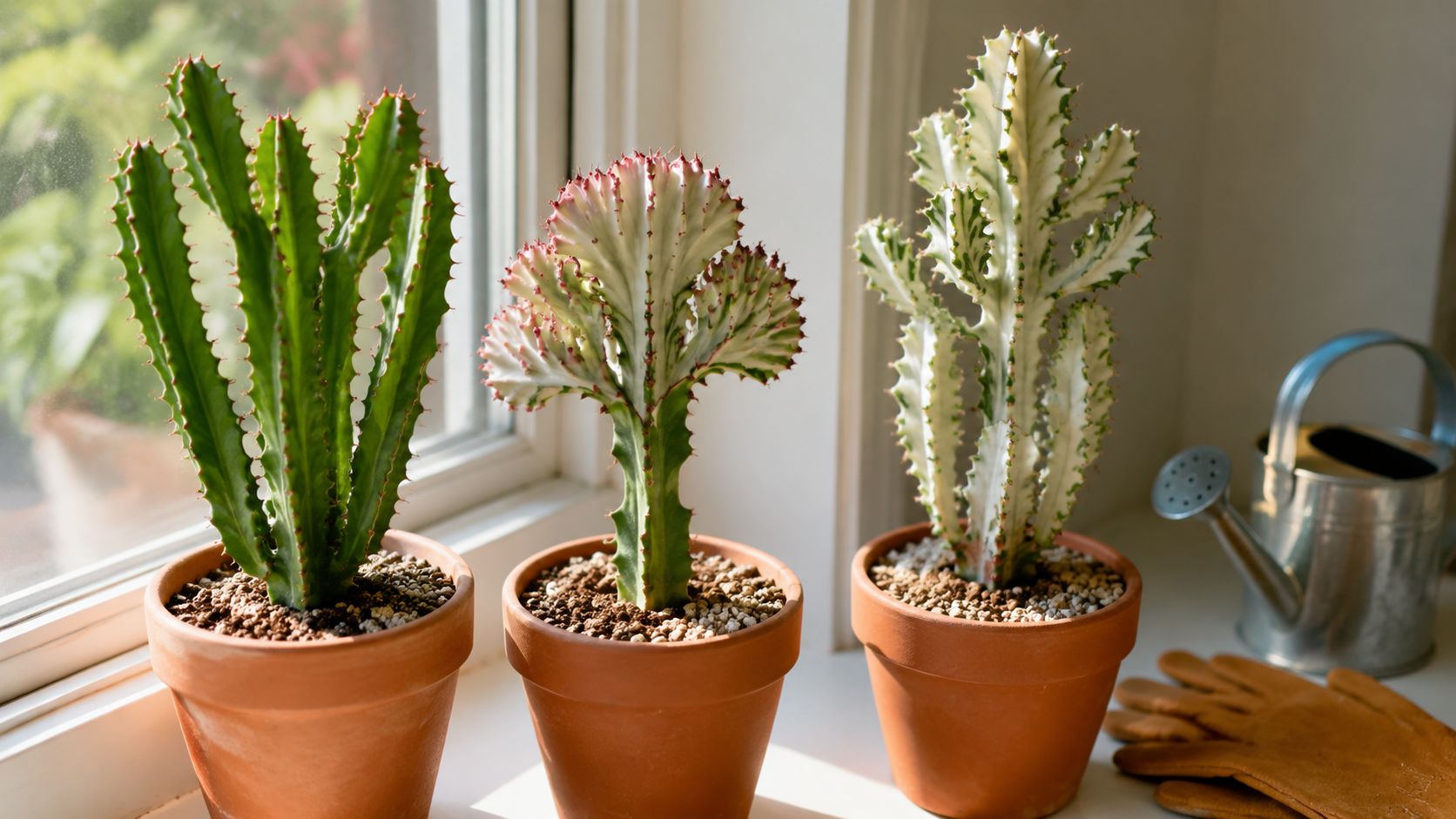
Euphorbia lactea ‘White Ghost’ is where generic advice falls apart. The white stem tissue carries far less chlorophyll than green Euphorbias, so the plant has less capacity to fuel growth and recover from stress. The Missouri Botanical Garden notes that variegated and crested Euphorbias are typically less vigorous than green forms and need more cautious siting and care (Missouri Botanical Garden plant finder for Euphorbia lactea 'White Ghost').
In practice, that changes two things immediately. Light must be bright but filtered, especially in hot afternoon exposure. Watering also has to stay restrained, because a slower plant with reduced green tissue does not rebound from wet roots the way a strong green trigona often can.
I treat White Ghost as a collector plant. It gets stable warmth, sharp drainage, and protection from harsh sun. If you cut one for propagation, the callusing stage matters even more than usual because the plant does not have much reserve to waste on a bad start.
Green forms of Euphorbia lactea usually recover faster and can take more light. White Ghost cannot. That is the trade-off for the color.
One more practical note. If fungus gnats or other potting mix pests show up around slower-growing Euphorbias, fix the soil condition first instead of reaching for more water or fertilizer. This homeowner's guide to soil pests gives a clear overview of what may be living in the mix and why damp media keeps the problem going.
Common Euphorbia Pests Diseases and Fixes
A lot of Euphorbia problems get misread because growers treat the plant like a true cactus. That is how a soft stem turns into a dead plant. With Euphorbia, I check the base, the roots, and any cuts or branch joints first. Pests matter, but root stress usually shows up earlier.

Symptom cause solution
| Symptom | Likely cause | Fix |
|---|---|---|
| Soft base or mushy stem | Root rot from wet soil or a cold, slow-drying mix | Unpot, remove rot, let cuts dry fully, repot in dry fast-draining mix |
| White cottony clusters | Mealybugs | Isolate plant, dab with alcohol on a cotton swab, repeat checks weekly |
| Fine webbing and stippling | Spider mites | Rinse plant carefully, improve air flow, then use neem or insecticidal soap |
| Yellowing with weak growth | Root stress, poor light, or sap loss after damage | Inspect roots first, then review light, watering, and pest pressure |
Root rot usually starts long before the stem collapses
By the time a Euphorbia feels soft at the base, the root system has often been struggling for a while. The common pattern is simple. Dense mix, too much water, low light, or a cool room keep the root zone wet longer than the plant can handle.
Pull the plant from the pot and look at the roots instead of guessing from the top growth. Healthy roots feel firm and hold together. Rotting roots turn dark, limp, or hollow, and the lower stem may discolor where it meets the mix.
The fix is mechanical more than chemical.
- Cut out all soft tissue: Use a sterile blade and keep cutting until the tissue is firm and clean.
- Let the wound callus: This matters with Euphorbia more than many growers realize. Fresh cuts planted too soon often restart the rot cycle.
- Repot into dry mineral-heavy mix: Skip rich potting soil and oversized pots.
- Hold water after surgery: A recovering Euphorbia needs dry time first, then cautious watering once the cut has sealed and the plant has reset.
If rot has climbed well into the stem, saving the roots may no longer be possible. At that point, the practical move is often to take a healthy top cutting, let it callus properly, and restart the plant.
Pests that exploit stressed plants
Mealybugs are the indoor pest I see most often on Euphorbia. They hide in rib folds, branch crotches, and around old leaf scars, especially on trigona, lactea, and other plants with tight crevices. A light infestation is manageable with alcohol swabs and repeat inspections. A heavy one usually means the plant has been sitting stressed for weeks.
Spider mites are different. They favor warm, dry rooms and show up first as dull stippling before webbing gets obvious. Broad, variegated, and slower-growing Euphorbias can look rough fast because damaged tissue does not green back up.
Soil insects cause a lot of confusion. Fungus gnats usually point to mix that stays wet too long, which is the underlying problem for Euphorbia care. This homeowner's guide to soil pests is a useful reference for sorting harmless potting mix activity from pests that signal a root problem.
Watch damaged cuts and branch breaks
Euphorbia wounds are weak points. A snapped branch, a bad pruning cut, or a cutting that never callused properly can invite rot from the top down, even if the roots are fine. That failure pattern gets overlooked in generic cactus advice.
Check any scar that stays dark, wet-looking, or sunken. Healthy healing tissue dries, firms up, and stops spreading. If a wound keeps enlarging, cut back to clean tissue and start the drying process again.
The safety rule that matters every time
Broken Euphorbia tissue releases milky sap, and the sap can irritate skin and seriously injure eyes. Wear gloves whenever you prune, divide, clean up rot, or take cuttings. Use eye protection if there is any chance of splatter.
Growers who have had sap hit an eye do not forget it.
Your Euphorbia Questions Answered
Why is my Euphorbia leaning
Leaning usually comes from phototropism or stretched growth. The plant is reaching toward its strongest light source, or it has already grown unevenly in dim conditions. Rotate the pot regularly and move it into brighter light gradually. If the stem is tall and top-heavy, add support rather than forcing it upright abruptly.
Can I grow my Euphorbia outdoors
Yes, if your climate and season fit the plant. Euphorbias do well outdoors in warm, bright conditions, but they need protection from prolonged cold and from sudden exposure to intense sun if they were grown indoors. Acclimate slowly. A plant moved straight from a window to all-day outdoor sun can scorch fast, especially variegated forms.
What does a yellowing stem mean
Yellowing can point in different directions. If the stem feels soft, suspect overwatering and root trouble first. If it's firm but wrinkled, the plant may be too dry. If older tissue at the base becomes tougher and more bark-like over time, that can be normal aging rather than a crisis. The texture tells you more than the color alone.
If you're adding to your collection or replacing a plant that outgrew your space, The Cactus Outlet offers Euphorbia and other succulent species with care information that helps you match the plant to the conditions you have.