
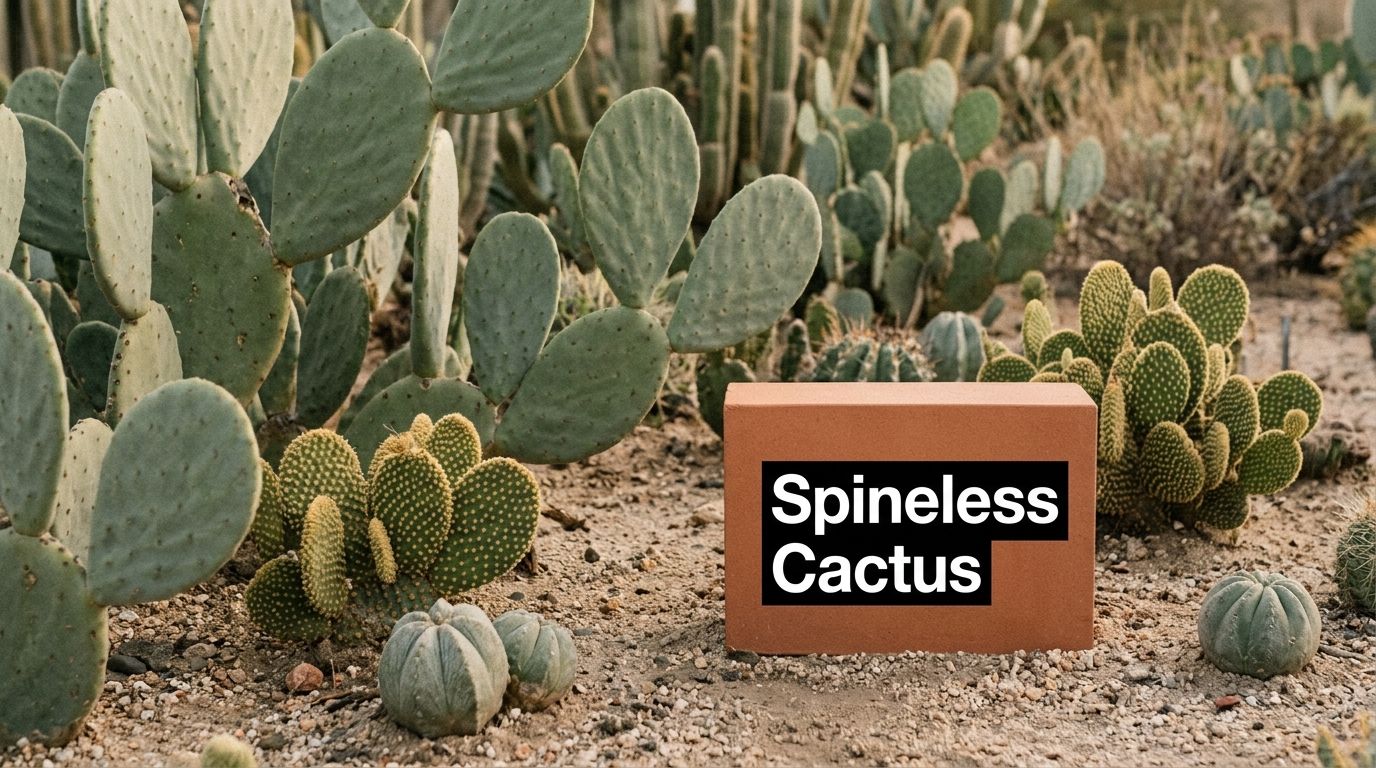

The best spineless cactus for outdoor design depends on placement: choose Totem Pole Cactus ‘Major' for a spineless architectural focal point, Ellisiana for greater cold tolerance, and larger Opuntia or Hedge Cactus forms for screening where conditions allow. The strongest candidates range from 5–6 ft outdoor accents to plants capable of forming substantial screens, so mature scale and winter exposure matter as much as drought tolerance.
Start With the Site, Not the Cactus
The popular advice is to choose the toughest-looking desert plant and place it in the driest corner of the yard. That approach misses the buying decision. Spineless cactus isn't automatically a deep-desert plant, and historical evidence shows that cultivated spineless Opuntia can perform best with some rainfall or irrigation rather than extreme aridity. Early accounts of Luther Burbank's spineless Opuntia even noted that the plants “needed water” to grow at the promised rate, while harsh conditions could trigger regrowth of spines as a defense response. The same account identified cold tolerance as a major limitation, with economically useful spineless cactus not known to thrive below about 10°F, later revised to 20°F in the historical discussion. The International Society for Horticultural Science documents this historical context.
That makes the best spineless cactus for site-matching purchase, not a universal winner. Totem Pole Cactus ‘Major' suits a modern entry, patio, walkway, or rock garden where vertical form matters. Opuntia cacanapa ‘Ellisiana’ is the stronger choice for colder inland areas. Larger Opuntia and Hedge Cactus forms can create screening or informal boundaries in warm regions, provided the site offers full sun and rapid drainage.
“Spineless” also deserves careful reading. Some selections are completely spineless, while others may produce glochids or occasional juvenile spines. Before you buy, compare mature height, mature spread, cold tolerance, handling risk, container performance, drainage needs, sourcing, delivery format, and acclimation guidance. The Cactus Outlet is a relevant source for large cacti and related agaves, aloes, euphorbias, and succulents, with product descriptions and care information that help buyers compare outdoor-ready plants without choosing from a photograph alone.
1. Totem Pole Cactus ‘Major' for a Spineless Architectural Focal Point
Totem Pole Cactus ‘Major' is the clearest recommendation when safety and sculptural impact carry equal weight. Its smooth, knobby, columnar form creates strong vertical structure in a xeriscape, rock garden, patio composition, walkway bed, or container display. Unlike many columnar cacti, this form is described as completely spineless, making it a better fit near household circulation areas where a heavily armed plant would create a recurring hazard. See the Totem Pole Cactus ‘Major' listing from The Cactus Outlet.
The plant's strength is visual rather than fast coverage. It's slow-growing and needs room for its eventual height, so buy it as a deliberate focal point rather than a quick privacy solution. A large specimen can supply immediate architectural weight, while a smaller purchase gives you a developing centerpiece that needs careful long-term placement.
Practical rule: Use ‘Major' where people look at the plant from close range, but don't use it as a substitute for a screen.
Best placement and buying considerations
Choose full sun, gritty or sharply draining media, and a position that doesn't collect irrigation or stormwater. The Cactus Outlet's product information provides care guidance for drought-tolerant, sun-loving placement, minimal watering, and well-draining media. Those details matter during shipping and installation because a plant can arrive healthy yet struggle if its roots stay wet after planting.
For patio buyers, the container option is especially useful. A pot lets you control drainage and move the plant under protection when the climate is too cool or damp. It also lets designers place a strong vertical accent beside a doorway, pool terrace, or modern wall without committing the plant to a permanent bed.
Advantages
- Safer surface: The completely spineless form is appropriate for patios, walkways, and homes with children or pets.
- Architectural silhouette: Upright columns add height and modern structure without relying on flowers.
- Low-water role: It suits xeriscapes, rock gardens, and containers when planted in fast-draining media.
- Specialist sourcing: The product page includes size options, care guidance, and climate information for online buyers.
Trade-offs
- Slow development: It isn't the right purchase when you need a rapidly filling screen.
- Climate limits: Cool, damp climates require a protected microclimate or indoor winter protection.
- Space planning: Measure for eventual height before placing it below eaves, near utilities, or beside a narrow access route.
For more placement ideas and care context, use The Cactus Outlet's guide to Totem Pole Cactus landscaping. This is the best spineless cactus for landscaping when the brief calls for one bold, low-contact statement plant rather than broad coverage.
2. Pachycereus schottii f. monstrosus for a Modern Column
Pachycereus schottii f. monstrosus is another Totem Pole Cactus, but buyers should treat it as a separate sourcing option rather than assume every listing represents the same plant or purchase format. Its smooth, irregular ridges and nearly absent spines create a sculptural column that works especially well in modern desert designs, courtyard beds, and restrained gravel compositions. Planet Desert lists Pachycereus schottii f. monstrosus with nursery size options.
This form is a focal plant, not a hedge. It grows slowly and can take years to reach a mature size, which makes a larger nursery specimen more practical when the design needs immediate presence. A smaller plant works in a container or developing rock garden, but buyers should understand that the final composition will mature gradually.
Match the column to the winter site
The plant suits warm, dry outdoor spaces commonly associated with USDA Zones 9–11, as described in the listed product information. Its cold sensitivity is the main trade-off. Damage can occur below roughly the mid-20s°F, so this isn't the correct outdoor purchase for a frost-prone site unless you can provide a protected microclimate or move the plant under cover.
Plant it in gritty soil that drains freely after irrigation. Keep the stem clear of wet mulch and avoid placing it where roof runoff lands. For online delivery, inspect the plant before planting, support a tall specimen during installation, and give it a gradual transition from protected nursery conditions to intense outdoor sun.
“A large Totem Pole specimen creates structure immediately. A small one creates a long-term project.”
Use this cactus when you want a quiet, almost stone-like vertical form beside a wall, entry court, or open gravel field. It's less useful where the goal is privacy, quick screening, or broad low planting. Compare the supplied size, container format, and care information before checkout, because the cost and establishment timeline change substantially with specimen scale.
3. Opuntia cacanapa ‘Ellisiana' for Cold-Tolerant Pad Structure
Opuntia cacanapa ‘Ellisiana' is the strongest choice when you want the recognizable pad form of prickly pear without relying on a frost-free climate. It forms a bushy plant that can reach about 4–6 ft tall and 3–6 ft wide, making it suitable for massing, focal planting, informal screening, and low privacy structure. Eco Garden Oklahoma describes the mature scale and landscape uses of ‘Ellisiana'.
The selection is also positioned as a premium low-maintenance plant, with a typical mature size of about 5–6 ft tall and 3+ ft wide, full-sun performance, strong drought tolerance once established, and a USDA hardiness range of 6–10. MasterScapes provides these landscape characteristics for spineless prickly pear ‘Ellisiana'. That range makes it the practical recommendation for inland buyers who can't use tender columnar cacti outdoors year-round.
Where Ellisiana earns its place
Use it in a sunny dry border, behind a low retaining wall, across a slope, or in a repeated planting where pads supply horizontal mass. It's more useful than Totem Pole Cactus when the design needs width and seasonal interest rather than one narrow vertical accent. Its flowers and fruit add ornamental change, while the reduced spine profile makes handling and close placement easier.
Cold tolerance still depends on drainage. University and horticultural references list ‘Ellisiana' around 10°F, and another independent nursery source describes survival below 10°F and about 10.4°F in very well-drained soil. Kansas Plant Farm provides the lower-temperature guidance. A Texas A&M-style handout also lists ‘Ellisiana' at 10°F.
Buyers should still handle pads with gloves. Spineless Opuntia can retain tiny glochids, and stress may produce occasional defensive structures. Before ordering, compare the exact selection, supplied plant size, and winter guidance. The Cactus Outlet's practical prickly pear cactus guide can help you evaluate pad-form plants against your intended landscaping function.
4. Opuntia ficus-indica ‘Burbank Spineless' for Warm Screens
Opuntia ficus-indica ‘Burbank Spineless' is the right purchase when a warm-climate yard needs a substantial pad-form shrub with both ornamental and culinary value. The Luther Burbank selection group is promoted as nearly spineless and is associated with edible pads, called nopales, and edible fruits, called tunas. In a yard, those broad pads can create a substantial informal screen or hedge where the site stays warm and winter protection is available if needed. Territorial Seed describes the selection's edible and landscape uses.
This isn't the safest choice for bare-hand handling. “Nearly spineless” does not mean glochid-free, and occasional tiny structures can remain on the pads. Keep the plant away from narrow paths, children's play routes, and places where routine pruning would require frequent contact. Use gloves and plan the mature footprint before placing it near gates, walls, or service access.
Choose it for breadth, not cold performance
Burbank Spineless is better suited to warmer garden areas than the hardier ‘Ellisiana' selection. The listed guidance places it around Zones 7–10 with protection, but buyers should rely on the supplied cultivar information and their local winter exposure rather than treating that range as a guarantee. Frost-free or strongly protected conditions make the selection easier to manage, especially when the design depends on a large, persistent screen.
The plant's strongest commercial advantage is versatility. It can serve as a specimen, informal hedge, edible design element, or broad background planting. Major seed and nursery sellers provide shipping and growing information, which helps buyers compare source policies before placing an order. That sourcing detail matters more for a large Opuntia than for a small container accent because damaged pads and winter timing can affect establishment.
Use it when the project brief values substantial shrub structure and edible production. Choose ‘Ellisiana' instead when cold tolerance and safer close placement matter more than culinary use. Choose a columnar cactus when the design needs height without width.
5. Opuntia gomei ‘Old Mexico' for a Scalloped Hedge
Opuntia gomei ‘Old Mexico' earns attention through pad shape. Its large, scalloped edges create a more ornamental outline than a plain pad wall, while bright yellow flowers add seasonal contrast. The selection forms a shrub around 3–6 ft, according to the listed nursery description, so it can work as a specimen, low screen, or informal hedge in Southwest and Texas yards. Nativo TX presents the selection's pad form, flowers, scale, and regional use.
This is a design-first Opuntia. Use it where the planting will be seen from a patio, driveway, or garden room, and give the pads enough room to read as individual forms. A repeated row can create a boundary, but it won't produce the narrow, uniform wall associated with a columnar fence cactus. Its broad habit needs measured spacing and a maintenance path outside the planting.
Handle the label carefully
The selection is described as spineless, but mature plants or stressed growth may still produce small spines or glochids. Wear gloves when unloading, planting, or pruning, and don't place it where visitors must brush past the pads. That safety qualification makes ‘Old Mexico' less suitable for a tight walkway than a spineless Totem Pole Cactus, even though it's far friendlier than heavily spined prickly pear.
Heat and drought tolerance make it a logical choice for warm, low-water sites, but drainage remains essential. Prolonged winter wet can cause rot, especially in heavy soil or a low bed. Build a raised or sharply draining planting area before the plant arrives rather than trying to correct saturated soil after installation.
Choose ‘Old Mexico' when the buyer wants a decorative hedge with distinctive pad edges, not a perfectly thorn-free plant. For online purchases, confirm the exact clone, supplied pot size, and seasonal handling instructions. A smaller plant may establish well but won't provide immediate screening, while a larger specimen needs a clear delivery route and prepared planting space.
6. Cereus hildmannianus for Warm-Climate Screening
Cereus hildmannianus, commonly called Hedge Cactus, earns consideration as a warm-climate screening plant because it grows into a tall, tree-like structure. It can define a boundary, support a living fence, or form a vertical backdrop. Established plants also produce night-blooming white flowers and apple-like fruits, adding seasonal interest to its main structural role. Planet Desert describes Hedge Cactus, its role as a screening cactus, and mature characteristics.
Treat the “spineless” label as a maturity-related detail, not a guarantee. Mature specimens are usually spineless or have only short spines, while juvenile plants may still carry spines. For a walkway, pool edge, or busy patio, confirm the actual supplied plant before purchase. A young specimen may not yet have the smoother surface expected from mature growth.
Match the screen to climate and access
Cereus hildmannianus fits full sun, heat, and drought in warm regions commonly associated with Zones 9–11. It is not frost-hardy. Buyers in colder areas should provide protected cultivation or container placement, or select another cactus. Regular freezing can turn a cold-sensitive screen into a costly replacement project.
Use it only where the planting bed can accept tall vertical growth and installers can reach the planting line without contacting young stems. Regional desert nurseries may offer larger specimens and local delivery, but availability, delivery terms, and supplied size vary by seller. Confirm those details before ordering, and review the guidance on Cereus hildmannianus as a columnar screening cactus.
Placement decision: Choose Hedge Cactus for a warm boundary with long-term height, not a narrow family walkway unless the delivered specimen is safely mature and the bed allows further growth.
This cactus suits a designer or contractor brief better than a casual patio purchase. Prepare drainage, access, and the final height plan before delivery. If a smaller Opuntia provides enough screening, choose it for easier scale control. Choose Hedge Cactus when the site is warm and the design calls for a dramatic living fence with strong vertical presence.
7. Astrophytum myriostigma for Containers and Tight Courtyards
Astrophytum myriostigma, or Bishop's Cap, is the compact specialist in this comparison. Its naturally spineless, ribbed, star-like form works in containers, dry rock gardens, small courtyards, and collector-style displays where a large sprawling Opuntia would overwhelm the space. Planet Desert offers Bishop's Cap through its Astrophytum collection.
The plant's appeal is symmetry and control. It delivers a sculptural specimen without requiring a broad planting bed, and specialty cactus retailers commonly offer multiple nursery sizes. Some listings ship plants bare-root, so buyers should prepare a well-draining container and handle the root system carefully on arrival.
Make the container the climate solution
Bishop's Cap is less cold-hardy than ‘Ellisiana' and is best suited to Zones 10–11 or container culture in cooler areas, based on the listed nursery guidance. A container lets you move the plant under cover for winter, but it also makes drainage your responsibility. Use a pot with generous drainage holes and a gritty succulent mix, then keep the plant away from saucers that hold standing water.
Its slow growth means the plant won't rapidly fill a large courtyard bed. That's an advantage when the design needs a stable accent, but a disadvantage when a buyer wants instant mass or privacy. It's also not the correct choice for a hedge, screen, or broad slope planting.
Place Bishop's Cap where its ribbed geometry can be viewed up close, such as on a patio table, raised plinth, entry shelf, or small rock garden. A specialist seller can provide current size and shipping details, so compare the exact plant format before purchase. For tight spaces and winter-sensitive climates, this is the best spineless cactus for landscaping when container control matters more than outdoor scale.
Top 7 Spineless Cacti: Landscaping Comparison
| Item | Implementation complexity 🔄 | Resource requirements ⚡ | Expected outcomes 📊 | Ideal use cases 💡 | Key advantages ⭐ |
|---|---|---|---|---|---|
| Totem Pole Cactus "Major" (Spineless) | Low care; slow growth 🔄 | ⚡ Very low water; full sun; well‑draining mix; room for height | 📊 Dramatic vertical focal point; long‑term specimen ⭐⭐⭐ | Xeriscapes, containers, patios, high‑traffic areas | ⭐ Spineless for safety; strong architectural form; vendor support |
| Pachycereus schottii f. monstrosus (Totem Pole) | Low maintenance; very slow to mature 🔄🔄 | ⚡ Low water; gritty soil; warm site; large eventual footprint | 📊 Long‑lived architectural column; slow size gain ⭐⭐⭐ | Desert/modern landscapes, specimen plantings | ⭐ Nearly spineless; bold vertical impact; nursery availability |
| Opuntia cacanapa 'Ellisiana' (Ellisiana) | Easy; reaches compact size in ~5 yrs 🔄 | ⚡ Low water; fast‑draining soil; tolerant cooler zones | 📊 Shrubby pad form with flowers/fruits; medium growth ⭐⭐ | High‑traffic yards, mixed xeriscapes, ornamental edible use | ⭐ Spineless pads; showy flowers and fruit; good cold tolerance |
| Opuntia ficus‑indica 'Burbank Spineless' | Easy; watch for occasional glochids 🔄 | ⚡ Low water; prefers warm climates; space for screening | 📊 Substantial shrub/screen; edible pads/fruits ⭐⭐ | Edible gardens, warm‑climate screens and hedges | ⭐ Culinary value; established cultivar; widely available |
| Opuntia gomei 'Old Mexico' (Spineless) | Easy; occasional small spines/glochids possible 🔄 | ⚡ Low water; excellent drainage; 3–6 ft habit | 📊 Ornamental scalloped pads and flowers; good hedge potential ⭐⭐ | Southwest/Texas landscapes, hedges, specimen plants | ⭐ Distinctive scalloped pads; strong regional popularity |
| Cereus hildmannianus (Hedge Cactus) | Low–medium; juveniles may have spines 🔄🔄 | ⚡ Low water; full sun; needs vertical space | 📊 Tall living fence/screen; night blooms and fruit ⭐⭐ | Living fences, large xeriscapes, screening | ⭐ Maturely spineless; effective tall screen |
| Astrophytum myriostigma (Bishop's Cap) | Low care; slow and sensitive to rot 🔄 | ⚡ Very low water; excellent drainage; best in containers/warm zones | 📊 Sculptural, fully spineless container specimen ⭐⭐⭐ | Containers, rock gardens, tight courtyards | ⭐ Naturally spineless; strong architectural symmetry; safe for close spaces |
Buy for the Climate You Actually Have
The best spineless cactus for your site is the one that performs in the conditions you can provide. Choose Totem Pole Cactus ‘Major' when the project needs a completely spineless architectural focal point near a patio, walkway, or entry. Choose Pachycereus schottii f. monstrosus for a similar sculptural column from a specialty source, but reserve it for a warm, dry location. Choose ‘Ellisiana' when cold tolerance, pad structure, and broader use matter most.
Use Burbank Spineless and ‘Old Mexico' for warm-climate shrub structure, but treat both as nearly spineless selections that may still carry glochids. Choose Hedge Cactus for a living boundary where the climate supports it and the planting line has enough room. Choose Bishop's Cap for a container, courtyard, or compact rock garden where winter protection and close viewing are more important than screening.
Before checkout, verify the following:
- Climate fit: Compare the supplied hardiness guidance with the cold conditions at your property. Historical evidence shows that cold tolerance is a key selection limit for spineless Opuntia, and “spineless” alone doesn't identify a plant as cold-hardy. The historical horticultural account explains this limitation.
- Mature footprint: Measure both height and spread, then mark the planting area and delivery route. A plant that fits the photograph may not fit the finished garden.
- Garden function: Decide whether you're buying a focal point, screen, hedge, patio specimen, container accent, or massed pad planting.
- Safety profile: Inspect the product description for terms such as completely spineless, nearly spineless, glochids, and juvenile spines. Wear gloves even when a listing uses “spineless.”
- Drainage: Select full sun and fast-draining soil or media. Salinity can be a bigger limitation than drought in real-world settings, particularly near coastal sites, reclaimed-water irrigation, and parking-lot medians. CGIAR material documents Opuntia's greater sensitivity to salinity than water stress.
- Container strategy: Use a container when winter protection is needed, especially for Bishop's Cap or tender Totem Pole forms. Bring containers under cover before cold, wet conditions become a problem.
- Water expectations: Don't starve every spineless cactus equally. Field research recorded Opuntia transpiring 285 mm of water while producing 17,670 kg of dry matter per hectare, with a transpiration water-use efficiency of 162 kg H2O per kg dry matter. The field validation study provides these measurements. Use the evidence as a reminder to match irrigation to establishment, rainfall, soil, and climate rather than treating extreme drought as the goal.
- Shipping and acclimation: Prepare the planting site before delivery, inspect the plant and packaging on arrival, and transition shipped plants gradually into intense outdoor light. A cactus moved straight from protected conditions into harsh sun can suffer exposure stress even when the species is drought-tolerant.
- Retailer support: Compare product descriptions, current size options, care guidance, delivery format, packaging information, and customer support before ordering. The Cactus Outlet's large-cactus and succulent catalog gives buyers a place to compare Totem Pole Cactus with related agaves, aloes, euphorbias, and other garden specimens without treating every cactus as interchangeable.
For most homeowners, ‘Ellisiana' is the most adaptable outdoor starting point. For a premium modern focal point, buy Totem Pole Cactus ‘Major'. For screening, select a large Opuntia or Hedge Cactus only after confirming warm-climate performance, mature scale, and safe clearance. That decision process will save more work than choosing a plant based on drought tolerance alone.
The Cactus Outlet offers large cacti and succulents for garden focal points, patios, containers, and dry-climate planting designs, including the spineless Totem Pole Cactus ‘Major'. Compare product descriptions, care guidance, size options, and related agave, aloe, euphorbia, and cactus collections at The Cactus Outlet before choosing the specimen that fits your climate and space.