
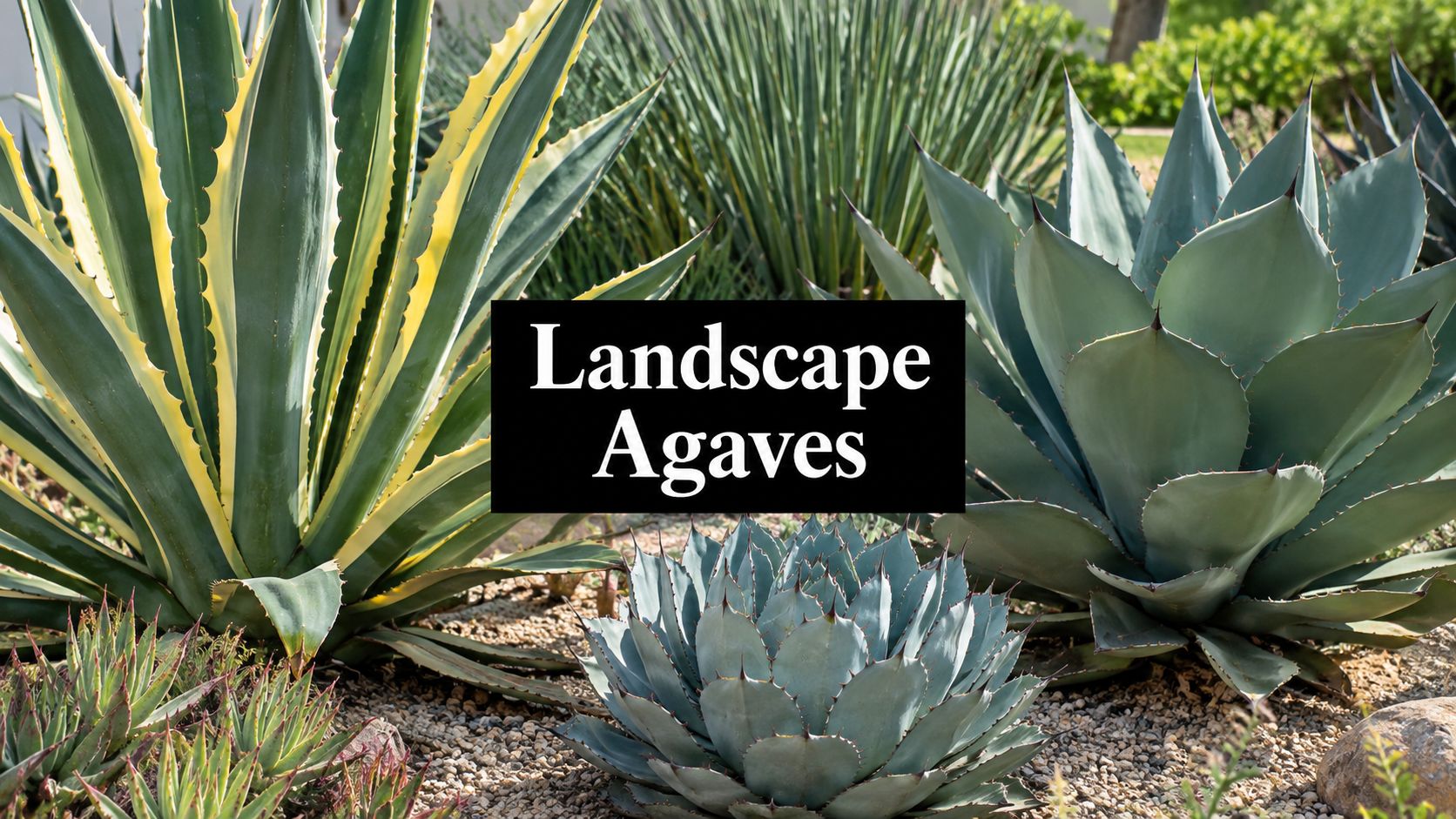

You find the perfect agave in a garden photo, order one online, and then discover the problem after delivery. The rosette is too wide for the entry bed, the leaves reach into the walkway, or winter rain sits around the crown until a plant advertised as hardy begins to fail. A beautiful agave in the wrong place becomes a costly garden correction.
The best agave varieties for landscaping aren't one universal winner. The right choice depends on the job: a broad focal point, a compact entry accent, a cold inland rock garden, a patio container, or a dry bed that receives winter rain. This guide matches varieties to mature size, cold tolerance, moisture conditions, and placement role, so you can shortlist plants before buying a large specimen online. You'll also see how to plan spacing, drainage, delivery acclimation, and long-term maintenance while exploring the Agave collection from The Cactus Outlet.
Introduction Why the Right Agave Makes or Breaks Your Landscape
A dramatic century plant can look perfectly proportioned in a nursery photo, then overwhelm a narrow front bed within a few growing seasons. Its rosette reaches over the path, leaving too little clearance for people, tools, or eventual removal. A supposedly cold-hardy agave can fail for a different reason when planted in a low spot. Winter water around the crown, not freezing temperatures, becomes the problem.
I specify agaves by garden role, not appearance alone. Agave americana suits a wide, open bed. Agave parryi fits a tighter rock garden. Agave neomexicana deserves consideration where severe cold sets the limit, while Agave ovatifolia provides a broad blue-gray form without the full footprint of a giant century plant. Drought tolerance does not make these plants interchangeable. Their mature spread, cold response, and tolerance of seasonal moisture differ enough to determine where each one belongs.
Agave americana makes a useful reference point. A 2022 review reports that it can survive with as little as 200 mm of annual rainfall, has optimal water inputs around 552 mm per year, and tolerates minimum temperatures near -10°C. The review also records an average native rainfall range of 600 to 800 mm. That range matters when choosing a site. The plant handles dry conditions, but drainage and seasonal moisture still affect performance. The 2022 review provides the rainfall and temperature figures for Agave americana.
Design rule: Choose the agave that fits the mature bed, not the one that looks best in the shipping pot.
The practical payoff is clear: fewer pruning conflicts, less supplemental irrigation after establishment, better sightlines, and less risk when removing a heavy mature plant from a cramped bed. To save time on yard work, select for final dimensions and site tolerance before prioritizing color or silhouette.
How to Choose the Right Agave for Your Site and Style
A narrow entry, wet winter bed, or exposed sunny slope each calls for a different agave. Screen every candidate through four practical filters before comparing color and shape. This prevents a striking nursery plant from failing its assigned role.
Start with mature size
Treat an agave like outdoor furniture. A large sectional does not belong in a narrow entry, and a giant rosette should not sit beside a walkway because its nursery size looks manageable. Measure the bed, mark the circulation route, and check mature height and width. Agave ovatifolia reaches about 2 to 4 feet tall and 3 to 5 feet wide, while Agave americana grows substantially larger. That difference decides whether a plant works as an entry accent or an open-bed focal point. University of California guidance compares mature agave dimensions and garden uses.
Separate cold tolerance from wet-winter tolerance
Freezing temperatures and saturated soil create different tests. Cold hardiness concerns temperature. Wet-winter tolerance concerns how the crown and roots handle moisture during the cold season. Extension guidance covers agaves ranging from frost-tender types to species tolerating about -20°F, and identifies species that handle wet winters better than others. Central Texas Gardener discusses species-specific cold and wet-winter performance.
Match sun and drainage
Strong sun suits most agaves, but it cannot compensate for compacted, slow-draining soil. Use a raised bed, slope, or sharply draining soil profile wherever water lingers. Established agaves rarely need supplemental water. During very dry summers, give deep, infrequent irrigation instead of frequent shallow watering. California extension guidance explains established-water needs and irrigation approach.

Consider growth rate and maintenance
Slow-growing, compact agaves stay easier to manage near paths and walls. Agave victoriae-reginae suits tight designs because its compact form reduces pruning and offset-management conflicts. Agave parryi brings small, sculptural geometry to sunny rock gardens. For a broader introduction before shortlisting plants, read this guide to the wonderful world of agaves.
Use this checklist before buying:
- Size: Can the mature rosette fit without blocking circulation?
- Temperature: Does the species tolerate your actual winter lows?
- Moisture: Will the planting area stay dry during cold, wet weather?
- Maintenance: Will offsets, leaf tips, or eventual removal create conflicts?
Best Agave Varieties for Landscaping Compared at a Glance
Choose an agave by the job it must do, its mature spread, and the conditions at the planting site. A broad rosette needs open ground, while a compact species can fit beside a path or in a container. Cold tolerance also depends on winter moisture and drainage, not temperature alone.
Agave Variety Quick Comparison by Garden Role
| Variety | Mature Size | Cold Hardiness | Best Garden Role |
|---|---|---|---|
| Agave americana | Up to about 6 feet wide | Near -10°C minimum tolerance | Large focal point for wide, open beds |
| Agave ovatifolia | 2 to 4 feet tall by 3 to 5 feet wide | About 5°F in university guidance, with some grower guidance near 0°F | Broad focal plant where form and cold tolerance must balance |
| Agave parryi | About 2 to 3 feet wide | Strong cold tolerance relative to many agaves | Rock gardens, smaller yards, entry accents |
| Agave victoriae-reginae | Compact, slow-growing form | Strong cold performance relative to many agaves | Tight borders, containers, formal accents |
| Agave neomexicana | Compact to moderate garden form | Down to -20°F | Cold, low-water sites and high-desert settings |
| Agave deserti | About 2 to 4 feet wide | Suited to dry, exposed placement | Desert groupings and open, sun-baked beds |
Independent landscaping guidance compares Agave parryi, Agave americana, and Agave deserti by mature width and landscape role. For Agave ovatifolia, California extension guidance supports the size and about 5°F tolerance. A separate grower account places it near 0°F, but that result depends on exposure and winter moisture. The grower's Agave ovatifolia discussion explains its form and cold-hardiness trade-off.
The buying decision is straightforward. Select americana when the bed has room for scale. Choose ovatifolia for a wide rosette with stronger freeze performance. Use parryi or victoriae-reginae for controlled geometry, neomexicana for the coldest dry sites, and deserti for exposed, sun-baked compositions. Confirm mature spacing before delivery, then match the plant to drainage and winter conditions rather than relying on a generic zone label alone.
Large Statement Agaves for Focal Points and Open Beds
A large agave belongs in an open bed, broad gravel garden, or spacious corner, not a narrow foundation strip. Its mature spread determines path clearance, sightlines, irrigation access, and how difficult removal will be later.

Agave americana for open-bed impact
Agave americana is the classic large century plant because it delivers immediate mass, performs in full sun, and tolerates very low rainfall when drainage is right. The referenced review records survival with as little as 200 mm of annual rainfall, optimal water inputs around 552 mm, and minimum temperatures near -10°C. Those Agave americana benchmarks are documented in the referenced review.
I specify it for broad gravel beds, large corner installations, and open desert-style gardens where the leaves can spread without entering circulation routes. Mature width can reach up to 6 feet, so measure the bed and reserve that footprint before delivery. The planting guide identifies Agave americana as a large focal plant and gives its approximate mature width.
Keep the crown away from narrow paths, door swings, and frequently serviced utilities. Near a walkway, rigid pointed leaves create a real access problem, especially as the rosette reaches full size.
Agave ovatifolia for the better-balanced focal point
Agave ovatifolia, or whale's tongue agave, is the better choice when you want a broad blue-gray rosette without the full scale of americana. University guidance places it at 2 to 4 feet tall and 3 to 5 feet wide, with hardiness near 5°F. A specialist grower reports survival near 0°F, giving designers another option when mature spread and winter exposure both matter. The grower's discussion covers its drought tolerance, form, and reported low-temperature performance.
Its broad leaves read clearly from the street, yet the plant fits more comfortably into a designed bed than a giant century plant. Use one specimen in gravel, or repeat it sparingly where each rosette has enough width to remain distinct.
Large does not mean “plant it wherever there's empty soil.” Design the bed around the plant's final footprint.
For immediate impact, compare large agave plants for sale only after measuring the installation site. The delivered plant needs a prepared destination, reliable drainage, and enough access for safe placement.
Compact and Cold Hardy Agaves for Small Yards and Tight Spaces

A narrow entry, compact courtyard, or small front bed has no room for a plant that outgrows its assigned space. Choose by mature width first, then match cold and winter moisture tolerance to the site. A compact agave can deliver strong geometry without forcing a path relocation or difficult removal later.
Agave parryi for rock gardens and entry accents
Agave parryi is the practical choice for a compact, sculptural rosette in a sunny, dry position. An independent planting guide places it at about 2 to 3 feet wide, so it fits beside an entry, in a small front yard, or among decorative rock more easily than a large americana.
Its value is proportion. The rosette still commands attention without consuming the entire bed. Repeat it in small groups only when each plant has enough visual space, or place one beside a gate, boulder, or gravel transition. This is the agave I specify when the planting needs a defined accent without future crowding.
Agave victoriae-reginae for controlled geometry
Agave victoriae-reginae suits formal borders, containers, and tight modern compositions where slow growth and orderly form matter. Its compact habit limits pruning, offset conflicts, and pressure along walkways. It also handles cold better than many agaves, although winter drainage still determines whether it performs well.
Use it when crisp geometry matters more than fast coverage. A row of compact rosettes can frame a gravel path without the bulk of a larger species. The trade-off is patience. Buyers get control and structure, not rapid fill.
Agave neomexicana for severe cold exposure
Agave neomexicana is the strongest recommendation for a cold, dry site. A plant guide describes it as extremely drought tolerant and able to withstand temperatures down to -20°F, making it a reliable choice for exposed, low-water conditions. The referenced guide documents Agave neomexicana's drought tolerance and temperature threshold.
Cold tolerance does not excuse wet soil. Put neomexicana in the raised, rocky, fastest-draining part of the property, especially where winter survival outranks maximum size.
| Site constraint | Strongest starting choice |
|---|---|
| Narrow entry or small rock garden | Agave parryi |
| Formal border or container | Agave victoriae-reginae |
| Cold, dry inland or high-desert site | Agave neomexicana |
| Broad bed with moderate winter cold | Agave ovatifolia |
Before ordering, review this cold-hardy agave guide to compare options for low-temperature sites, then confirm mature width and drainage at the planting location.
Planting Placement and Design Ideas That Last
A durable agave installation starts with the site, not the pot. Set each plant high enough to shed water, give it strong sun, and reserve enough clearance for its mature spread. Size, winter moisture, and access should determine placement before color or form.
Build the site around drainage
Winter drainage controls whether an agave survives cold weather. Standing water can kill a cold-hardy plant, while dry soil improves its ability to tolerate freezing conditions. Gardenia's cold-hardy agave guidance explains the relationship between drainage, dry soil, and freeze survival.
Use a raised or sloped bed wherever the ground holds water. Keep irrigation emitters away from the crown, avoid low points below downspouts, and set the plant above the surrounding grade instead of burying it to create a neat edge. Mineral mulch, gravel, and exposed soil around the crown reinforce the dry conditions agaves need.

Use a clear placement pattern
A specimen agave should frame a view, not block it. Place large forms in open beds, compact Agave parryi near rock transitions or entry accents, and Agave victoriae-reginae where a formal border needs controlled scale. Agave deserti reaches about 2 to 4 feet wide, so it fits dry, exposed areas and grouped desert plantings. The independent planting source gives Agave deserti's approximate width and recommended role.
Choose companions that reinforce the rosette. Aloes, euphorbias, and large cacti add height and texture, while gravel and stone create a stable visual ground plane. Keep thirsty plants on a separate irrigation pattern unless you are prepared to manage conflicting water needs.
Plan patio containers as structural objects
A large Agave americana requires a heavy container of 25 gallons or larger with excellent drainage for patio growing. The container guidance for Agave americana specifies the 25-gallon-or-larger threshold and drainage requirement. Lightweight pots become unstable as the plant gains mass, especially on exposed patios.
Give each substantial agave its own container. Select enough weight to balance the plant, confirm that water drains freely, and leave clear space around sharp leaves near seating areas and doors.
Installation rule: Drainage isn't an accessory to cold hardiness. It's part of cold hardiness.
After delivery, inspect the root zone and acclimate the plant gradually to its new sun exposure. Set the planting height correctly, water thoroughly when needed, and let the soil dry before watering again. The installation works when the rosette stays clear, the mature spread has room, and winter saturation stays away from the crown.
Where to Buy the Best Agave Varieties for Landscaping Online
The best buying decision follows a simple order. First, measure the mature space. Second, match temperature and winter moisture conditions. Third, choose the form and color that support the design. Reversing that order is how buyers end up with an oversized specimen in a narrow bed or a cold-hardy plant in a wet pocket.
For a large focal point, choose a specimen whose mature spread suits an open bed and whose delivery size matches your installation access. For a patio, prioritize a stable container plan and excellent drainage. For a compact border, compare slow-growing forms such as Agave victoriae-reginae with the broader geometry of Agave parryi. For colder low-water sites, put Agave neomexicana on the shortlist before considering appearance.
The Cactus Outlet supports this purchase process with online agave listings alongside large cacti, aloes, euphorbias, and other succulents. Use product descriptions to confirm the specific plant, inspect the stated size before ordering, and prepare the planting location before the specimen arrives. Homeowners can buy for an individual focal point, while garden designers and contractors can evaluate individual or bulk purchasing needs without splitting the planting plan across unrelated searches.
Don't chase minor variety keywords one at a time. Build one planting plan around mature size, drainage, cold exposure, and garden role, then buy the agaves that fit that plan. That approach produces a cleaner composition and avoids paying for a plant that never had the right site.
The Cactus Outlet offers agaves and other large cactus and succulent plants for outdoor focal points, rock gardens, patios, and container designs. Visit The Cactus Outlet to compare available agaves, choose plants that match your site, and start with a placement plan built around mature size and drainage.