

There's usually a spot in the yard that keeps bothering people. It gets strong sun all day. Smaller shrubs look lost there. Seasonal flowers burn out. You want one plant that can hold the whole composition together without begging for constant water.
That's where large agaves earn their keep.
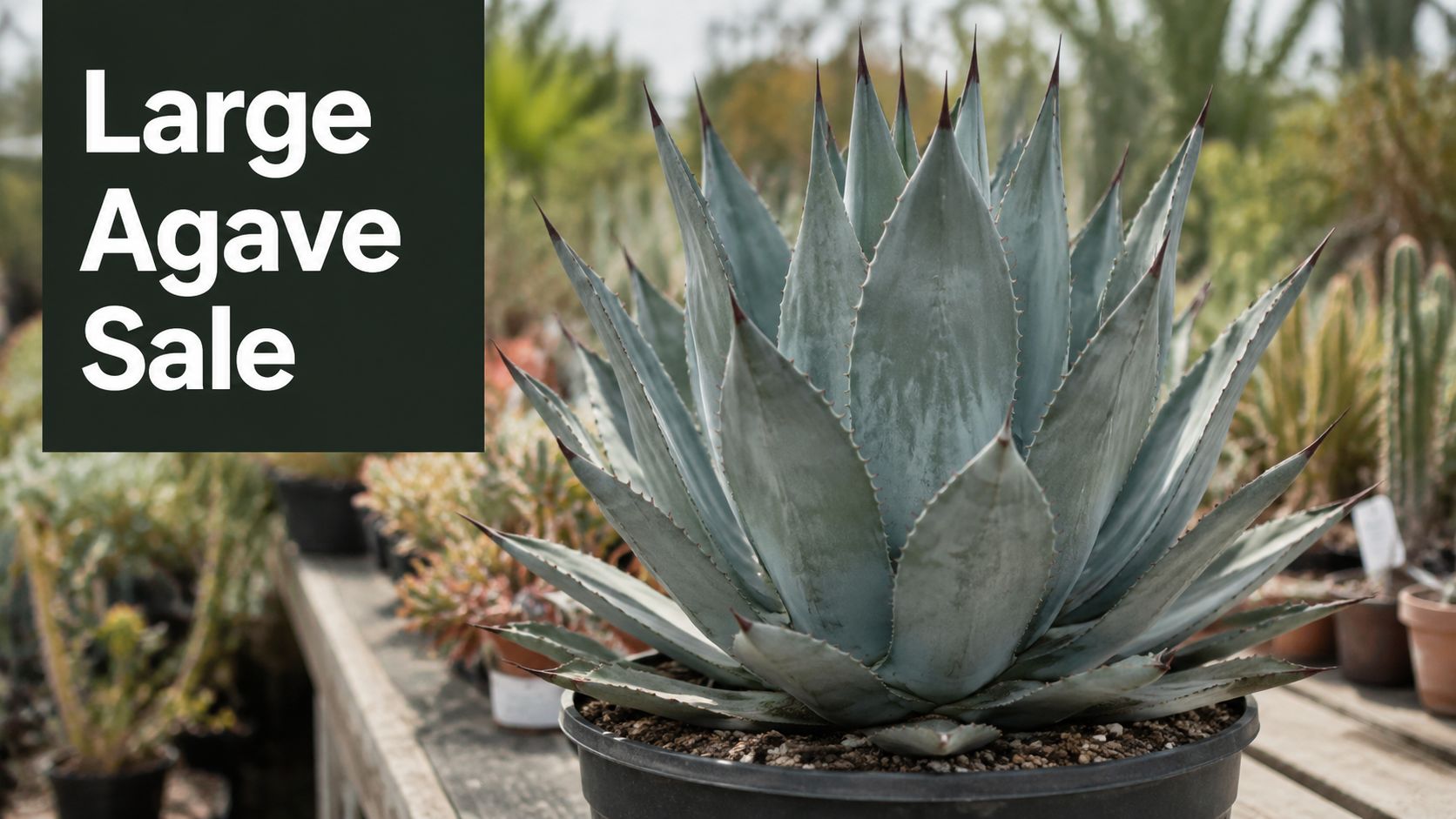
A mature agave doesn't read like filler planting. It reads like structure. In xeriscape work, I use them as living sculpture because they bring mass, geometry, and permanence in a way few drought-tolerant plants can. But shopping for large agave plants for sale isn't like picking up a few nursery perennials. Size changes everything. The plant is heavier, sharper, harder to move, more expensive to replace if planted badly, and much less forgiving of a poor site choice.
The good news is that a well-chosen large agave can anchor an outdoor space for years. The catch is that most buying guides spend too much time on beauty and not enough on logistics. Buyers need both.
Your Guide to Architectural Agaves
Large agaves work because they solve two design problems at once. They fill visual space, and they do it with a dry-climate plant form that still feels refined. In modern gardens, desert-style courtyards, pool surrounds, and gravel-based front yards, they give you that strong focal-point effect without relying on thirsty planting.
The agave category is also much broader than many buyers realize. The genus includes over 200 species, and at least one major seller lists 50+ varieties, which tells you this isn't a one-plant market but a deep category with room for both everyday outdoor plants and collector selections (Victory Nursery agave overview). That range matters because “large agave” can mean bold blue rosettes, softer forms, heavily armed species, or rare variegated plants that used to sit mostly in the collector world.
What buyers usually underestimate
The biggest mistakes happen before the plant even goes in the ground.
- They buy for the current pot size: A big nursery container looks substantial, but the mature footprint matters more than the purchase footprint.
- They ignore hazard zones: Most large agaves have serious spines, so the wrong placement near paths, entries, or pool edges creates a daily annoyance.
- They underestimate handling: A mature specimen is awkward to carry, difficult to rotate, and unpleasant to wrestle without preparation.
- They assume drought tolerant means foolproof: It doesn't. Agaves tolerate neglect better than soggy soil.
Practical rule: Buy a large agave the way you'd choose a boulder or a small tree. Treat it as permanent structure, not a flexible accent you can casually move later.
What works in real landscapes
The best results come from matching the plant to the space, then matching the site to the plant. That means choosing the right species, thinking through mature spread, checking how the leaves interact with people, and planning the delivery path before purchase day.
That's the difference between a dramatic focal point and a costly problem.
How to Choose the Right Agave Species
Species choice matters more than people think. Two agaves can both look blue and architectural in a nursery photo, yet behave very differently once planted. One may spread aggressively and carry dangerous terminal spines. Another may hold a tighter rosette and fit comfortably in a smaller bed. A third may offer a softer look that makes more sense near human traffic.

Start with function, not color
If you're buying large agave plants for sale for your outdoor space, ask these questions first:
- Where will people walk nearby: A fierce spine profile can be fine in a gravel island and terrible beside a front path.
- Is the plant meant to dominate or support: Some agaves command the whole scene. Others pair more easily with grasses, rock, and lower succulents.
- How much room do you really have: A plant can fit visually and still fail spatially.
- Do you want a collector look or an outdoor planting workhorse: Rare and variegated forms can be beautiful, but they also change the budget conversation.
Plant Delights notes it's offering “an increasing number” of rare, variegated agaves once “confined to the high-dollar collectors' market,” which reflects how collectible forms have become more available beyond specialty circles. The same collection also highlights why agaves remain popular in practical outdoor settings: they tolerate extreme heat, thrive in full sun, and are very drought tolerant (Plant Delights agave collection).
Popular Large Agave Species Comparison
| Species Name | Max Size (W x H) | USDA Hardiness | Spine Danger | Sun Needs |
|---|---|---|---|---|
| Agave americana | Large, broad rosette | Varies by site and climate | High | Full sun |
| Agave ovatifolia | Large, broad rosette | Varies by site and climate | Moderate to high | Full sun |
| Agave ‘Blue Flame’ | Large, upright rosette | Varies by site and climate | Moderate | Full sun |
| Agave attenuata | Large but softer in form | Varies by site and climate | Low relative to most agaves | Bright sun to strong light |
| Agave parryi | More compact than many large forms | Varies by site and climate | High | Full sun |
How I think about the main options
Agave americana is the classic big statement plant. It looks authoritative from a distance and instantly imbues its setting with an old California, Mediterranean, or desert-modern backbone. It also asks for respect. The leaves are large, the points are hazardous, and the plant needs serious room to feel intentional rather than cramped. If you're comparing forms and care habits, a solid background read on Agave americana plant care helps frame what living with this species is like.
Agave ovatifolia, often called whale's tongue agave, usually appeals to people who want a substantial specimen with a broad, sculptural shape that feels bold without looking chaotic. I like it in contemporary gravel gardens where the leaf shape can do the visual work.
Agave ‘Blue Flame’ is a designer favorite when buyers want a neater, more flowing silhouette. It often reads cleaner and less brutal than heavily toothed species, which makes it easier to integrate near patios or view corridors, though it still shouldn't be treated carelessly.
Agave attenuata is the exception people ask for when they want the look of agave without the same level of weaponry. Softer forms have obvious value around seating areas and tighter circulation routes. It's the species many homeowners wish all agaves were. They aren't.
A soft-looking agave doesn't just change the look of the bed. It changes who can live comfortably around it every day.
Why some plants cost more than others
Price differences usually come down to some combination of maturity, rarity, variegation, and how difficult the plant is to grow into saleable form. That's why a broad retail market can exist alongside collector-level demand. The category serves both buyers who want one dependable garden centerpiece and buyers who chase unusual markings, tighter form, or scarcity.
Choose the species first. Everything else gets easier after that.
Sizing Up Your Space and Budget
The hardest lesson with agaves is simple. You're not buying the pot. You're buying the future footprint.
For large agaves like Agave americana, mature plants can reach roughly 6 feet tall and 10 to 12 feet wide, which means the main design issue is horizontal spread, not just height (Planet Desert on Agave americana size). That kind of width changes where you can place the plant, how close you can safely walk past it, and whether the bed still has room for companion planting later.
Read the site from the outside in
Most buyers stand over the planting hole and think locally. That's a mistake. Start from the edge conditions.
Look at walkways, doors, pool traffic, utility access, view lines from inside the house, and the route needed to prune or clean around the plant later. A big agave can dominate a bed in a good way, but it can also trap maintenance access if it's dropped into the wrong location.
Here's what usually works better:
- Open gravel islands: These let the rosette read cleanly and give the leaves room to project without crowding people.
- Corner placements with breathing room: Good for dramatic silhouette, bad if the leaves start blocking windows or paths.
- Raised areas or mild slopes: Often better visually and practically because the crown stays proud and drainage tends to improve.
What usually doesn't work is squeezing a large agave into a narrow strip because the nursery specimen still looks manageable.
Budgeting for more than the plant
The plant price is only the first line item. With large specimens, the full budget often includes labor, delivery, protective gear, disposal of packaging, and sometimes help with placement. Even if the agave itself is a good value, the install can become the expensive part if access is tight or the bed needs drainage correction first.
A smaller plant shifts the equation. It costs less up front and is easier to handle, but it asks for patience. A larger specimen buys immediate structure and mature visual weight, yet it raises the stakes if you make a bad placement decision. Neither route is always better. It depends on whether you value instant impact more than flexibility.
Buy the biggest agave your site can support, not the biggest one your budget can barely tolerate.
A simple decision filter
If you're torn between sizes, use this shortlist:
- Can the mature rosette live there without touching circulation space?
- Can you install it safely without damaging the plant, the crew, or the hardscape?
- Will you still like that scale once offsets and leaf spread make the bed feel fuller?
If any answer is shaky, size down. In xeriscape design, restraint usually ages better than overstatement.
Navigating the Purchase and Shipping Process
Buying local and buying online are different experiences, and large agaves expose that difference fast. At a local nursery, you can inspect leaf damage, spine profile, symmetry, and overall proportion in person. Online, you get access to broader selection and more specialized inventory, but you need to ask sharper questions before ordering.

Local nursery vs online specialist
A local yard is easier when your priority is seeing the actual specimen and avoiding shipping uncertainty. It's also easier to judge whether the plant has been grown hard in sun or pushed under softer conditions. You can often reject a plant with bent leaves, hidden damage, or an awkward lopsided shape on the spot.
Online sourcing makes sense when local inventory is thin or you're hunting a specific form. Retailers with deep succulent inventory can offer useful species range, including resources on plants like blue agave for sale, which helps buyers compare form and use before committing. The trade-off is that the transaction demands more trust and more planning on your end.
What to ask before you buy
Don't stop at “How big is it?”
Ask practical questions such as:
- Is it shipped in soil or bare root: Bare root can be normal for succulents, but you should know what you're receiving.
- How is the crown protected: The center is where cosmetic damage hurts the look most.
- What condition should be considered normal on arrival: Minor scuffs are different from structural breakage.
- What's the unloading expectation: Some plants arrive as manageable parcels. Others are an awkward event.
Handling is where buyers get surprised
Most large agaves are dangerous to handle casually. That isn't fearmongering. It's basic plant reality. Many have hazardous leaf tips and spines, which is one reason placement near walkways or pools needs more thought than most sales listings acknowledge (discussion of spine hazards and placement concerns).
Use the right setup when the plant arrives:
- Heavy gloves: Thin gardening gloves won't do much against rigid tips.
- Eye protection: Leaf points sit right at face level when you pivot or lift.
- Moving blankets or thick cardboard: Useful for wrapping outer leaves during transport from curb to planting area.
- A dolly or extra hands: Weight and awkward shape are often a bigger issue than raw mass.
- Clear path in advance: Gates, steps, and decorative pots become problems fast.
If you wouldn't carry a sheet of metal barehanded through a narrow gate, don't carry a large agave that way either.
Shipping reality
A shipped agave may arrive with some cosmetic imperfection. That's not unusual. What matters is whether the crown is sound, the core is firm, and the plant hasn't been crushed or held wet in a way that invites rot later. Unbox it carefully, stage it in bright shade if needed, and don't rush a stressed plant straight into bad soil just because delivery day has arrived.
Planting Your Large Agave for Long-Term Success
Planting day decides whether the agave settles in or starts declining from the crown down. Most failures trace back to one issue. The site held too much moisture around the base.
Large agaves need at least six hours of direct sunlight daily and should be planted in well-draining soil with the crown kept above grade to reduce rot risk (Gardenia agave growing guide). That requirement matters even more with large specimens because they're expensive, heavy, and frustrating to replace.

Build the site before the plant goes in
A wide, shallow planting approach usually serves agaves better than a deep pit. You want the root zone to transition into surrounding soil without creating a bowl that traps water. In heavy ground, I prefer a slight mound or berm so the rosette sits proud and runoff moves away from the crown.
That logic is similar to what matters with other drought-adapted structural plants. If you're comparing root behavior and why soil conditions matter so much around desert forms, this overview of the yucca plant root system is useful context.
A planting sequence that avoids common mistakes
-
Choose the hottest, brightest appropriate spot
Full sun matters, but so does airflow and drainage. Avoid low pockets where irrigation or runoff collects. -
Dig wider than you think, not deeper
The hole should support lateral root establishment. Deep holes often settle and pull the crown too low. -
Set the plant high
This is not optional. Keep the rosette above grade so water doesn't sit at the base. -
Use mineral structure if your soil stays wet
Gritty amendments, decomposed granite, or pumice can help create the fast drainage agaves prefer. Don't turn the hole into a bathtub of rich organic matter. -
Water once, then back off
Initial watering helps settle the soil. Constant moisture afterward is where many expensive plants are lost.
For broader cultural basics and species-specific pointers, a practical companion read on how to grow agave plants can help buyers line up site prep with ongoing care.
Here's a quick visual walkthrough of the process:
What not to do
The classic failures are predictable:
- Burying the crown too low
- Planting into dense amended soil that stays damp
- Letting drip irrigation hit the rosette repeatedly
- Installing a huge specimen in a shady corner because it “fits” visually
A large agave forgives drought sooner than it forgives trapped moisture.
If you only remember one thing on planting day, remember that.
Long-Term Care and Landscape Design Ideas
Large agaves are low maintenance, not no maintenance. That distinction matters because a neglected specimen can look rough long before it dies. Lower leaves dry, old foliage clings, pups crowd the base, and the plant's sharp geometry gets lost if the surrounding composition isn't maintained.
What ongoing care actually looks like
The basic jobs are simple but not casual. Remove tired lower leaves carefully, clean up debris trapped beneath the rosette, and decide whether offsets support the design or clutter it. In a naturalistic desert planting, pups can help create age and repetition. In a clean-lined entry garden, they often need thinning so the main rosette stays legible.
Watch for obvious decline signals such as collapsing center growth, unexplained lean, or sudden loss of vigor. Agaves don't usually ask for much, so when a mature plant starts looking wrong, it's worth paying attention early.
Design ideas that age well

A single large agave works well as a focal point in a field of gravel, stone mulch, or low ground-hugging succulents. That approach lets the form do the heavy lifting. It's especially effective in front yards where one strong specimen can replace a muddled mix of small shrubs.
Grouping agaves takes more restraint. Repetition can look powerful, but only if spacing respects the mature forms and the leaf hazards. I prefer mixing one dominant agave with softer companions such as grasses or looser succulents so the contrast keeps the composition from feeling too rigid.
For homeowners building a broader desert-style palette around an agave centerpiece, local examples can help. If you want ideas for regional combinations and hardscape mood, this guide on how to transform your Peoria yard with desert plants shows the kind of layered, climate-appropriate planting language that pairs well with architectural succulents.
Good agave design balances force with relief. The rosette supplies the force. The surrounding plants and open space provide the relief.
A large agave should feel intentional from every angle. Give it room, keep the maintenance crisp, and it will carry the surroundings instead of fighting it.
If you're ready to compare real inventory, The Cactus Outlet offers large cacti and succulent plants, including agave options, with product details that can help you evaluate size, form, and suitability before buying.