
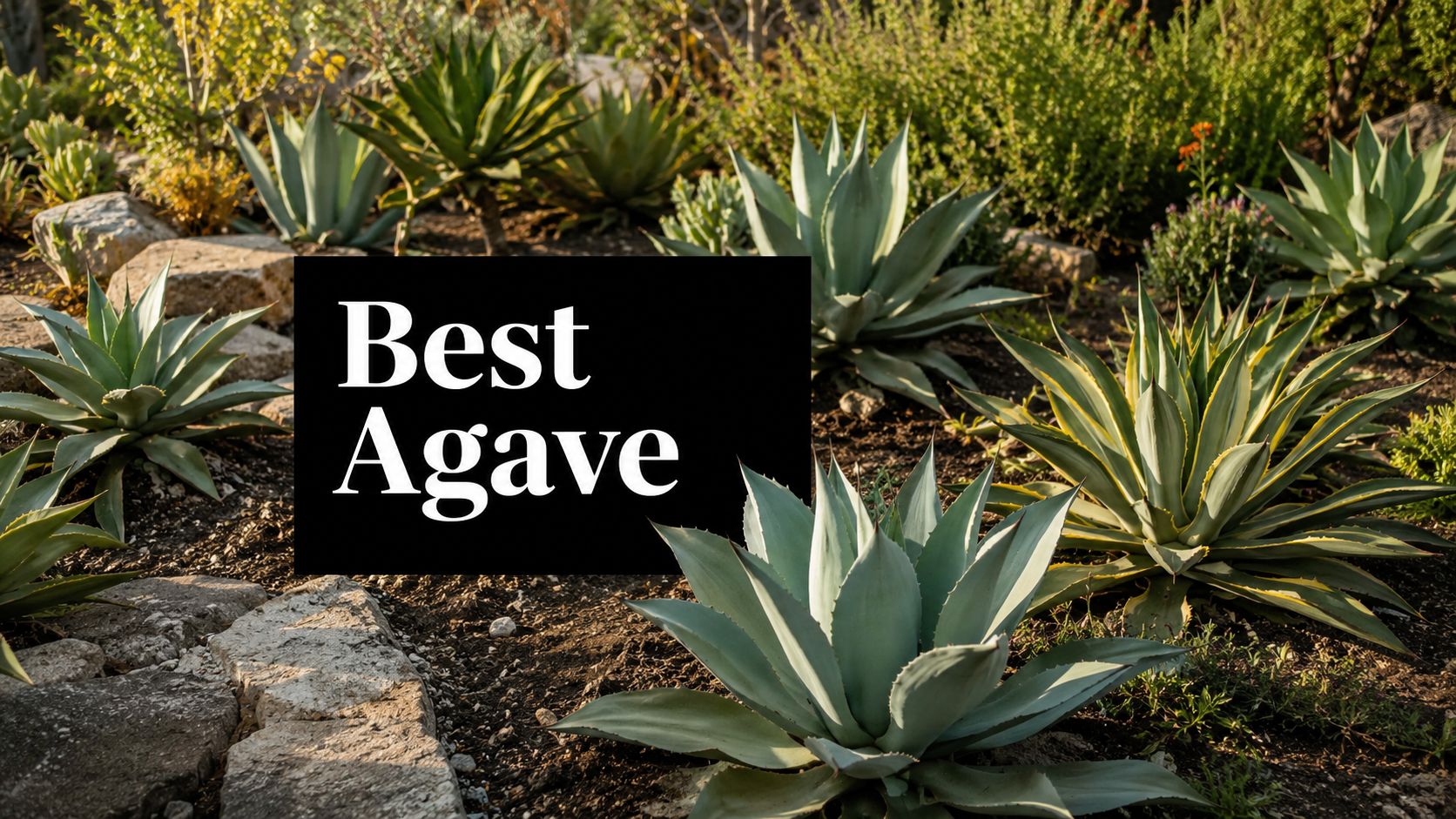

You're standing beside a bare planting bed with a tape measure in one hand and a nursery listing open on your phone. The agave in the photo looks perfect, but the questions to consider are less glamorous: How wide will it get, can it handle your winter, and will its spines or pups take over the path? Answer those before you order, and you can avoid an expensive replacement and a bed that needs redesigning later.
The best agave for your yard isn't the one with the most dramatic photograph. It's the plant whose mature footprint, cold tolerance, drainage requirements, and role in the design fit your property. The recommendations below are written for homeowners comparing large agaves online, planning a patio container, or choosing a long-term specimen for a xeriscape bed.
Choosing the Right Agave for Your Yard
Start with the planting space, not the product photo. Measure the bed's usable width, note nearby walkways and foundations, and imagine the rosette at maturity rather than at the size shown in the shipping carton. A compact agave can disappear in a broad front yard, while a large Agave americana can crowd a narrow entrance and turn routine trimming into a spine-management job.
Next, check climate. Agaves vary sharply in winter tolerance. Agave americana is commonly grown in USDA zones 8 through 10, while Agave parryi can survive around zone 5 and temperatures near -20°F when conditions are suitable, according to Central Texas Gardener's agave guidance. That temperature range doesn't mean every agave thrives in every cold region. Winter moisture and drainage matter just as much as the lowest temperature.
Then define the plant's job. A specimen accent needs presence and a clear viewing angle. A mass planting needs consistent form and manageable spacing. A slope plant must tolerate exposure and runoff without sitting in a basin. A patio agave needs a mature size that works in a container, not just a small nursery footprint.
Use this order before you compare colors
- Measure the mature footprint. Confirm the listed spread and leave practical clearance from paths, walls, and neighboring plants.
- Match the climate. Check the USDA zone, expected winter lows, rainfall pattern, and whether the planting site stays wet.
- Choose the role. Decide whether you need an accent, screen, massing plant, slope anchor, or container focal point.
- Compare appearance last. Blue leaves, variegation, and symmetry matter, but only after the plant can survive and fit.
A blue Agave tequilana may photograph beautifully, but that doesn't make it a sensible choice for a tight suburban driveway or a cold, wet zone 7 site. The right agave is the one whose mature spread, hardiness, and growth habit match the bed you already have. If you're shopping specifically for plants that can handle colder outdoor spaces, the cold-hardy agave guide is a useful place to narrow the list.
After this screening, any species page becomes easier to judge. In about a minute, you should be able to answer go or no-go by checking mature size, climate fit, drainage needs, and intended use.
Key Selection Criteria Buyers Often Overlook
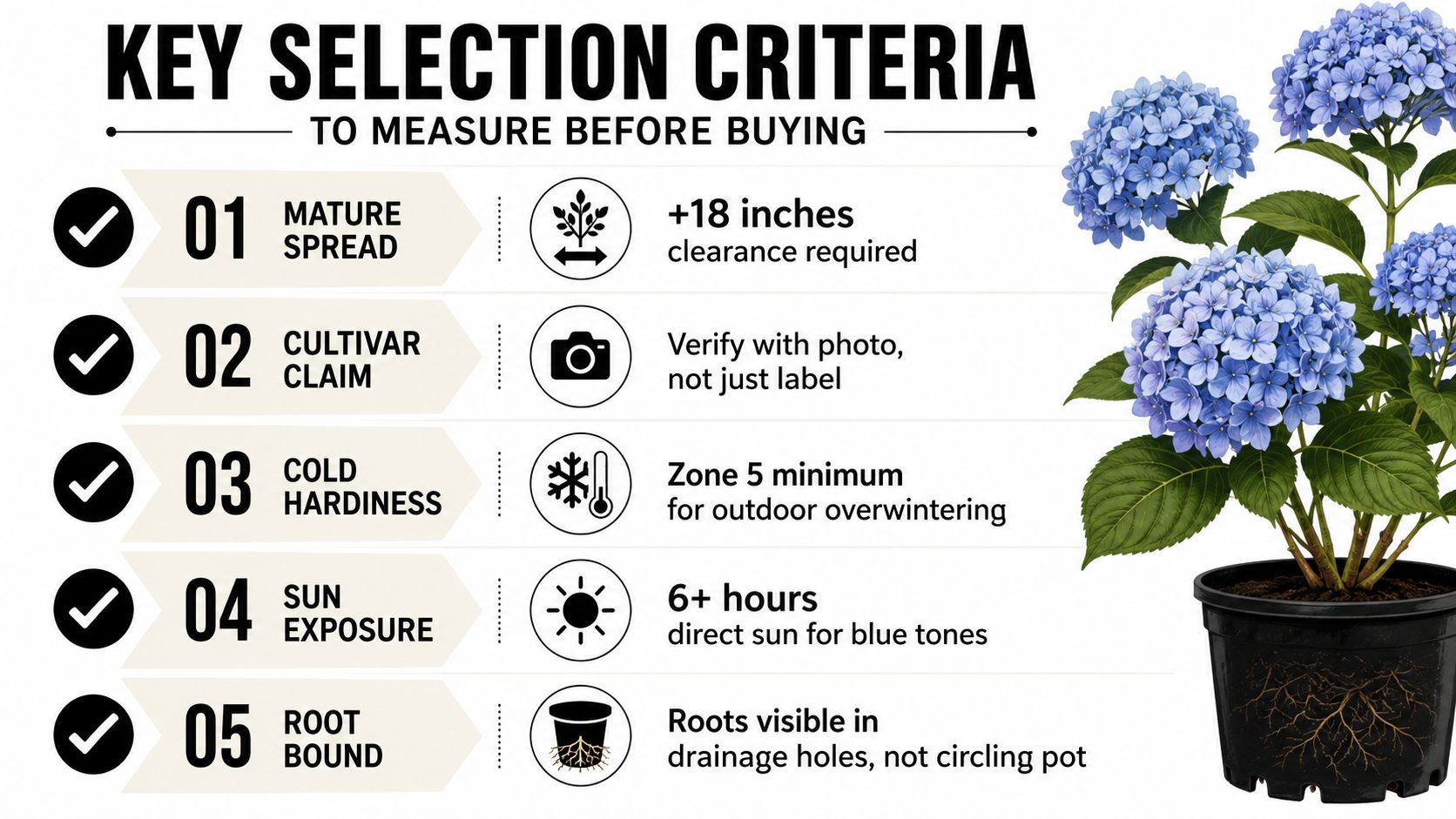
Nursery labels often emphasize color and form. Buyers need a more practical checklist. Before checkout, turn each selection criterion into something you can measure at home.
Start with spread and clearance
Use the mature diameter, not the current pot size. A compact Agave filifera ‘Compacta’ is listed around 1.5 to 2 feet wide and about 2 feet across, while Agave ovatifolia can reach roughly 30 to 70 inches across, according to this horticultural agave reference. Those plants belong in very different beds.
Give the mature rosette additional room for airflow, access, and pup removal. A plant that technically fits against a wall may still be a poor purchase if every leaf presses into the wall or blocks the only route to a gate. Treat cultivar dimensions as useful averages, not guarantees of the smallest possible plant.
Separate cold from winter wet
A hardiness number describes cold exposure, not a plant's ability to sit in saturated soil. Agave parryi may handle severe cold in a dry site, but the same plant can fail in a wet clay bed where melting snow or persistent rain keeps the crown damp. Planting slightly high, avoiding swales, and providing sharp drainage are central to reliable performance, as Rea and Sons Landscaping's climate-focused guidance explains.
Check habit and safety
A solitary rosette stays visually controlled. A heavy-pupping agave can become a colony that pushes toward a walkway and competes with nearby plants. Agave parryi var. truncata, for example, offers a compact form but can produce offsets, so allow access around the plant rather than wedging it into a narrow corridor.
Spines and leaf-margin teeth also matter. Keep sharply tipped agaves away from children's play areas, dog routes, and the corner of a path where shoulders and hands naturally pass.
Test the soil before you buy
Fill the proposed planting hole with water and watch how quickly it drains. If water remains for an extended period, don't assume gravel at the bottom will solve the problem. A raised mound, a better-draining location, or a different species is usually the sounder decision.
For smaller spaces, Agave filifera ‘Compacta’ is easier to place than a broad century plant. For a larger, sculptural bed, Agave ovatifolia makes sense only when the mature footprint and drainage are both available. The large agave plant buying guide helps frame that decision around outdoor design scale rather than the plant's current container.
Top Agave Species Compared
The table below is a buying shortcut. Hardiness varies by species, cultivar, exposure, and winter moisture, so use the figures as screening information and verify the seller's plant-specific description before ordering.
Top Landscaping Agaves Compared
| Species | Mature Spread x Height | USDA Hardiness | Sun | Best Landscape Role |
|---|---|---|---|---|
| Agave americana | Up to 12 ft spread, large rosette | Zones 8–10 commonly | Full sun | Large specimen, slope |
| Agave americana var. marginata | Large, broad rosette | Warm zones, verify locally | Full sun | Variegated specimen |
| Agave americana var. medio-picta | Large, broad rosette | Warm zones, verify locally | Full sun | Focal planting |
| Agave attenuata | Broad, softer rosette | Frost tender near 25°F | Sun to bright exposure | Soft accent, protected patio |
| Agave parryi | Compact to medium rosette | Around zone 5 in suitable sites | Full sun | Xeriscape, massing |
| Agave parryi var. truncata | Compact rosette | Single-digit cold conditions, verify locally | Full sun | Courtyard, container |
| Agave ovatifolia | Roughly 30–70 in across | Around 5–0°F in well-drained soil | Full sun | Sculptural specimen |
| Agave ‘Blue Glow’ | About 2–3 ft | Verify cultivar listing | Full sun | Modern courtyard, container |
| Agave victoriae-reginae | Compact architectural rosette | Verify cultivar listing | Full sun to bright light | Tight spaces, massing |
| Agave desmettiana | Medium, arching rosette | Warm climates, verify locally | Sun to partial protection | Border and container |
| Agave weberi | Large rosette | Warm climates, verify locally | Full sun | Broad landscape anchor |
| Agave stricta | Narrow-leaved, upright form | Warm climates, verify locally | Full sun | Repeated accents, dry beds |
Agave americana is dramatic and widely useful, but its mature spread can reach up to 12 feet, according to UF/IFAS growing-zone guidance. It's a strong choice for a broad, dry bed, not a narrow foundation strip.
The variegated forms, Agave americana var. marginata and Agave americana var. medio-picta, bring contrast but keep the same basic spacing problem as the species. Buy them for a large focal area where the leaf pattern can be seen from a distance.
Agave attenuata has a softer, more tropical appearance and is friendlier near paths because it lacks the fierce terminal spines found on many blue agaves. Its cold limit is a serious constraint, with the reference range placing it near 25°F, so reserve it for protected, warm sites or containers that can be sheltered.
Agave parryi is the practical cold-climate choice when the site is dry. Agave parryi var. truncata stays more compact and suits courtyards, though its tendency to pup means it still needs room around the base.
Agave ovatifolia earns its place as a large sculptural plant. Its whale-tongue leaves provide a bold silhouette, and its listed cold tolerance near 5 to 0°F can work in colder gardens when drainage is excellent.
Agave ‘Blue Glow’ stays tidy at about 2 to 3 feet, making it a natural fit for modern courtyards and containers. For a deeper look at blue forms and buying considerations, compare the Blue Agave selection.
Agave victoriae-reginae reads as architectural sculpture in a tight bed. Agave desmettiana is more relaxed and arching, while Agave weberi needs the room expected from a substantial garden anchor. Agave stricta brings a narrower, more upright texture where a broad rosette would feel heavy.
Matching Species to Landscape Roles
Choose the job first, then choose the species. The same agave that looks excellent in a spacious desert courtyard can be completely wrong beside a small front walk.
Specimen accent
For a large blue focal point in a warm, dry yard, choose Agave americana or Agave franzosinii. Give the plant a broad viewing area and enough room for its eventual spread. In a zone 8 through 10 garden, Agave franzosinii works especially well when you want a mature, silver-blue statement plant rather than a collection of small rosettes.
Use Agave attenuata as the softer runner-up near paths, but only where frost exposure is limited. Its gentler foliage improves pedestrian areas, yet its cold tenderness rules it out for many open outdoor spaces.
Mass planting
For repeated rosettes, Agave victoriae-reginae is the tidy architectural pick. Agave parryi is the stronger alternative where cold tolerance and low-water performance matter more than a formal, compact outline.
Plant centers roughly 3 to 4 feet apart for clumping Agave parryi, based on spacing guidance from this agave landscaping reference. Let the plants read as a connected group without forcing mature leaves into one another.
Slope and screen work
A dry slope needs a plant that can hold its visual weight without regular irrigation. Agave gentryi or Agave salmiana suits a low-rainfall hillside where the soil drains quickly. Use them as anchors rather than as filler, and avoid runoff channels where water will collect around the crown.
For a privacy screen, Agave fourcroydes or Agave americana variegata can create a staggered row. Use about 8 feet between centers for a solitary Agave americana, as the spacing guidance indicates, and confirm the mature width before ordering.
Patio containers
Choose Agave ‘Blue Glow’ or Agave parryi var. truncata for a patio container in zones 7 through 9, using a 24-inch pot as the stated design reference for this role. The container must drain freely and remain stable under the plant's weight.
For broader garden planning, Swift Trees Perth's native plant guide offers useful context on combining structural plants with climate-appropriate companions in modern garden designs.
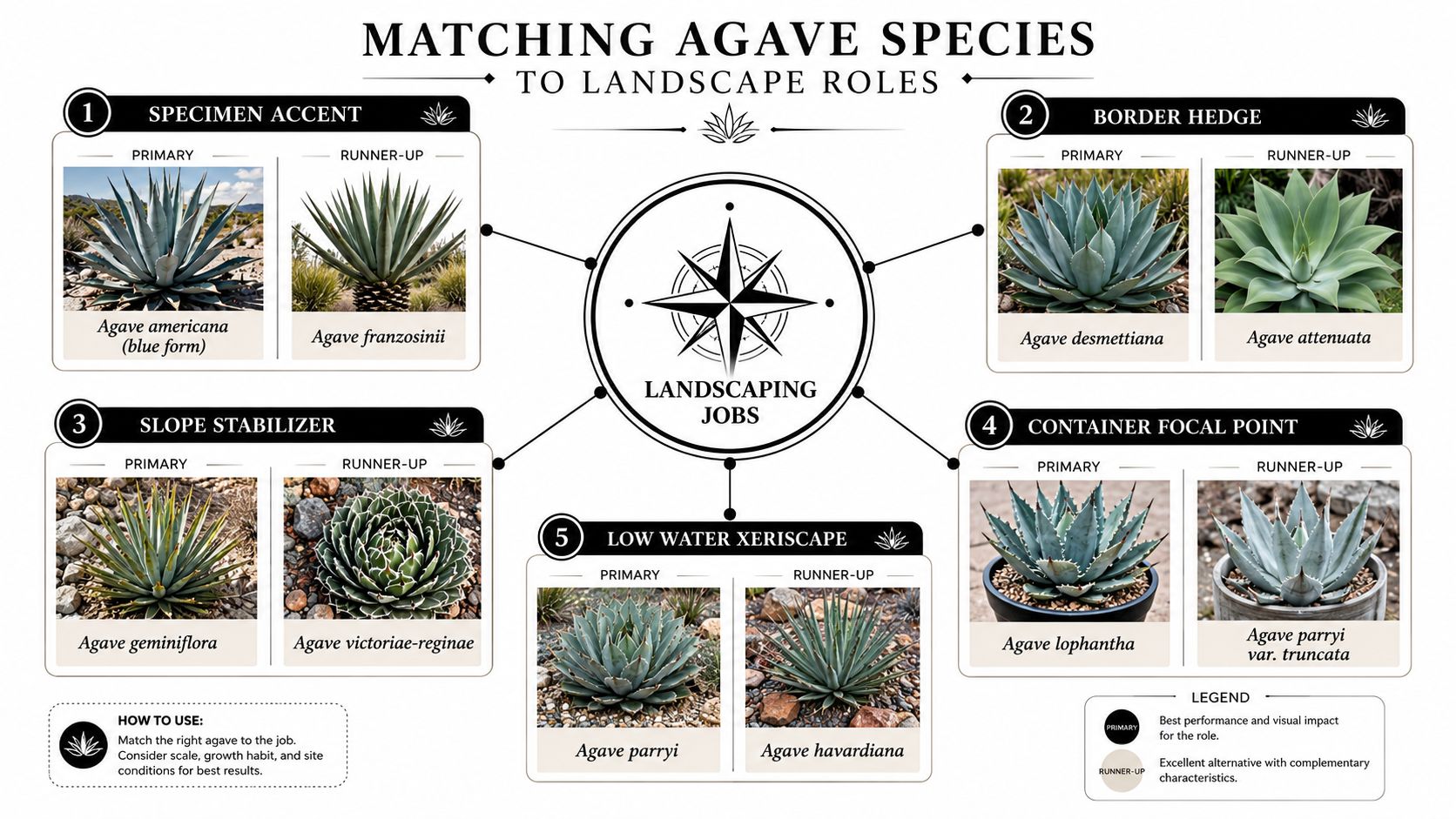
The role-based choices are easier to visualize in a complete planting plan. Use the video below as a visual reference for positioning agaves among hardscape and companion plants.
Planting, Spacing, and Acclimation Tips
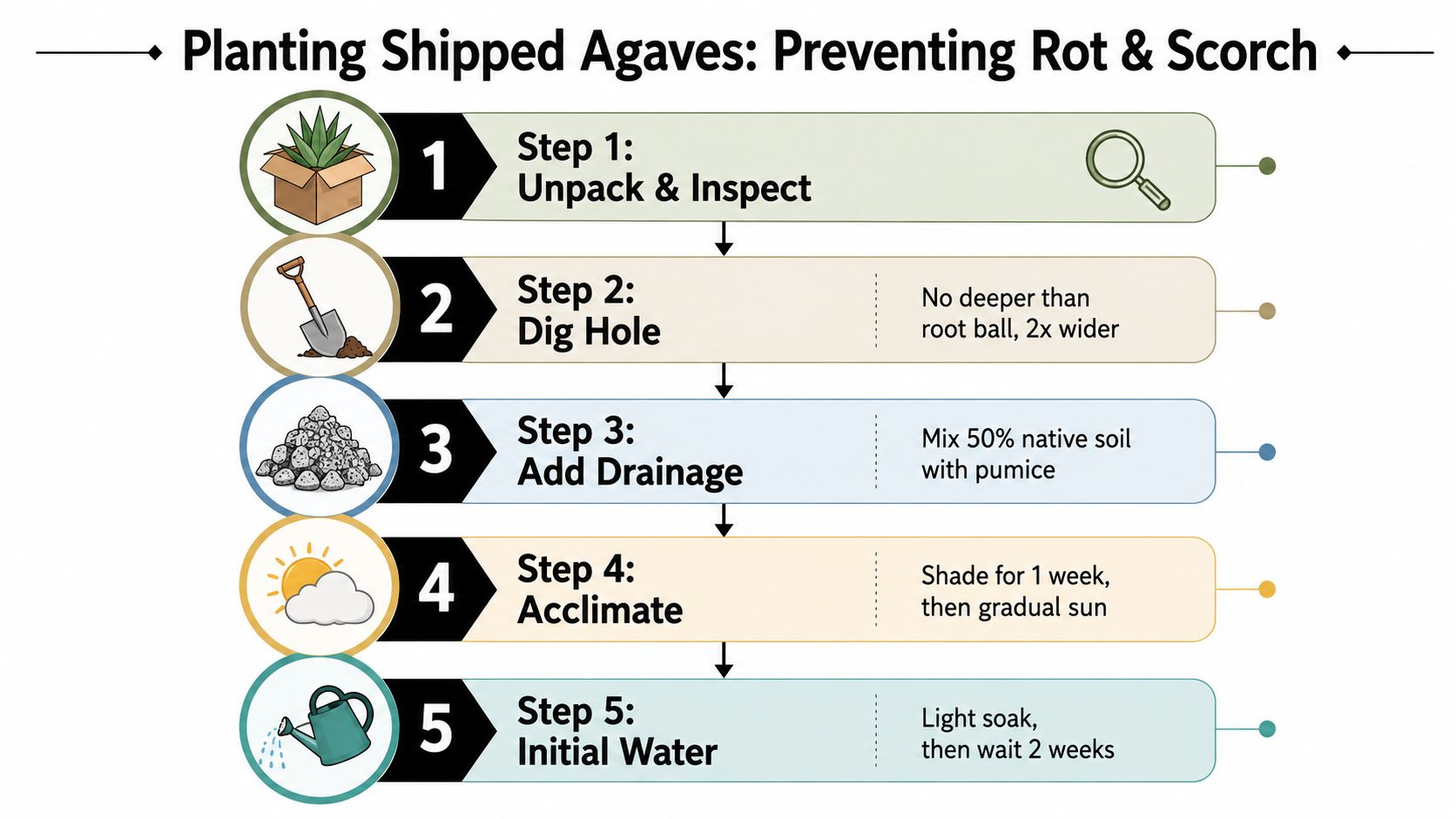
A shipped agave can fail for two opposite reasons. The crown stays too wet and rots, or the plant moves from protected nursery conditions into intense sun and scorches. Set up the site first, then handle the plant.
Build drainage into the planting decision
Dig a hole no deeper than the root ball and twice as wide. Set the crown high enough that it won't sit below surrounding soil, then backfill with native soil rather than creating a moisture-holding compost pocket around the roots.
Heavy clay deserves a raised mound or berm, commonly in the 6 to 12 inch range, instead of a heavily amended hole. An amended pocket can collect water around the root zone, exactly where agaves need air and rapid drainage. Use a surface dressing of 1 inch of decomposed granite, not bark, which can keep the crown damp.
Space from mature dimensions
Measure the mature spread listed for the plant and place centers at roughly 80% to 100% of the mature diameter when you want the rosettes to fill without severe crowding. A solitary Agave americana needs far more room than a compact Agave victoriae-reginae, and current nursery size tells you almost nothing about that final relationship.
Leave access for leaf removal and pup management. If the plant's mature spread reaches a wall, path, or fence, move the center point before planting rather than hoping pruning will keep the rosette small.
Acclimate gradually
Keep a shipped plant under 50% sun for the first 2 to 3 weeks, then increase exposure in stages. That transition reduces the risk of leaf scorch while the plant adjusts to its new light level.
Water at planting, then keep irrigation restrained. Established agaves generally need supplemental water only during extended drought, while very dry summers may call for watering only once or twice a month, according to University of Arizona landscape research. During the first growing season, water only when the site remains dry and rain hasn't supplied moisture. Never use a calendar to justify watering a wet crown.
Common Mistakes That Kill New Agaves
The first mistake is treating an agave like a thirsty shrub. Homeowners install drip irrigation, add frequent hand watering, and then wonder why a drought-adapted plant collapses. Agaves store water in thick leaves, so excess moisture can create more trouble than a short dry spell, especially in heavy soil where roots lose oxygen.
The second mistake is reading a hardiness number without reading the winter conditions. A plant that handles low temperatures in dry Arizona air may fail at a warmer temperature in a rainy region if the crown stays saturated. Choose for the combined reality of winter low, rainfall, drainage, and exposure, not a temperature figure alone.
Buying rule: If your winter is wet, drainage is part of the hardiness rating.
The wrong species for humid wet heat
Warm zones don't automatically make every agave a safe choice. In a humid zone 8 or 9 site, a well-drained, cold-tolerant choice such as Agave parryi or Agave neomexicana can be more dependable than a broad Agave americana planted where summer rain and poor airflow keep the crown wet.
That isn't an argument against americana. It's an argument against using a large, dramatic plant in a location whose moisture pattern works against it. A dry raised bed and a damp low pocket are different climates, even inside the same yard.
The current-size trap
A small rosette in a shipping box can look harmless beside a 6-foot bed. The mature plant may not be harmless at all. Before you order, divide the mature spread by two to estimate the radius, then compare that radius with the available space from the planting center to paths, foundations, fences, and other plants.
Overcrowding also creates a maintenance problem. A plant that outgrows the design can force you to remove pups, cut back companion plants, or dig out the agave entirely. Buy for the finished yard, not the photograph taken at the nursery.
Ordering and Shipping Large Agaves Online
Before checkout, confirm the exact species and cultivar, current container or boxed size, mature spread, hardiness information, and the seller's expected ship timing. Compare the plant's climate requirements with the forecast at your address, especially if a cold snap or prolonged rain is approaching.
Container-grown agaves generally arrive with an established root system and can settle into your garden more quickly, but their larger shipping volume can raise freight costs. Bare-root plants ship with less weight and packaging, yet they need careful handling after arrival. Keep them shaded, dry at the crown, and protected from irrigation while they recover.
Large plants such as Agave americana, Agave franzosinii, and Agave salmiana may require a freight quote rather than standard parcel checkout. Confirm that detail before assuming the displayed product price includes delivery to your location. The Cactus Outlet offers agave plants and outdoor-sized selections, including individual plants such as Agave ‘Blue Glow', Queen Victoria Agave, King Ferdinand Agave, and an outdoor-size Agave franzosinii, so compare the live listing with your site measurements before purchasing.
When the shipment arrives, photograph the plant and packaging before signing when possible. Check the crown and leaf bases for soft rot, splitting, or severe damage, and report problems within the carrier's stated damage window. Keep a new agave out of full sun and off irrigation for 10 to 14 days while you inspect it and begin acclimation.
Final Checklist for Your Best Agave Pick
Use three filters on every species page. First, confirm that the mature spread fits the planting footprint, with at least 2 feet of clearance from paths, walls, foundations, and neighboring plants. Second, match the USDA hardiness zone to the site's winter wetness and drainage, because cold tolerance alone doesn't protect a crown sitting in saturated soil.
Third, confirm that the plant's role matches its growth habit and safety profile. Choose a broad, spined specimen for an open focal bed, a compact rosette for tight massing, a suitable cold-hardy plant for a dry slope, and a manageable cultivar for a patio container. Factor ownership beyond the purchase price too, including pup removal, safe leaf trimming, and the cost of removing a plant that eventually outgrows the design.
Browse the Cactus Outlet agave collection and compare it with the cold-hardy cactus collection after you've filtered your choices by size, climate, and role.
The Cactus Outlet offers agaves and other large succulent plants for homeowners planning specimens, containers, and low-water garden designs. Visit The Cactus Outlet with your mature-size measurements and USDA zone in hand, then choose a plant that fits the space before you place the order.