
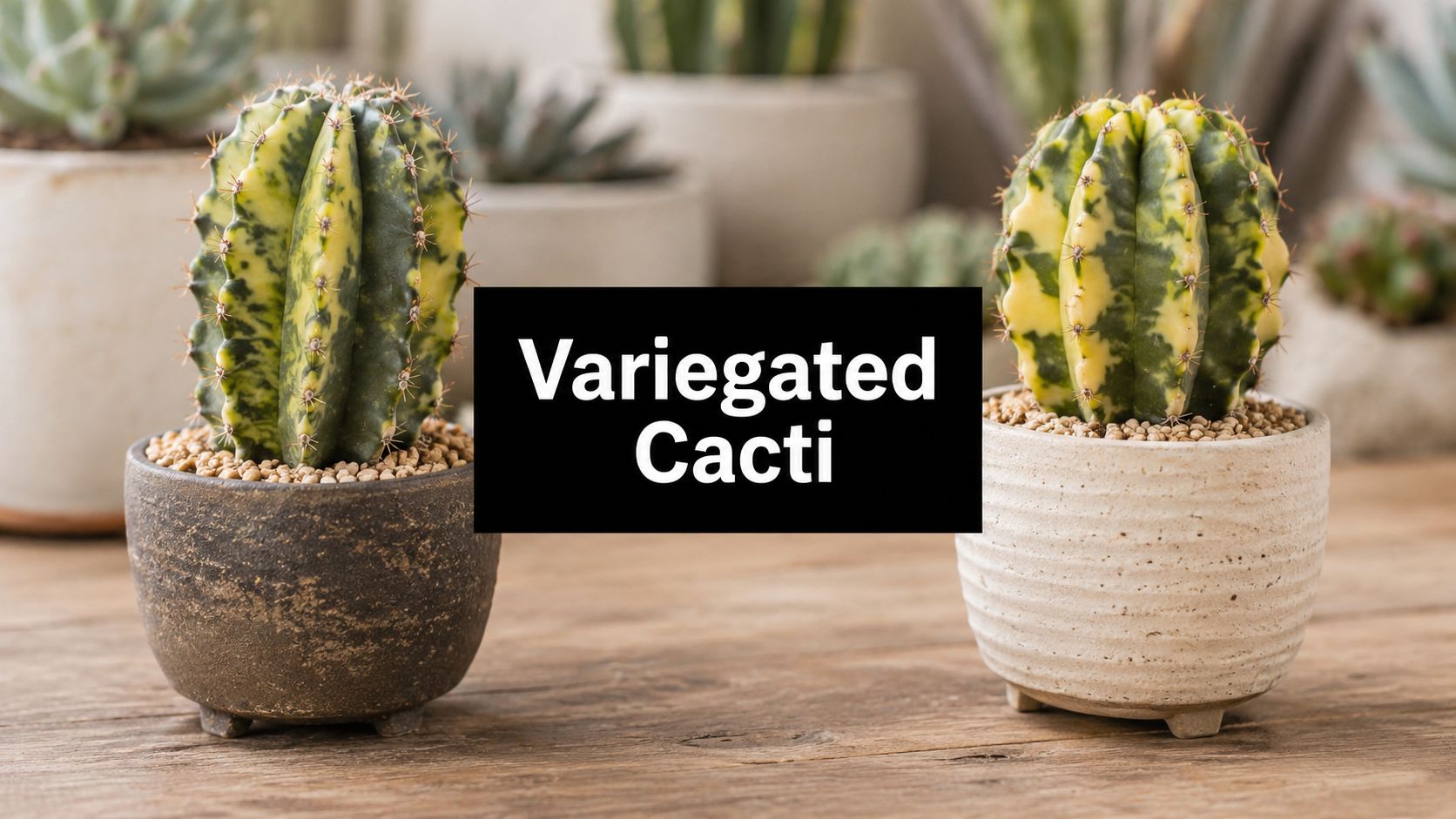

I still remember the first variegated cactus I saw in person. It looked as if someone had brushed pale yellow paint across a green paddle overnight, and for a moment I thought it had to be damaged until I leaned closer and realized the strange color was the whole point.
The Allure of Variegated Cacti
Collectors fall for variegated cactus plants fast because they don't look predictable. A standard cactus can be beautiful in a quiet, architectural way. A variegated one looks like a happy accident that stayed.
The appeal starts with color. Instead of one uniform green, you get bands, marbling, splashes, or sectoring in cream, yellow, white, and sometimes pink. Those patterns can make even a familiar genus feel brand new. A common shape suddenly becomes personal, almost like a fingerprint.
What confuses many beginners is the name itself. Variegated cacti are not a single species. They are a growth form, meaning the unusual coloration can appear in different kinds of cacti rather than belonging to one botanical group. That's why a collector may own a paddle-shaped variegated cactus, a round ribbed one, and a grafted neon form, all under the same broad umbrella of "variegated cactus plants."
Why they feel special
Part of the thrill is that no two plants look exactly alike. One plant may carry a thin cream stripe down a rib. Another may show half-green, half-yellow tissue. A third may blush pink under bright conditions. For collectors, that unpredictability is the attraction.
For growers, though, beauty comes with responsibility. A cactus with less green tissue often behaves differently from a solid green plant. It may grow more slowly. It may burn faster in harsh light. It may need propagation methods that preserve the pattern instead of losing it.
Practical rule: If a cactus looks unusually colorful, don't assume it's easier to grow because it's sold as a novelty. Assume it needs closer observation.
That tension is what makes variegated cacti so fascinating. They sit right at the intersection of botany, design, and patience. You aren't only buying a decorative object. You're caring for a plant whose striking color is linked to how it makes energy, how it grows, and sometimes how it survives.
The Science of Variegation in Cacti
A variegated cactus looks exotic, but the underlying biology is plain and surprisingly logical. Some cells make plenty of chlorophyll, the green pigment that powers photosynthesis. Other cells make less of it, or none at all. Where green pigment is missing, you see cream, yellow, pink, orange, or red instead.
Marble cake is a useful comparison here. It is still one cake, but different batters create different swirls. A variegated cactus is still one plant, yet different groups of cells produce different colors across the same stem, pad, or rib.

That color comes at a cost. Green tissue is the plant's solar panel. Pale tissue is decorative, but it contributes less energy. A heavily variegated cactus often grows more slowly, reacts faster to harsh sun, and may depend on greener tissue, or even a grafted rootstock, to stay strong over time. This is one reason collectors should judge a plant by more than its pattern alone. Beauty matters, but so does the amount of functioning green tissue behind that beauty.
Chimeral variegation
This is the type many collectors encounter first. In a chimera, different layers of tissue carry different pigment behavior. One layer may produce chlorophyll normally while another does not. The result is striping, marbling, sectors, and split-color patterns that can look almost painted on.
Because the pattern is tied to where those cell layers sit in the growing point, it can shift. A pup that develops from greener tissue may come out nearly solid green. Another offset may carry the dramatic pattern that made the parent valuable. That unpredictability explains why two offsets from the same cactus can look like siblings rather than twins.
For buyers, this matters. A high price does not always mean long-term stability. Some famous patterns are horticultural treasures, but they are also unstable arrangements of tissue. If you pay collector prices, ask whether the plant has held its pattern through several rounds of growth or offsetting.
Genetic variegation
Some variegation is tied more directly to a mutation that can be reproduced through the plant's cells more consistently. Even then, consistency has limits. Seedlings often vary, and the exact arrangement of colors on a prized parent rarely repeats like a photocopy.
That is why serious growers preserve exceptional clones through cuttings, offsets, or grafting. The plant is being copied, not re-created from scratch. For a collector thinking about value, that distinction matters. A clone with a known history is usually more predictable than a seedling sold on promise alone.
Stress and other look-alikes
Confusion starts here for many beginners. A pale patch is not automatically variegation.
Sun scorch can bleach tissue. Old scars can dry into tan patches. Pests can leave stippling or corky marks. Nutrient issues and disease can also distort color. True variegation usually follows the architecture of the plant. It runs with the ribs, pads, tubercles, or growth lines in a way that feels built in, not splashed on after damage occurred.
A quick check helps. Ask whether the unusual color appears integrated with the plant's pattern and repeats in new growth. If the answer is yes, variegation is more likely. If the patch looks abrupt, sunken, rough, or necrotic, you are probably looking at injury instead.
| Type | What it looks like | What it means for collectors |
|---|---|---|
| Chimeral | Streaks, sectors, marbling | Pattern may shift or revert in new growth |
| Genetic | Repeating color traits | Usually preserved best through cloning methods |
| Stress-related look-alike | Scorch, patchiness, scars | Usually a care problem, not collectible variegation |
The key lesson is simple. Variegation is not just color. It is a change in how the cactus makes energy and how reliably that color can persist. Once you understand that, the market makes more sense too. Some expensive plants are enduring clones with proven stability. Others are fragile novelties priced by hype. Knowing the science helps you tell the difference, and it also helps you buy with a clearer conscience in a trade where rarity can tempt sellers to overpromise.
A Gallery of Popular Variegated Cacti
Collectors often start with one flashy plant and then discover a whole world of forms. Some are tiny and jewel-like. Others become large-scale specimens. That's one reason variegated cactus plants are so addictive to collect. The category doesn't stay in one shape for long.

Opuntia monacantha variegata
If you want proof that variegation isn't only an indoor novelty, this is the plant to study. Opuntia monacantha variegata, often sold as the variegated Joseph's coat cactus, can reportedly grow up to 20 feet tall, is typically recommended for USDA zones 9–11, and is advised to have indoor protection where temperatures fall below 50°F, according to Planet Desert's plant listing for variegated Joseph's coat cactus. Its flowers are described as appearing in late spring and summer, in shades from yellow to deep orange.
Visually, it has a painterly quality. The pads can carry cream, yellow, and green in broad, irregular fields. On a small plant, that looks playful. On a mature specimen, it looks dramatic.
Moon Cactus
This is the variegated cactus commonly recognized first, even if they don't know its proper name. The bright top is often red, orange, or yellow, and it's usually grafted onto a green rootstock. That contrast makes it one of the most visually obvious examples of how variegation can become a commercial phenomenon.
Collectors should look at Moon Cactus with clear eyes. It can be charming, but it also teaches an important lesson. Some variegated cacti stay vigorous only because another cactus is doing the heavy lifting underneath.
Variegated Gymnocalycium
Beyond the familiar Moon Cactus form, variegated Gymnocalycium types can be remarkable on their own. Their ribbed bodies break color into curved sections, so the plant can look almost sculpted. A strong specimen may show green on one rib, pinkish or yellow tissue on the next, and a marbled transition between them.
These plants often appeal to collectors who like compact cacti with a lot of visual drama in a small pot.
Variegated Astrophytum
A variegated Astrophytum looks refined rather than loud. The genus already has a geometric, star-like quality, and variegation adds another layer of pattern. Instead of broad painted sectors, you often get a quieter interplay of symmetry and interruption.
This is the sort of plant that rewards close looking. It may not shout across the room, but it becomes more interesting every time you rotate the pot.
Variegated monstrose forms
Some collectors chase plants that are already unusual in shape, then add variegation on top. A monstrose cactus grows in abnormal, distorted ways. Add variegation and you get a plant that can seem almost coral-like or sculptural.
These are often the pieces that make experienced collectors pause. They can also be the plants where stability becomes most important to judge before buying.
What makes one more desirable than another
Collectors usually pay attention to a few things at once:
- Pattern balance: Some prefer strong half-moon sectors. Others love marbling.
- Plant vigor: A weaker but prettier plant may struggle long term.
- Form rarity: A common species with exceptional variegation may be more interesting than a rare species with dull patterning.
- Propagation history: A plant that has held its pattern through offsets often inspires more confidence than one with unstable new growth.
The most beautiful variegated cactus isn't always the one with the most color. It's the one whose color, shape, and vigor still look convincing a year after purchase.
That point matters because the ultimate test of a collector plant starts after the excitement of unboxing.
Essential Care for Variegated Cactus Plants
A variegated cactus asks you to grow with a lighter hand and sharper eyes. The pale or pink parts contain less chlorophyll, so the plant has a smaller energy budget than a fully green cactus. That one fact explains most of its care differences. It grows more slowly, recovers more slowly, and shows stress sooner.
Collectors sometimes treat variegated plants as luxury objects. They are better understood as plants with a built-in handicap. If you know where that handicap matters, they become much less mysterious and much less likely to disappoint you after the excitement of buying wears off.
Light that keeps color without scorch
Light is the first balancing act. Your cactus still needs enough brightness to stay compact and hold good color, but the pale tissue has weaker sun protection. A cream patch works like skin that forgot its sunscreen. It can still function, but it burns faster.
For most indoor growers, bright indirect light or gentle morning sun is the safe starting point. Harsh afternoon sun is where many beautiful specimens get scarred. If the plant starts stretching, it needs more light. If the pale sections turn tan, papery, or sharply bleached, it needs less direct exposure.

A simple habit helps. Rotate the pot a little every week or two so one side does not take all the light stress while the shaded side weakens.
Watering with judgment, not a calendar
Variegated cacti punish routine watering more often than they reward it. Because many of them grow slowly, they also use water slowly. Wet soil that a green cactus might tolerate for a short time can stay dangerous for a variegated one.
Let the potting mix dry properly before watering again. Then water thoroughly and let excess moisture drain away. Do not keep giving small sips. That often leaves the lower root zone damp for too long while fooling the grower into thinking they are being careful.
If you want a broader baseline for reading soil, pot weight, and seasonal watering shifts, this general cactus care guide is a useful reference point. Then adjust downward for slower, more delicate variegated forms.
Soil and pots that forgive mistakes
The root zone should dry fast and breathe well. Use a well-draining substrate with plenty of mineral material, and choose a pot with a drainage hole. This is less about collector perfection and more about buying yourself time. In a dense, soggy mix, root problems can advance before the body of the cactus shows obvious distress.
Unglazed clay can help if you tend to overwater because it releases moisture faster. Plastic can work well too, but only if your watering is disciplined. Match the pot to your habits, not just your shelf aesthetic.
Feeding for structure, not speed
New collectors often try to push growth because the plant seems expensive and slow. Resist that urge. Heavy feeding can produce soft, weak tissue or awkward growth that spoils the look you paid for.
A mild fertilizer during active growth is enough. The goal is a firm plant with stable patterning, not a fast plant. This matters for collectors who hope a plant will hold value over time. A specimen that grows steadily, keeps its form, and avoids scars is far more convincing than one forced into quick, unstable growth.
What changes compared with a green cactus
| Care area | Standard green cactus | Variegated cactus |
|---|---|---|
| Light | Often tolerates more direct sun | Usually safer in bright indirect light |
| Water | Can recover faster from minor mistakes | Needs closer drying between waterings |
| Growth | Often more vigorous | Usually slower and easier to stress |
| Collector goal | General health | Health, stable pattern, and clean appearance |
That last row matters more than it first appears. With variegated cacti, good care is not only about survival. It is also about preserving the qualities that made the plant desirable in the first place.
A short checklist for daily decisions
- Look at the pale tissue first. Scorch shows there before trouble is obvious elsewhere.
- Lift the pot before watering. Weight is often a better guide than habit.
- Check the base for softness. A soft base calls for quick action.
- Expect slower growth. Compact growth is usually healthier than rapid growth.
- Watch after purchase. A plant that declines quickly may have been stressed before you bought it, which is one reason ethical sourcing matters as much as care.
Good variegated cactus care protects two things at once: the life of the plant and the integrity of its pattern.
Propagation and Grafting Techniques
Propagation is where many collectors stop being shoppers and become growers. With variegated cacti, this matters because the usual "just grow it from seed" approach often won't preserve what you liked in the first place.
Why grafting matters
Grafting is best understood as a support system. The top piece, called the scion, may have stunning color but weak performance. The bottom piece, called the rootstock, provides vigor, roots, and a stronger engine for growth.
Many popular market forms are handled this way because variegation can be unstable or physically weakening. Growers often use grafting to keep slow or weak forms vigorous, especially the Moon Cactus. Guidance for Gymnocalycium mihanovichii variegata commonly recommends temperatures of 18°C to 26°C and watering about every 1–2 weeks during active growth, then reducing to once a month in winter, as outlined in this Moon Cactus care video.

A simple grafting sequence
- Choose healthy material. Pick a firm scion with attractive variegation and a vigorous rootstock.
- Use a clean blade. Flat cuts heal and align better than ragged ones.
- Match the vascular rings. You don't need perfect centering. You do need contact between the active inner tissues.
- Secure the pieces. Elastic bands, clips, or gentle pressure hold them in place while they knit.
- Let the union heal. Keep the graft bright, warm, and protected from stress during the first stage.
For a visual walkthrough, this video gives a useful demonstration:
Offsets are the easier entry point
If your cactus produces pups or side growth, start there. Remove the offset with a clean cut, let the wound callus, and then place it in a suitable dry mix until rooting begins. This is often the gentler route for beginners and a practical way to preserve a pattern that has already proven attractive.
For broader propagation basics, this guide on how to propagate cactus from cuttings is a helpful companion.
Grafting looks technical, but the principle is simple. One cactus supplies roots and strength. The other supplies the look you want to keep.
Once you see it that way, the method feels much less intimidating.
Troubleshooting Common Variegated Cactus Issues
If you own variegated cactus plants, you need a calmer mindset than a collector of tougher green species. The plant may show stress sooner, but that doesn't mean disaster is automatic. It means you need to read the signals early.
Reversion to green
Reversion is one of the biggest collector disappointments. A plant starts producing greener growth, and the special pattern begins to fade into ordinary cactus tissue. Why does this happen? Because greener tissue often has a growth advantage.
If a branch or offset turns fully green, it may outgrow the variegated parts and eventually dominate the plant. When the structure allows it, pruning out the all-green growth can help preserve the variegated sections. You have to act while the shift is still localized.
Pests that hide too well
Guidance around rare cacti often points out that reduced chlorophyll can make variegated plants harder to grow, more pest-prone, and more vulnerable to rot if care isn't adjusted, a concern highlighted in Homes & Gardens' discussion of rare cacti. The practical issue isn't just that pests arrive. It's that pale tissue can make early signs harder to spot.
Check creases, areoles, and the plant base with patience. A cactus that looks "dusty" or slightly dull may be hiding a problem. Isolation and prompt treatment matter more than heroic rescue later.
Rot that starts quietly
Rot often begins at the base or inside a wound, and variegated plants may not have the reserves to recover if the problem spreads. A mushy patch, sour smell, or sudden collapse means you need to intervene fast.
Try this triage approach:
- Stop watering immediately: Don't add moisture to a plant already failing internally.
- Inspect the base and roots: Remove the plant from its pot if needed.
- Cut back to firm tissue: If rot is localized, a clean cut may save the upper portion.
- Re-root or graft if possible: Some tops can survive if removed in time.
A premium variegated cactus can absolutely be worth buying, but only if you respect what you're purchasing. You're not buying invincibility. You're buying a more delicate expression of a cactus body.
Buying Variegated Cacti Responsibly
The hardest buying question isn't "Is this pretty?" It's "Is this stable, and was it obtained responsibly?" Those two questions belong together.
A costly variegated cactus may be worth the premium if the pattern looks integrated, the plant body is healthy, and the seller can explain how it was propagated. If the color is attractive but the plant looks weak, recently stressed, or vaguely described as "super rare" without useful details, slow down.
Ethics matter just as much as horticulture. Public conservation discussion around cactus collecting has drawn attention to poaching and habitat loss, including cases where wild populations fell by about 90% over a few years, as noted in this cactus conservation explainer on YouTube. For buyers, the practical lesson is simple. Verify propagation source before you reward rarity hype.
A short pre-purchase checklist helps:
- Ask how it was propagated: Nursery-grown offsets, grafts, or seed-grown stock are not the same story.
- Ask how long the seller has grown it: Stability over time matters.
- Look for root and stem health: Great color can't compensate for active decline.
- Question dramatic rarity claims: Hype often fills the space where provenance should be.
- Buy from transparent sellers: Clear plant descriptions and care information are a better sign than mystery.
If you're comparing sellers, this guide on the best place to buy cactus online can help you think through what transparency should look like.
A responsible collector doesn't just chase the brightest plant. A responsible collector asks whether the plant is likely to live well in cultivation, and whether buying it supports propagation rather than pressure on wild populations.
If you're ready to add thoughtfully chosen cacti to your collection, The Cactus Outlet offers a broad selection of cactus and succulent plants with care information that can help you buy with clearer expectations and grow with more confidence.