

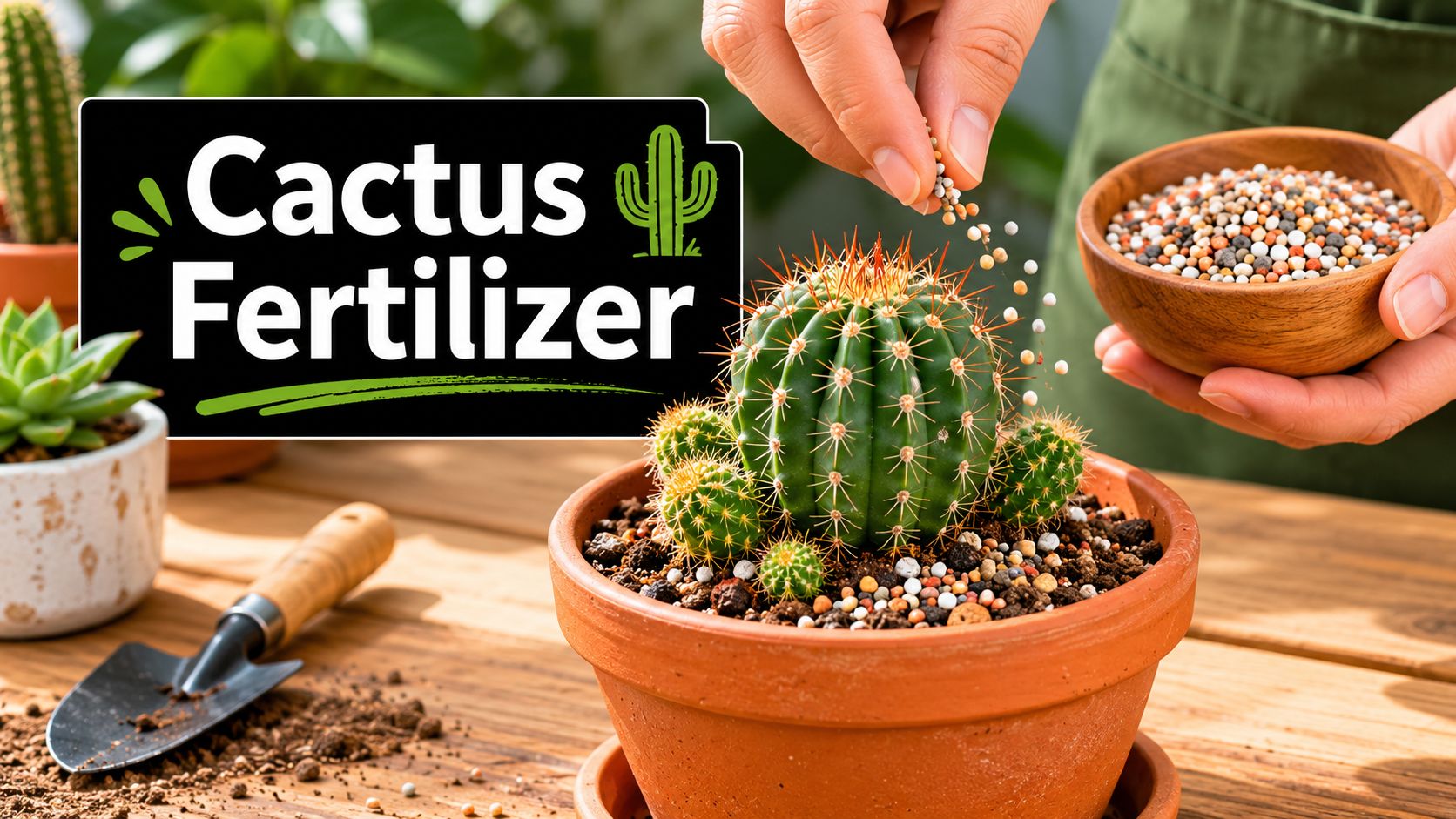

You're probably here because you've stared at a bottle of cactus fertilizer and thought, “If I use too much, I'll damage the plant. If I use too little, what's the point?” That hesitation is healthy. Cacti and succulents don't need the heavy feeding that leafy houseplants often tolerate, and that's exactly why a careful fertilizer application routine works so well.
The good news is that feeding these plants isn't complicated once you understand the rhythm. Most problems come from timing, concentration, or applying fertilizer to a plant that isn't in a position to use it. For cacti, less is more. A mild dose, given at the right time, does far more good than a strong feed poured on out of habit.
At The Cactus Outlet, we spend a lot of time helping growers get past the fear of overdoing it. The safest approach is to think of fertilizer as support, not fuel. Light, drainage, and watering carry most of the load. Fertilizer just helps an actively growing plant do its job better.
Understanding When to Fertilize Your Cactus
The first rule of fertilizer application for cacti is simple. Feed growth, not the calendar.
Most cacti and many succulents use nutrients during active growth, which is commonly in spring and summer. During dormancy, they slow down. Roots take up less, the plant builds less new tissue, and extra fertilizer tends to sit in the potting mix instead of being used.

Read the plant before you read the label
A cactus in active growth usually tells you. Look for:
- Fresh color at the tip that's slightly lighter than older growth
- New pads, segments, or offsets forming
- Noticeable firm expansion after warm weather and regular watering
- Roots drying the pot faster than they did in cooler months
If none of that is happening, don't rush to feed. A resting plant won't reward you for your enthusiasm.
Timing critically influences whether nutrients are absorbed or lost. University extension guidance notes that timing can matter more than product choice, especially where nutrients can wash through draining soil or potting media. For cacti and succulents, that means linking fertilizer application to watering and active growth, not treating it as a fixed monthly task according to Missouri Extension guidance on application timing.
Practical rule: If your cactus isn't growing, skip the feeding and wait.
Think in terms of an energy budget
Cacti are conservative plants. They store water, grow in bursts, and protect themselves by slowing down when conditions aren't right. Fertilizer only helps when the plant has enough light, warmth, and moisture to convert nutrients into roots, stems, and flowers.
That's why feeding in cool, dim conditions often backfires. You're adding inputs when the plant's energy budget is low. It can't spend what it can't use.
A better sequence looks like this:
- Watch for active growth
- Resume normal watering
- Add weak fertilizer only after the plant is already moving
Seasonal timing is a guide, not a law
Indoor growers often run into one tricky issue. A plant may not follow outdoor seasons exactly. A bright south-facing window, a warm room, and longer day length can nudge a succulent into growth earlier than expected. A cold garage, shaded patio, or winter shipping recovery can delay it.
Use the season as a starting point, then confirm with observation.
A missed feeding rarely hurts a cactus. An unnecessary feeding often does.
If you're unsure, wait until you see clear signs of growth and then start with a diluted dose. Confidence comes from reading the plant, not from sticking to a rigid date on the calendar.
Choosing the Right Cactus and Succulent Fertilizer
Most cactus fertilizer mistakes start in the shopping aisle. The label promises bigger blooms, faster growth, or all-purpose convenience, but cacti usually do best with restraint.
What N P K means in practical terms
The three numbers on a fertilizer label represent nitrogen, phosphorus, and potassium. For cactus care, the important takeaway isn't memorizing chemistry. It's understanding plant behavior.
- Nitrogen pushes green growth
- Phosphorus is often marketed for roots and blooms
- Potassium supports general plant function
For cacti and many succulents, overly nitrogen-heavy products can encourage soft, stretched growth that doesn't match the plant's natural form. That's why growers often prefer a lower-nitrogen formula rather than a lush foliage formula.

Be skeptical of bloom boosters
A lot of gardeners assume more phosphorus is automatically helpful, especially for flowering plants. That's a habit worth questioning. State guidance in multiple areas now limits phosphorus use for lawns unless a soil test shows need or a narrow exception applies, and the broader lesson is useful for container growers too: don't assume phosphorus belongs in every feeding plan as summarized by Minnesota fertilizer guidance.
For cacti and succulents, that means high-phosphorus “bloom booster” products aren't a default choice. If a product leans heavily on phosphorus as its selling point, I'd treat it cautiously rather than assuming it's specialized just because the bottle says flowering.
If you want a deeper product-by-product breakdown, The Cactus Outlet has a useful guide on how to choose the best fertilizer for succulents.
Liquid versus granular
This choice is mostly about control.
| Fertilizer type | What it does well | Where it can go wrong |
|---|---|---|
| Liquid concentrate | Easy to dilute lightly, good for precise fertilizer application | Easy to overmix if you guess |
| Pre-mixed liquid | Convenient for small collections | Less flexible if you want a weaker feed |
| Granular slow-release | Low-maintenance, useful for larger pots or outdoor plantings | Harder to correct if too much is added |
For most indoor and patio growers, liquid fertilizer is the safer starting point. You decide the strength each time. That matters with sensitive plants.
Granular products can work well, especially for large containers, but they ask for more discipline. Once they're in the pot, you can't pull them back out neatly.
A cactus-specific fertilizer doesn't need to sound exotic. It needs to let you feed lightly and predictably.
What I'd actually look for on the label
Skip the dramatic marketing language and focus on this short checklist:
- Lower nitrogen than a leafy houseplant feed
- No extreme phosphorus push
- Clear dilution instructions
- Micronutrients listed, since trace elements support overall plant health
- A format you'll use carefully, not one you'll rush through
The right product is the one that makes careful fertilizer application easy.
Proper Fertilizer Application Methods for Cacti
Most growers do better with a repeatable routine than with a complicated schedule. The safest method is simple, mild, and consistent.

The safest liquid feeding routine
Liquid feeding gives you the most control, which is why it's my default recommendation for cacti and succulents in pots.
Follow this sequence:
-
Start with a plant that's actively growing
Don't test fertilizer on a resting or stressed plant. -
Water with plain water first
This is one of the most important habits in cactus fertilizer application. Moist roots are less likely to be damaged by dissolved salts than bone-dry roots. -
Mix weaker than you think you need
Quarter-strength or half-strength is a sensible place to start for sensitive plants. You can always repeat a mild feed later. You can't undo a harsh one. -
Apply to the soil, not the body of the plant
Wet the potting mix evenly. Avoid pouring fertilizer into the crown or letting it sit around the base. -
Let the pot drain completely
Never leave the container standing in runoff.
Frequency that stays on the safe side
Cacti usually respond better to light, periodic feeding than to heavy doses spaced far apart. During active growth, many growers use a weak solution on a regular watering cycle rather than a strong monthly blast.
A practical version looks like this:
- For vigorous summer growth use a weak feed every couple of waterings
- For slower growers feed less often
- For newly repotted plants wait until the roots have settled and growth resumes
If you're between “feed now” and “wait a bit,” waiting is usually the better decision.
That same conservative mindset shows up in field fertility work too. Extension guidance for nutrient-rate testing emphasizes using a range of rates and choosing a profitable plateau rather than chasing the absolute maximum response. In one UF/IFAS example, selecting 95% of maximum yield lowered the recommendation from about 270 to 200 lb/acre N, saving 70 lb/acre with no yield sacrifice in the UF/IFAS nutrient response example. Container cactus care isn't field agronomy, but the principle carries over cleanly: the best rate is often lower than the biggest one.
How to use granular fertilizer without burning roots
Granular fertilizer can work, especially in large pots and outdoor containers, but placement matters.
Use it like this:
- Keep granules away from the stem base so concentrated salts don't sit against tender tissue
- Distribute lightly across the outer root zone rather than dumping in one spot
- Water in after application so nutrients begin dispersing into the mix
- Don't stack granular and liquid feeds together unless you're intentionally reducing both
Here's a quick visual walkthrough before you mix your next batch:
A few method changes for different setups
Not every cactus lives in the same conditions.
| Setup | Better method | Reason |
|---|---|---|
| Small indoor pots | Diluted liquid | Highest control |
| Large patio containers | Liquid or light granular | Easier to scale carefully |
| Fast-draining mineral mixes | Smaller, repeated liquid feeds | Nutrients move through quickly |
| Recently stressed plants | Delay feeding | Recovery comes before nutrition |
If you keep the method gentle, fertilizer application becomes routine instead of risky.
Common Fertilizer Mistakes and How to Fix Them
Most fertilizer damage doesn't happen because someone chose the “wrong brand.” It happens because the plant was fed at the wrong moment, at the wrong strength, or in the wrong soil condition.
That's fixable.

What over-fertilizing usually looks like
A cactus won't always collapse overnight. More often, it shows stress in quieter ways:
- White crust on the soil or pot rim from salt buildup
- Yellowing or dull color after a feeding
- Soft, awkward growth that looks too lush for the species
- Brown or dry root damage when you unpot it
- Mushy tissue near the base, especially if excess feeding came with excess moisture
The last point matters because many people blame fertilizer alone when the bigger issue is fertilizer plus wet soil.
How to correct the problem
If you suspect you fed too strongly, act fast but don't panic.
- Flush the pot thoroughly with plain water if the mix drains well
- Let the container dry appropriately afterward
- Remove visible fertilizer residue from the soil surface if possible
- Pause all feeding until the plant resumes stable growth
- Repot if the mix is compacted, sour, or crusted with salts
Subtle nutrient deficiency can happen too, but it's less common than overfeeding in home cactus collections. A plant that grows very slowly, stays pale during its active season, and sits in the same exhausted mix for a long time may benefit from a mild feeding plan. A weak response is still information. You don't need to force the issue.
Feeding a dormant cactus is usually wasted effort. Feeding a stressed cactus can turn stress into damage.
Do this and don't do this
Quick reference
- Do water first before liquid fertilizer application
- Do feed only during active growth
- Do start weaker than the label allows
- Don't use bloom boosters by default
- Don't fertilize a newly stressed plant just to “help” it recover
- Don't assume more fertilizer fixes slow growth caused by poor light
A lot of fear around cactus feeding comes from treating every mistake like a disaster. It usually isn't. If the roots are still viable and the plant isn't rotting, a reset in watering, a flush, and a pause in feeding often puts things back on track.
Sample Fertilizing Schedules for Popular Cacti
A feeding plan makes more sense when you attach it to actual plants. Growth rate, pot size, light level, and season all matter more than a one-size-fits-all rule.
If you want to get even more precise, it helps to understand how plant growth cycles affect watering and feeding. That context explains why one cactus is ready for nutrients while another is still resting in the same yard.
What these examples have in common
None of these are aggressive schedules. They assume the plant is established, getting proper light, and growing normally. If a plant was recently shipped, repotted, or stressed, delay feeding until you see fresh growth.
| Plant Type | Fertilizer Type | Dilution | Frequency |
|---|---|---|---|
| Peruvian Apple Cactus | Liquid cactus fertilizer | Quarter-strength to half-strength | During active growth, lightly on a regular watering cycle |
| Saguaro cutting or young Saguaro | Liquid cactus fertilizer | Quarter-strength | Infrequent feeding during clear active growth |
| Euphorbia | Balanced low-strength liquid fertilizer | Quarter-strength to half-strength | Light feeding during warm active growth |
| Agave | Liquid or light granular fertilizer | Light dilution or sparse granular use | Occasional feeding while actively growing |
| Aloe | Liquid succulent fertilizer | Quarter-strength to half-strength | Periodic light feeding in active growth |
A few plant-by-plant notes
Peruvian Apple Cactus tends to move faster than many slow desert species, especially in warmth and strong light. That makes it a good candidate for a regular but weak fertilizer application routine.
Saguaro is the opposite kind of lesson. Slow growers don't need to be pushed. If growth is modest, let it stay modest.
Euphorbia often gets grouped with cacti because it fills a similar design role, but its growth habits can be different. Feed lightly and watch the new growth. If stems start looking too soft, pull back.
Agave benefits more from good drainage and sun than from frequent feeding. A little support during active growth is enough.
These schedules aren't meant to turn care into a spreadsheet. They're meant to show how the same principle applies across different plants: match feeding intensity to actual growth speed.
Beyond Fertilizer A Holistic Approach to Plant Health
Fertilizer doesn't rescue a cactus from bad fundamentals. It supports a plant that already has the basics in place.
That means bright light, a fast-draining potting mix, and watering that matches the species and season. If you're still dialing in the root environment, start with a reliable cactus and succulent soil mix guide. Feeding makes more sense once drainage is working in your favor.
Water management matters just as much. Many symptoms people blame on fertilizer are really moisture problems, especially in containers that stay wet too long. If you're not sure whether your plant is dealing with excess water, this guide can help you spot overwatering signs before you add anything else to the pot.
The long-term mindset is simple. Use fertilizer application as a light touch, not a heavy hand. Feed only when the plant is growing, dilute more than you think you need, and let the cactus set the pace.
If you're building or refining your collection, The Cactus Outlet offers large cacti and succulents with care information that helps you match feeding, watering, and soil choices to the plant you own.