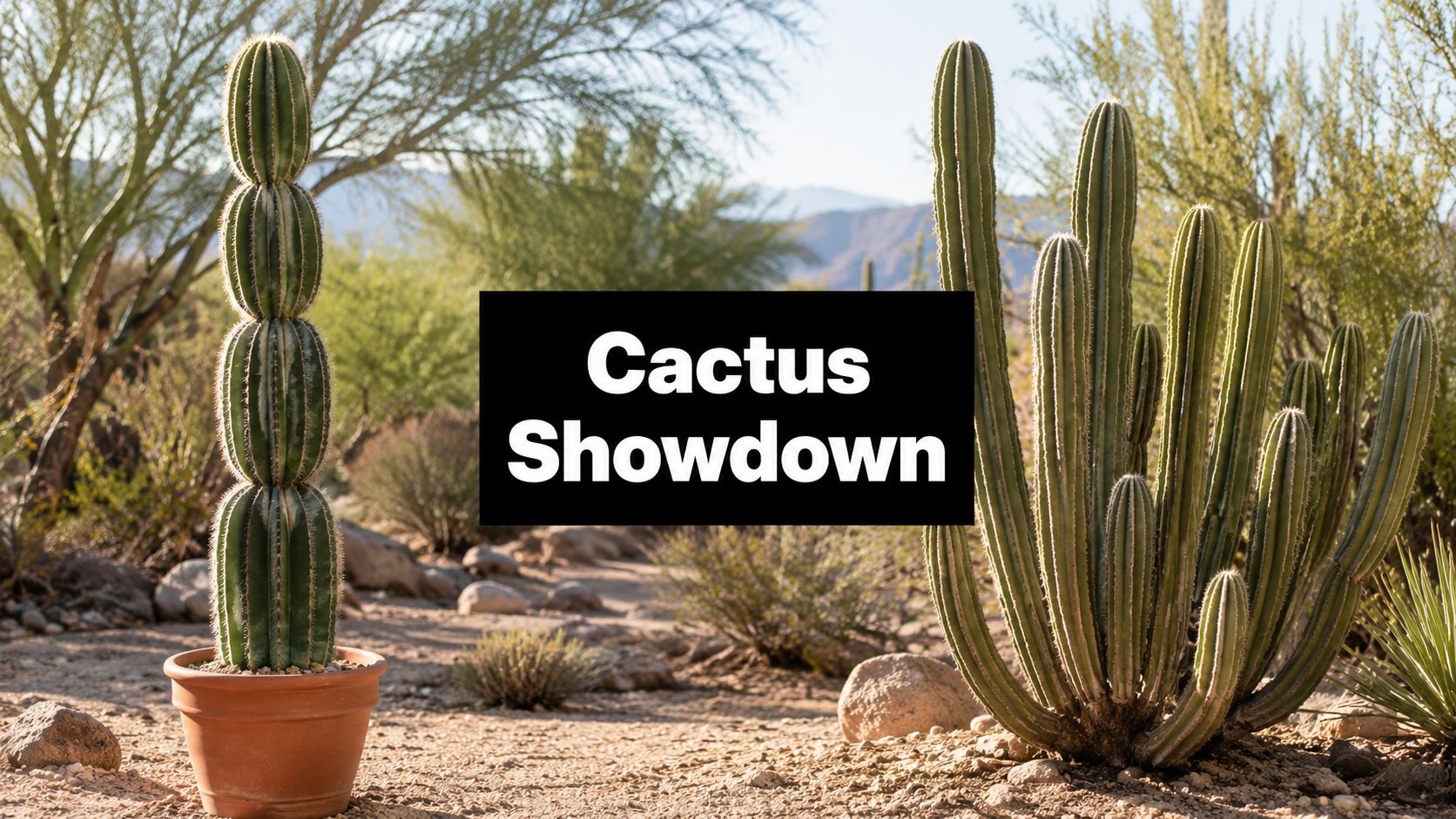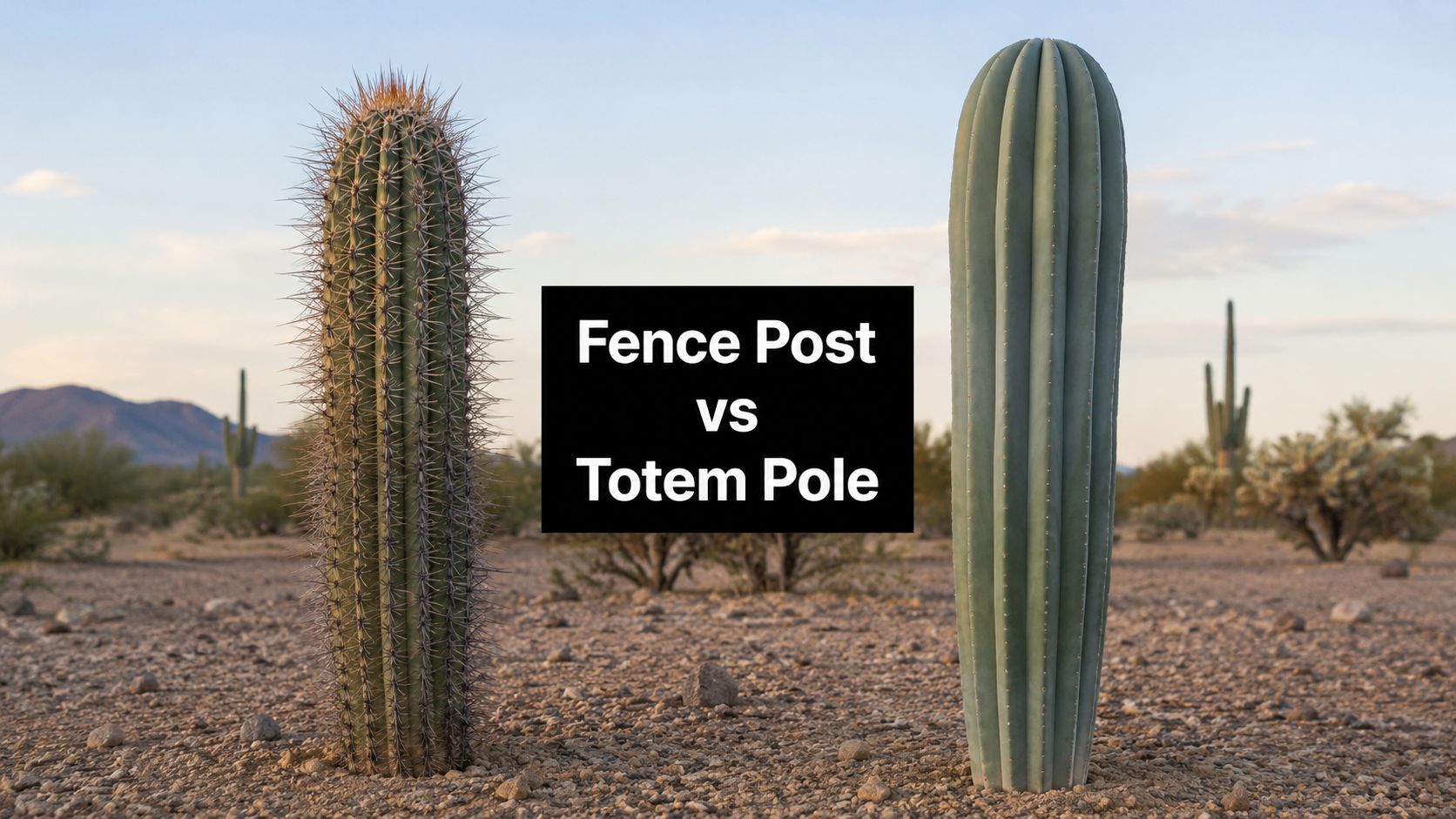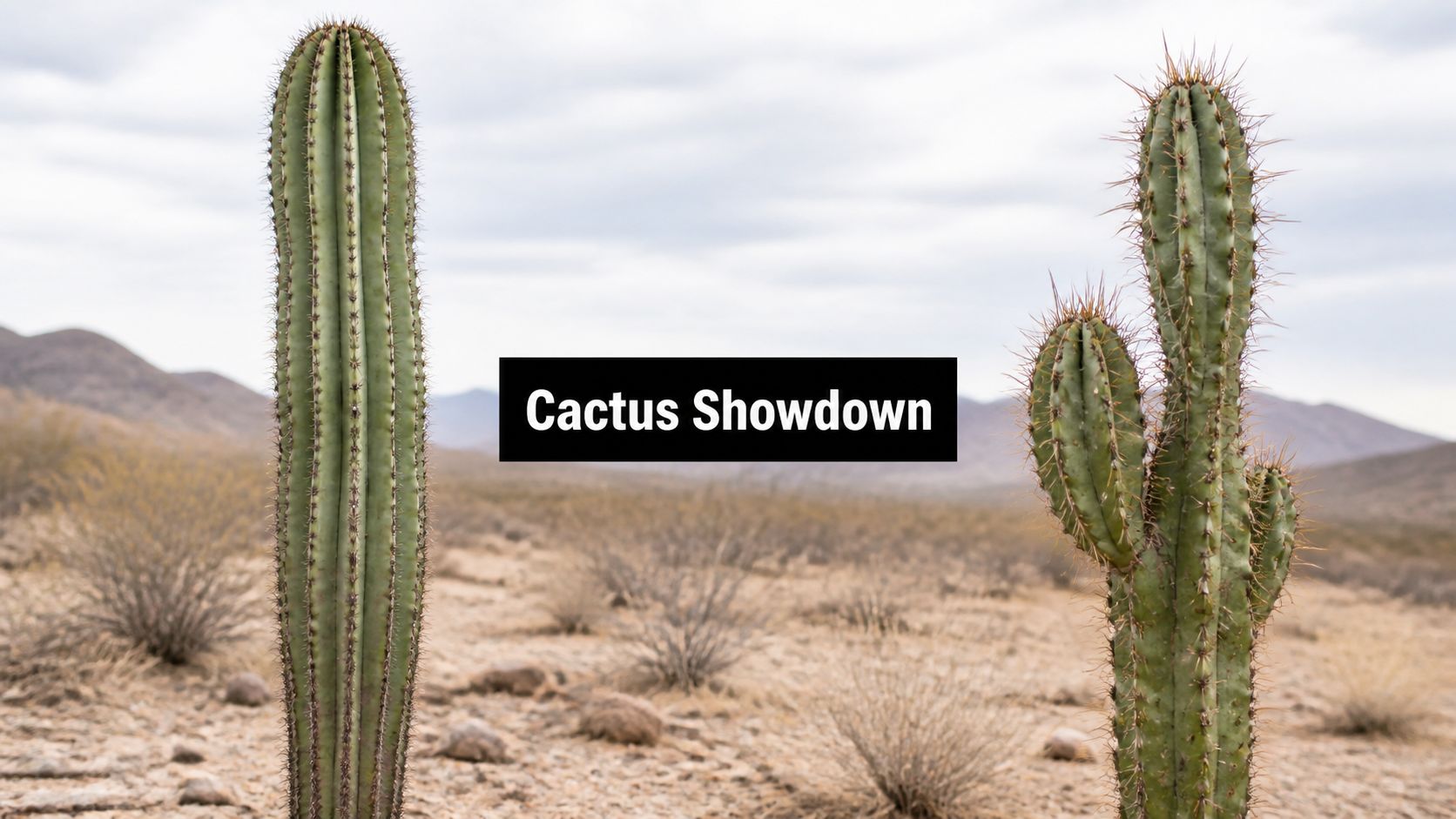

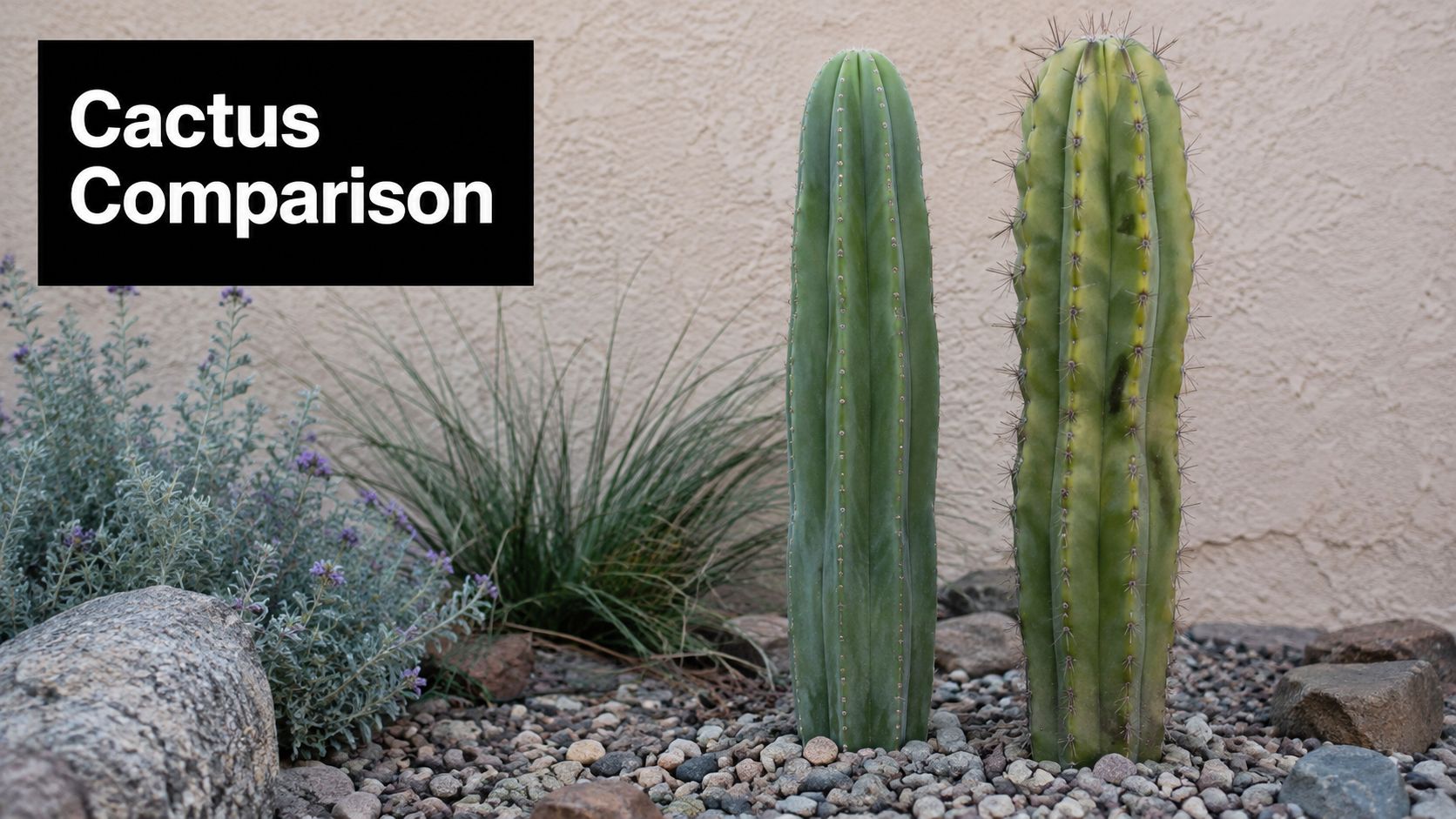

Most comparison posts get this wrong. They obsess over spine counts and flower color, then ignore the thing that ruins a purchase, the mature shape of the plant, how it fills space, and whether the label on the tag even matches what lands in your yard.
San Pedro cactus vs Peruvian apple cactus is a useful comparison only if you're buying for a real site, not a photo. One plant stays more strictly columnar and is easier to use where vertical presence matters. The other turns into a branching, tree-like cactus that needs more room and behaves differently in a garden setting, which is exactly why mislabeling creates buyer regret.
| Trait | San Pedro (Echinopsis pachanoi) | Peruvian Apple (Cereus peruvianus) |
|---|---|---|
| Mature form | More strictly columnar | More tree-like with age |
| Ribs | Broader and more rounded | Skinnier and sharper |
| Spines | Usually lighter, often sparse in cultivation | More prominent, stronger armature |
| Placement | Better for tighter vertical siting | Better for open setbacks and larger footprints |
| Main buyer risk | Underestimating spread from clustering | Underestimating branching and canopy spread |
If you're planning a patio, screen, or specimen planting, get the layout right first. A concrete edge, retaining wall, or pad detail can be the difference between a clean install and a cactus that crowds the space later, which is why a resource like Atlanta Concrete Solutions can be useful when you're coordinating hardscape and planting zones together.
For buyers who want a deeper species overview, The Cactus Outlet's San Pedro cactus guide is worth keeping open while you compare options.
Why These Two Cacti Are Not Interchangeable
The biggest mistake buyers make is treating these as two names for the same tall cactus. They're not. San Pedro cactus and Peruvian apple cactus can both read as upright columns at first glance, but their mature architecture diverges enough to change where they belong in a yard, along a driveway, or beside a patio.
The label is only the starting point
San Pedro is commonly treated as Echinopsis pachanoi, while Peruvian apple cactus is usually Cereus repandus, often still sold under the older name Cereus peruvianus. That naming instability is part of the problem, because retail listings, nursery tags, and marketplace photos often collapse different species into one vague “columnar cactus” category. For the buyer, the key question isn't what the listing says, it's what the plant will do once it reaches full size.
The practical difference shows up after the first few seasons. San Pedro tends to stay more vertically disciplined, while Peruvian apple cactus builds a more branching, tree-like structure. That matters if you're planting near a walkway, in a side yard, or in any spot where lateral spread becomes a maintenance issue.
Practical rule: buy for the plant's final footprint, not the tag. If the mature shape won't fit, the label doesn't save you.
Why naming confusion costs money
When a cactus is misidentified at purchase, the mistake usually doesn't show up right away. It shows up when the plant reaches six or eight feet and starts pressing into the space you reserved for it. Then the homeowner discovers the stem count, spine profile, and branch pattern were not what they expected, and the “easy” specimen becomes a relocation project.
That's why this comparison is about placement, not novelty. San Pedro's long documented ceremonial history, including archaeological evidence stretching back millennia, is real and well established, but none of that helps you if you plant it where its future form won't fit. The same logic applies to Peruvian apple cactus, which is a cactus first and a naming headache second, especially in trade channels that still use older synonymy.
For designers, the bottom line is simple. If the project needs a strong vertical line with limited width, San Pedro is the more predictable choice. If the project can tolerate branching and a broader canopy footprint, Peruvian apple cactus gives you more sculptural volume.
Identification Traits That Matter for Buyers
A quick glance can fool you. Both cacti are tall, ribbed, and often sold as premium columnars, but the traits that matter in the field are the ones that affect handling, spacing, and long-term maintenance.
Rib shape and stem texture tell the story
San Pedro typically presents broader, more rounded ribs, and in cultivation it can appear fairly soft-edged. Peruvian apple cactus has skinnier, sharper ribs and reads as more angular. That's not just an identification detail, it changes how the plant looks from a distance. San Pedro has a calmer, fuller silhouette, while Peruvian apple cactus has a more rigid profile that feels visually denser.
Spine profile matters just as much. Side-by-side technical guides describe San Pedro as having about 0 to 7 spines per areole, often under 2 cm and sometimes nearly spineless in cultivation, while Peruvian apple cactus is described as having roughly 6 to 8 spines per areole, typically 2 to 4 cm long, with stronger armature. For moving plants in and out of trucks, staging them near pathways, or setting them into a tight courtyard, that difference is not cosmetic.
Handling note: lighter spination makes San Pedro easier to position close to circulation areas. Heavier, longer spines make Peruvian apple cactus a better fit for open setbacks.
Branching habit changes the whole use case
San Pedro usually stays more columnar, though it can cluster from the base and form dense multi-stem groupings. Peruvian apple cactus develops a more tree-like branching pattern as it matures. That distinction decides whether the plant behaves like a vertical specimen or starts acting like a canopy plant.
Flowers separate them too. San Pedro has large, nocturnal white blooms. Peruvian apple cactus also blooms at night, often with pinkish-white flowers, and is followed by edible red fruit. That fruit detail matters mainly in residential settings, where dropped fruit can create cleanup around paving, seating areas, or pool decks.
For buyers, the rule is straightforward. Choose San Pedro if you want a cleaner vertical read and lighter handling demands. Choose Peruvian apple cactus if you want a more dramatic branching cactus with a heavier sculptural presence and you've got the room for it.
| Trait | San Pedro (Echinopsis pachanoi) | Peruvian Apple (Cereus peruvianus) |
|---|---|---|
| Ribs | Broader, rounder | Skinnier, sharper |
| Stem color | Blue-green to green | Darker green to gray-green |
| Spines | Sparse to minimal in cultivation | More prominent, stronger |
| Habit | Strictly columnar or basal clustering | Tree-like branching with age |
| Flowering | Large white night blooms | Night blooms, often pinkish-white, with edible fruit |
Mature Size and Cold Hardiness Compared
Size is where the buying decision gets real. A cactus that looks reasonable in a container can turn into a dominant site feature in the ground, and if the climate is marginal, cold tolerance becomes just as important as height.
What the mature footprint really means
San Pedro cactus is described in cultivation as reaching 10 to 20 feet tall with a spread of 3 to 6 feet in one guide, while another reference places its mature form in the 10 to 20 foot range outdoors with a broader spread in clustered plantings. Peruvian apple cactus is generally even larger, commonly reaching 10 to 15 feet in cultivation and up to 30 feet in ideal conditions, with some references listing mature heights near 20 feet and a spread of about 24 inches.
That gap matters most in tight sites. If you're designing a narrow side yard, San Pedro is easier to place because its vertical form is less likely to crowd adjacent circulation. Peruvian apple cactus is the one that can surprise people by becoming a more substantial semi-tree over time, especially when it's given room and heat.
Cold tolerance is not equal
San Pedro is rated for USDA zones 8b to 10 in one gardening reference and can take brief lows around 20°F when protected. Peruvian apple cactus is generally treated as a zone 9 to 11 plant, with some references placing it around 8a to 9a, but it is less forgiving of hard freezes. For marginal climates, that's the deciding factor.
If your outdoor setting regularly brushes the colder edge of cactus culture, San Pedro is the safer bet. If the site is warm, protected, and you want a bigger branching specimen, Peruvian apple cactus can carry the design farther. The internal product guidance on Peruvian apple cactus is useful if you're comparing what the plant is likely to do after planting.
How that translates to real projects
A San Pedro planted in the ground can become a screen or anchor sooner than many homeowners expect, especially because it is known for fast vertical growth in favorable conditions. Peruvian apple cactus grows into a heavier structure, which gives it more presence but also more wind exposure and more room demand.
A narrow site wants discipline. A broad site can afford drama.
If you're buying for a container, both species can start there, but neither is a forever-small plant. The container buys time, not a permanent size reduction.
Best Outdoor and Container Use Cases

The best placement choice comes down to clearance, traffic, and maintenance tolerance. If those three are not aligned, a striking columnar cactus turns into a recurring problem.
Where San Pedro earns its place
San Pedro fits sites that need a strong vertical line in a relatively tight run. Use it as a privacy screen along a property edge, a sculptural element in a narrow side yard, or a tall accent near a wall where its columnar form stays visible. Its lighter spination also makes it easier to place closer to circulation than a more heavily armed cactus.
The trade-off is basal clustering. Given enough time and space, it can form a multi-column base, so lateral room still matters even when the plant looks slim at purchase. Homeowners usually miss the footprint because they focus on height first.
Where Peruvian apple cactus fits better
Peruvian apple cactus is the better choice for patio staging and entry planting when you want a singular architectural specimen with more drama. Commercially, it is also described as a good option for outdoor pots and containers, which fits its upright habit and strong visual line. It works well beside hardscape, especially where the design needs height without a busy canopy.
Do not squeeze it into a high-traffic pinch point. Its stronger armature and branching habit call for a more open setting. Place it where people will not brush past it constantly, and do not force it onto a path edge just because it looked narrow at purchase.
Container and site placement basics
Use containers with reliable drainage, and expect repotting to be part of the plan, not a rare event. Both species eventually outgrow standard residential pots, so a container should buy time, not promise a permanent size limit. South-facing walls can amplify heat, which helps warm sites but can also push plants harder than expected in summer.
For walkways, play areas, and pool decks, leave generous clearance from the start. A mature cactus drops debris, sheds older growth, and gets harder to service as it gains height. The liability question is simple. If people will pass close enough to touch it regularly, the plant is in the wrong place.
Placement rule: if the project is high traffic, choose the cactus with the lower contact risk and give it more room than you think it needs.
Legal and Safety Context for Homeowners
Buyers often get tangled up. They ask the wrong question, then the wrong plant ends up in the cart. The issue is not only what the cactus is called, but what kind of use the purchase implies.
Ornamental ownership is not the same as extraction
San Pedro cactus is legal to own and grow as an ornamental in the United States, but mescaline is federally controlled, and extraction or consumption changes the legal picture. Peruvian apple cactus is a different species and doesn't sit in that psychoactive discussion. That makes it the lower-friction choice for homeowners, HOAs, and commercial properties that want a large columnar cactus with less compliance ambiguity.
The legal confusion is made worse by trade naming. Older names still circulate, and some listings blur Echinopsis pachanoi, Trichocereus pachanoi, Cereus repandus, and Cereus peruvianus without making the species boundaries clear. If you're buying at point of sale, look at the stem, not the marketing copy.
Safety is more than legal status
Spines are the obvious hazard, but weight matters too. Mature columnar cacti can tip in wind or in saturated soil, especially if they're top-heavy or newly installed. That is why specimens over six feet deserve professional installation, especially where patios, pool zones, or high-value hardscape are nearby.
For verification, use the traits that are visible on the plant itself. Rib count, spine color, stem diameter, and branching pattern are more reliable than a common name on a tag. A homeowner who wants a low-risk ornamental should ask the seller to confirm species before delivery, not after planting day.
| Factor | San Pedro Cactus | Peruvian Apple Cactus |
|---|---|---|
| Ornamental legality | Legal to own and grow as an ornamental in the U.S. | Legal to own and grow as an ornamental |
| Psychoactive association | Yes, legally sensitive because of mescaline | No psychoactive association |
| Spine hazard | Lighter, but still a contact risk | Stronger armature, higher contact risk |
| Tip-over concern | Present in tall specimens | Present in tall specimens |
| Best buyer profile | Buyer who wants a San Pedro specifically and understands the legal distinction | Buyer who wants a straightforward ornamental columnar cactus |
The Cactus Outlet's Trichocereus pachanoi guide is a solid reference if you're sorting out naming and ornamental use before you commit to a delivery.
How to Choose the Right Cactus for Your Project
Start with the site, not the plant. If you get the climate, space, and exposure wrong, the rest of the decision is just decoration.
Use three filters before you buy
First, check the USDA zone. If you're in zone 8b or colder, Peruvian apple cactus is the riskier plant and San Pedro is the safer bet because it tolerates marginal cold a little better. If you're in zone 9b or warmer and want faster vertical screening, San Pedro is the more direct answer.
Second, measure both vertical and lateral clearance at maturity. San Pedro is easier to fit into a tighter run, but it still needs room for basal clustering. Peruvian apple cactus needs more open space because the branching habit creates a wider, more tree-like footprint.
Third, look at foot traffic. If people, pets, or pool use will happen near the planting, the species with the lighter contact profile usually causes fewer regrets. That doesn't make it harmless. It just makes placement easier to manage.
Choose the right format for the job
If you want a long-term specimen in the ground, buy with the mature footprint in mind and don't assume a container will keep it small forever. Containers are useful for staging and microclimate control, but both species eventually outgrow standard pots. If you're working on a patio, start with a plan for where the plant goes after the container phase ends.
For larger projects, the economics change fast. Bigger specimens cost more to buy and move, and mature columns may require special delivery or placement planning. Smaller plants take longer, but they give you more control over establishment and reduce the risk of a bad fit.
Best practice: match the cactus to the space you actually have, not the space you wish you had.
For shoppers building around a design brief, The Cactus Outlet's columnar cactus inventory is the right place to compare plant forms, then choose the specimen that fits the climate and the maintenance plan.

Common Buyer Questions Answered
A lot of buyer confusion starts with names. San Pedro is frequently sold as Echinopsis pachanoi or Trichocereus pachanoi, while Peruvian apple cactus may appear as Cereus repandus or the older Cereus peruvianus. That's normal in trade, but it doesn't mean the plants are interchangeable.
A few questions buyers ask all the time
“Which one is safer for a family yard?” Peruvian apple cactus is the easier ornamental choice if you want to avoid psychoactive association. San Pedro is still legal as an ornamental, but its identity makes some buyers and property managers uncomfortable, and that matters in real purchasing decisions.
“Will a container keep it small?” No. A container slows the plant down and gives you flexibility, but it doesn't erase the mature architecture. If you want a cactus for a patio now and a garden specimen later, plan for that transition from the start.
“What about freezes?” San Pedro has the better cold margin of the two, but neither plant should be treated as frost-proof. If your yard gets surprise freezes, site the plant where you can protect it or choose the more climate-appropriate option and keep the installation simple.
“Do spine levels really matter?” Yes. They matter for children, pets, and anyone who walks close to the plant while carrying bags, tools, or pool gear. A cactus that looks fine from across the yard can be a nuisance at arm's length.
If you're checking how a cactus will sit beside a deck, pergola, or outdoor room, Utah Deck Supply is a useful resource for thinking through the hardscape side of the layout before the plants go in.
“What should I expect from care?” Don't overcomplicate it. Keep the plant in the right light, don't trap it in wet soil, and respect dormancy. These are large-column decisions first, not fine-bonsai decisions.
The Cactus Outlet carries large columnar cacti, including San Pedro and Peruvian apple cactus, for buyers who want the plant matched to the site instead of guessed from a photo. If you're planning a patio specimen, a privacy screen, or an outdoor install, visit The Cactus Outlet and choose the cactus that fits your climate, clearance, and long-term design.