
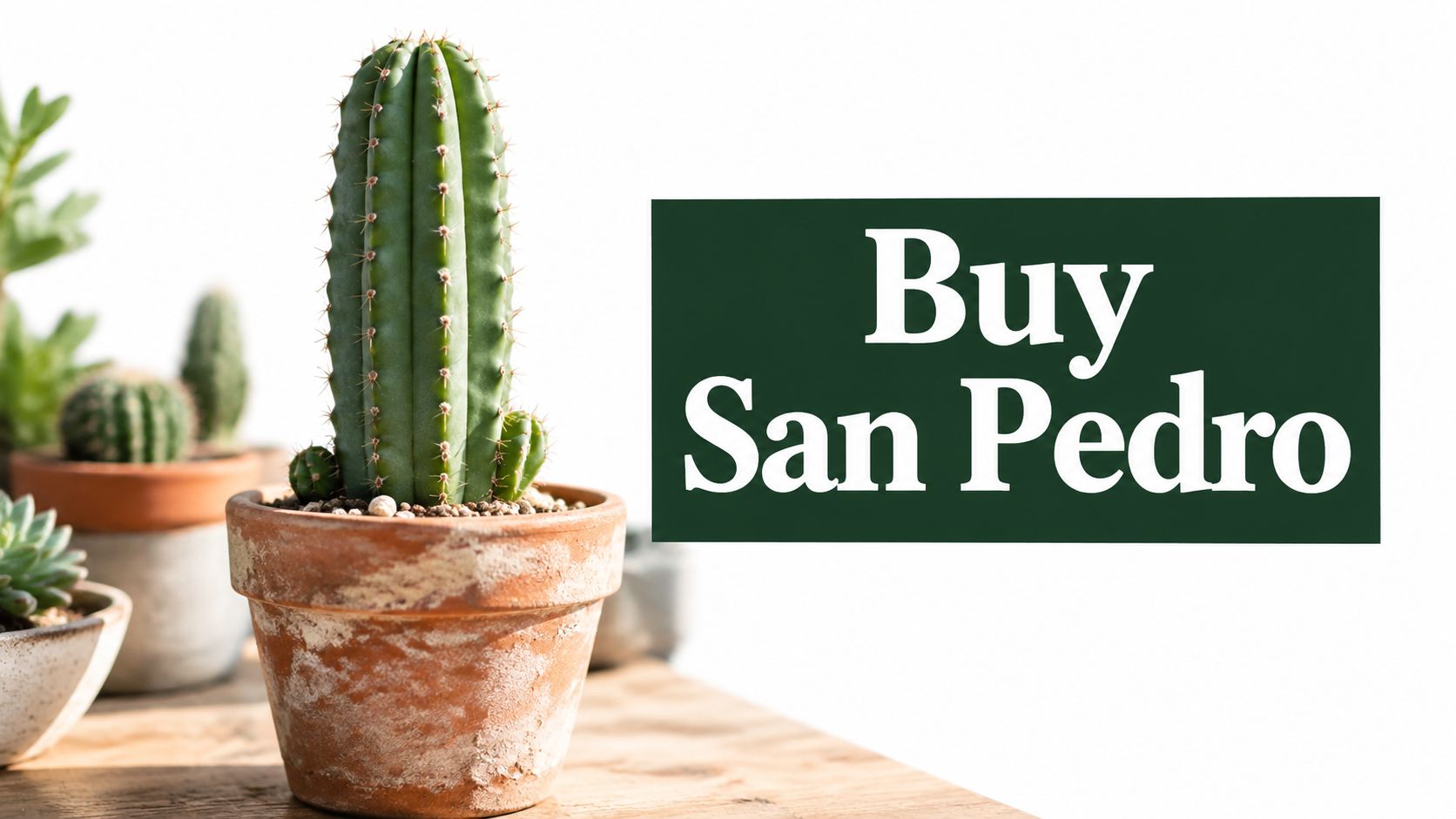

At 11 p.m., you're scrolling through San Pedro listings with your phone in one hand and three browser tabs open. One seller shows a tall rooted plant, another offers an unrooted cutting, and a third has a suspiciously cheap column with no recent photos. Before you click buy San Pedro cactus online, you need answers to three practical questions: which format suits your outdoor space, whether the seller can legally ship to you, and whether the price reflects a healthy specimen or an expensive problem.
San Pedro makes sense as an ornamental purchase. It's a drought-tolerant, columnar cactus with real presence in a dry garden, patio container, or architectural setting. Local nurseries often carry smaller desert plants, but mature columnar specimens take space and time to grow, which pushes serious buyers toward online specialty nurseries. The problem is that online listings can hide the exact details that matter most. This guide focuses on those details, from documentation and specimen quality to packaging and the first days after delivery.
Why Buyers Are Searching for San Pedro Online Right Now
San Pedro earns attention because it does a job smaller ornamental cacti can't. A compact barrel cactus can fill a pot, but a strong San Pedro creates vertical structure beside stucco, gravel, agave, aloe, or a low-water planting bed. Buyers looking for a large focal plant, a patio statement, or a drought-tolerant privacy screen usually aren't shopping for a tabletop specimen. They want a column that changes the scale of the space.
That's why online buying has become the practical route for many homeowners and designers. A neighborhood garden center may have common succulents on hand, but it rarely has a broad selection of mature, nursery-grown columnar cacti ready for delivery. Online sellers can show rooted plants, cuttings, and larger specimens side by side, allowing you to compare form instead of settling for whatever happens to be available locally.
The three decisions that matter before checkout
Rooted or unrooted? A rooted plant arrives established and is the simpler choice for a first purchase or an immediate garden installation. An unrooted cutting can be easier to ship and often offers more flexibility, but you'll need to manage callusing, potting, and gradual re-establishment.
Can the seller ship to your location? Domestic ornamental sales and international plant shipments involve different documentation. A responsible buyer checks destination rules before paying, rather than assuming that a listing available online can legally cross every border.
Does the price match the plant? Height alone doesn't tell you much. A thick, firm cutting may be a better buy than a taller, thin column. Recent photos, base condition, root status, and the seller's packaging policy tell you more than a dramatic product title.
Practical rule: Buy the plant that fits your space and experience, not the plant with the largest number in the listing title.
The trust gap is manageable if you treat the purchase like a nursery procurement decision. Ask for the actual specimen, verify the shipping terms, and choose a seller that can explain what you're receiving. That approach turns late-night scrolling into a controlled comparison instead of a gamble.
Understanding San Pedro as an Ornamental Columnar Cactus
San Pedro earns its place as a large ornamental columnar cactus because of its height, strong vertical lines, and modest water needs. In open ground, a mature plant can reach up to about 6 m. Container specimens are often cited at roughly 1–2 m over several years, so choose the planting position with its eventual form in mind. A plant that fits beside a patio door today may become a dominant vertical feature once established.

Read the form before you buy
Begin with the column itself. Healthy color ranges from pale green to blue-green, depending on the specimen and its growing conditions. The body should feel firm, with even skin, defined ribs, and clean areoles. Those ribs provide the architectural texture that suits drought-tolerant planting, while the areoles mark where spines and new growth develop.
Rib count and shape can indicate maturity and individual form, but they should not decide the purchase alone. A thick column with broad, stable ribs usually has more presence than a taller plant stretched by weak light. Check whether the top remains proportionate to the base. A narrow, weak-looking tip suggests poor light exposure.
San Pedro suits several settings:
- Dry-climate foundation beds: Combine a vertical column with rounded agaves, low groundcovers, and mineral mulch.
- Patio containers: Choose a heavy pot that can support the plant's height and prevent tipping.
- Architectural entry planting: Set one specimen against stucco, stone, or a plain wall so its silhouette remains clear.
- Privacy groupings: Several columns add height without the water demand of a conventional hedge.
Match climate to placement
Outdoor suitability is commonly associated with USDA zones 8b–10, with reported tolerance down to about 20°F (-9°C), as outlined by Gardenia's Trichocereus pachanoi profile. Use that range for planning, not as a guarantee. Cold, wet soil and strong wind can make an exposed site unsafe even within a suitable zone.
Container growing gives buyers in colder regions more control. A pot about 40–60 cm, or 16–24 in, across is a practical starting range for a substantial specimen, according to container planting guidance for Trichocereus pachanoi. Use fast drainage and enough weight for the mature silhouette. For compatible drought-tolerant planting combinations, consult this drought-tolerant landscape guide.
Legal and Documentation Basics Before You Check Out
The plant's ornamental status doesn't eliminate the paperwork layer. In the United States, San Pedro is widely described as legal to own, grow, and sell for non-consumptive ornamental use, while mescaline is federally listed as a Schedule I substance. The legal distinction is intent-driven. Buy and discuss the specimen as a horticultural plant, and don't purchase listings that market it for preparation or consumption. This overview of San Pedro ownership and trade explains the split between ornamental possession and controlled-substance concerns.
International shipping is more complicated because Cactaceae is listed under CITES Appendix II. That means international trade in specimens may require export permits or re-export certificates. Artificially propagated ornamental material receives more lenient treatment than wild-harvested stock, and seeds of Cactaceae from Ecuador and Peru are exempt from CITES controls, a distinction that matters to propagation and e-commerce businesses. The rule is not a blanket license to ship any cactus anywhere. Customs, plant-health authorities, and destination-country restrictions can still apply.
Domestic versus international transactions
For an ordinary domestic ornamental purchase, buyers generally don't need a special buyer permit to own the plant. The seller should still be able to identify the plant accurately and provide a clear invoice showing the transaction's horticultural nature. If the plant is moving across state lines, ask whether the seller follows applicable plant-health and carrier requirements, especially for a large rooted specimen.
International buyers should ask for documentation before payment, not after the box is already in transit. Confirm who is responsible for export paperwork, whether the destination accepts the species, and whether a phytosanitary certificate or plant passport is required. Don't rely on a seller's generic statement that they “ship worldwide.”
| Documentation a Reputable San Pedro Seller Should Provide | Domestic Seller | International Seller |
|---|---|---|
| Itemized invoice | Clear plant description and sale details | Required as part of the customs record |
| Origin information | Nursery or cultivated-source details when available | Cultivation and origin records are especially important |
| Phytosanitary documentation | Provide when the shipment or destination requires it | Confirm requirements with the destination plant authority |
| CITES documentation | Usually not the central issue for a domestic sale | Ask whether an export permit or re-export certificate applies |
| Shipping restrictions | State and carrier checks before dispatch | Destination-country import approval and customs review |
Ask before paying: “What documents accompany this shipment, and who handles any required plant-health or CITES paperwork?”
Don't accept vague answers about “legal everywhere.” Rules vary by jurisdiction, and the same cactus may be treated as a permitted ornamental plant in one location and restricted for import or preparation in another. The safest listing is specific about the plant, the seller's location, the destination, and the documents supplied.
Choosing the Right Specimen, Size, and Format
The right format depends on what you want to accomplish. A homeowner filling a sunny container has different needs from a contractor installing an instant focal point. Compare the purchase formats before comparing individual listings.
| San Pedro Buying Formats Compared | Typical Price (USD) | Time to 1 m | Shipping Risk | Best For |
|---|---|---|---|---|
| Rooted plant | Not stated by verified data | Not stated by verified data | Root and soil movement can add stress | Beginners and buyers wanting an established specimen |
| Unrooted cutting | Not stated by verified data | Not stated by verified data | Lower soil-related mess, but requires careful acclimation | Experienced buyers and flexible planting plans |
| Seedling | Not stated by verified data | Not stated by verified data | Small and easy to protect, but slower to create visual impact | Collectors with patience |
| Bulk or wholesale lot | Not stated by verified data | Not stated by verified data | Depends on packing, count, and uniformity | Designers, contractors, and repeat buyers |
The table leaves price and time blank for a reason. Listings vary too widely, and the verified data doesn't support invented ranges. Judge value through size, thickness, rooting status, provenance, shipping protection, and seller accountability, not a made-up market average.
Rooted plants versus cuttings
A rooted plant is the straightforward choice if you want to pot it and establish it with minimal handling. Inspect the base, ask whether the plant is firmly rooted, and confirm whether the seller ships it in its growing container or bare-root. A tall potted plant can create immediate visual impact, but its weight and root ball make packaging more demanding.
Cuttings often make sense for online purchases because they avoid the shipping stress associated with a large soil-filled pot. They still need a dry, protected cut end and a buyer who won't rush watering. A 30 cm, thick cutting can be a stronger long-term purchase than a 60 cm, thin column, because girth, firmness, and growth history matter more than height alone.
Photo and health signals
Demand recent images of the actual plant. Stock photography can't show the base, current color, blemishes, or the condition of the growing tip. Look for:
- Firm base: Avoid soft, collapsing, or waterlogged tissue.
- Defined ribs: Broad, stable ribs generally read as more mature than narrow, stretched growth.
- Clean areoles: Check for debris, cottony material, or suspicious buildup.
- Consistent skin: Healed scars can be acceptable, but active dark, spreading, or wet-looking patches deserve questions.
- Proportionate growth: A thin top on a thick base may reflect a previous lighting problem.
If your San Pedro will live on a patio, prioritize a manageable container size and a pot with enough weight to resist tipping. If you're creating a garden focal point in a mild climate, buy for eventual scale rather than short-term convenience. For buyers placing a specimen in a decorative vessel, vintage planter identification advice can help you evaluate an older planter before pairing it with a living cactus.
Seller Signals, Shipping, and Packaging That Actually Protect the Plant
A seller's policy pages matter as much as the product photo. Before ordering, find the dead-on-arrival policy, return window, damage procedure, and contact information. A nursery that expects buyers to document damage should say what evidence it needs and how quickly the buyer must report a problem.
Independent reviews help, but read patterns rather than isolated praise. Look for repeated comments about accurate plant photos, secure packing, response time, and how the seller handled damaged deliveries. A polished storefront doesn't prove that a large cactus will arrive intact.
Verify the seller in a few minutes
Use this sequence before checkout:
- Open the return and DOA pages. Confirm the remedy, deadline, and required photos.
- Check the shipper's identity. Look for a physical business address, usable contact method, and consistent nursery name.
- Request a current image. For a premium specimen, ask for the actual plant beside a recognizable scale reference.
- Ask about the box. Rooted plants need protected root balls and immobilized stems. Cuttings need dry, secure packing that prevents impact at the cut end.
- Confirm weather handling. Ask whether the seller uses insulation or heat protection when conditions could damage the plant.
- Clarify labels and documents. International shipments need accurate botanical descriptions and any required plant-health or CITES paperwork.
A double-walled box is useful only if the plant can't slide inside it. Loose movement creates bruises, broken tips, and pressure damage. Rooted specimens should arrive with the root area protected from crushing, while cuttings should be fully callused before dispatch. Don't confuse a fancy box with a well-engineered package.

Red flags that should stop the order
- No actual-plant photos: Stock images conceal size and condition.
- No shipper address: You can't verify who you're buying from.
- No written return policy: A verbal promise won't protect an expensive shipment.
- Suspiciously low pricing: The seller may be omitting rooting status, condition, or shipping safeguards.
- Refusal to provide a video: A seller doesn't need to accommodate every request, but refusing any current proof for a high-value plant is a warning.
- Vague legal language: “Ships everywhere” isn't a documentation plan.
For a broader comparison of online nursery standards, review this guide to choosing an online cactus store. The best purchase is the one you can inspect, document, and resolve if the delivery fails.
Caring for a San Pedro in the First Two Weeks After Delivery
The box should not sit unopened for days. Unpack the cactus promptly, photograph the package before removing the plant, and document any crushed corners, broken ribs, or wet packing material. Then inspect the base, growing tip, skin, and, if visible, the roots.
For an unrooted cutting, the cut end should be dry and firm. Don't plant a wet or soft end. For a rooted specimen, look for a stable base and signs that the root ball hasn't been badly disturbed. Keep the shipping materials until you're satisfied that the plant arrived in acceptable condition.
Use a staged acclimation routine
Place the plant in bright indirect light for a few days, then wait 2–5 days before repotting if it arrived bare-root or was recently removed from its pot. This post-shipping guidance is consistent with cactus acclimation recommendations, which also advise against immediate watering and call for a gradual increase in sun exposure.
A practical sequence looks like this:
- Arrival day: Unpack, photograph, inspect, and place in bright indirect light. Keep the plant dry.
- Days 2–5: Let the cactus stabilize. Repot only when the plant and any cut surfaces are dry and sound.
- Days 6–10: Introduce gentle morning sun for short periods, watching for bleaching or yellow patches.
- Days 11–14: Increase exposure gradually if the skin remains firm and evenly colored. Avoid a sudden jump into intense midday sun.
For a container, use a fast-draining nursery-style substrate. A simple starting mix is 50% potting soil and 50% pumice or perlite, based on the care guidance from The Cactus Outlet's San Pedro care guide. Choose a container with drainage and avoid upsizing dramatically. A pot that holds excessive unused soil stays wet longer than the plant needs.
Don't water on arrival. After repotting, allow the plant to settle in dry mix, then make the first thorough watering only when the plant is stable and the medium can drain freely. The same caution applies to a cutting. It needs time to form or maintain a protective callus and begin rooting before moisture becomes useful.
Watch the temperature forecast as well. The plant is commonly associated with outdoor growing in USDA zones 8b–10 and reported tolerance to about 20°F (-9°C), but a newly shipped specimen deserves extra protection from cold and wet conditions. Bring a container indoors or shelter it when your local exposure threatens the plant, especially during the acclimation window.
For a visual care reference, use this short video after reading the written routine:
The common mistakes are predictable: watering on day one, placing the cactus in full midday sun on day two, using rich moisture-holding soil, and skipping the inspection around the base and areoles where mealybugs may hide. Slow handling protects the investment.
Your Pre-Purchase Checklist and Final Takeaways
Before paying, check these points:
- Purpose fit: Buy for a drought-tolerant ornamental plant suited to your garden or patio.
- Size and space: Allow room for a tall, columnar cactus in the ground. Container specimens stay more manageable, but still need stable support and adequate light.
- Actual plant photos: Request recent images of the base, ribs, areoles, and growing tip. Reject vague listings or photos that hide damage.
- Seller trust: Check the return window, damage or DOA policy, independent reviews, and working contact details.
- Format fit: A rooted plant offers the simplest start. Choose a cutting or seedling only if you accept slower establishment.
- Shipping readiness: Confirm protective packing, weather handling, delivery timing, and required documents before checkout.
- Legal readiness: For international orders, ask about phytosanitary and CITES paperwork before payment.
- Value check: Compare thickness, rooting status, condition, rarity, and documentation, not height alone.

Two habits protect a new purchase. Document the arrival before removing the packaging, including any crushed sections, rot, or broken tips. Then hold off on water until the cactus has stabilized and its roots or cut surface are ready. This record supports a damage claim, while dry handling lowers the risk of early rot.
The Cactus Outlet offers San Pedro cactus, large cacti, agaves, aloes, euphorbias, and other succulents for container projects. Review its specimens and care information, then visit The Cactus Outlet to choose a plant suited to your space and climate.