
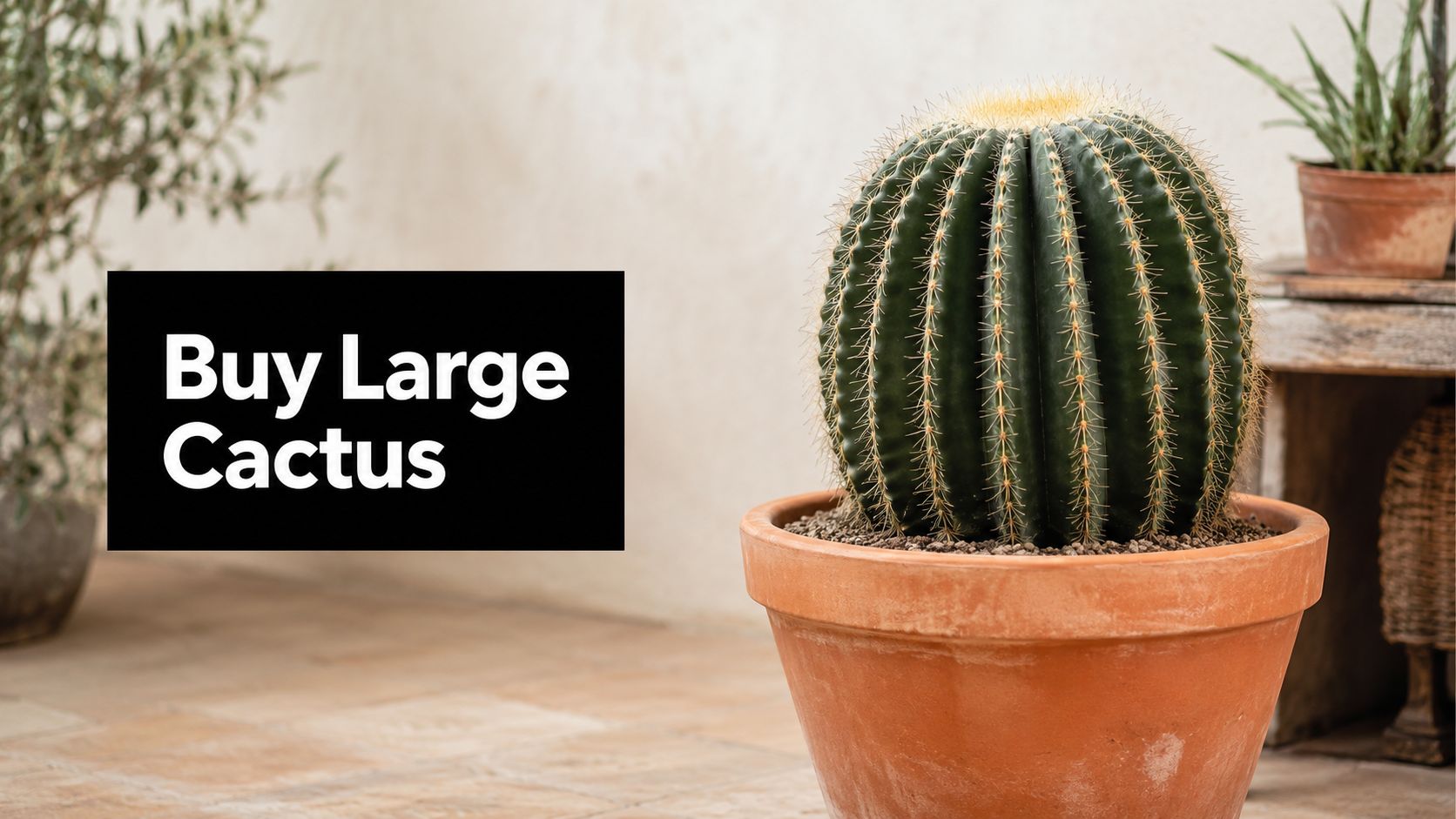

A lot of people decide to buy a large cactus the same way. They see one outside a modern home, in a hotel courtyard, or in a collector's greenhouse and suddenly the little desktop succulents they've been nursing don't feel quite the same. A mature cactus has presence. It doesn't read like décor. It reads like architecture.
That ambition is reasonable. It's also where many buyers get into trouble. A large cactus isn't a casual add-to-cart plant, and it isn't forgiving of bad placement, rough shipping, or rushed installation. The buyers who end up happiest are usually not the ones who chase the tallest specimen first. They're the ones who think through climate, access, delivery, and what the plant will need in the first week after arrival.
I've always liked helping people make that jump from admirer to owner because the right purchase can anchor a room, a patio, or an entire outdoor area for years. The wrong one becomes an expensive lesson. Some of the appeal is exactly why these plants command attention in the first place. The saguaro, for example, can live about 150 to 200 years and may take 50 to 70 years just to produce its first arm, according to Arizona saguaro facts from the Arizona Department of Education. When you buy a large specimen, you're often buying accumulated time as much as a plant.
Bringing a Desert Giant Home
The most common scene I hear from customers goes like this. They've been thinking about a large cactus for months, maybe longer. They've saved photos, measured a corner twice, and still hesitate because it feels like too much plant, too much money, and too much risk to get wrong.
That hesitation is healthy.
A large cactus changes a space immediately, but it also asks more of the owner. You need a real plan for placement, safe handling, drainage, and acclimation. If the cactus is going outdoors, you need to know what winter looks like in your yard, not just what summer looks like on the nicest weekend in June.
A mature cactus isn't just something you own. It becomes part of how the space feels every day.
That's why I tell buyers to think of the purchase the way they'd think about a piece of durable outdoor furniture or a sculptural tree. You're not just choosing a species. You're choosing how much complexity you want to manage after it arrives.
Why size feels different
Small cacti let you experiment. Large cacti don't. A heavy columnar cactus, a broad golden barrel, or a specimen euphorbia-equivalent form in a big planter changes logistics fast. You need to think about doors, stairs, patio exposure, and whether the final location has enough sun to justify the purchase.
Some buyers want instant impact and are prepared for that responsibility. Others discover they'd be happier with a medium-size plant they can move more easily. Both are good decisions.
What makes the purchase worth it
The reward is hard to overstate when the match is right. Large cacti give you shape, age, texture, and a kind of visual calm that leafy plants rarely deliver. They're sculptural without looking overdesigned.
That's also why they deserve patience on the front end. If you want to buy large cactus plants with confidence, the practical work happens before checkout.
Choose the Right Cactus for Your Space
Most buying mistakes start with appearance. A buyer falls in love with a silhouette, then tries to force that plant into the wrong conditions. With large cacti, climate fit comes first. The saguaro is a clear example. It's a Sonoran Desert native limited to elevations below about 4,000 feet, and buyers in frost-prone or coastal conditions need to treat it as a specialized plant, not generic drought-tolerant landscaping, as noted by the National Park Service saguaro overview.

Start with a site assessment
Before you shortlist any species, answer four questions:
- Will it live indoors or outdoors
- How much direct sun does that exact spot get
- What happens there in winter
- Can you safely move the plant in and out if conditions shift
A bright indoor room with strong light can support some large cacti well. A dim room with decorative intent but weak light usually can't. Outdoors, the issue is often less about summer heat and more about cold, wet conditions hanging around too long.
Practical rule: Buy for the hardest season, not the prettiest one.
Common fits and mismatches
A saguaro belongs with buyers who understand desert conditions and can provide them. A golden barrel often suits decorative containers and dry, high-light settings where the owner wants a bold form without the same height. A prickly pear can work well where width is acceptable and the buyer understands pad spread and handling.
If you're comparing forms, growth habits, and common specimen options, this guide to types of large cactus plants is a useful visual starting point.
Popular Large Cactus Comparison
| Cactus Type | Max Height | Sun Needs | Frost Tolerance |
|---|---|---|---|
| Saguaro | About 45 feet in cultivation | Full sun | Low |
| Prickly Pear | Varies by type | Full sun | Varies by type |
| Golden Barrel | Lower growing, broad form | Full sun | Limited |
| Peruvian Apple Cactus | Tall columnar form | Bright sun | Limited to moderate depending on conditions |
The table is simple on purpose. Exact performance depends on your site, your watering habits, and how exposed the plant is to cold and wet weather together.
Match the plant to the job
A designer installing a statement planter by a sunny entry wants one outcome. A collector filling a greenhouse corner wants another. A homeowner trying to soften a pool deck needs something else again.
Use that intended job as a filter:
- For indoor statement use: prioritize manageable form, strong light access, and safe clearance from walkways.
- For outdoor desert-style planting: prioritize climate realism, drainage, and winter exposure.
- For collectors: prioritize species fit and condition over sheer size.
- For gifts or one-time installs: prioritize transport practicality. The recipient has to live with the plant after the reveal.
The best large cactus is the one that still makes sense six months later.
How to Inspect for Health and Quality
This is the part buyers skip when they're dazzled by size. Don't. If you wouldn't buy a used truck without walking around it first, don't buy a large cactus without inspecting the body, the base, and the root situation as carefully as the seller allows.

What healthy looks like
A healthy large cactus usually reads as stable before you touch it. The tissue should look firm, not collapsed. Color should be consistent for the species and growing conditions. Minor cosmetic marks can be normal, especially on older specimens, but widespread scarring, fresh gouges, or odd discoloration deserve attention.
Look for these basics:
- Firm body tissue: You want flesh that feels solid, not soft or waterlogged.
- Even structure: A little asymmetry is natural. Leaning, collapse, or awkward bends can signal stress.
- Clean growing point: The top or active growth area should look intact.
- No obvious pest clusters: Check ribs, areoles, creases, and the base.
What should stop you
Some problems are manageable. Others aren't worth inheriting unless you know exactly what you're taking on.
Red flags include:
- Soft spots near the base
- Blackened or wet-looking tissue
- Patches that look actively rotting
- Hidden pest buildup in spines or crevices
- A plant that rocks loosely in its container
A large cactus can hide trouble well. Surface beauty doesn't guarantee internal health.
How to judge online listings
Online buyers have to inspect differently. Product photos matter, but so does what the seller is willing to say when asked. Request current images if the listing looks generic. Ask whether the exact plant shown is the one being shipped. Ask whether there are healed scars, fresh damage, or cosmetic blemishes.
A serious seller should be comfortable answering condition questions clearly. If you're evaluating vendors, this article on the best place to buy cactus online gives a practical framework for what to look for in a seller beyond the species list.
If a seller only talks about height and price, you still don't know enough.
Inspect the roots when possible
For local pickup, root condition matters almost as much as the visible body. You don't need a dramatic bare-root examination for every plant, but you do want to know whether the cactus is well established, freshly potted, or recently cut and rooted.
That distinction changes aftercare. A freshly rooted large cactus may look finished but still needs a gentler transition than a well-established specimen. Buyers often mistake visual maturity for installation readiness. They aren't always the same thing.
Understanding the True Cost of a Large Cactus
The sticker price is only the first number. Buyers get surprised when they budget for the plant and forget the rest: delivery, installation labor, a proper container, drainage materials, protective gloves, and sometimes the simple fact that a very large specimen can't be handled by one person safely.
The biggest built-in cost driver is time. Large cacti are expensive because they're slow to produce. A small 3-inch barrel cactus may already be 3 to 4 years old, and reaching an 8 to 10 inch sale size can take at least another three years, which means a larger specimen can represent roughly 6 to 7 years of growth time before sale, as explained in this article on why large cacti and succulents are so expensive. That's before you add handling, space, and loss risk.
What you're actually paying for
A buyer looking at a mature cactus is paying for several layers at once:
- Years in production
- Nursery space occupied for a long time
- Labor to repot, move, and maintain the specimen
- Loss risk if a plant scars, rots, tips, or stalls
- Packaging and freight complexity once sold
That's why large cactus pricing often feels disproportionate if you compare it to fast-growing ornamentals. It isn't apples to apples.
The hidden costs after checkout
These costs catch people all the time:
- Delivery access: A cactus that reaches your curb still has to reach its final spot.
- Installation help: Tall, heavy, or spiny specimens often require more hands and a plan.
- Pot and soil: Decorative pots without proper drainage are one of the fastest ways to ruin a good cactus.
- Protective handling gear: Thick gloves, moving blankets, and tie-down support can make the job safer.
If you're coordinating a move, a renovation, or a large install and want a sense of how transport labor can affect total project cost, it can help to learn about Australian removalist prices as a general moving-cost reference. The exact services differ from plant delivery, but the core lesson is the same. Access, weight, distance, and handling difficulty all change the final bill.
Cheap can become expensive
The cheapest specimen is often the one that needs the most correction. A bargain cactus with poor rooting, weak packaging, or a bad shape may cost less upfront and more in time, replacement, and frustration.
A healthy, well-grown plant that fits the site is usually the less expensive choice over the life of the purchase.
Navigating Shipping Logistics and Legal Rules
Shipping isn't a side detail when you buy large cactus plants online. It's the purchase. You can choose the right species, pay for a healthy specimen, and still lose the deal if the plant is packed badly or sent in the wrong weather window.
What good shipping looks like
Large cacti are brittle, top-heavy living goods. They can bruise, snap spines, scar skin, or develop problems later from impact and temperature stress. One of the clearest signals of a careful seller is attention to packaging. Good sellers use insulated cartons, internal bracing, and heat or cold packs when needed, and many recommend weather-based shipping holds because live plants are more damage-sensitive than standard parcels, as described on this large Peruvian cactus shipping page.
That standard matters. A cactus that looks fine in a product photo can still fail in transit if it shifts inside the box or sits in the wrong temperature range too long.
Questions every buyer should ask
Ask these before you place the order:
- How is the cactus stabilized inside the package
- Do you hold shipments during extreme heat or cold
- Will the plant ship bare-root, potted, or semi-dry
- What carrier or freight method is used for larger specimens
- What happens if there is transit damage
If the answers are vague, keep shopping.
Shipping skill is part of plant quality. Buyers should treat it that way.
Packaging details that matter
Packaging for a large cactus should protect both the plant and everyone handling the package. Internal bracing keeps the specimen from rolling or punching through the sidewall. Ventilation matters. So does clear labeling. Even basic supplies like fragile packaging labels from The Box Warehouse help show how much of safe transit comes down to visible handling instructions, not just the outer box.
A seller that understands this won't package a cactus like ceramic décor. Live plants need stability, airflow, and timing.
Legal and species restrictions
Some marquee cacti come with legal complications. Protected species, transport rules, and state-level requirements can affect whether a plant can be sold, moved, or planted in a given location. Saguaros deserve special caution here because buyers often assume availability means unrestricted movement.
If you're considering that species in particular, review practical buying considerations for how to buy a saguaro cactus. The legal side should never be an afterthought.
This is the one place in the buying process where I tell people to slow down on purpose. A seller with fewer species but stronger shipping discipline is often the safer choice. The Cactus Outlet, for example, is one online retailer in this category that presents large cactus options along with species-specific information. That kind of detail is more useful than a long product grid if you're buying a plant that has to survive real transit.
Your Cactus Has Arrived What to Do Next
Arrival day is where buyers either protect the plant well or undo a lot of good preparation with one rushed decision. Don't drag the box into full sun, tear it open fast, and set the cactus straight into its final harshest conditions.
Start with a calm inspection area.

First hour priorities
Use gloves and support the plant from stable points, not from soft tissue or delicate tips. Open the package slowly and save the packing material until you've checked condition. If there's visible damage, document it before you reposition anything.
Then work through this short checklist:
- Inspect the body: Look for fresh breaks, compressed spots, or scrapes from transit.
- Check the base and roots: Make sure nothing shifted badly during shipment.
- Note the moisture level: Don't assume it needs water just because it traveled.
- Choose a temporary acclimation spot: Bright but protected is usually the right start.
Here's a helpful visual on handling and settling in a newly arrived cactus:
Don't rush the light transition
One of the most common mistakes is moving a boxed cactus directly into intense afternoon sun. Even sun-loving species can stress if they've been in darkness, fluctuating temperatures, and dry packaging during transit.
Give the plant a short adjustment period in bright indirect light or gentler morning exposure. Then increase light gradually. The exact pace depends on the species, the season, and how long the plant was in transit, but the principle stays the same. Let the cactus reorient before asking it to perform.
Watering after delivery
New owners tend to overreact in one of two ways. They water immediately because the plant looks tired, or they leave it unattended for too long because they're afraid of doing anything wrong.
The better approach is observation. If the cactus shipped bare-root or was recently handled at the root zone, it may benefit from a short rest before watering. If it arrives established in dry mix, you still want to judge the medium before deciding. Watering should follow root condition, not anxiety.
Essential Long-Term Care for Your Giant Plant
Long-term success with a large cactus usually comes down to restraint. Most losses don't come from neglect. They come from too much water, poor drainage, and a placement that never really fit the plant.
The care routine that works
Use a soak and dry approach. Water thoroughly when the plant and growing mix are ready for it, then let the mix dry appropriately before watering again. That sounds simple because it is. What complicates it is decorative potting, indoor low light, and owners trying to make a cactus behave like a tropical plant.
Your maintenance routine should stay grounded in a few basics:
- Light: Keep the plant where it gets the level of light you bought it for.
- Drainage: Use a cactus-appropriate mix and a container that doesn't trap water.
- Airflow: Stagnant, damp conditions create trouble faster than most owners expect.
- Observation: Watch for subtle softening, discoloration, or leaning before it becomes a bigger issue.
A large cactus usually wants less interference than its owner wants to give.
What not to do
Don't keep topping off small amounts of water. Don't move the plant repeatedly between weak light and scorching light. Don't bury the base deeper for stability if the cactus looks wobbly. Fix the root and support problem correctly instead.
Fertilizer is often overused too. A mature cactus doesn't need to be pushed. Strong form, good drainage, and proper light matter more than aggressive feeding.
Why simple care wins
A giant cactus can be remarkably durable when the fundamentals are right. That's the good news. The hard truth is that poor fundamentals catch up slowly, and by the time the plant shows real distress, correction is harder.
Buy wisely, install carefully, and then stay disciplined. That's the whole game.
A Rewarding Investment in Living Art
A large cactus asks for more thought at the start, but that's exactly why a good purchase feels so satisfying later. Choose for the site, inspect for health, budget for the full job, respect shipping realities, and handle the first week with patience. After that, care gets simpler.
When you buy large cactus plants the right way, you're not just filling space. You're bringing home structure, age, and character that smaller plants rarely match. Done well, it's one of the most rewarding plant purchases you can make.
If you're ready to shop with those realities in mind, The Cactus Outlet is worth exploring for large cacti and succulents with detailed product information to help you compare species, size, and care needs before you buy.