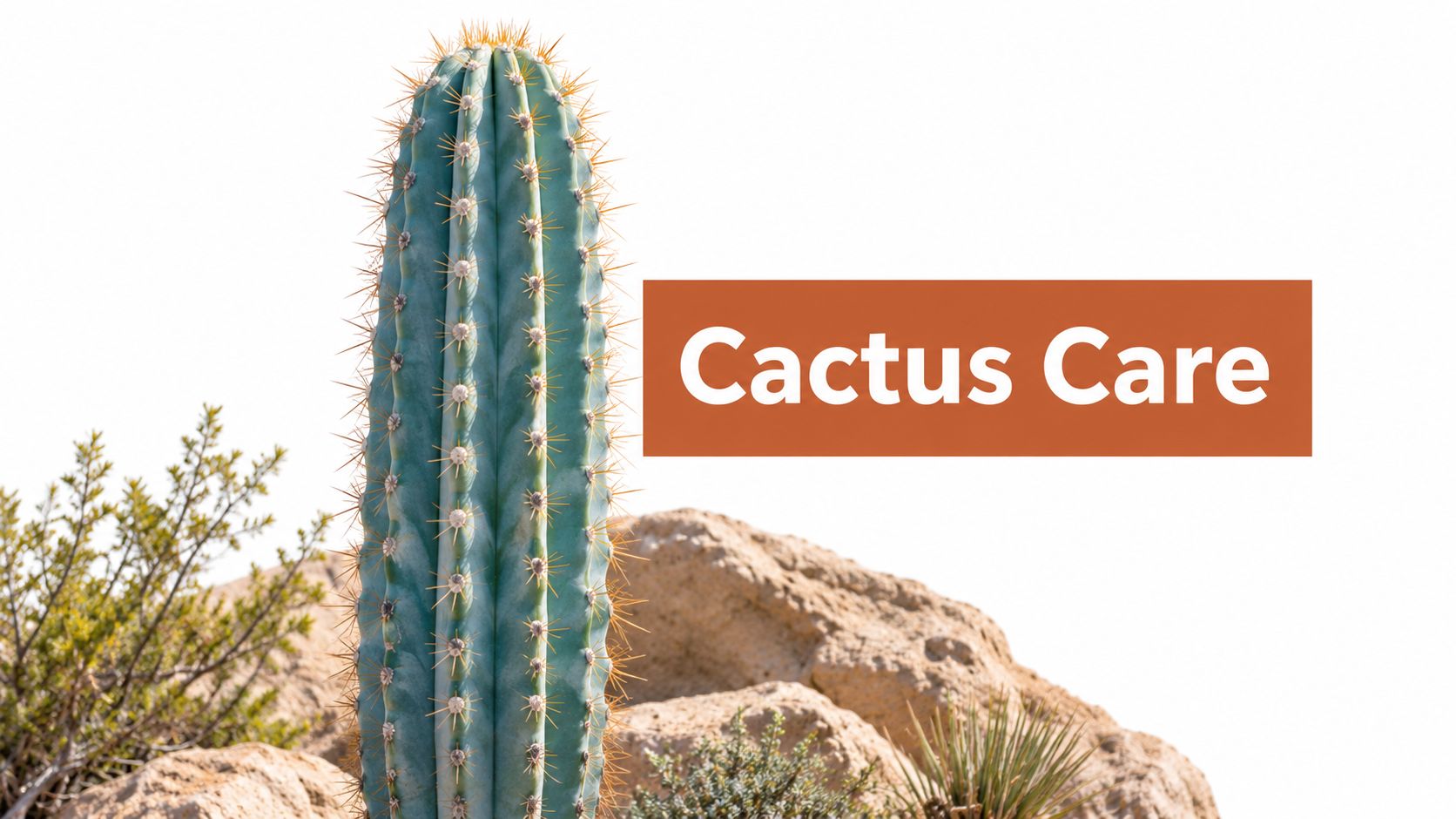


Of all the columnar cacti out there, the San Pedro cactus, or Trichocereus pachanoi, is a true showstopper. Native to the high-altitude Andes, this fast-growing giant is loved for its striking blue-green hue, nearly spineless columns, and commanding presence. It’s less of a plant and more of a living sculpture for your home or garden.
Meet the San Pedro: A Living Architectural Wonder

Think of the San Pedro as a piece of the dramatic Andean landscape you can bring home. Its graceful, vertical columns have a powerful yet calming presence, looking more like an architectural feature than a simple houseplant.
This unique quality draws in everyone from first-time cactus owners to seasoned collectors. If you're new to the game, you'll find the San Pedro is surprisingly forgiving and easy to manage. For the veterans, its vigorous growth and majestic form present a deeply rewarding project to nurture.
To give you a quick snapshot of what makes this cactus so special, here’s a look at its key traits.
San Pedro Cactus At a Glance
| Characteristic | Details |
|---|---|
| Scientific Name | Trichocereus pachanoi (syn. Echinopsis pachanoi) |
| Common Name | San Pedro Cactus, Huachuma |
| Origin | Andean mountains of Ecuador and Peru |
| Growth Habit | Fast-growing, multi-stemmed columnar cactus |
| Mature Size | Can reach 20 feet (6 m) tall and 6 feet (1.8 m) wide |
| Growth Rate | Up to 12 inches (30 cm) per year |
| Light | Full sun to partial shade |
| Water | Low; allow soil to dry completely between waterings |
| Flowers | Large, white, nocturnal flowers in summer |
| Hardiness | USDA Zones 8b-10; not frost-tolerant |
This table covers the basics, but the real story of the San Pedro is in the details—its surprising speed and distinct look.
A Standout for Speed and Simplicity
Many cacti teach a lesson in patience, growing so slowly that you barely notice a change from one year to the next. The San Pedro is not one of them. Its vigorous growth is one of its most talked-about traits, offering a dynamic experience that’s incredibly satisfying to watch unfold.
The growth rate of Trichocereus pachanoi is genuinely impressive. It’s a plant that rewards your care with visible progress, which is a huge reason it’s a favorite among our growers.
This isn’t an exaggeration. With plenty of sun, the right soil, and a good watering schedule, a San Pedro can easily shoot up 12 inches (30 cm) in a single year. It quickly establishes itself as a centerpiece, not a background plant. For a deeper dive into its growth habits, the profile on Gardenia.net is a great resource.
Key Features of Trichocereus Pachanoi
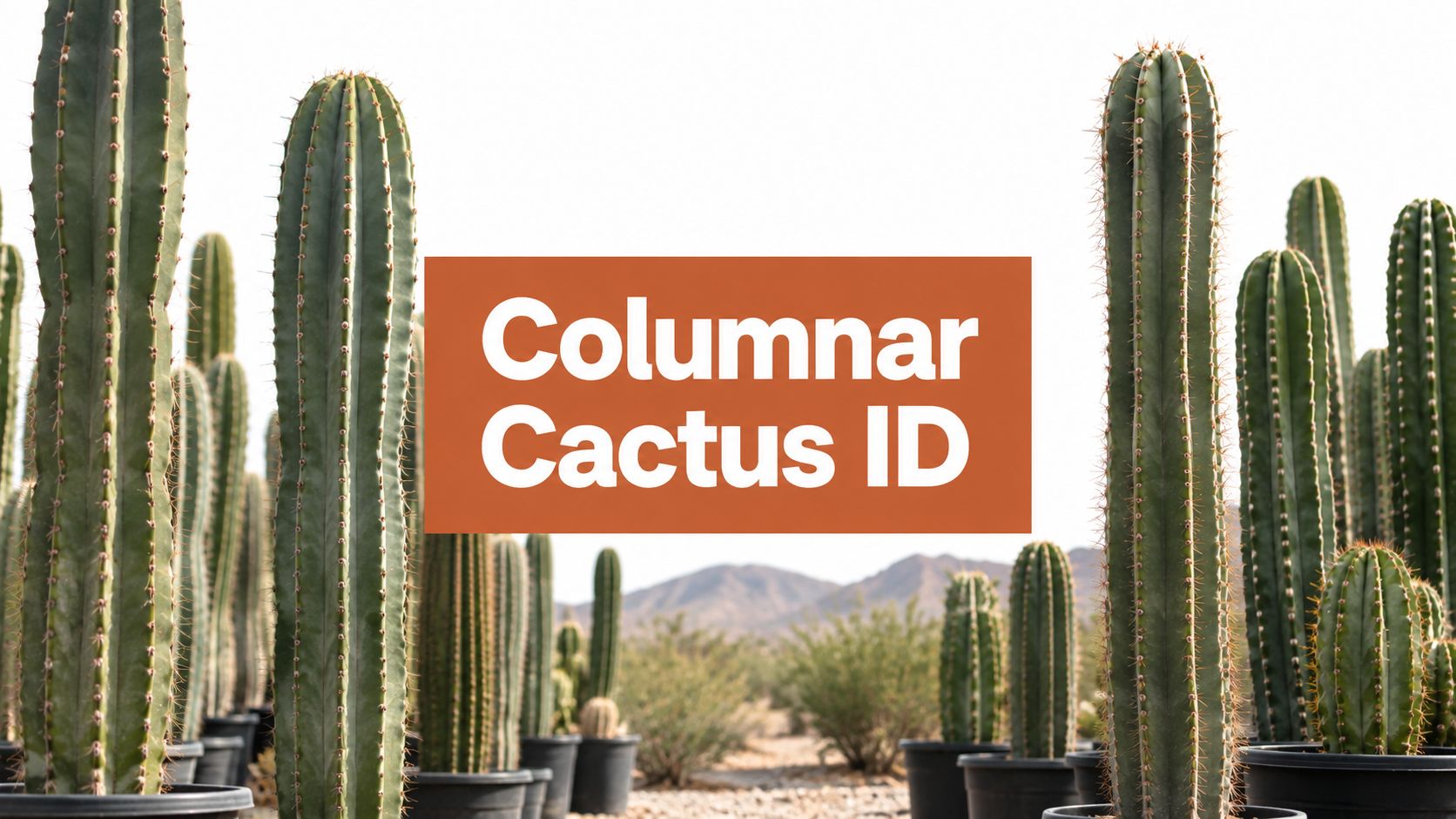
So, how do you spot a San Pedro? It has a few signature features that make it easy to identify once you know what to look for.
- Columnar Form: It grows in tall, elegant pillars, often branching from the base to form a candelabra-like cluster over time.
- Smooth, Blue-Green Skin: Its skin is a beautiful deep green to a dusty blue-green color that’s smooth to the touch.
- Minimal Spines: Unlike its spikier cousins, T. pachanoi is often nearly spineless or has tiny, sparse spines. This makes it much easier and safer to handle.
- Rounded Ribs: You'll notice 6-8 broad, rounded ribs running down the stem, giving the columns a soft, undulating look.
In this guide, we'll walk you through everything you need to know to help your San Pedro not just survive, but truly thrive. Let’s get started.
Journey Through Time: The Millennia-Old History of San Pedro
When you bring a Trichocereus pachanoi into your home, you're doing more than just adding a new plant to your collection. You're becoming a steward of a living artifact with a history that stretches back thousands of years, deeply rooted in the spiritual traditions of the Andes. This isn't some modern horticultural novelty; it's a direct link to ancient cultures.
The story begins high in the mountains of Peru and Ecuador, the cactus’s native home. It has silently watched empires rise and fall for millennia. For the earliest civilizations there, the San Pedro cactus wasn't just another plant on the hillside—it was a powerful spiritual ally and a sacred medicine.
Echoes from the Ancient World
The connection between humans and this cactus is astonishingly old. Archaeologists have found evidence in Peru's Guitarrero Cave suggesting people were using it as far back as 6800-6200 BCE. Think about that for a moment. That's a relationship that predates the pyramids of Giza.
By 1300 BC, its role was so central that the Chavín people, a major pre-Inca civilization, began carving its likeness into their temple stonework. You can see just how far back the history of the San Pedro cactus Trichocereus pachanoi goes by exploring this detailed historical timeline on Gardenia.net.
The Chavín weren't the only ones, either. Later cultures like the Moche and the Nazca also featured the cactus in their pottery, textiles, and carvings. These aren't just simple drawings; they often depict shamans or deities holding the cactus during ceremonies, leaving us a clear record of its profound spiritual importance.
“This cactus wasn't just decorative; it was a central part of spiritual and healing ceremonies, a fact immortalized in ancient temple carvings.”
For these ancient healers, or curanderos, the cactus was a primary tool. They used it in ceremonies to diagnose illnesses, which were often seen as having spiritual or energetic roots. The rituals were a way to gain insight, find guidance, and connect the individual with the divine.
The Naming of a Sacred Plant
For thousands of years, this revered plant was known by its indigenous Quechua name, Huachuma. The name we use most commonly today, "San Pedro," is a much more recent development that came with Spanish colonization and the introduction of Catholicism.
The name itself, which translates to "Saint Peter," speaks volumes about the cactus's perceived power. In Christian belief, Saint Peter is the one who holds the keys to the gates of heaven. When Spanish missionaries witnessed the powerful, visionary experiences that came from Huachuma ceremonies, they drew a direct parallel. They saw the cactus as another kind of key—one that could unlock the doors to heaven, even if just for a little while.
So, when you tend to your San Pedro, you're participating in an ancient tradition. Your cactus is a descendant of a sacred plant that has been at the center of spiritual life in the Andes for well over 3,000 years. Every new pup that emerges is a continuation of that incredible lineage, connecting your home directly to the sacred mountains of South America.
How to Confidently Identify Trichocereus Pachanoi
Stepping into the world of columnar cacti can feel overwhelming at first. So many look alike! But telling a true San Pedro cactus Trichocereus pachanoi from its cousins is actually pretty simple once you know what to look for. Think of it like being a plant detective—you're just searching for a few tell-tale clues.
What really sets a genuine Trichocereus pachanoi apart are its ribs. A mature plant will almost always have between 6 to 8 ribs. More importantly, look at their shape. They should be low, broad, and distinctly rounded. Don't picture sharp, angular peaks; instead, imagine soft, rolling hills running up the cactus column. This is what gives San Pedro its characteristic plump, gentle look.
The Key Visual Clues
Your investigation starts with a quick visual check. No special tools needed, just a sharp eye for the combination of color, ribs, and spines. These three things together paint the classic San Pedro portrait.
-
Coloration: The skin of a T. pachanoi is one of its most striking features. It can be a vibrant, deep green or even a lovely dusty blue-green. That bluish tint comes from a waxy, powdery coating called a farina, which helps protect the plant.
-
Rib Shape: As we mentioned, this is your number one clue. The ribs are always rounded and typically have shallow, V-shaped dips between them. If you see a cactus with sharp, thin, or deeply cut ribs, you’re probably looking at a different species.
-
Spines (or Lack Thereof): Trichocereus pachanoi is famous for being one of the friendliest-looking columnar cacti. Some have very small, sparse spines—usually just 1 to 3 per areole—that are yellowish-brown and not much of a threat. Many cultivated varieties are completely spineless.
A true San Pedro often feels surprisingly smooth compared to its spikier relatives. That combination of rounded ribs and minimal spines is the most reliable giveaway for a confident ID.
Comparing San Pedro to Common Lookalikes
To really hone your skills, it helps to see how Trichocereus pachanoi stacks up against its close relatives, the Peruvian Torch and Bolivian Torch. They're the ones people mix up most often, but the differences become obvious when you know the specifics. For an even deeper dive, check out our comprehensive cactus identification guide that covers a whole range of species.
This quick table breaks down the main differences at a glance.
| Feature | San Pedro (T. pachanoi) | Peruvian Torch (T. peruvianus) | Bolivian Torch (T. bridgesii) |
|---|---|---|---|
| Ribs | 6-8 broad, rounded ribs | 6-9 ribs, often more defined | 4-8 ribs, very broad and flattened |
| Color | Deep green to blue-green | Glaucous gray-blue | Light to frosty green |
| Spines | Minimal to none; short | Long, honey-colored to brown | Very long, needle-like spines |
| Areoles | Small and white | Large and fuzzy | Prominent, with long spines |
The Peruvian Torch (Trichocereus peruvianus), for example, tends to be more of a grayish-blue color. It also packs longer, more serious-looking spines that are often honey-colored or brown. Its ribs can be a bit more defined than the gentle waves of a San Pedro.
Likewise, the Bolivian Torch (Trichocereus bridgesii) is easy to spot by its incredibly long, needle-like spines and its tendency to have fewer, broader ribs—sometimes as few as four. If you see a cactus that looks like it wants to fight you, it’s almost certainly not a pachanoi. By focusing on these distinct differences, you'll be able to spot a true San Pedro in any lineup and feel great about the cactus you're bringing home.
Your Complete San Pedro Cactus Care Manual
One of the best things about growing a San Pedro cactus (Trichocereus pachanoi) is how quickly you see results. Unlike some of its slower-growing cousins, this cactus puts on noticeable size season after season, which is incredibly satisfying. To get there, all you really need to do is understand its home in the Andes Mountains and try to replicate those conditions.
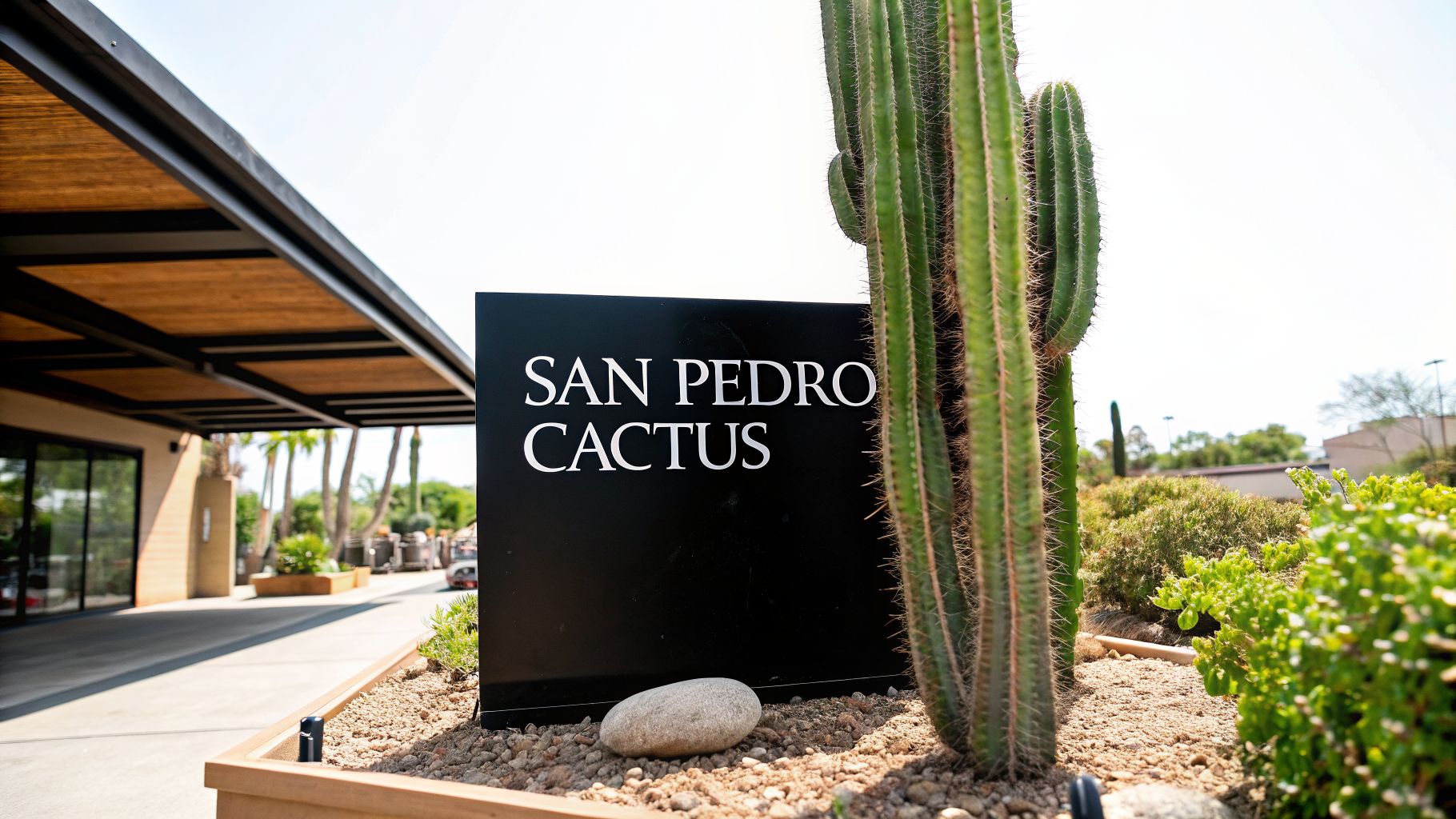
We're talking about a high-altitude environment with intense sun, gritty soil that drains in a flash, and clear wet and dry seasons. Nail these basics, and you'll have a thriving, magnificent cactus on your hands. Before we get into the care details, here’s a quick visual refresher on a key identification trait—the shape of its ribs.

As you can see, those distinctly rounded ribs are a classic tell for T. pachanoi. It’s a simple but reliable way to distinguish it from other columnar cacti that often have sharper, more defined ridges. Now, let's get into keeping it happy.
Light: Give It Plenty of Sun
San Pedro is a sun-worshipper, plain and simple. In its native habitat, it’s blasted with high-altitude sunlight. To keep it happy, you should aim for a spot that gets at least six hours of direct sun every day. If you can give it a full-sun spot outdoors, it will thank you for it.
Growing indoors? Your best bet is a south-facing or west-facing window, where the light is strongest. Just be careful—if your cactus has been living in a shadier spot, don't just thrust it into the intense sun. Ease it in over a week or two to avoid sunburn, which looks like ugly bleached or brown scars on the skin.
Soil: The Secret is Drainage
If there’s one thing that will kill a San Pedro, it’s letting its feet stay wet. Root rot is public enemy number one for almost all cacti. The key is to use a potting mix that lets water rush right through, giving the roots plenty of air.
You can’t go wrong with a simple homemade mix. Just combine a standard cactus soil with an inorganic amendment like pumice or perlite.
- **A foolproof ratio is 50% cactus soil to 50% pumice.
- This creates a gritty, airy foundation that won't get compacted or waterlogged.
When you're potting it up, make sure to plant it deep enough so it's stable. These guys can get tall and heavy, and a solid base will keep them from tipping over.
Watering: Master the "Soak and Dry"
When it comes to watering, timing is everything. Forget a rigid schedule and instead adopt the "soak and dry" method. During the growing season (spring and summer), give the pot a complete drenching until water pours out of the drainage holes.
Then comes the most important part: let the soil become bone dry before you even think about watering again. You can check by sticking a wooden skewer a few inches into the soil. If it comes out with any dampness or soil clinging to it, wait longer. In the dormant winter months, you’ll cut back dramatically, watering maybe once a month or even less.
Feeding: Fuel for Fast Growth
To power its impressive growth spurts, your San Pedro will appreciate some food during its active season. A little fertilizer from spring through summer provides the fuel it needs to push out new growth.
Be picky about your fertilizer, though. Avoid anything high in nitrogen, as this can cause weak, lanky growth that's prone to problems. Instead, look for:
- A balanced fertilizer (like a 10-10-10)
- A bloom-booster formula higher in phosphorus and potassium
Whatever you choose, dilute it to half-strength and apply it every other time you water during the growing season.
Temperature: Warm Days and Cool Nights
Coming from the Andes, San Pedro is built for a wide temperature range—warm days and cool nights are its jam. It feels most at home in temperatures between 70°F and 90°F (21°C and 32°C).
While tough, it is not frost-proof. Any prolonged exposure to temperatures below 30°F (-1°C) can cause serious, permanent damage, especially to the tender growing tip. If you live somewhere with freezing winters, your cactus will need to come inside or be protected with a frost cloth. They also prefer low humidity, so make sure there's good air circulation, particularly for indoor plants.
We adjust these care elements throughout the year to match the seasons. This schedule helps simplify what your cactus needs and when.
Seasonal Care Schedule for San Pedro Cactus
This table provides a simple guide for adjusting your care routine as the seasons change, helping you mimic the natural cycles your Trichocereus pachanoi is accustomed to.
| Season | Watering Frequency | Feeding | Sunlight |
|---|---|---|---|
| Spring | Gradually increase as temps rise. Let soil dry completely between waterings. | Begin feeding with half-strength fertilizer every other watering. | Move outdoors or to a sunnier spot, acclimating slowly. |
| Summer | Water thoroughly when soil is completely dry. May be weekly in hot climates. | Continue feeding every other watering to support peak growth. | Provide at least 6 hours of direct sun. Watch for sunburn in extreme heat. |
| Fall | Gradually decrease watering frequency as days get shorter and cooler. | Stop feeding by the end of the season to signal dormancy. | Keep in a sunny spot. Prepare to move indoors if frost is a threat. |
| Winter | Drastically reduce watering to once a month or less. Keep soil very dry. | No feeding. The cactus is dormant and does not need nutrients. | Provide as much light as possible indoors, or protect from frost outdoors. |
Following this seasonal rhythm is the best way to keep your San Pedro healthy and encourage vigorous growth year after year.
For more foundational knowledge that applies to San Pedros and other varieties, feel free to check out our comprehensive cactus care guide.
How to Propagate San Pedro Cactus Cuttings
There's a special kind of magic in turning one San Pedro cactus Trichocereus pachanoi into an entire collection of new plants. The best part? It's surprisingly simple. The most reliable way to multiply your collection is by taking cuttings, a process that veteran horticulturalists often boil down to three simple words: "Chop, callus, plant."
This method is perfect for anyone looking to expand their garden, share with fellow cactus lovers, or even salvage a plant that’s been accidentally damaged. The San Pedro is incredibly resilient; much like a starfish can regrow a lost arm, a healthy piece of this cactus can generate a whole new plant from scratch.
Making the Cut
Your first job is to choose a healthy, strong section of the main cactus column. You’re looking for a piece with vibrant green color that’s firm to the touch and free of any spots, scars, or soft areas. A cutting should be at least 4-6 inches long to ensure it has enough stored energy to sprout roots, though you can certainly go longer.
Grab a clean, sharp knife and make one decisive cut straight across the stem. A clean cut is non-negotiable, as a jagged or crushed wound is an open invitation for rot and infection. Once the cutting is separated, you can also bevel the top edge of the parent plant, cutting it at a 45-degree angle. This little trick helps prevent water from sitting on the fresh wound as it heals.
The most critical part of propagation isn’t the cut itself but the healing period that follows. Rushing this step is the number one reason new cuttings fail.
The All-Important Callusing Stage
With your cutting in hand, it's time for the hardest part: waiting. You need to let the cut end dry out completely and form a callus. Think of it as a scab that forms over the wound. This hard, dry layer seals the moist inner tissue, protecting it from fungus and bacteria once it's in the soil.
To get a perfect callus, just follow these steps:
- Stand the cutting upright in a cool, dry place with plenty of air circulation.
- Keep it out of direct sunlight while it’s healing.
- Let it sit for at least one to three weeks.
The exact time this takes depends on how thick your cutting is and the humidity in your home. A beefy, wide cutting might need a month or more, while a thinner one could be ready much sooner. You’ll know it’s ready when the cut end feels dry and hard to the touch, and it might even look a little concave. Seriously, don't rush this stage—a solid callus is your ticket to a successful new plant.
Planting and Rooting Your Cutting
Once your cutting is beautifully callused, you’re ready to plant. Grab a pot with great drainage and fill it with a gritty, fast-draining soil mix. The same blend you use for your mature cacti will work perfectly—a 50/50 mix of cactus soil and pumice is a fantastic choice.
Gently place the callused end about 2-4 inches deep in the soil, just deep enough so it stands up on its own. If you have a particularly tall cutting, a few stakes can help keep it stable. Now, here comes the second test of your patience: do not water it.
Wait at least a week or two before giving the cutting its first sip of water. This gives any delicate new roots that may have been damaged during planting a chance to heal. For the next month or two, water only when the soil is bone dry. Eventually, you can give the cactus a gentle wiggle—if you feel resistance, you've got roots! From there, you can slowly transition it to a regular watering schedule.
For a deeper dive into this technique, check out our complete guide on how to propagate cactus from cuttings.
Choosing Your Perfect San Pedro Cactus

Alright, let's talk about the exciting part: picking out your very own San Pedro cactus Trichocereus pachanoi. Choosing the right one from the get-go is the secret to starting a long and happy relationship with your new plant. It’s less about finding a "perfect" cactus and more about finding a healthy one.
When you're looking at a cactus, whether in person or online, you need to be a bit of a detective. A healthy San Pedro should feel solid and heavy for its size, with a nice, plump body. The color should be a vibrant green or even a cool blue-green. Steer clear of any with squishy spots, yellowing, or deep, ugly scars—these can be red flags for rot or a history of pest problems.
Rooted Plant or Cutting
You've basically got two paths you can take: starting with a fully rooted plant or trying your hand with an unrooted cutting. There’s no wrong answer here; it just depends on your own patience and experience.
-
Rooted Plants: If you're new to this or just want a head start, a rooted plant is your best bet. It's already an established individual, ready to acclimate to your home and start growing. You get to skip the nail-biting phase of waiting for roots to appear.
-
Cuttings: Now, cuttings are a different game. They're usually more budget-friendly and give you that incredible satisfaction of bringing a new plant into the world from scratch. It takes patience, as you have to let the cut end callus over before planting to prevent rot. As the great horticulturalist Ralph Moran said, the process is as simple as, “Chop, callus, plant.”
A rooted plant is like adopting an adult dog—stable and ready to go. A cutting is like raising a puppy—a bit more work, but incredibly rewarding.
Ordering Online and What to Expect
Let's be honest, most of us get our plants online these days. Shopping at a specialty nursery like The Cactus Outlet gives you access to a way bigger selection than you’d ever find locally. Just make sure the seller provides good, clear photos and an honest description of the plant you're buying.
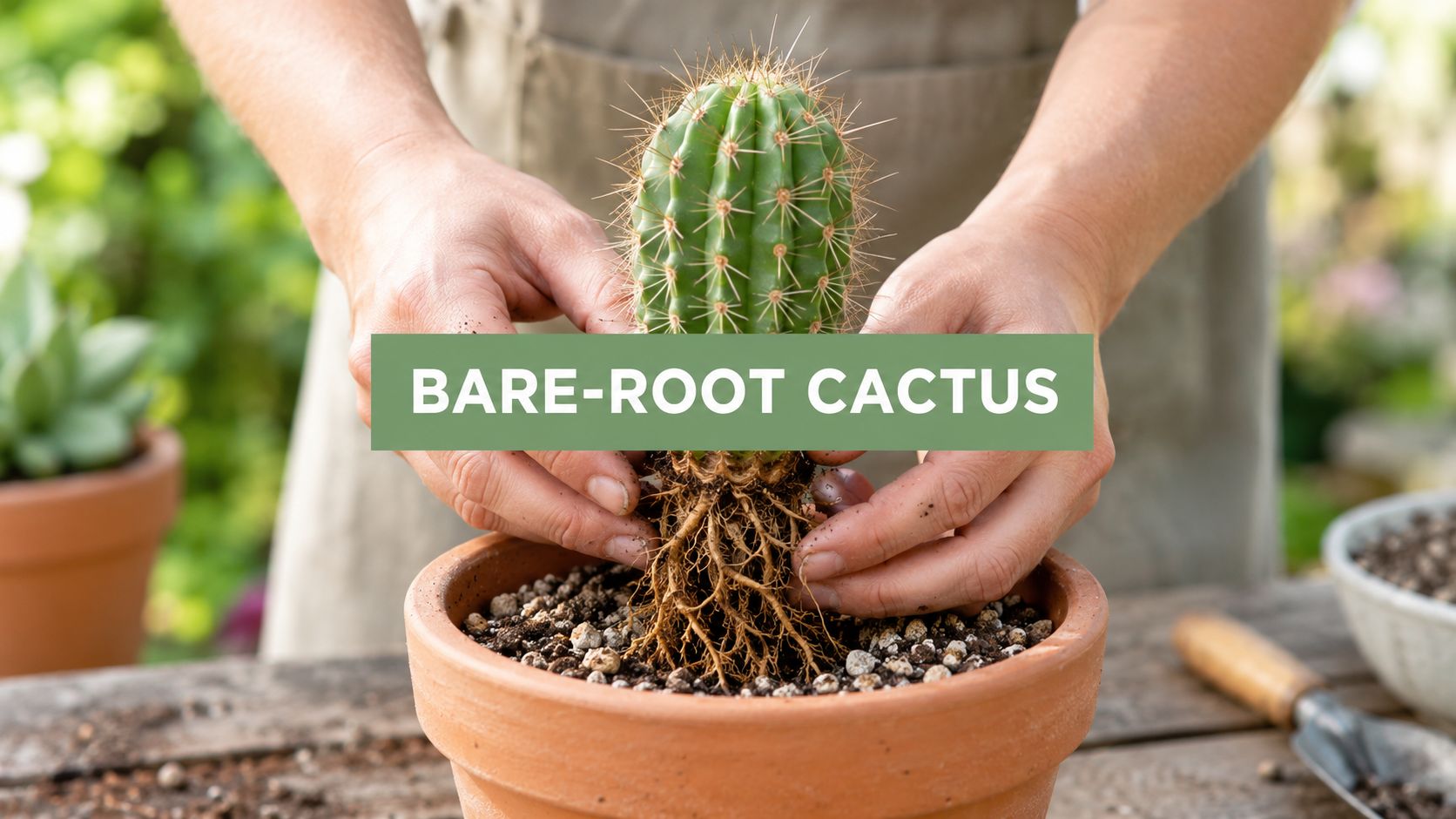
Your San Pedro will almost certainly show up bare-root. This means the seller has carefully removed it from its pot and cleaned off all the soil. Don't panic! This is the gold standard for shipping cacti. It keeps the plant safe, light, and dry during its journey to you.
The moment your cactus arrives, give it a good once-over. It should be firm, even if it looks a little thirsty. Get it potted into your well-draining cactus mix, but hold off on watering for at least a week. This gives any tiny roots that were damaged in transit a chance to heal.
Sourcing Responsibly
Finally, and this is important, we have to talk about where these amazing plants come from. The San Pedro cactus Trichocereus pachanoi has become incredibly popular, and that puts a lot of pressure on its native habitat in the Andes.
Always, always buy from growers and nurseries that cultivate their own cacti. By choosing a nursery-grown plant, you’re not just getting a healthier, pest-free specimen; you're casting a vote for sustainability. You're helping protect the wild populations and ensuring these cacti are around for future generations to cherish and grow.
Answering Your San Pedro Questions
Growing a San Pedro cactus is usually a straightforward affair, but even the most seasoned growers run into a few head-scratchers. Let's tackle some of the most common questions that pop up on the journey with Trichocereus pachanoi.
Why Is My San Pedro Cactus Turning Yellow?
If your San Pedro is looking a little pale or yellow instead of its usual vibrant green, it's usually telling you one of two things: it’s getting scorched by the sun, or it's hungry.
First, check the light. If the yellowing is mostly on the side that gets the most sun, you're likely looking at a simple case of sunburn. It's an easy fix—just move it somewhere with bright, indirect light or where it gets some shade during the intense afternoon hours.
If sun isn't the problem, it’s time to think about food. A lack of nutrients, especially nitrogen, can wash out its color. This is really common during the spring and summer growing season when the cactus is using a lot of energy. Try feeding it once a month with a balanced, low-nitrogen fertilizer mixed at half-strength. That should be all it needs to get back to a rich, healthy green.
A yellowing cactus is a call for help, but it's almost always a simple fix. Look at the lighting first, then its feeding schedule. A small adjustment to one of these two things will bring it right back.
How Can I Get My San Pedro Cactus to Flower?
Seeing a San Pedro bloom is a truly special event, with those massive, fragrant white flowers that open at night. Getting there takes a bit of patience and a deliberate strategy. It’s a combination of age, size, and most importantly, seasonal cues.
Your cactus won't even think about flowering until it's mature, which means it needs to be several years old and fairly tall. But the real secret to triggering blooms is to mimic its natural winter rest period. This cool, dry dormancy is what tells the plant to start preparing its flowers.
- Put It to Bed: As fall begins, stop watering almost entirely. Move your cactus to a cool, dry place where temperatures stay around 40-50°F (4-10°C).
- Wake It Up Gently: When spring rolls around and the weather warms, you can start watering again, but do it slowly.
- Give It a Boost: Start a feeding routine with a fertilizer higher in phosphorus. Phosphorus is the key nutrient that encourages flower production.
This seasonal cycle is everything. It signals the shift from regular growth to the spectacular effort of flowering.
Is Trichocereus Pachanoi Safe to Have Around Pets and Children?
The Trichocereus pachanoi has fewer spines than many other cacti, which might make it seem safer. The real concern, however, isn't the prickles—it's the natural alkaloids inside the plant. These compounds can be toxic if eaten by curious pets or small children.
While just touching the skin of the cactus is perfectly harmless, ingesting any part of it is a serious risk. To keep everyone safe, the best and only approach is to place your San Pedro well out of their reach. When you're deciding where to put it in a home with kids or pets, always err on the side of caution.
Ready to add one of these stunning architectural plants to your collection? Here at The Cactus Outlet, we have a fantastic selection of healthy, nursery-grown San Pedro cacti waiting for a new home. Find your perfect architectural succulent today!