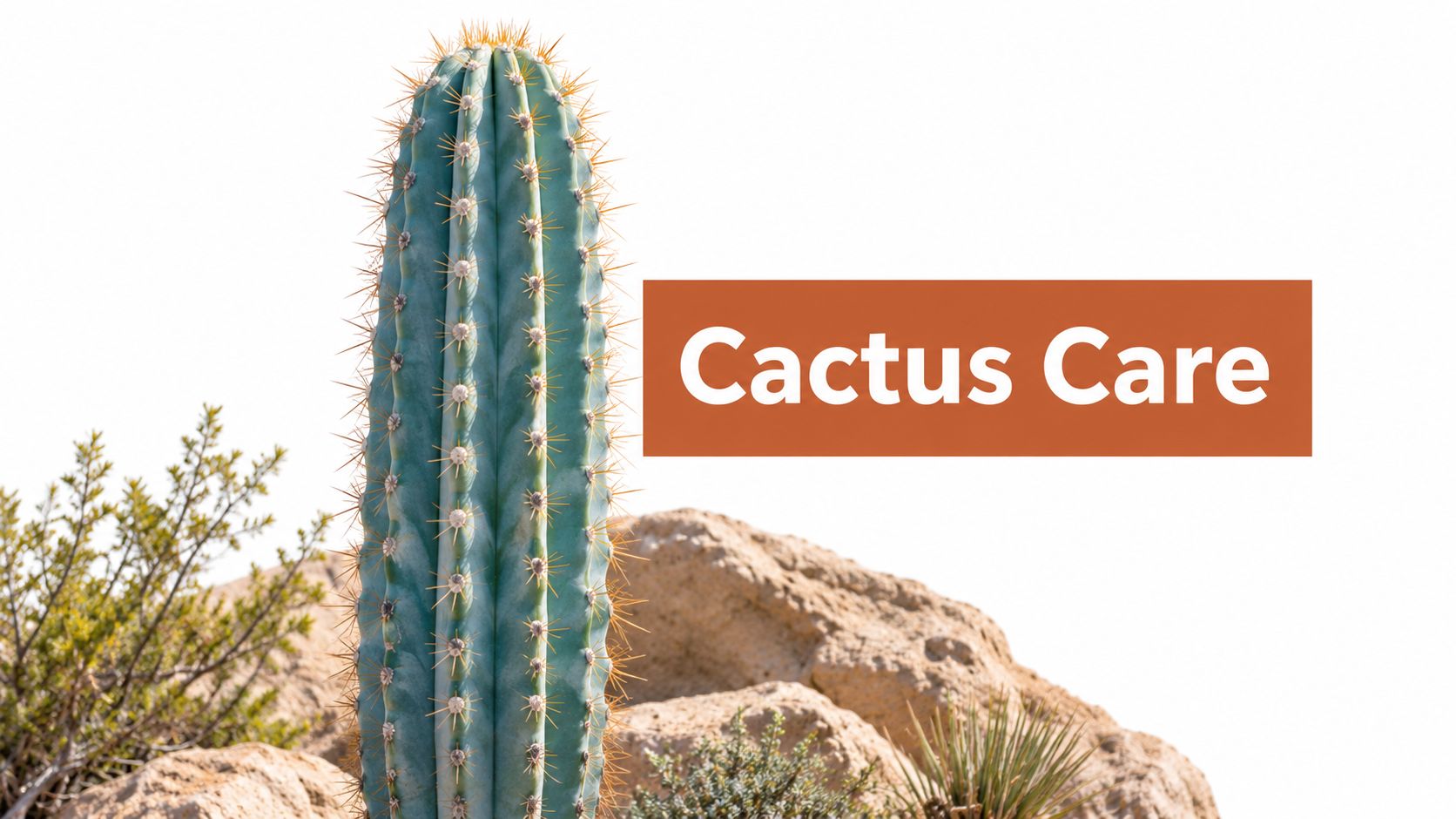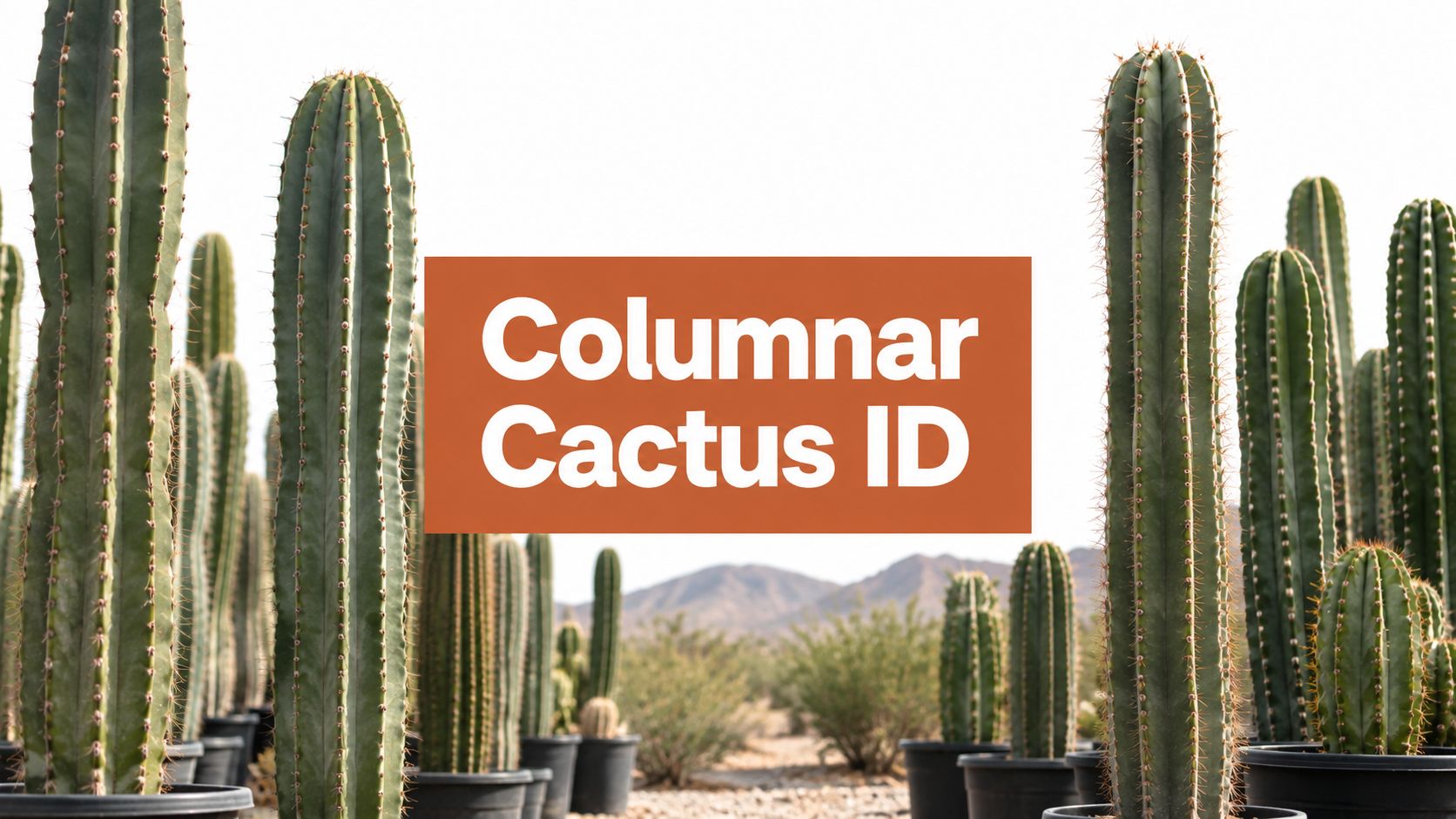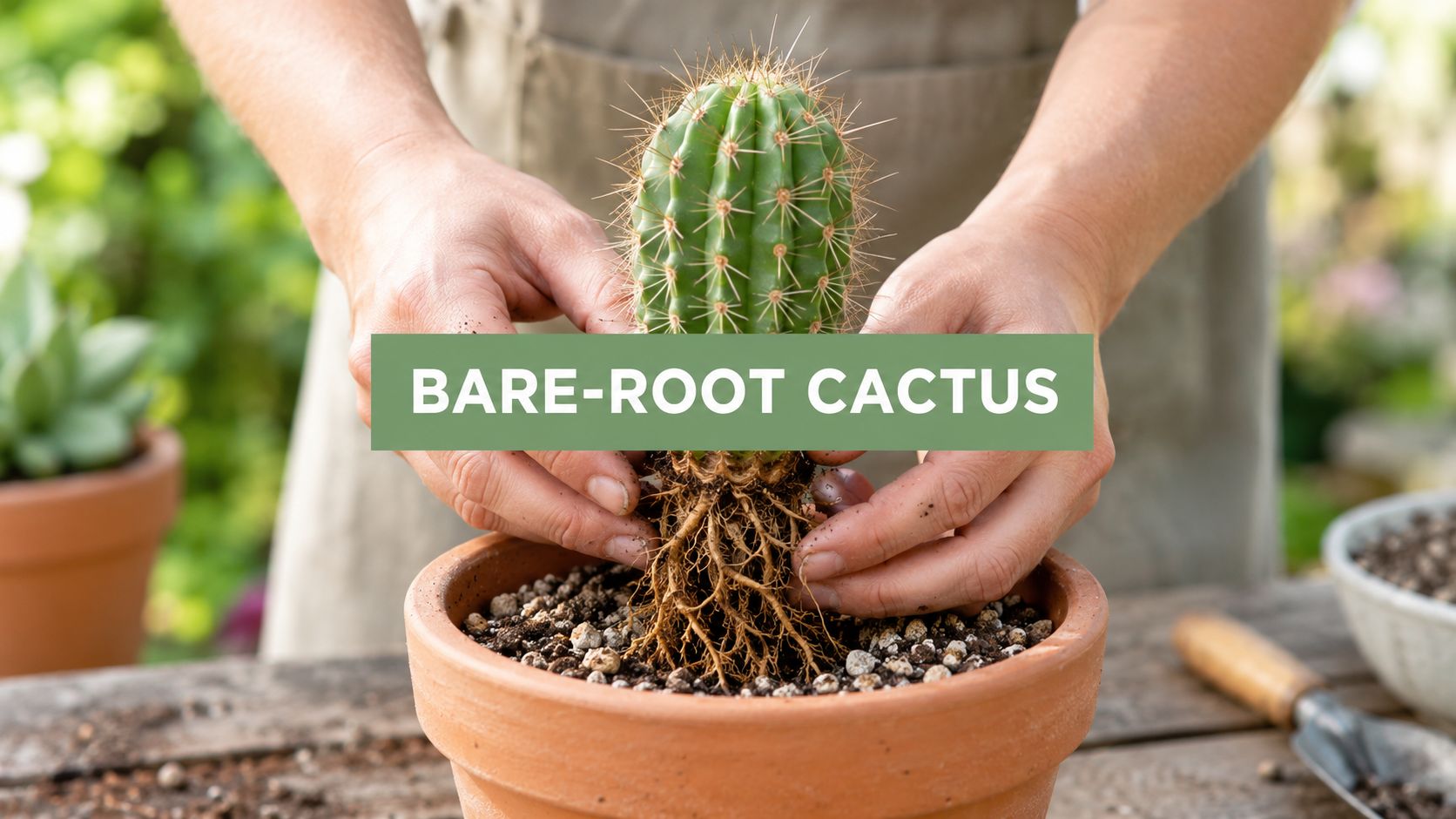

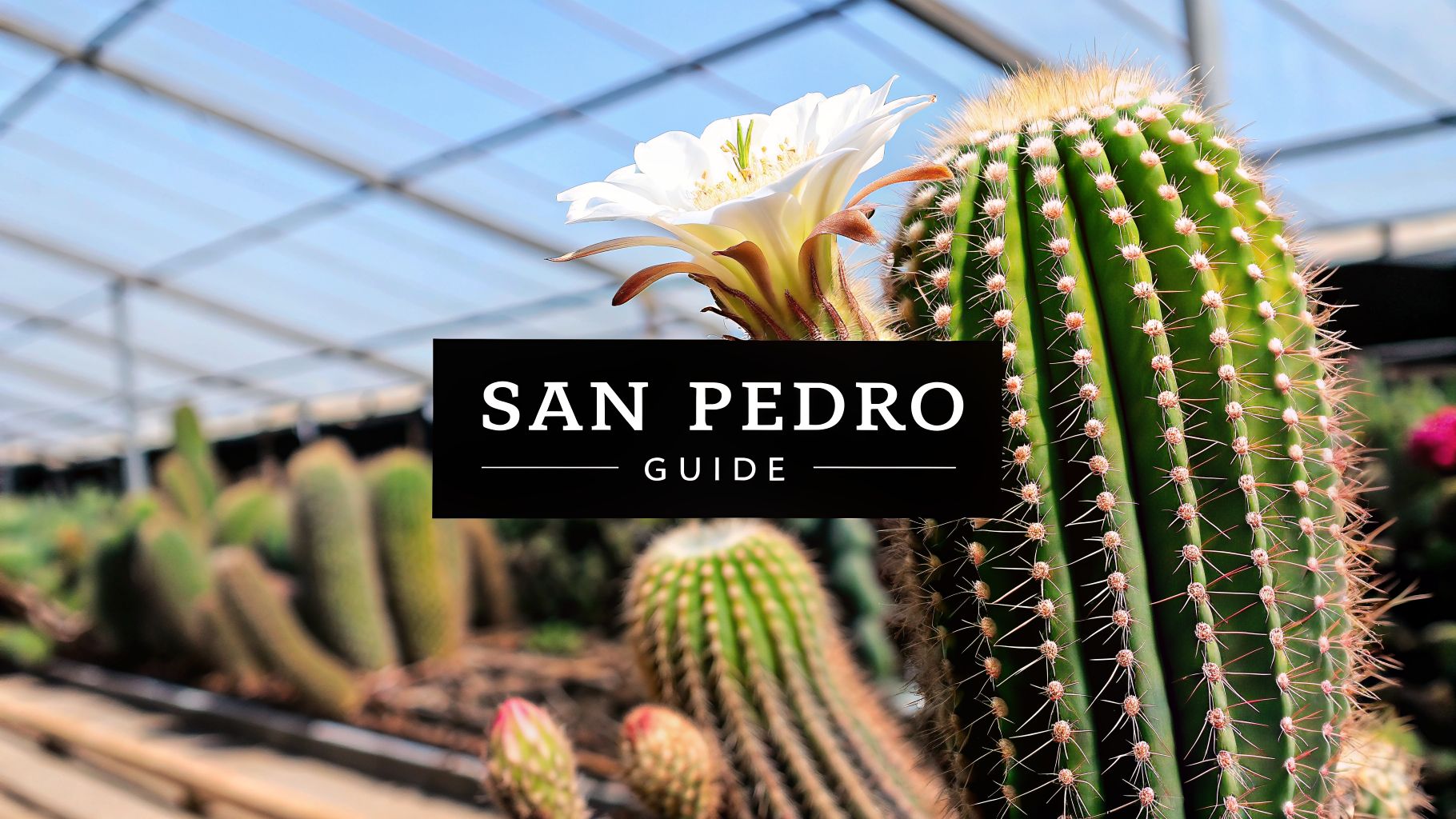

The San Pedro Cactus, known to botanists as Echinopsis pachanoi, is a fast-growing columnar cactus native to the Andes Mountains. It’s legendary for its towering height, smooth green skin, and relatively few spines. This combination of striking beauty and deep historical roots makes it a must-have for cactus collectors and casual gardeners alike.
Meet The San Pedro Cactus, Echinopsis pachanoi

If you're looking for one of nature's most impressive columnar cacti, you've found it. The San Pedro, or Echinopsis pachanoi, is a true showstopper, known for its rapid growth and elegant, multi-ribbed columns. It’s an iconic species that feels both ancient and perfectly suited for modern spaces.
What really sets it apart from its prickly relatives is its surprisingly smooth skin. This makes it a much more approachable plant for homes and gardens where you might actually want to get close to it. Its resilience and simple needs have cemented its status as a favorite for everyone, from first-time plant owners wanting a dramatic accent to seasoned collectors.
I like to think of San Pedro not just as a plant, but as a living sculpture with a story stretching back thousands of years. It’s a dynamic piece of natural art that changes with the seasons, rewarding you with incredible height and, if you're lucky, massive, beautiful flowers that bloom in the night.
A Plant of Presence and Simplicity
The appeal of Echinopsis pachanoi really comes down to its powerful visual presence. Its strong, vertical lines bring a sense of grandeur to any setting, whether it’s a single column in a minimalist pot or a row of them creating a living fence. This cactus has a knack for commanding a space without overwhelming it.
On top of that, it has a reputation for being incredibly easy to grow. As long-time horticulturalist Ralph Moran puts it, the plant starts easily from cuttings and can thrive with a "neglect them, water whenever" approach, rewarding you with a "nice, tall, columnar cactus." You can't ask for a more forgiving entry into the world of cacti.
Here’s what makes the San Pedro such a standout choice:
- Rapid Growth: This cactus doesn't mess around. It can shoot up a foot or more per year, giving you quick results and a sense of accomplishment.
- Minimal Spines: The small, sparse spines mean you can handle it without needing a suit of armor, making it perfect for patios, balconies, and even indoor spots.
- Aesthetic Versatility: It looks just as good in a rustic desert-scape as it does in a sleek, contemporary home. It simply fits.
- Cultural Depth: Growing a San Pedro connects you to a plant with a rich history intertwined with thousands of years of human culture.
In this guide, we'll walk through everything you need to know to grow this magnificent cactus successfully. We'll cover its origins in the Andes, how to identify it, and the exact care details that will help your San Pedro flourish for decades. By the time you're done, you'll have the confidence to grow your own thriving Echinopsis pachanoi.
Uncovering The History And Cultural Significance Of San Pedro
To really understand the San Pedro cactus, you have to look past its beautiful, towering columns and peer into its incredible history. This isn't just any houseplant. It's a living piece of history, deeply tied into the spiritual and cultural fabric of ancient Andean life. Its story is one of deep reverence, resilience, and connection.
The bond between people and Echinopsis pachanoi is ancient, stretching back thousands of years in the high mountains of South America. For many pre-Incan cultures, this cactus was a central figure, a powerful tool used in their most sacred ceremonies to connect with the divine.
A Sacred Key for Ancient Civilizations
The Chavín people, who thrived in Peru's northern Andes from around 900 to 200 BCE, offer some of the clearest proof of San Pedro's ceremonial use. For them, the cactus was a key—a way to unlock otherworldly experiences that let priests and shamans speak with their gods and navigate the spirit world.
You can see this reverence carved in stone. Art from the Chavín, especially carvings and weavings found at the Chavín de Huántar temple, often shows gods and shamans holding the distinct, ribbed stems of a San Pedro cactus. These images are a clear record of just how important the plant was to their beliefs and rituals.
The name ‘San Pedro,’ or Saint Peter in Spanish, is a nod to this very power. When colonial missionaries saw indigenous people using the cactus, they drew a parallel to Saint Peter, who is said to hold the keys to heaven. The name suggests that the cactus, too, holds the keys to open the gates to a higher consciousness.
Knowing this history changes how you see the cactus in your own home. You're not just growing a plant; you're tending to a direct link to some of South America’s oldest and most foundational cultures.
From Ancient Relic to National Heritage
Remarkably, the legacy of the San Pedro cactus has survived. Despite centuries of cultural upheaval and suppression, the traditional use of Echinopsis pachanoi has been kept alive in the Andes, passed down through countless generations of healers.
This unbroken chain of knowledge finally received formal recognition in 2022, when Peru’s Ministry of Culture declared the traditional use of San Pedro in northern Peru a national cultural heritage. This act officially protects its ancestral legacy and acknowledges how vital the plant is to the identity and well-being of communities today. Understanding its cultural role often means looking at both traditional practices and modern natural medicine policy trends.
Echoes From a Distant Past
The history of San Pedro is one of the oldest and most continuous of any psychoactive plant. In fact, archaeological work at Guitarrero Cave in Peru uncovered fossilized cactus remains dated to between 6800-6200 BCE.
That's a staggering discovery. It confirms that humans have been interacting with Echinopsis pachanoi for well over 8,000 years, cementing its place as a cornerstone of human ethnobotany. You can learn more about the long history and official recognition of the San Pedro cactus tradition.
This deep, ancient connection gives a whole new layer of meaning to growing one. Every new pup that emerges is part of a story that began thousands of years ago—a story of spirituality, healing, and the timeless human search for something more.
How To Confidently Identify Echinopsis Pachanoi
For anyone diving into the world of columnar cacti, telling a true San Pedro from its lookalikes is one of the first hurdles. It’s a common point of confusion, especially with so many "torch" cacti out there that share a similar upright shape. Getting the ID right isn't just about botanical bragging rights; it ensures you understand the specific needs and growth patterns of the plant you're bringing home.
Think of it this way: a Granny Smith and a Red Delicious are both apples, but you wouldn't use them interchangeably in a recipe. It's the same with these cacti. Knowing you have a genuine Echinopsis pachanoi is the first step to giving it the care it needs to thrive.
Decoding The Physical Traits
The secret to a confident ID is training your eye to spot a few key physical traits. While nature always allows for a little variation, a classic Echinopsis pachanoi has some tell-tale signs.
First, look at the ribs. A mature San Pedro typically has between 4 and 8 of them, and they are noticeably broad and rounded. This gives the cactus a full, fleshy look, almost like it's swollen with water. It’s a stark contrast to other species that often have sharper, more numerous ribs.
Next up are the spines, or rather, the lack thereof. San Pedro is surprisingly smooth. The small, whitish bumps along the ribs—the areoles—sprout just 3 to 7 tiny, yellowish-to-brown spines. On many plants, especially mature growth, these are so short they barely stick out at all.
A great hands-on test is to imagine running your hand up the cactus column. A true Echinopsis pachanoi often feels remarkably smooth, unlike the more formidably spined lookalikes. This tactile feedback can be one of the most intuitive ways to confirm your identification.
Finally, lean in and look for the subtle V-shaped indentations or "notches" right above each areole. These shallow, chevron-like marks are a classic signature of the species. If you want to go even deeper, our comprehensive cactus identification guide covers a wide range of features to help you sharpen your skills.
This decision tree gives a great visual breakdown of how the plant's cultural importance has been officially recognized.

As the chart shows, Peru formally declared the plant a part of its national cultural heritage in 2022, cementing its long history in the region's traditions.
San Pedro vs Other Torch Cacti
This is where things can get tricky. Echinopsis pachanoi is often confused with its close relatives, the Peruvian Torch (Echinopsis peruviana) and the Bolivian Torch (Echinopsis bridgesii). They all share that classic columnar "torch" look, but the devil is in the details.
The table below puts them side-by-side to make those differences clear.
| Feature | Echinopsis pachanoi (San Pedro) | Echinopsis peruviana (Peruvian Torch) | Echinopsis bridgesii (Bolivian Torch) |
|---|---|---|---|
| Ribs | 4-8, broad and well-rounded. | 6-9, wider and more flattened. | 4-8, often fewer and deeply notched. |
| Color | Bright to dark green, sometimes glaucous (bluish). | Distinctly glaucous bluish-green. | Tends to be a lighter, paler green. |
| Spines | Very small and sparse (3-7 per areole), often absent on mature growth. | Longer, thicker, and more pronounced; typically honey-colored to brown. | Very long and formidable (up to 4 inches), usually 4 per areole in a cross shape. |
| Areoles | Small, with faint V-shaped notches above them. | Large and woolly, without distinct notches. | Far apart, with deep grooves between them. |
When you're out plant hunting, pay closest attention to the spines and ribs. Those are usually the dead giveaways. With these tips in your back pocket, you can confidently spot a true San Pedro and know you're adding the right specimen to your collection.
A Practical Guide to Growing San Pedro Cactus
The secret to a happy San Pedro is simple: try to recreate its home in the high Andes. We're talking brilliant sun, gritty soil, and clear wet and dry seasons. If you can dial in those key elements, you'll see your Echinopsis pachanoi transform from a simple cactus into a stunning architectural feature in your home or garden.
And you'll see it happen fast. This cactus is famous for its explosive growth. It’s not uncommon for a San Pedro to shoot up 12 inches (30 cm) or more in a single year when conditions are right. While most mature plants top out around 3-6 meters (10-20 feet), the tallest one ever recorded was an incredible 12.2 meters (40 feet) tall. For more on this, check out the info on San Pedro cactus growth and hardiness on gardenia.net.
Finding the Right Light
To get that kind of growth, the first thing you need to get right is the light. San Pedro is a sun-worshipper. Find a spot where it can soak up at least six hours of direct sun every day. An outdoor patio or a sunny patch in the yard is perfect, but a bright, south-facing window can absolutely work if you're growing it indoors.
A word of caution, though: just like people, cacti can get sunburned. If your plant has been living in a shadier spot, don't just thrust it into the intense afternoon sun. You'll see ugly yellow or brown scorch marks appear on its skin. Instead, acclimate it over a week or two, gradually increasing its sun exposure each day.
Why the Right Soil Mix Is Everything
If there's one golden rule in the cactus world, it's this: never let them have "wet feet." San Pedro is no exception. It absolutely demands a soil that drains fast, preventing water from pooling around the roots and causing rot—the number one killer of cacti. A bagged commercial cactus mix is a decent start, but it's rarely enough on its own.
Think of the perfect soil as a loose, gritty, rocky mix, not dense garden soil. You want to create something that water rushes through, not something that holds onto it like a sponge.
The best way to do this is to amend your soil with plenty of inorganic material. I usually mix my base soil with an equal amount of gritty stuff to guarantee excellent drainage.
- Pumice: This is the gold standard for a reason. It's porous, creating tiny air pockets for roots and letting water drain right through.
- Perlite: A great, lightweight alternative to pumice that does a similar job of improving drainage and aeration.
- Coarse Sand: Good for breaking up heavy soils, but use it with pumice or perlite to keep the mix from compacting over time.
A solid recipe is a 50/50 split: 50% organic matter (like cactus mix or coco coir) and 50% inorganic drainage material. If you want to dive deeper, we have a whole guide on crafting the perfect cactus and succulent soil mix.
Watering: A Seasonal Rhythm
Watering your San Pedro isn't a fixed schedule; it’s a rhythm that follows the seasons. During the spring and summer growing season, the cactus is active and thirsty. Give it a deep, thorough watering, but—and this is important—only when the soil has completely dried out from the last time. The easiest way to check is to stick your finger a couple of inches deep. If it feels totally dry, it's time to water.
Once the weather cools in fall and winter, the cactus goes dormant. This is its rest period, and you need to cut back on water drastically. For plants outside, the occasional rainfall might be all they need. If your cactus is indoors, a very light watering once a month is usually plenty to keep it from shriveling.
Temperature and Frost Protection
Coming from high mountain deserts, Echinopsis pachanoi is tougher than many people think. It’s perfectly happy in USDA zones 8b-10. It can even handle a brief dip down to -9.4°C (15°F), but only if its soil is bone dry. Wet, cold soil is a recipe for disaster.
The real enemy is frost. A hard frost can turn the growing tips of the columns into a discolored, mushy mess. If you live in a climate that gets freezing winters, you'll need to protect it. You can throw a frost blanket over it during cold snaps or, if it's in a pot, simply bring it onto a covered porch or indoors until the danger has passed.
Propagating And Designing With San Pedro

One of the best parts about growing Echinopsis pachanoi is just how simple it is to make more of them. This is a tough, forgiving cactus, which makes propagation an easy and satisfying project for growers at any level. Taking cuttings is the perfect way to expand your collection, share plants with friends, or even save a plant that's been damaged.
The whole process is often cheekily summed up by seasoned growers as "chop, callus, plant." It sounds simple because it is. This basic method taps into the San Pedro’s incredible will to live, allowing it to regrow from a piece of its stem almost like a starfish growing a new arm.
How To Propagate San Pedro Cactus Cuttings
First, grab a healthy, mature San Pedro and a clean, sharp knife. Using a sterile blade is non-negotiable—it prevents nasty bacteria from getting into the fresh cut and causing rot. From there, it’s just a few easy steps.
- Make a Clean Cut: Choose a healthy section of a column that’s at least a few inches long. In one smooth motion, make a clean, straight cut through the stem to take your cutting.
- Let It Callus: This is the most important step! Place the cutting in a dry, shady area with good airflow for one to three weeks. You’re waiting for the wet, cut end to dry out and form a hard, tough seal. If you plant a fresh cutting without this callus, it will almost certainly suck up too much moisture and rot from the bottom up.
- Plant Your Cutting: Once the end is dry and hard to the touch, it’s ready for soil. Plant it about two to four inches deep in a pot of well-draining cactus mix. This gives it enough stability to stand upright while it works on growing roots.
- Wait Patiently: Don't even think about watering it for the first couple of weeks. This gives the new roots a chance to emerge without being waterlogged. After that, you can start with a very light watering schedule. You should see signs of new roots or growth within a few weeks to a couple of months.
If you're looking to dive deeper into this process, be sure to read also: our detailed guide on how to propagate cactus from cuttings, which is packed with more pro tips.
Designing With Echinopsis Pachanoi
Beyond making new plants, Echinopsis pachanoi is an absolute superstar when it comes to landscape and interior design. Its strong vertical lines and smooth green skin open up a ton of creative avenues. It's no wonder this cactus is a top seller in the ornamental plant world, beloved by both serious collectors and landscape designers.
Those nearly spineless, 10-20 foot spires are perfect for adding drama to a patio, anchoring a collection of potted plants, or even creating a living fence when planted in a row. For more on its background, you can explore its cultural significance and horticultural traits.
The San Pedro's massive, fragrant white flowers—which can be up to 10 inches wide—bloom only at night. This makes it a perfect candidate for a "moon garden," a space filled with night-blooming or pale-colored plants that come alive after dark.
Here are a few ways people are using San Pedro in their designs:
- Dramatic Indoor Accent: A single tall San Pedro in a simple, modern pot can act as a living sculpture. Place it in a bright corner to add height and a touch of minimalist, organic style.
- Living Privacy Fence: Planting a row of columns along a property line or around a patio creates a stunning architectural screen. As they fill in, they provide natural beauty and a surprising amount of privacy.
- Desert Scape Centerpiece: In a rock garden or xeriscape, a cluster of San Pedro cacti creates a powerful focal point that instantly brings to mind the high-altitude landscapes of the Andes.
Your San Pedro Cactus Questions, Answered
If you're getting into the world of Echinopsis pachanoi, you've probably got some questions. We all do when we start out! It's a magnificent plant, but like any living thing, it has its own unique needs and quirks.
Here, we'll walk through some of the most common questions we hear from growers. Think of this as a conversation with an experienced friend who can help you skip the guesswork and get right to enjoying your cactus.
How Fast Does San Pedro Cactus Grow?
This is easily one of the most exciting parts of owning a San Pedro. This isn't your average, slow-growing cactus; under the right conditions, it's a speed demon. In a single growing season, it's not unusual to see it shoot up 12 inches (30 cm) or more. That rapid growth is what makes it such a rewarding plant for anyone wanting to see a big impact in their garden fairly quickly.
Out in its native Andes mountains, Echinopsis pachanoi can become a true giant, reaching heights of up to 40 feet (12.2 meters)! In a home garden or a pot, however, a mature height of 10 to 20 feet (3-6 meters) is a much more realistic expectation. What makes the difference? A few key things:
- Sunlight: The more sun, the faster the growth. Aim for at least six hours of good, direct light.
- Room to Grow: A cactus planted in the ground with unlimited space for its roots will always outpace one in a pot.
- Food and Water: Consistent watering and a good feeding schedule during its active growing season are the fuel for its rapid ascent.
Is It Legal to Grow Echinopsis Pachanoi?
This is a critical question, and the answer is refreshingly straightforward for most people. In places like the United States, it is perfectly legal to buy, sell, and grow the San Pedro cactus for ornamental and landscaping purposes. That's why you can easily find it for sale at specialty nurseries and online shops.
So, where does the confusion come from? It's all about the plant's natural chemistry. San Pedro contains mescaline, and the legal issues are tied to what you do with the plant.
The legal line is almost always drawn at intent. Growing a beautiful San Pedro in your garden or home is a widely accepted and legal hobby. It's when someone takes steps to extract its compounds or prepare it for consumption that they cross into illegal territory, facing serious legal consequences.
Laws can differ from one state or country to the next, so it's always smart to double-check your local regulations just to be sure. For enthusiasts and collectors, the path is clear: grow it for its stunning beauty, and you'll be on the right side of the law.
What Are the Most Common Pests and Diseases?
San Pedro is a tough cactus, but it’s not invincible. Ironically, the biggest threat usually comes from a grower's best intentions: too much water. Overwatering is, without a doubt, its number one enemy.
- Root Rot: This is the most common killer. It happens when the soil stays wet for too long, essentially drowning the roots. They begin to decay, and the rot can quickly spread up into the cactus itself. The fix is all in prevention: use a very gritty, fast-draining soil and let it dry out completely before watering again.
Pests can also pop up, but they're much easier to handle if you catch them early. They love to hide down in the grooves between the ribs, so make a habit of inspecting your plant now and then.
Common San Pedro Pests:
- Mealybugs: These look like tiny bits of white cotton. They are sap-suckers that can weaken the plant over time.
- Scale Insects: These look like small, hard, brown bumps stuck to the skin. Like mealybugs, they feed on the plant's juices.
- Spider Mites: Less common but still a nuisance, these tiny pests create fine, dusty webs and can cause a discolored, speckled look on the cactus skin.
For a few stray pests, your best tool is a simple cotton swab dipped in 70% isopropyl alcohol. Just dab it directly on the bugs. If you're dealing with a bigger infestation, a good spray of insecticidal soap or neem oil will usually get things under control.
You might also see fungal issues like orange rust or black spots, especially if it's humid or the air around the plant is stagnant. Good airflow and avoiding getting the cactus itself wet when you water are the best ways to prevent this. If you do get a stubborn fungal spot, a copper-based fungicide can help clear it up.
Ready to add the stunning vertical beauty of Echinopsis pachanoi to your collection? At The Cactus Outlet, we offer a curated selection of healthy, well-rooted San Pedro cacti and other incredible specimens, shipped directly to your door.