
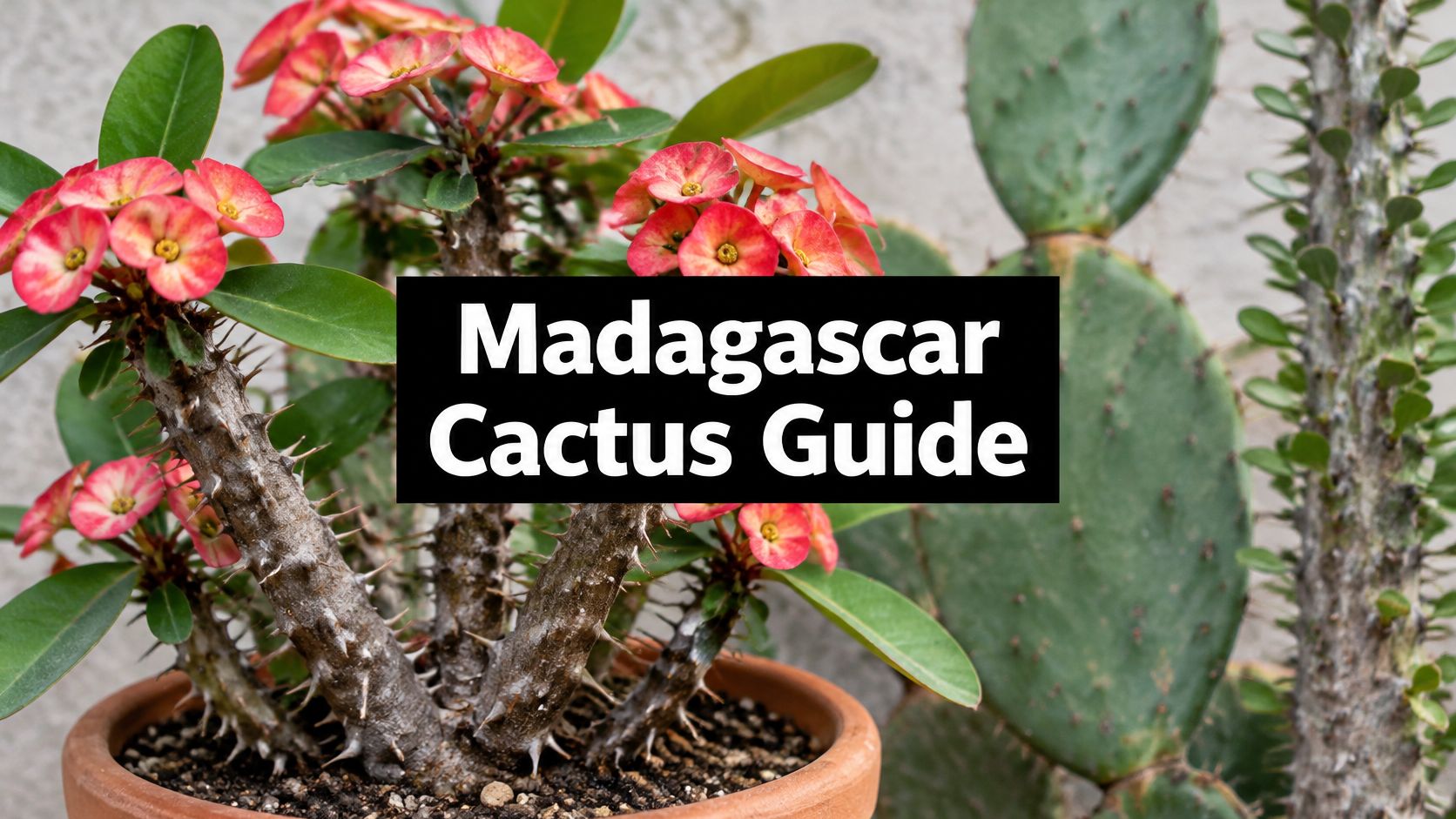

A Madagascar cactus plant usually isn't a true cactus. The island holds more than 600 succulent species, yet the plant most often sold under that trade name is Crown of Thorns, Euphorbia milii, a spurge, or a spiny lookalike such as Alluaudia, and neither belongs to the cactus family Cactaceae.
Search for care instructions and the advice you'll find is a schedule. Water once a week in summer, once a month in winter, bright light, sandy soil. That advice assumes there's only one plant behind the name. There are at least five, spread across three plant families, and they don't share a watering interval, a cold limit, or a safety profile.
The fix isn't a better schedule. It's naming the plant in your hand first, then following the row that matches it. Get that wrong and the mistakes stack up. A spurge watered like a desert cactus rots at the base, a Pachypodium given a full soak in its leafless season collapses, and a latex-bearing stem gets pruned bare-handed beside a child's play area.
Which Plant the Name Usually Means
One trade name, several unrelated plants. That's the whole problem with the Madagascar cactus plant label, and it's why care advice copied from a generic succulent page so often fails.
Start with the plant you're most likely holding. Crown of Thorns, Euphorbia milii, is the usual houseplant or warm-climate ornamental sold under the name: woody stems, paired spines, small leaves, colorful bracts, and milky latex in every cut surface. It's a tropical Madagascar species, and it performs best when the soil dries between deep waterings, as Wisconsin Horticulture's Crown of Thorns guide describes. That's a spurge, not a cactus, and spurge care differs from cactus care in pruning, light tolerance, and handling precautions.
So the question worth asking before you water, prune, or place the pot is this one: "Is my Madagascar cactus a cactus, and how can I identify it before applying care or safety advice?"
Match the plant, then the care. Watering intervals, pot size, and pruning method don't transfer between a spurge, a Didiereaceae, and a true cactus.
Pencil tree, Euphorbia tirucalli, gets folded into the same nickname and is easy to tell apart once you've seen it: jointed, pencil-thick green stems with no leaves worth mentioning, and the same irritating sap. Madagascar ocotillo, Alluaudia procera, is neither an American ocotillo nor a cactus. It builds a woody column, carries spines, and produces small leaves that come and go with moisture. The true cacti in this story are mostly introduced Opuntia prickly pears, known locally as raketa, with flat pads and fruit. Pachypodium species round out the group: a swollen trunk, spines, and leaves clustered near the growing tips, again outside Cactaceae.
| Common name | Scientific name | True cactus? | How to recognize it | What changes in care |
|---|---|---|---|---|
| Crown of Thorns | Euphorbia milii | No, a spurge | Woody shrub, paired spines, small leaves, colorful bracts, milky sap | Soak only after drying; keep sap off skin, eyes, children, and pets |
| Pencil tree or pencil cactus | Euphorbia tirucalli | No, a spurge | Jointed pencil-thick green stems and copious latex | Bright light and sharp drainage; treat sap as an irritant |
| Madagascar ocotillo | Alluaudia procera | No, Didiereaceae | Woody column, spines, seasonal small leaves | Full sun, pulse watering, room for a tall woody plant |
| Southern Madagascar raketa | Opuntia species | Yes, but introduced | Flat pads, spines or spineless forms, edible-looking fruit | True-cactus soak and dry; don't treat it as native flora |
| Madagascar palm lookalike | Pachypodium species | No | Swollen trunk, spines, leaves clustered near growing tips | Seasonal water and drainage; not cactus care |
Walk across that table and the point lands. The plant in your hand decides the watering cue, the pruning kit, the cold risk, and whether the pot can sit where a toddler or a cat can reach it. Pot size, substrate drainage, temperature, season, and indoor light set the drying time. No single number does. If you want the family-level breakdown, our article on why cacti and euphorbias look alike but are different plants goes deeper on the two groups people confuse most.
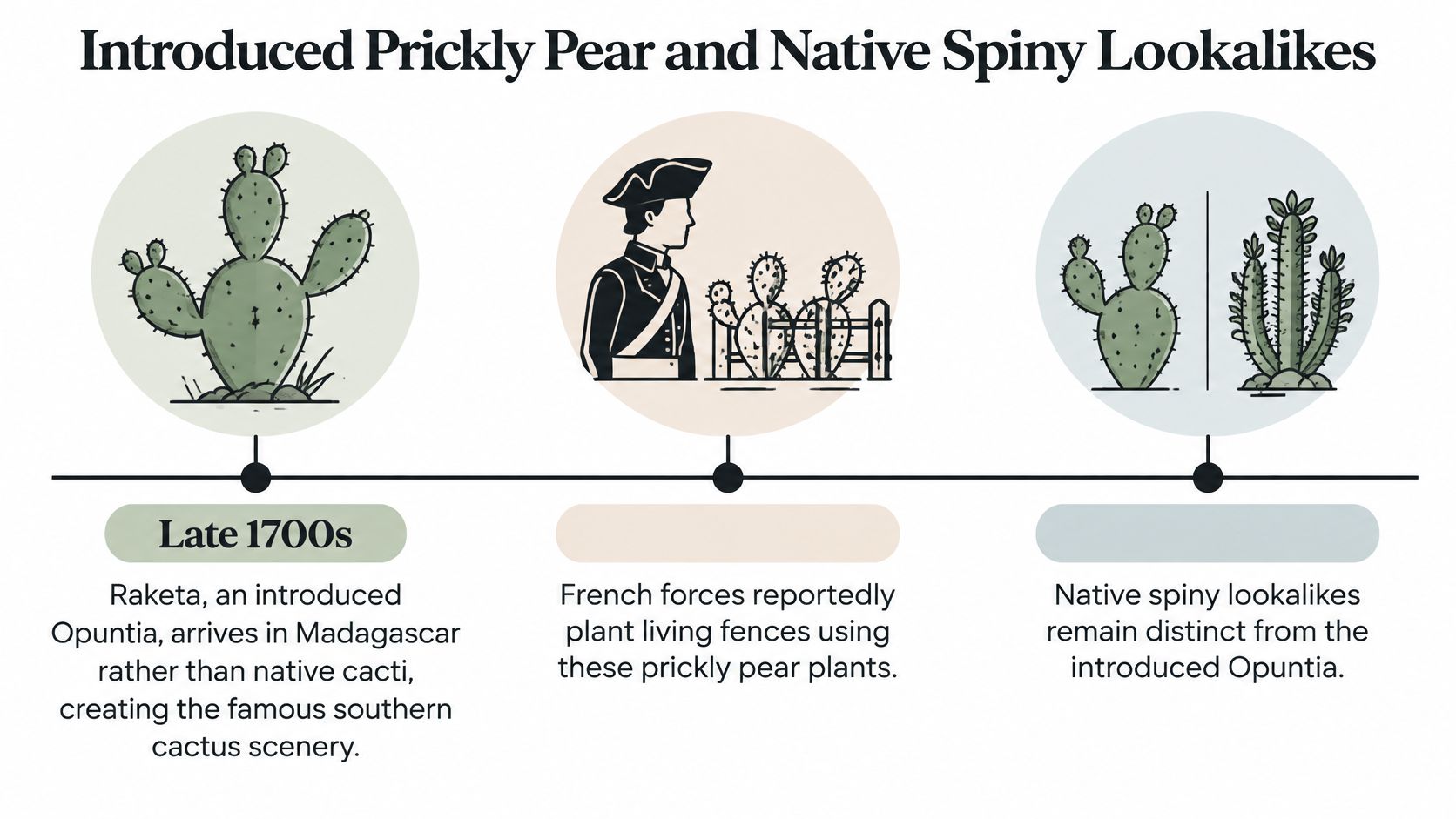
Introduced Prickly Pear and Native Spiny Lookalikes
Two histories sit behind that famous southern cactus scenery, and pulling them apart explains why almost none of it is native flora.
How Raketa Arrived and Spread
The first Opuntia plants reached southern Madagascar in the late eighteenth century. French colonial forces reportedly planted them in 1768 around Fort Dauphin, now Taolagnaro, as living defensive fences, according to a Swedish University of Agricultural Sciences study of southern Madagascar's cactus economy. Within several decades, local communities were using the plants as barriers around villages, gardens, and agricultural fields.
By the late nineteenth and early twentieth centuries, Opuntia had spread widely enough that one southern area was described as a "cactus region." The plants earned their place. Cladodes and fruit supplied supplementary livestock fodder during periods when grass was scarce, and in 1930 additional spineless, cochineal-resistant varieties were introduced, raising their usefulness in the southern economy.
Local selection followed, and it produced diversity rather than uniformity. A field study counted 16 locally recognized raketa variants at Ankilimasy, while Lavanono and Antaranta each had 8 varieties. That range is the product of introduction plus generations of trade, planting, and adaptation.
In protected dry areas, that spread is now monitored, because introduced populations can compete with native vegetation and alter open habitats. Raketa is a true cactus, and it's also not native. If you grow prickly pear for pads or fruit at home, our prickly pear growing guide covers the practical side.
The Spiny Natives Are a Different Family
Madagascar's own cactus-like plants mostly sit outside Cactaceae. The Didiereaceae contains about 22 species in 7 genera, of which 11 Malagasy species across 4 genera are endemic to the island, and the genus Alluaudia alone holds 6 species, per the IUCN World Heritage Outlook assessment of the Andrefana dry forests. The same assessment counts roughly 7,600 endemic plant species on the island, including more than 600 succulents, describes the succulent flora as one of the world's most endangered, and reports only about 50,000 hectares of spiny-forest vegetation protected at the time of publication.
The country-level numbers reinforce it. 84% of Madagascar's vascular plants are endemic, and IUCN's Madagascar plant work lists 5,038 plant species officially assessed as at risk of extinction by 2025.
Why American Cactus Care Does Not Transfer
Alluaudia, Didierea, Alluaudiopsis, and Decaryia evolved succulent stems, columnar architecture, and formidable spines independently of American cacti, yet they kept woody growth and small deciduous leaves, as the Didiereaceae family overview sets out. In the southwest's spiny thickets, those leaves appear mainly during the brief rainy season and drop through the long dry season, cutting transpiration when water is scarce. Many species reach roughly 2 to 20 meters in nature.
That combination breaks the usual cactus reflexes. A woody, leaf-dropping plant that can approach tree size needs vertical clearance, a container heavy enough not to tip, and a substrate that drains sharply rather than a shallow bowl of potting compost. A rule like "never let it wrinkle" or "ignore the leaves" runs straight into seasonal leaf drop that's normal, not decline. And when you buy, ask for nursery-propagated material rather than wild-collected plants, because the wild populations are the ones under pressure.
Light Water and Soil for Each Type
No weekly number works across these plants, and hunting for one costs you the growing season. The workable rule is wet then dry, with the gap set by the plant's own cycle rather than the calendar. Once you know which row of the table your plant sits in, the schedule writes itself.
For Madagascar ocotillo, Alluaudia procera, drought tolerance doesn't mean permanent dehydration or zero irrigation in cultivation. Natural populations grow in sandy soils over crystalline bedrock in southern and southwestern Madagascar, including habitats that may receive no rain for more than a year, and the species is drought-deciduous, leafing out rapidly when seasonal rains arrive, as LLIFLE's Alluaudia procera profile explains. That's a pulse strategy: conserve through dormancy, then grow hard when moisture returns. In a hot, dry summer garden it takes steady irrigation in stride, provided every soaking is followed by a genuine dry-down.
The Six Steps That Set the Interval
- Site it in full sun, outdoors. Once the plant is large and spiny, a hallway or a busy doorway is the wrong home for it.
- Build a sharply draining mineral mix. Avoid heavy clay, and skip any saucer or outer cachepot that holds water against the base.
- Soak thoroughly, then wait. During active container growth, roughly June through September, water until it runs from the drainage holes and don't water again until the root zone has dried. The practical check is the top inch of medium, dry to the touch.
- Let the water leave freely. A plant that dries between waterings keeps growing; one that sits in water rots from the roots up.
- Cut back hard when the plant is cool or leafless. Reducing irrigation during dormancy is part of the cycle, not neglect.
- Give a light drink, not another soak, if a dormant plant shrivels. A small corrective watering is enough to rehydrate without restarting summer conditions in midwinter.
Nebraska Extension states the growing-season rule the same way, then sets the other half of the year: its cacti care guidance calls for cool nights around 40 to 50°F, four to five hours of bright light daily, and no watering from mid-to-late November through March unless the plant begins to shrivel, in which case only a light application is advised.
The cue that beats every schedule: lift the pot. A container that still feels heavy is still wet at the root zone, whatever the surface tells you.
| Plant | Light | When to water | Soil and pot | Seasonal change |
|---|---|---|---|---|
| Euphorbia milii | Bright light; some direct sun | Deep soak only after the mix dries | Fast drainage; never leave a saucer full | Interval lengthens in cool, dim conditions |
| Euphorbia tirucalli | Strong light | Same soak-and-dry rule; do not mist on a calendar | Mineral, sharply drained mix | Reduce water when growth slows |
| Alluaudia procera | Full sun | Deep water after substantial drying; top inch dry in active container growth | Sandy or mineral mix; no heavy clay | Steady summer water where summers run hot and dry; very little when leafless |
| Opuntia | Full sun outdoors | Soak, then dry; no standing water | Gritty soil, raised or sloped site | Naturally drier and leaner in winter |
| Pachypodium | Bright light to full sun, by species | Water in active leaf growth, then dry | Very sharp drainage | Rest with much less water when leafless |
For the two spurges, the wet-then-dry idea holds, but pot size, indoor light, temperature, and season set the gap. That's why a fixed frequency chart misleads indoors, where a shaded corner can double drying time. The Little Green Leaf cactus watering guide is a useful cross-check on how environment shifts frequency, provided you apply it to the plant you've identified rather than to cacti in general.
Pruning is where identity turns into a safety matter. Wear gloves and eye protection with either Euphorbia, because the latex irritates skin and is far worse in an eye. A true Opuntia follows ordinary cactus soak-and-dry, but it's a different plant from the spurges and from Alluaudia, and it doesn't want the same winter treatment.
Drainage Cold and Container Limits
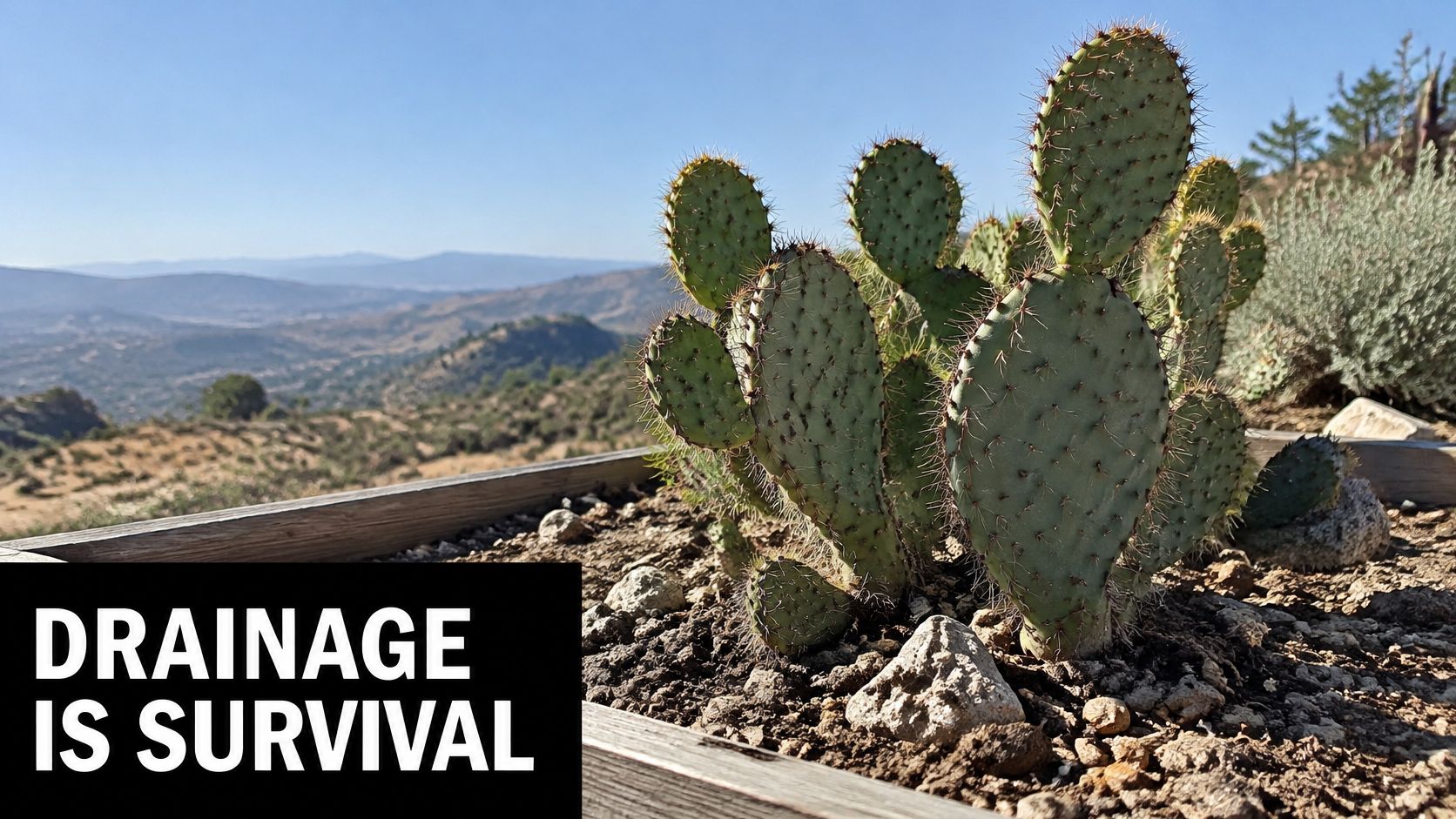
Drainage is a survival requirement rather than a soil preference. Colorado State University Extension recommends loose soil with excellent drainage for winter-hardy cacti, and points to sunny hillsides or raised beds as practical ways to keep water from standing, per Colorado State University Extension. Mix ample gravel or sand into the planting area with only a small amount of organic matter, then apply a thin layer of stone chips or gravel to lower crown-rot risk.
Winter Dryness Does the Protecting
Cacti reduce their internal moisture in winter and may visibly shrivel. That dehydration is the mechanism that keeps cells from bursting when they freeze, so a wet autumn works against the plant's own antifreeze. Heavy winter mulch and late-season irrigation both interfere with it. Cold-hardy outdoor specimens aren't perennials to be tucked in like a rose.
Wrapping a Pot That Stays Outside
For containers that can't come indoors, the Royal Horticultural Society advises letting pots and specimens dry slightly before wrapping, then wrapping the container itself with hessian or repurposed bubble wrap to help prevent the roots freezing, according to the RHS guide to growing hardy cacti and succulents. A pot pushed against a south or west wall picks up radiated nighttime heat, and a slightly raised spot runs warmer than a sunken one.
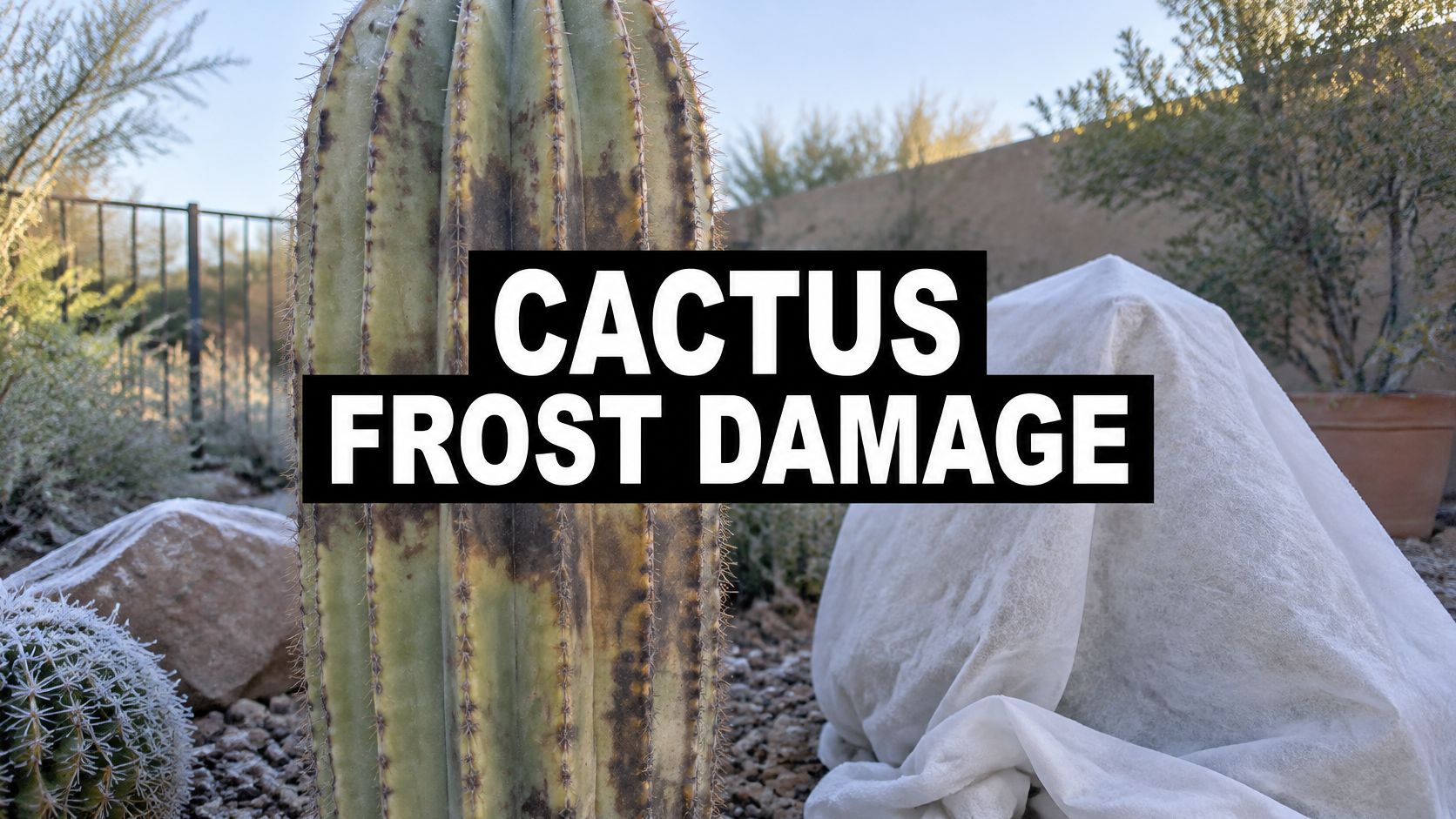
On a night forecast at or just below freezing, a cotton sheet over the plant is enough cover, and a 60-watt bulb placed beneath the sheet adds heat as long as it touches neither the plant nor the fabric. Plastic sheeting is the wrong material for this job. It holds condensation against the stem and does more harm than the cold.
Where Cold Decides the Container
Site selection matters as much as covering. University of Arizona guidance notes that saguaros grow in well-drained sand, silt, loam, gravelly, or rocky soils, while poorly drained clay is unsuitable and saguaros rarely occur naturally on such ground, per University of Arizona Extension. A planting site shouldn't be a depression where irrigation or rainwater pools.
Where cold is the constraint, that same guidance recommends protecting stem tips with a cap or wrapping the whole plant on cold winter nights using horticultural frost cloth, and removing any covering before spring growth resumes so ventilation returns to normal.
For Alluaudia and the Madagascar spurges, be more conservative than for a Southwest columnar cactus. They're less tolerant of prolonged wet soil and less tolerant of hard freezes, so where hard freezes are normal, grow them as movable containers and bring them in. Don't assign a hardiness temperature the plant's own label doesn't support.
Problems That Follow the Wrong Name
Sort the failures by the mismatch rather than reaching for a pest list. Most of what goes wrong with a Madagascar cactus plant traces back to a care routine built for a different species.
Soft, dark tissue at the stem base means the mix stayed wet. The usual causes are a fixed weekly schedule, a full saucer, or a decorative outer pot with no drainage hole. Yellowing that follows a cold, wet week is moisture plus chill, and adding water makes it worse rather than better.
Sudden leaf drop on a firm Alluaudia during a dry or cool spell is deciduous rest, not death. Check the stem: firm and green underneath means the plant is fine, and leaves return when warmth and a real watering pulse line up. A Crown of Thorns that stretches and stops flowering is short of light, not short of fertilizer, and feeding it in a dim corner only produces more weak growth.
Fix drainage before you touch the watering can. A plant sitting in water can't be rescued by watering it less often.
| What you see | Mistaken assumption | Correction |
|---|---|---|
| Soft dark base | Cacti want a weekly drink | Empty saucers, dry the mix fully, then soak only after drying |
| Leaves gone on a firm Alluaudia | The plant has died | Treat leaf drop in dry or cool weather as dormancy unless the stem is soft |
| No flowers and thin growth on Crown of Thorns | It needs more fertilizer | Move to brighter light before feeding |
| Rash after a cut | All succulent sap is harmless | Assume Euphorbia latex; wash skin and protect eyes |
| Shrivel in winter | It needs a deep soak | Give only a light drink if truly shriveled; don't resume summer watering |
Two more symptoms don't belong in a watering table. White crust on the soil surface and a sour smell point to poor drainage and mineral buildup, not underwatering. Skin or eye irritation after pruning points to latex, so wash it off promptly and keep the plant where children and pets can't brush against a cut stem. Spines at doorway or path height are a placement problem, not a plant problem: once these specimens are large, they belong outdoors or in a carefully sited container.
Make one change at a time. If you re-site a plant and cut its water in the same week, you'll never learn which correction worked.
Choose a True Outdoor Cactus Instead
Crown of Thorns and pencil tree remain warm-climate or movable container plants across most of the country, so the Madagascar cactus name is a weak filter for a tall outdoor accent. Alluaudia procera becomes a genuine woody specimen only where full sun, heat, and fast-draining soil support pulse watering.
Where nights run colder, a true columnar cactus fits the setting better. Our Tucson nursery grows large outdoor cacti and succulents, and the columnar, barrel, and prickly pear collections cover Mexican fence post, Peruvian apple, saguaro, and barrel cactus, along with selected Euphorbia when a spurge is what you want. Plants ship bare root and hand-packed, not in nursery pots.
What to Ask Before You Buy a Large Specimen
Don't judge age, origin, or ethics from size. BGCI's succulent measurements project is still collecting measurements on cultivated Malagasy species to estimate how plant size relates to age, a relationship researchers describe as a knowledge gap, and plant poaching is a recognized pressure on these populations. Ask for the scientific name, the nursery-propagation history, and provenance or phytosanitary records for international shipments.
Size alone doesn't prove wild collection, but an unusually mature specimen deserves more transparency than a two-inch seedling. Before you choose a large size, confirm three things: how much sun the spot gets, where the water drains to in a heavy rain, and whether the pot has to come indoors. If winter survival is the deciding factor, our guide to cacti that survive winter covers what holds up.
The plants sold as a Madagascar cactus are mostly indoor or movable specimens, while the outdoor accents that hold a patio corner for decades come from our columnar, barrel, and prickly pear collections, grown in Tucson and shipped bare root. Every order is hand-selected, inspected, and packed by people who have spent more than 20 years shipping cacti and succulents, with free shipping nationwide and orders leaving our Arizona nursery in one to two business days. Start with the plant you have or the spot you need to fill, then browse the full range at The Cactus Outlet.