
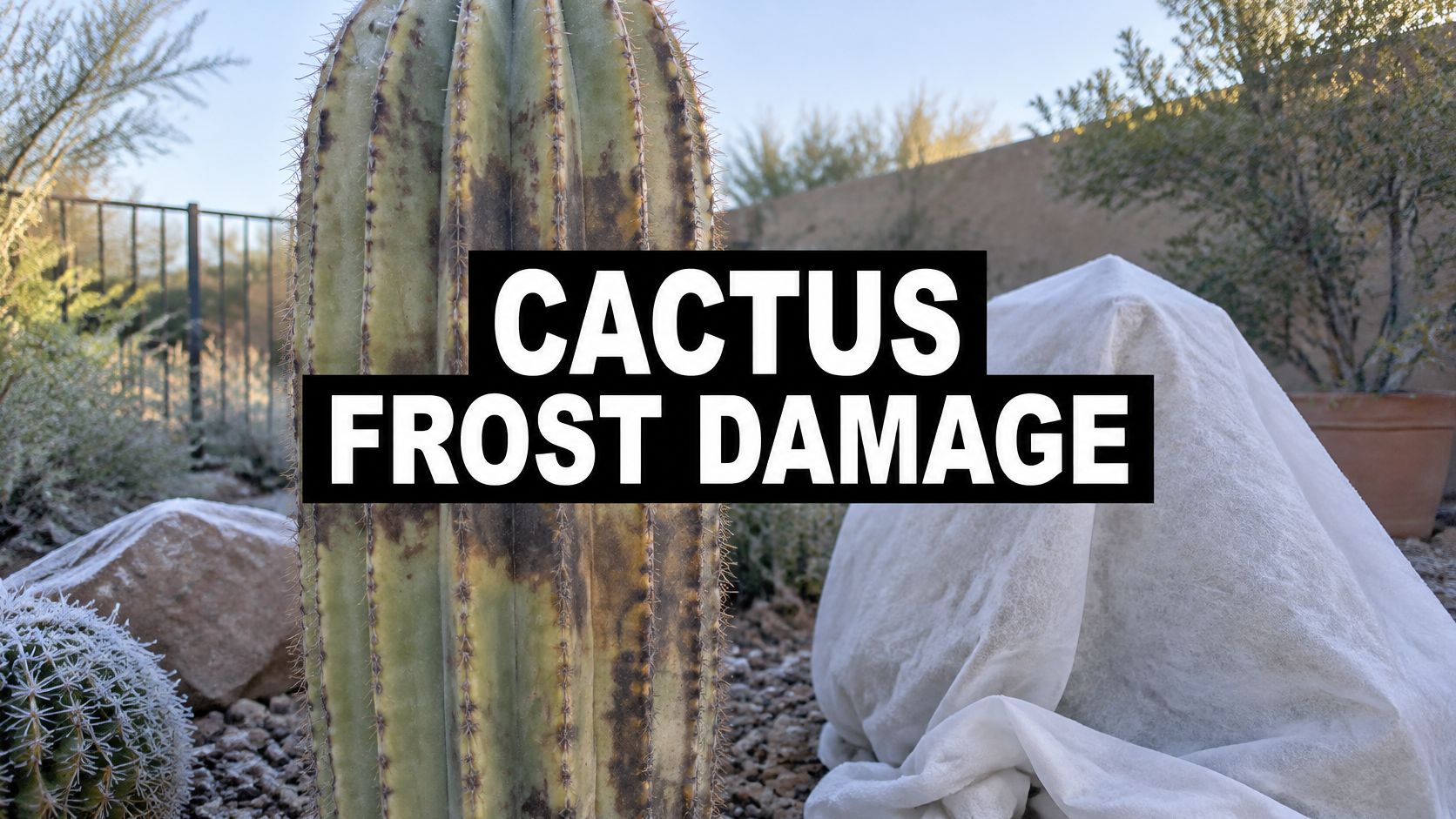

You wake up after a freezing night, walk outside with coffee in hand, and your Mexican fence post or barrel cactus looks different. A tip has gone pale. One side looks darker than it did yesterday. A prickly pear pad feels softer than it should.
Don't cut anything yet. Cactus frost damage rarely tells its full story on the first morning. What looks ruined may only be surface injury, and what looks almost normal may blacken over the next two weeks. Your first job isn't rescue. It's classification, then patient observation.
Frost Damage Severity at a Glance
Most surface damage from a light freeze isn't an emergency. The University of Arizona Cooperative Extension guide distinguishes a brief freeze at or slightly below 32°F (0°C), which may damage only the epidermis and eventually be outgrown, from several hours below freezing, which can blacken and kill exposed tissue or permanently scar columnar cacti. That distinction matters more than the single lowest number on your weather app.
Match What You See to the First Move
| Condition | What you see | Likely outcome | First action |
|---|---|---|---|
| Brief freeze at or slightly below 32°F (0°C) | Surface damage to the outer skin | Often outgrown over time | Leave the plant alone and monitor |
| Several hours below freezing | Blackened or killed exposed tissue | Possible permanent scarring on columnar cacti | Wait and assess over the following weeks |
| Growing point damaged | Soft or discolored new growth at the tip | Growth may pause or branch if the tip dies | Cap or protect the tip and do not cut yet |
| Plant actively growing during the freeze | Tissue damage more likely during spring frosts | Higher risk than a dormant plant at the same temperature | Check closely over the following weeks |
| Dormant, dry plant in the ground | Visible damage may be limited to exposed tips | Often limited injury if tips stay firm | Breathable cover for the tip if the forecast calls for it |
| Container specimen | Cools faster than soil-grown plants | Higher risk to roots and exposed tissue | Move to shelter before the freeze |
Duration changes the outcome. So does tissue position. A scarred rib on a large columnar cactus is cosmetic if the tissue underneath stays firm, while a soft, discolored growing point threatens future growth. Note how long the plant stayed below freezing, which side faced the cold, and whether new growth was present.
Growth stage can outweigh temperature. In a two-season South African study of prickly pear cultivars, damage occurred primarily during late-season spring frosts from August through October after repeated freezing nights ranging from -2.06°C to -9.6°C while plants had begun sprouting. Dormant plants in that same work showed no observed damage at winter temperatures as low as -8°C. An actively growing plant can therefore be the vulnerable one, even when the forecast looks less severe.
Practical rule: Classify first, then act. Surface injury gets monitoring. Blackened, soft, or tip injury gets time and repeated checks before you decide it's dead.
Cold-hardiness ratings aren't absolute. Walls hold and release heat, low ground collects cold air, washes channel it, and water features alter the temperature near a plant. Two identical specimens on opposite sides of your yard can come through the same night very differently. Record what happened at the plant, not just what the forecast predicted for your ZIP code.
Inspect and Wait Before You Prune
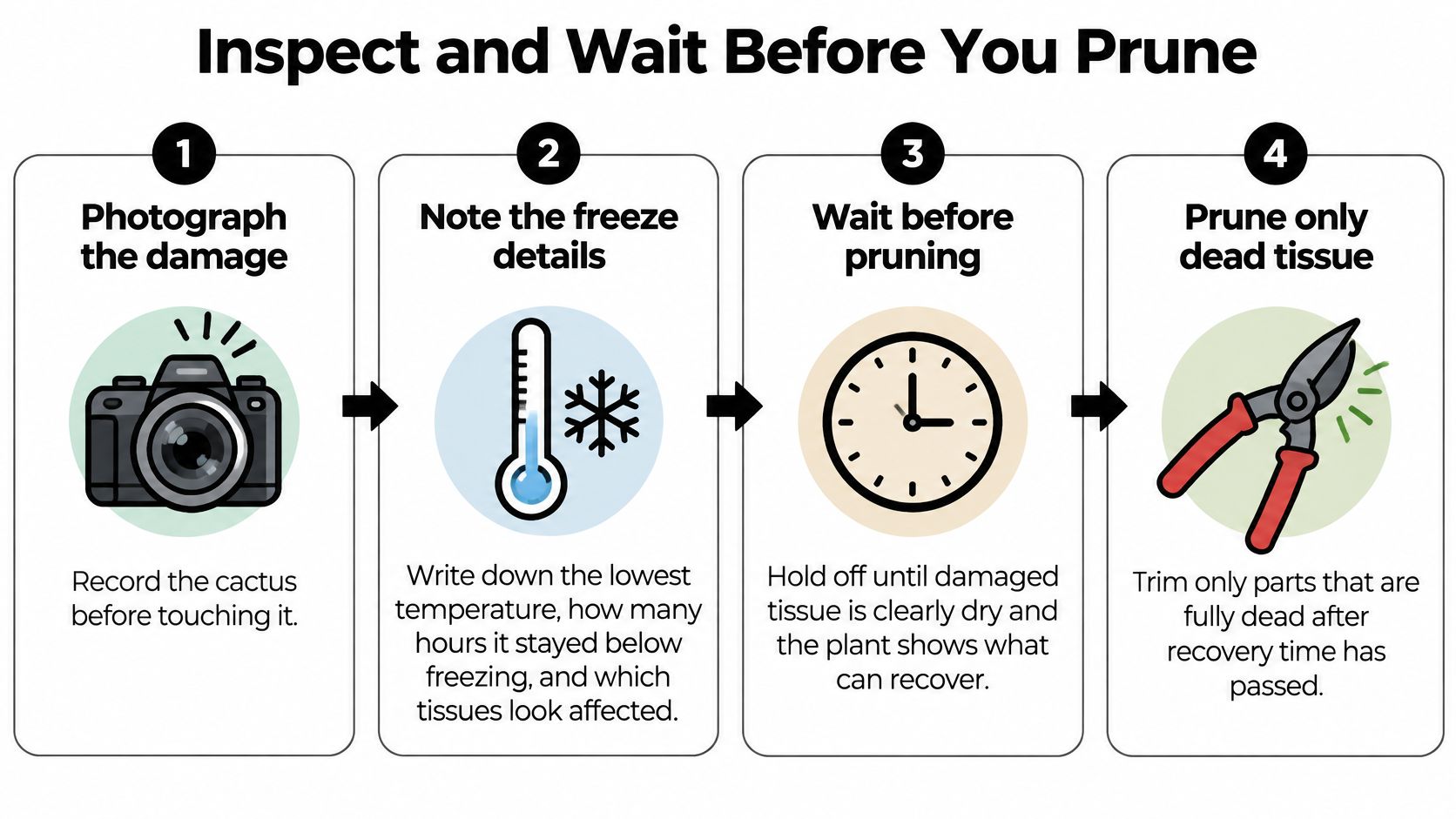
Before you touch the plant, write down the lowest temperature you can verify, the number of hours below freezing, and which parts look affected. That record turns a worried guess into a useful baseline. You'll compare every later change against it.
A Simple Inspection Routine
- Photograph each affected area: Use the same angle and distance each time, and include a hand or tape measure for scale on a large specimen.
- Note the location: Mark whether injury sits on the outer skin, the growing tip, one exposed side, or the ribs of a columnar plant.
- Press gently at the edges: Use a gloved fingertip or the flat of a tool to separate firm tissue from soft tissue without puncturing the skin.
- Leave damaged tissue in place: Don't peel, trim, or clean up pads and tips while the boundary is still moving.
- Recheck the same spots: Compare color, firmness, and spread against your photos over the following weeks.
That sequence feels passive, but it prevents the most common mistake. According to a review of freeze injury in Opuntia, exposed tissues commonly blacken first, then dry and become crisp, and you shouldn't remove damaged tissue immediately because delayed necrosis can reveal the true boundary of injury. Cutting on day two often means cutting again later, and each fresh wound gives rot organisms another entry point.
Function can also return before appearance improves. In a controlled study on Coryphantha vivipara, reducing nocturnal temperature from 10°C to -10°C for one night reduced nighttime carbon-dioxide uptake by 70%, yet plants recovered their original uptake capacity within four days. At -15°C, two of five plants died during two months of observation, while -20°C killed all five. That's a continuum, not a switch.
A plant that looks stalled after a freeze may still be functioning. Color alone doesn't tell you whether living tissue remains underneath.
When Cutting Finally Makes Sense
Wait until spring growth shows where living tissue ends. Then sterilize a sharp knife, pruning saw, or loppers between cuts and remove only clearly dead, soft, or discolored tissue, cutting back to firm, healthy tissue. Work in dry weather, keep the wound dry afterward, and don't water a freshly cut plant back into growth while frost risk continues.
Early pruning can stimulate tender regrowth at exactly the wrong time. I'd rather look at an ugly blackened patch for a few more weeks than create a clean wound in living tissue that didn't need cutting. If a pad turns completely soft and collapses, remove that clearly dead piece. If it's firm but discolored, keep watching it.
Why Dry Soil Beats Watering Before a Freeze
Don't water your cactus right before a freeze to protect it. That habit helps some garden plants in some settings, but it works against an outdoor cactus. Water-filled tissue and saturated soil make freeze injury more likely and interfere with the gradual dry-down that helps a plant acclimate.
The University of Arizona Cooperative Extension freeze guidance states that cold hardiness is best developed by reducing irrigation as winter approaches and allowing cacti to gradually enter dormancy, and it advises never watering succulents directly before a freeze because most hardy succulents withstand freezing better when surrounding soil is dry. For columnar, barrel, prickly pear, and container specimens, dry and dormant beats lush and hydrated on a freezing night.
The Practical Sequence
- Reduce irrigation gradually: Start as nights cool, rather than stopping abruptly after heavy late-season watering.
- Use soak-and-dry judgment: Water thoroughly only when the soil has dried, then let it dry again. Pot size, soil mix, season, and drainage all change the interval.
- Check before the event: Push a wooden skewer or moisture probe into the root zone. If it's wet, don't add more water for protection.
- Skip pre-freeze watering: Spend that time moving containers and preparing covers instead.
An established in-ground plant that's dry and dormant is a different case from a container specimen. Pots cool quickly on every side, so moving them to shelter often matters more than covering them in place. A recently shipped, transplanted, or actively growing plant may not be acclimated yet, and it deserves more conservative protection at the same forecast temperature.
Irregular cold snaps make calendar-based winter care unreliable. I'd base the decision on the forecast, current soil moisture, your last irrigation, and whether the plant is pushing growth. Our guide to winter cactus care fits that same approach. If you've already watered by mistake, don't panic and don't water again. Protect the plant, improve drainage if water is pooling, and let the root zone dry.
Cold Sensitivity by Species and Tip Protection
Desert origin doesn't give every cactus the same cold tolerance. Protection should match the species, the cultivar, and the plant in front of you. A genus name on a label is a starting point, not a guarantee.
The University of Arizona monthly gardening guide identifies Mexican fencepost cactus and young saguaro as cold-sensitive cacti whose growing tips should be capped during frost or freeze warnings. Use a paper grocery bag or a large Styrofoam cup over the tip. Don't let plastic touch the plant, because it conducts cold instead of insulating the tissue.
How to Cap a Tip Well
- Choose a loose cap: It should cover the growing point without crushing new spines or sealing in moisture.
- Secure it gently: Use soft twine or plant tape below the tip so wind doesn't lift it overnight.
- Remove it after the freeze: Take it off once temperatures rise, dry it out, and keep it for the next warning.
That small step protects the tissue that controls upward growth. A scarred side rib may be permanent but survivable. A killed tip changes the plant's shape and future growth, especially on a young saguaro or a specimen Mexican fence post you bought for its clean columnar form.
| Species or group | Cold sensitivity noted in research | Protection focus |
|---|---|---|
| Mexican fencepost cactus | Cold-sensitive (University of Arizona Extension) | Cap the growing tip during frost or freeze warnings |
| Young saguaro | Cold-sensitive (University of Arizona Extension) | Cap the growing tip during frost or freeze warnings |
| Brittle pricklypear (Opuntia fragilis) | Survives locations where winter minimums fall below -58°F (-50°C) (USDA Forest Service) | Native benchmark only; do not apply to other Opuntia |
| Prickly pear cultivars (Opuntia ficus-indica) | Damage varied by cultivar in a South African two-season study | Assess per cultivar and current growth stage |
The brittle pricklypear figure needs careful handling. The U.S. Forest Service species account reports that Opuntia fragilis can survive locations where minimum winter temperatures fall below -58°F (-50°C). Don't apply that extreme benchmark to ornamental prickly pear cultivars, San Pedro, Peruvian apple, golden barrel, or any large columnar specimen in your yard.
Cultivar differences inside one species can be wide. In the South African prickly pear work, some Opuntia ficus-indica cultivars were heavily damaged while Monterey was comparatively tolerant. That is why the cultivar name matters when you're comparing plants for a cold patio or an exposed front yard. If you want a broader species shortlist, start with our guide to cold-hardy cactus options, then narrow by your site and growth stage.
Where reliable information for a specific plant is thin, protect conservatively. I'd cap the tip and cover the plant for a warning rather than gamble a mature specimen on a general hardiness claim. The cost is ten minutes and a paper bag. The cost of guessing wrong can be the growing point.
How to Protect a Cactus Before a Freeze
Move containers first. That's the highest-value step because it removes the plant from the coldest air and protects the root ball at the same time. Put containerized specimens indoors, in a garage, under a solid patio cover, or in another frost-free enclosure before temperatures fall.
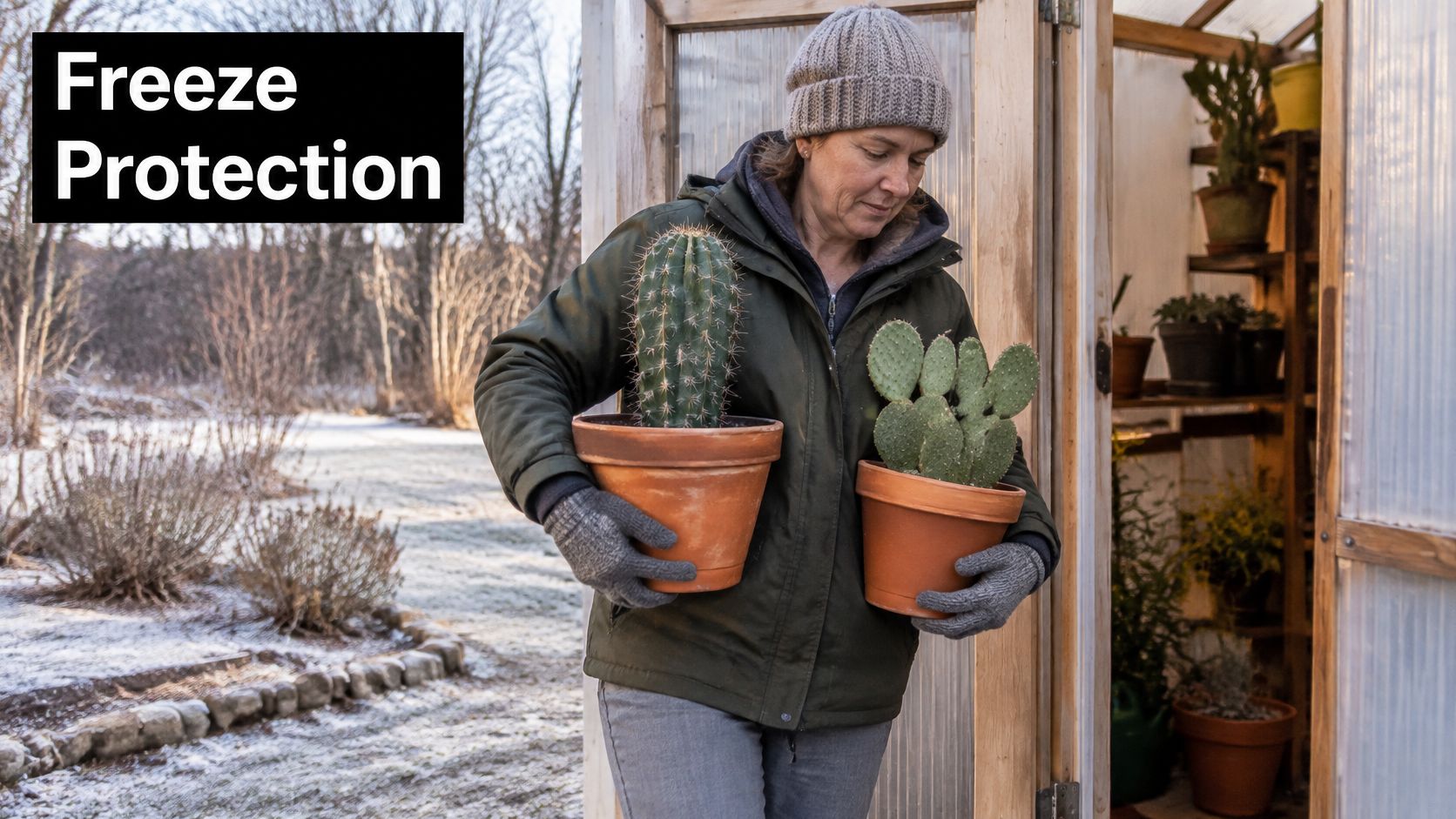
If you bring plants inside for a cold snap, don't park them against a drafty window and assume they're safe. Indoor placement still matters, and this explanation of how nighttime cold stresses indoor plants is useful context for why a chilly room corner can still set a tender plant back. Keep moved cacti in bright, stable conditions and return them outside gradually after the danger passes.
For Plants in the Ground
- Cover the whole plant: Drape frost cloth or another breathable fabric over the full plant, not just the top.
- Seal it at ground level: Extend the fabric to the soil and weight the edges with rocks or bricks so stored soil heat stays underneath.
- Protect the growing point: Add a paper bag or foam cup cap on cold-sensitive columnar tips before you drape the cover.
- Keep plastic off the tissue: Use cloth or paper against spines and skin. If you add an outer layer for wind, don't let plastic touch the plant.
- Avoid loose or wet covers: A flapping top-only sheet funnels cold air underneath, and a wet blanket can freeze against tissue.
- Remove covers in the morning: Take them off when the temperature underneath approaches the safe range given below, so heat and humidity don't build up.
The University of Arizona Extension winter newsletter advises covering plants with breathable fabric extended to ground level and removing coverings in the morning when temperatures beneath them approach 50°F (about 10°C). It also warns against loose top-only covers, sealed plastic touching the plant, and wet coverings that freeze against tissue. Those failure modes explain many cases where a covered cactus still gets hurt.
Evening checklist: Containers moved, soil checked and left dry, tips capped, breathable covers reaching the ground, edges weighted, and spare dry covers ready if wind shifts.
Covers help most on marginally hardy ornamental cacti, the plants that sit near their limit in your climate. Native cold-adapted species may need little more than tip protection in the same yard. But no frost cloth turns a tender specimen into a hardy one through a long, severe freeze. Timing, dry soil, acclimation, and full ground coverage together reduce risk. Any one of them alone is weaker than people expect.
Set up before sunset while you can still see spines, low pads, and gaps at the base. Work with thick gloves, long sleeves, and tongs for adjusting fabric around barrel and prickly pear spines. In the morning, remove covers promptly, shake off moisture, and let them dry before storing them for the next warning.
Deciding Whether to Prune, Keep or Replace Your Cactus
Use one rule before every decision. No cutting until new spring growth shows where living tissue ends. That pause protects valuable specimens from a rushed diagnosis and gives superficial injury time to declare itself as cosmetic.
Four Questions That Settle Most Cases
- Is the growing point alive: A firm, healthy tip keeps the main recovery path open, even if one side is scarred.
- Is damage limited to the outer skin: Pale, corky, or lightly blackened surface tissue that's firm underneath is usually outgrown or becomes a permanent but stable scar.
- Is damage deep or extensive: Soft tissue spreading through much of a columnar trunk, a collapsed tip, or pads turning mushy across the plant point toward major pruning or replacement.
- Did the site make it worse: Check low ground, reflected cold from hardscape, wind exposure, nearby walls, and water features before blaming the species alone.
Say a tall Peruvian apple or Mexican fence post has blackened outer ribs but a firm, healthy tip. I'd keep it, monitor the boundary, and accept that some scarring may remain visible. The plant can continue growing from the top, and the damaged section becomes part of its history rather than a reason to discard a mature specimen.
Now consider the opposite case. Spring arrives, the tip is dead and soft, and discoloration keeps moving into the interior instead of drying and stopping. That plant needs a more serious intervention. You may cut back to firm tissue if the remaining base is healthy and the form still suits its setting. If most of the trunk is compromised, replacement is often cleaner than months of cutting away decline.
Our guide on how to revive a dying cactus can help you separate freeze injury from rot and other decline before you commit. Send clear photos of the tip, the worst patch, and the whole plant to a local extension office or nursery if you're unsure. You can also call The Cactus Outlet at 1-800-826-9396 with questions about a specimen you're trying to assess.
If you do replace a plant, choose with the failure in mind. Each cactus or succulent from The Cactus Outlet is hand-packaged and shipped bare root, securely wrapped in bubble wrap and tape, so plan for planting and acclimation on arrival rather than leaving a new specimen exposed during freeze season. A better species match, a higher planting spot, dry winter soil, and tip caps ready in advance will do more than buying the same plant again.
If a freeze has left you weighing repair against replacement, shop large columnar cacti, prickly pears, barrels, saguaros, agaves, and other premium outdoor specimens at The Cactus Outlet and choose plants that fit your cold exposure, patio, or garden design. Bring your photos, your lowest temperatures, and your site conditions to the decision, then protect the next specimen before the first warning instead of after it.