
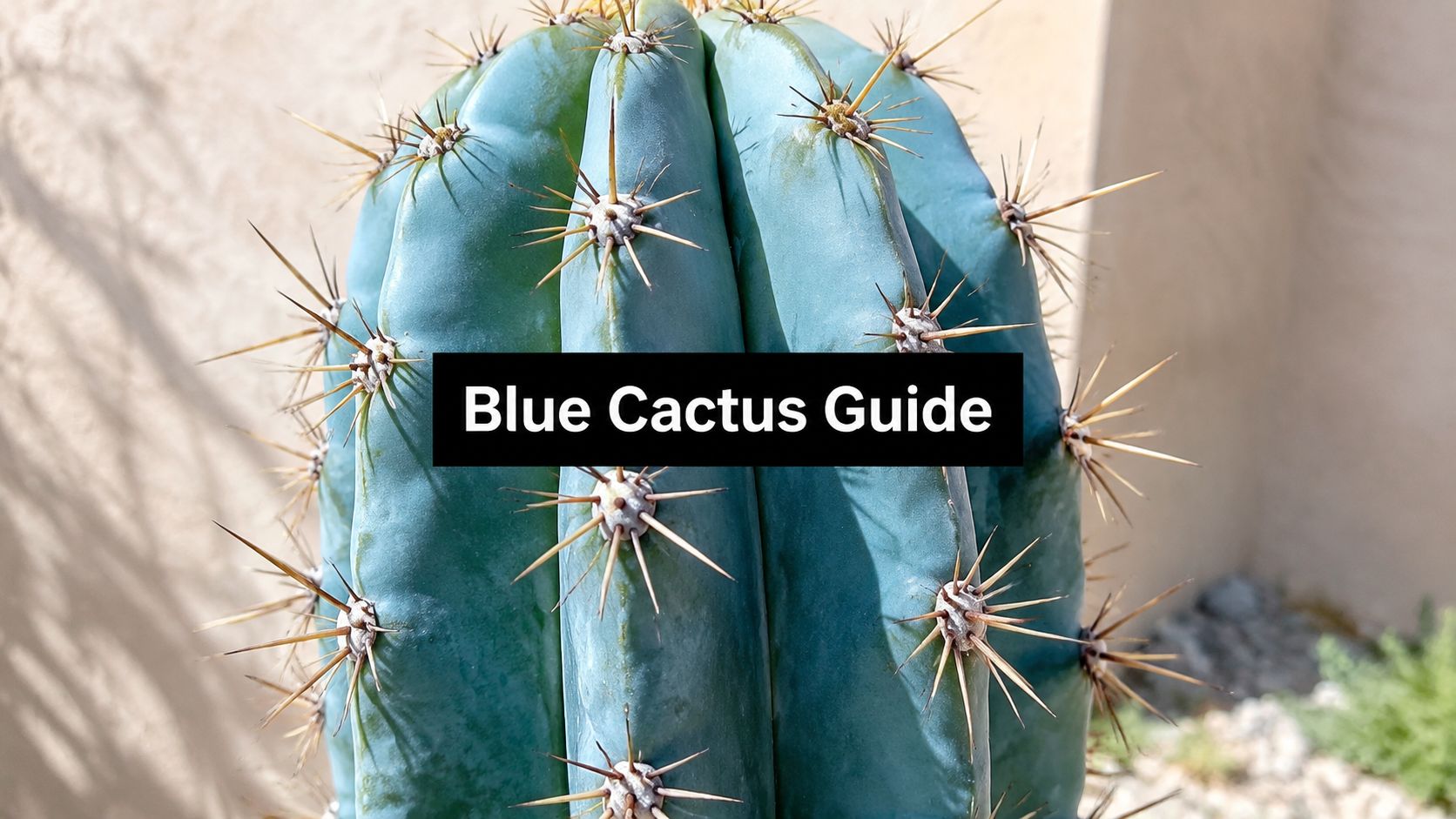

You're probably here because you saw one and stopped scrolling. A powdery blue cactus doesn't look real the first time you see it. It looks airbrushed, edited, almost ceramic. Then you realize it's a live plant with spines, weight, growth, and a personality that's a little less forgiving than the average windowsill succulent.
That's the appeal of the Brazilian Blue Cactus. It has the clean vertical lines designers love, the rarity collectors chase, and just enough attitude to humble anyone who treats it like a generic cactus. The biggest misunderstanding is the color. That blue isn't a fixed trait like paint on a pot. It's a living surface effect tied to wax, sun, and handling.
Grow it well, and it becomes one of the most dramatic columnar cacti you can own. Grow it carelessly, and it turns dull, stretched, scarred, or soft at the base. If you enjoy South American species more broadly, this overview of cacti from South America gives useful habitat context for why so many of them demand sharp drainage and bright exposure.
An Introduction to an Otherworldly Cactus

The Brazilian Blue Cactus earns attention fast. In a nursery, it pulls your eye away from green plants immediately. Online, it's the one people assume has been color-edited. In person, the stems have a silvery, chalky glow that feels more mineral than botanical.
What makes it so compelling is the contrast. The form is bold and architectural, but the color looks soft. The plant is tough, drought-adapted, and built for hard sun, yet its signature finish can be damaged by something as simple as rough handling. That tension is what makes it interesting to grow.
Practical rule: If you think of the blue color as a protective bloom instead of a permanent paint job, the plant's care starts making a lot more sense.
Collectors like it because it stands apart from common green columnar cacti. Designers like it because it reads almost like living sculpture. Growers like it because, with the right setup, it doesn't just survive. It puts on serious size and presence over time.
Unveiling the Blue Torch Identity
The name causes confusion before the plant even gets home. In the trade, the Brazilian Blue Cactus is usually sold as Pilosocereus azureus or Pilosocereus pachycladus. If that feels messy, it's akin to a plant wearing different name tags depending on the seller, while still belonging to the same recognizable group.

The name you'll see most often
For everyday buying and growing, what matters is this: the blue form commonly sold in cultivation belongs to the Pilosocereus genus. According to the Royal Horticultural Society entry, which also references Plants of the World Online, that genus is native to the Neotropics and included 61 accepted species as of July 2025. The same RHS source notes that some Pilosocereus varieties can reach over 4 m, and the blue torch species can reach up to 10 m in its native range, though it stays much smaller in containers (Royal Horticultural Society plant details).
That tells you two useful things right away. First, this isn't a novelty oddity with no botanical context. Second, it's not a forever-small desktop cactus.
Why its origin matters
This cactus comes from Brazil, and that background matters more than the label. It evolved for intense light, lean soils, and long dry periods. That's why it resents soggy potting mixes and dim indoor corners. It's built like a sun plant because it is one.
A lot of care mistakes happen when people buy it for the color but ignore the form. This is a fast-growing columnar cactus. That means upright growth, eventual height, and a stronger long-term relationship with space than is typically expected.
What to expect in a home collection
In a pot, it's manageable for quite a while, but “manageable” doesn't mean tiny. It becomes a specimen. That's part of the charm. You're not growing a disposable accent plant. You're growing a column that can anchor a patio, greenhouse bench, bright studio corner, or warm-climate garden.
If you want a cactus that stays politely small, pick something else. If you want a blue column with presence, this is exactly the right species group.
The Essential Care Trinity Light Water and Soil
Most growers lose the Brazilian Blue Cactus in one of three ways. They don't give it enough light, they water it like a leafy houseplant, or they put it in a mix that stays wet too long. Fix those three things and the plant becomes much easier.

Light decides both shape and color
The blue tone comes from a waxy coating on the stem, and current grower pages commonly recommend 4 to 6 hours of bright sun while also warning that extended direct exposure can burn plants that aren't acclimated. Those same pages note that strong sun helps maintain the blue look, which is why color and exposure are linked so closely (Planet Desert Brazilian blue cactus listing).
This is the core trade-off. More sun usually means stronger color and tighter growth. But a plant moved too quickly from lower light into harsh exposure can stress, scorch, or stall.
Use a gradual approach:
- Start with bright conditions: Place a newly arrived or nursery-grown plant where it gets strong light first.
- Increase sun in steps: Add more direct exposure over time instead of changing conditions in one day.
- Watch the stem surface: Healthy stress adaptation looks firm and stable. Damage looks bleached, browned, or patchy.
For growers mixing mineral ingredients at home, this cactus and succulent soil mix guide is a practical starting point.
A quick visual primer can help before you set up your plant:
Watering has to be boring
This plant likes a dry rhythm. Water thoroughly, then let the root zone dry before watering again. The mistake isn't usually underwatering. It's repeated moisture in a pot that never fully dries.
If you're unsure whether to water, wait. A thirsty columnar cactus usually recovers better than a rotting one.
In active growth, a healthy plant in a fast-draining mix can take a thorough soak. In cool weather or lower light, the same watering schedule can become a problem fast. Winter restraint matters.
A simple way to look at it:
| Situation | What works | What fails |
|---|---|---|
| Warm, bright growth | Deep watering followed by full drying | Small frequent sips |
| Cool or dim conditions | Longer dry intervals | Routine watering by calendar |
| Large pot with dense mix | Very cautious watering | Treating it like a porous cactus setup |
Soil is not the place to compromise
Standard indoor potting soil is too moisture-retentive for this plant. The Brazilian Blue Cactus wants highly porous media, not a peat-heavy sponge around its roots. Mineral structure matters because roots need air as much as they need moisture.
Build or buy a gritty mix that drains fast. Good components include pumice, perlite, and coarse sand. The goal isn't to starve the plant. The goal is to let water pass through quickly while leaving enough structure for roots to anchor and breathe.
When growers say a cactus “hates wet feet,” this is what they mean in practice.
Advanced Care for a Thriving Specimen
Once the basics are stable, the Brazilian Blue Cactus becomes a plant of management rather than rescue. You're no longer trying to keep it alive. You're guiding size, shape, and momentum. That usually comes down to feeding and repotting.
Feeding without forcing weak growth
A fast-growing columnar cactus responds well to light feeding during active growth. The trick is restraint. You want support, not a surge of soft tissue that's more vulnerable to stress.
I prefer a cactus fertilizer used conservatively during the growing season. A balanced cactus formula works better than aggressive feeding meant for leafy tropical plants. If a plant is underpotted, root-stressed, or sitting in poor light, fertilizer won't solve the underlying problem. It often makes it more obvious.
Look for these signals before feeding:
- Firm active tips: The plant is growing.
- Good light exposure: Nutrients can be used productively.
- Fast-draining mix: Salts won't linger in soggy media.
Skip feeding when the plant is stressed, recently repotted, or sitting through its cooler dormant period.
Repotting a spiny column safely
Repotting matters because this isn't a compact rosette. It gains height, weight, and imbalance. A top-heavy plant in an undersized pot becomes unstable long before it complains in obvious ways.
Common signs it's time:
- The pot dries almost immediately
- The plant leans or topples easily
- Roots crowd the container
- Growth slows despite good light and sensible watering
Choose a pot with excellent drainage and only step up moderately in size. A huge jump into a much larger container often keeps the lower root zone wet too long. That's a bad trade.
How to handle it without ruining the finish
The blue surface is part of the beauty, so handling matters. Wrap the stems with folded paper, clean cloth, or another buffer that grips without grinding the skin. Don't drag the stem against the rim of the old pot. Don't rotate it with bare hands if you can avoid it.
Handle for stability, not speed. Most cosmetic damage happens during rushed moves.
Repot during active growth if possible. Set the plant at the same general depth, backfill with your gritty mix, and wait before resuming heavy watering. That pause gives disturbed roots time to settle.
Large specimens often benefit from a heavier pot because physics matters. A blue column that looks elegant on a shelf may need a container with real weight once it matures.
Propagation and Solving Common Problems
The Brazilian Blue Cactus is generous in one sense. If you have a healthy stem section, you can usually turn it into another plant. It's unforgiving in another sense. If you ignore early warning signs, problems move from cosmetic to structural quickly.
Propagating from cuttings
Propagation is usually done from cuttings. Start with a healthy section from a firm plant. Make a clean cut, then let the cutting dry and callus in an airy place out of harsh direct exposure. Don't rush this stage. Freshly cut tissue pushed into damp soil is asking for rot.
Once the cut end has callused, place it into a very porous rooting mix. Keep the setup bright, warm, and dry enough that the cutting doesn't sit in stale moisture. I like to begin with less water than most beginners expect. New roots need oxygen.
A practical sequence looks like this:
- Choose clean material: Avoid weak, wrinkled, or blemished sections.
- Let the cut harden: The wound should no longer look fresh.
- Use a mineral-heavy medium: Porous rooting conditions matter more than richness.
- Wait for anchoring: Gentle resistance when nudged usually means roots are forming.
The blue finish can't be polished back on
The most misunderstood problem is color loss. From a production standpoint, this cactus is a fast-growing, upright columnar cactus with summer blooming and drought tolerance, but its blue color is tied to a surface wax that's easily degraded by handling. Grower guidance also notes that touching or rubbing stems can permanently dull the blue effect on affected growth, that overwatering is the main cause of failure, and that frost protection is needed below about 4 to 10°C depending on the source (Cactus Warehouse Brazilian blue columnar cactus notes).
That means two things. The rubbed patch usually won't turn powdery blue again just because you mist it, wipe it, or “condition” it. New growth may develop well under proper light, but damaged surface bloom on old tissue is often just gone.
Diagnosing the usual trouble
If the plant starts looking wrong, separate the issue by symptom instead of trying random fixes.
- Soft base or sour smell: Think rot first. Stop watering, inspect the root zone, and cut away compromised tissue if needed.
- Tall, thin, weak growth: That's usually inadequate light. The plant is stretching, not thriving.
- Dull color with otherwise firm stems: Review sun exposure and handling history before assuming disease.
- Cottony clusters or fine webbing: Check for common cactus pests such as mealybugs or spider mites.
Here's the part many growers miss. A plant can be alive, rooted, and technically healthy while still looking disappointing because the conditions favor survival more than beauty. The Brazilian Blue Cactus often asks you to choose where on that spectrum you want to sit.
Designing with a Living Sculpture
This cactus works best when you treat it like structure, not filler. It doesn't disappear into a room the way a trailing plant does. It defines a corner, punctuates an entry, or gives a patio vertical lift without visual clutter.
Its background explains that look. The plant's ornamental value comes from a Brazilian native-range cactus adapted to harsh, dry environments, especially the caatinga of northeastern Brazil. It's typically grown in USDA zones 9b to 11b, roughly zones 9, 10, and 11, and it needs full sun, very fast-draining soil, plus minimal winter watering because it goes winter-dormant (Desert Noir blue torch cactus listing).
Indoors
Indoors, the best placement is usually somewhere bright enough that the plant still reads crisp and upright. A sunny living room corner, bright stair landing, or entry with strong natural light makes sense. Pot choice matters too. Matte charcoal, pale concrete, and warm terracotta all play nicely against the blue stem, just in different moods.
If you're styling a room from the furniture outward, this broader guide to selecting the perfect plants for your space is useful because it matches plant form and visual weight to the room instead of treating every houseplant as interchangeable.
Outdoors
In warm climates, this cactus shines in xeric planting. It works beside gravel, stone, agaves, aloes, and other architectural drought-tolerant forms. I like it either as a solitary focal point or repeated in a restrained rhythm where the blue stems echo each other without cluttering the bed.
The key design mistake is crowding it. Give it air around the form so the color and outline can do their job.
Your Guide to Buying a Healthy Cactus
Buying a Brazilian Blue Cactus gets easier when you stop looking only at color. The best-looking plant on a sales page isn't always the healthiest one. What you want is a firm, stable specimen with clean growth, a sound base, and no obvious pest issues.

What to inspect first
Check the stem before anything else. It should feel solid, not mushy. The base matters even more than the tip because base problems often point to watering mistakes or root trouble. Some variation in blue tone is normal, especially after shipping or lower-light holding conditions, so don't reject a plant just because it isn't uniformly powder blue.
A smart buyer looks for:
- Firm tissue: No soft collapse near the soil line.
- Clean surface: Minor cosmetic marks can happen, but avoid obvious rot or pest residue.
- Balanced growth: Strong upright form is better than stretched, weak columns.
- Sensible potting: A cactus in a heavy, wet mix deserves extra caution.
What shipped stress can look like
Large cacti often show mild cosmetic stress after transport. That can mean a little dullness, some dust, or a temporary sulky look while the plant adjusts. What shouldn't happen is severe collapse, black mush, or active pest infestation.
If you're comparing online vendors, this article on the best place to buy cactus online gives a good framework for evaluating how sellers present plant condition, packing standards, and after-arrival expectations. The Cactus Outlet is one example of an online retailer focused on large cacti and succulents, which is relevant when you want columnar species that need careful packing rather than standard small-plant shipping.
Frequently Asked Questions
Will a Brazilian Blue Cactus flower indoors
It can, but indoor flowering is less common unless the plant is mature and gets strong light with a stable seasonal rhythm. Healthy growth comes first. Flowering is a bonus, not the main benchmark for success.
Is it safe around pets
The practical concern is usually the spines, not some decorative surface issue. Place it where pets and people won't brush against it. For most homes, that means giving it protected space rather than squeezing it into a traffic path.
Will the blue coating grow back where I rubbed it off
Usually, the affected patch on older tissue won't recover its original bloom. That blue look is a surface wax, not a stain inside the stem. New growth can look good under proper conditions, but old rubbed spots often remain visibly different.
Don't clean this cactus for looks. Every wipe risks removing the feature you bought it for.
How do I tell thirst from rot
A thirsty cactus may look a bit less full, but the tissue still feels structurally sound. Rot usually starts with softness, especially low on the plant, and can come with discoloration or an unhealthy smell at the base. When in doubt, inspect the lower stem and root zone before watering again.
Can it live indoors long term
Yes, if you can provide enough light and accept that the plant may prioritize survival over peak blue coloration in weaker indoor conditions. A bright window or sunroom is much more realistic than a dim shelf.
If you're ready to add a columnar cactus with real presence to your collection, browse The Cactus Outlet for large cacti and succulent options, then choose a plant that fits your light, space, and long-term growing style.