

Tired of a thirsty lawn, dead patches by midsummer, and beds full of random plants that never look like they belong together? Most yards don't fail because the owner picked “bad plants.” They fail because the planting plan ignores space, spread, and water demand, which is the basic logic behind durable garden designs. UF/IFAS recommends working from a simple palette of about 10 to 15 plants in large masses, grouping plants with the same water needs, and spacing plants at 85% of the high end of their spread range. That's why a bed built from a few repeat performers usually looks better than a collector's shelf of mismatched specimens.
This guide leans into that principle and applies it to cacti and succulents. Instead of throwing plant names at you, it gives you ten practical landscaping plant ideas built as working combinations: focal-point groupings, privacy screens, slope stabilizers, patio arrangements, and more. The focus is water-wise structure, strong form, and plants that still look intentional when you're not out there fussing every weekend.
The timing makes sense. Outdoor design is already a very large market, with the U.S. outdoor design services market valued at $331.05 billion in 2024 and projected to reach $347.21 billion by 2025, with one forecast above $714.81 billion by 2037. People keep investing in outdoor spaces because good exterior spaces do more than decorate a yard. They reduce maintenance friction, support property use, and hold up in real conditions.
1. Desert Garden Foundation
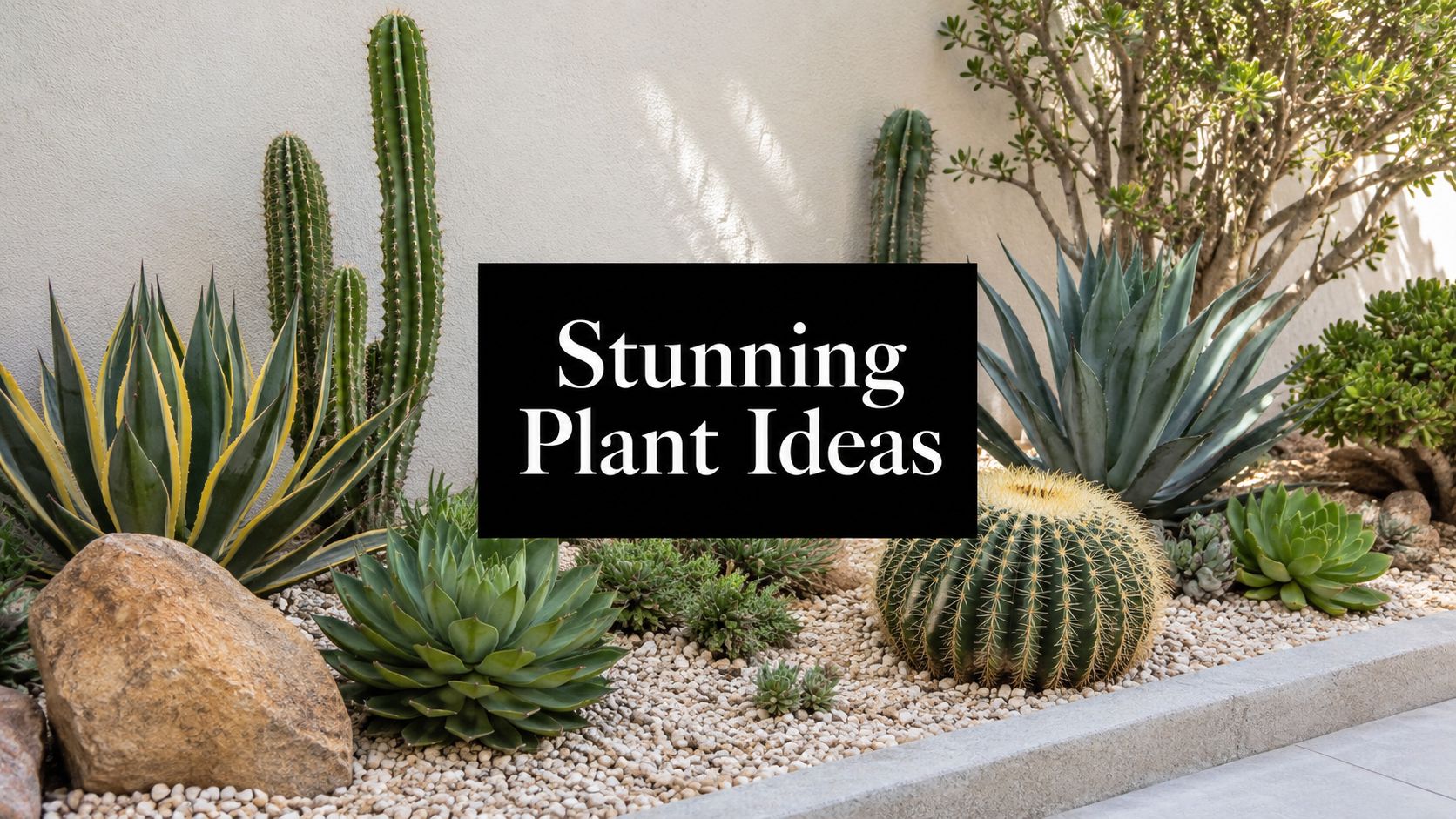
A mature Saguaro paired with barrel cactus is one of the cleanest, most convincing desert compositions you can plant. It works because the forms contrast naturally. One gives you height and gravitas, the other gives you rounded mass and visual weight at ground level.
This is the combo I use when a yard needs an anchor, not filler. In Phoenix luxury outdoor spaces, Scottsdale resort entries, and desert botanic-style residential beds, that pairing reads immediately as established and regional instead of improvised.

What makes this pairing work
Saguaros need visual breathing room. If you crowd them with too many accents, the whole bed feels nervous. Barrel cactus solves that because it holds the ground plane without competing for attention.
Use gravel mulch, a restrained rock palette, and only a few supporting plants. If you want a practical reference for layout style, this walkthrough on how to create a cactus garden is useful for seeing how simple compositions stay stronger.
Practical rule: If the eye can't settle on the main specimen within a few seconds, the bed has too many players.
Trade-offs and planting notes
The big mistake is treating Saguaros like shrubs and tucking them near walks, eaves, or entry paths. They need room now and later. Barrel cactus also needs enough clearance that maintenance crews aren't forced to brush past spines every time they trim nearby plants.
A good desert foundation bed usually includes:
- One dominant vertical specimen: A Saguaro or another strong columnar cactus.
- Two to four low massing companions: Barrel cactus works because the shape is distinct and repeatable.
- One unifying surface treatment: Gravel mulch is usually cleaner than bark in arid planting schemes.
If the soil stays wet for long stretches after irrigation, skip this play until drainage is fixed. In desert-style planting, poor drainage ruins more projects than under-watering.
2. Agave Accent Plantings
Agave is what I use when a planting scheme needs architecture fast. A single large rosette can do the work of an entire shrub grouping, especially in modern homes, Mediterranean courtyards, and commercial entries where strong geometry matters more than flowers.
Blue-toned agaves are especially effective against stucco, stone, and dark gravel. But they're not universal plants. They're statement plants, and statement plants need placement discipline.
Where agave belongs, and where it doesn't
Agave belongs where people can see it clearly without needing to brush past it. That means open bed corners, courtyard centers, poolside zones with clear setbacks, and framed views from windows. It does not belong tight against a front walk, beside a mailbox, or near a gate latch.
The best agave groupings usually rely on repetition, not variety overload. Use a few rosettes in different sizes, then let grasses, rock, and negative space do the rest.
Morning or side light makes agave look better than flat overhead exposure. If you can place it where low-angle sun catches the leaf margins, do it.
A simple working combo
For a dependable agave planting, I like three layers:
- Primary structure: One larger agave as the visual center.
- Secondary movement: Ornamental grasses or softer succulent forms nearby for contrast.
- Hardscape support: Small boulders or gravel that echo the rosette shape without copying it.
This play is strong in retail settings because it reads as low-maintenance and deliberate. It also fits the broader market shift toward residential outdoor upgrades. The global landscaping products market was valued at USD 88.64 billion in 2024 and is projected to reach USD 129.98 billion by 2030, with a 6.7% CAGR from 2025 to 2030, and the residential segment held the largest revenue share in 2024.
The caution is simple. Don't build the whole yard from spiky forms. Too much agave, too many yuccas, and too many sharp-edged materials can make a home's exterior feel defensive instead of welcoming.
3. Mixed Succulent Groundcovers and Slope Stabilization
Slopes expose lazy planting fast. If the planting is too sparse, you get erosion, exposed irrigation, weed invasion, and mulch washing into the lowest corner after every storm. Mixed succulent groundcovers solve that, but only when the planting density is high enough to knit the surface together.
Sedums, trailing succulents, and low, spreading forms work best when they're massed tightly and repeated. One plant every so often won't stabilize anything. It just creates islands in bare soil.

How to make a slope look planted, not patched
A good slope planting needs more than plants. It needs water control, access, and enough pattern to look intentional from a distance. On residential hillsides and embankments, I use repeated drifts of two or three succulents with one upright accent woven through the field.
If the site also needs structure, retaining work often comes first. That's especially true when you're planning your Sydney retaining wall, because plant choice only works after the slope itself is stable.
For more species ideas that fit this approach, browse these low-maintenance landscaping plants.
What works on real slopes
Dense planting beats decorative spacing. Gravel mulch helps lock the surface and suppress weed germination, but it isn't a substitute for root coverage. If runoff is strong, I'd rather see swales, terracing, or contour breaks than a prettier mulch choice.
Use this approach:
- Choose spreaders with different habits: One mat-former, one cascading type, and one upright accent usually gives enough variation.
- Keep maintenance access in mind: You still need a way to weed, reset irrigation, and replace losses safely.
- Avoid overfeeding: Rich, wet soil can push soft growth that collapses or rots.
There's also a market reason this category keeps growing. The global gardening market was estimated at USD 120 billion in 2024 and is forecast to reach USD 150 billion by 2030 at about 5% CAGR, with growth driven by home gardening, urban farming, and smart gardening technologies. People want plantings that look better than bare slope fabric but don't lock them into constant upkeep.
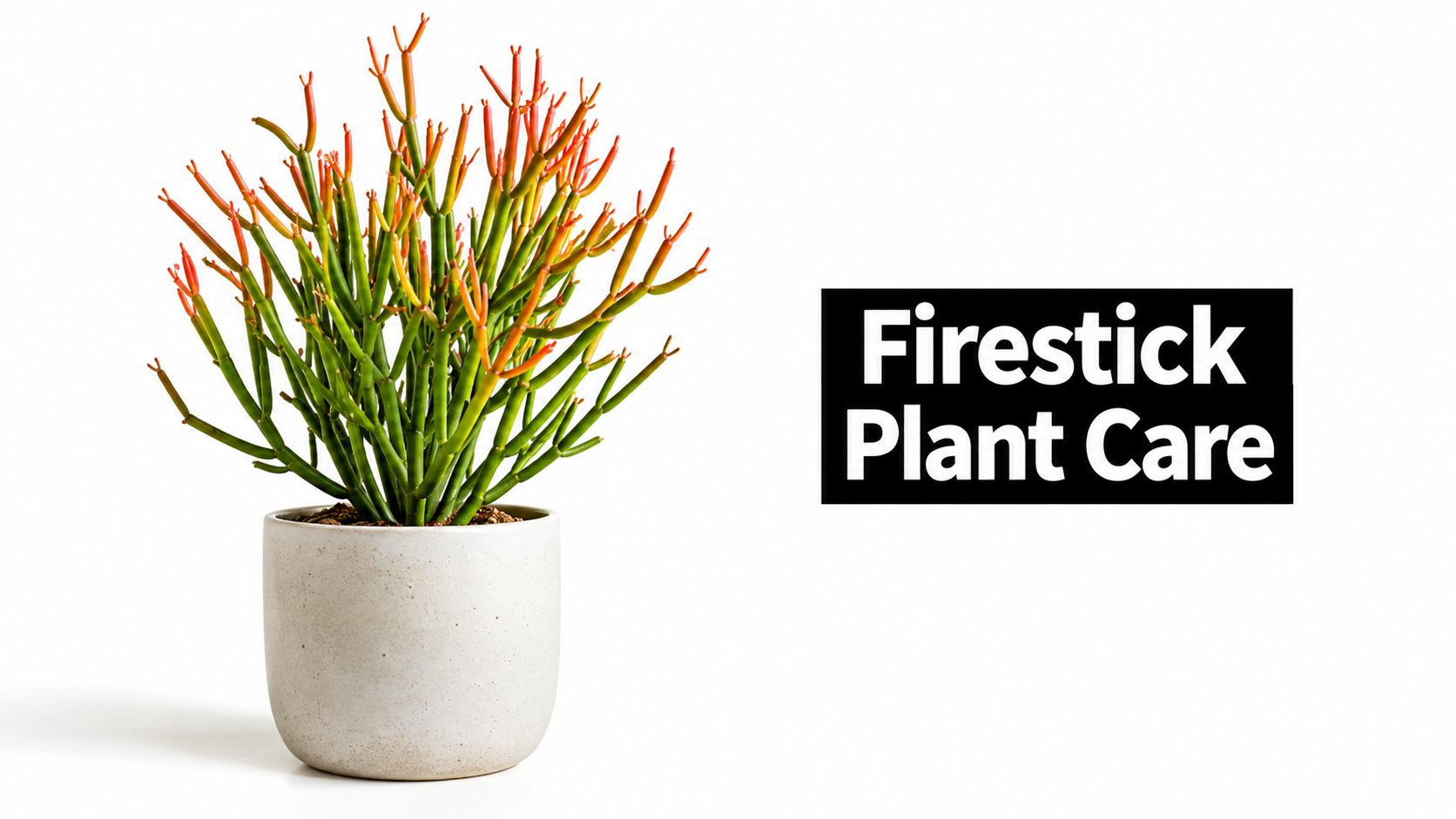
4. Euphorbia Landscape Statements
Euphorbias bring a different kind of drama than cactus. Saguaros feel monumental. Agaves feel architectural. Large euphorbias feel sculptural and a little wild, which is exactly why they're useful in contemporary gardens that need year-round shape.
Fire Sticks, Pencil Cactus, and candelabra forms all work as specimen material. They catch low light well, they photograph well, and they keep a bed from going visually flat in winter.
Best uses for large euphorbia
I like euphorbia in places where the planting needs height but not bulk. That makes it especially useful in narrow side beds, gravel courtyards, and modern corner compositions where broad shrubs would feel heavy.
This is also where site-specific selection matters. Advice for awkward spaces tends to stay generic, but the actual issue is mature size, root competition, and visual bulk in tight areas. Guidance on plants for tricky landscaping spots points in that direction, and that's the right way to think about euphorbia too.
Use euphorbia where you need vertical movement without creating a wall of foliage.
The trade-offs most people ignore
The sap is the big one. If a bed sits where kids play, pets push through, or gardeners brush against stems during routine work, think twice. This isn't a plant to place casually beside a path just because the color looks good from the street.
I also avoid stuffing euphorbia into mixed “desert” beds with too many unrelated forms. It's better as a clear statement with a few supporting plants. If you want a species overview before choosing one, these types of euphorbia cactus show the range of forms you can build with.
5. Peruvian Apple Cactus Feature Plants
Peruvian Apple Cactus earns its place because it does two jobs at once. It gives you strong vertical form, and it can also produce edible fruit. That combination is rare in ornamental desert planting, which is why I keep coming back to it for clients who want an outdoor space to do more than look good.
It fits especially well in Mediterranean-influenced gardens, productive side yards, and hybrid ornamental-edible garden areas. In Southern California and the hotter parts of the Southwest, it can work as a specimen or as a loose screen.
Why this one punches above its weight
Most edible gardens drift toward softness. Herbs, fruit trees, berry shrubs, and vegetables all have a looser visual language. Peruvian Apple Cactus gives you productivity without losing structure.
That's useful in front yards where a strict edible garden can look too utilitarian. A few columnar cacti, gravel, and restrained understory planting keep the design in the ornamental lane while still adding function.
Best applications
This plant works well in a few specific situations:
- Focal-point pairs: Two upright specimens can frame a gate, view, or stair approach.
- Loose privacy planting: A staggered row gives separation without the visual heaviness of a hedge.
- Food-ornamental mixes: Pair it with tough companion plants rather than high-water edibles.
The main mistake is treating it like a fast privacy fix. Young plants need time to read as a screen, and they look better when they're allowed to develop natural form. Don't overprune trying to force instant density. If fruit matters, give it full sun and enough room that flowering stems aren't crammed against walls or neighboring plants.
6. Aloe Landscape Groupings
Aloes give you one of the easiest high-impact combinations in dry-climate design. They have bold form like agave, but they soften the mood with flower spikes and less rigid geometry. That makes them more forgiving in residential settings where you want strong structure without a harsh edge.
Tree Aloe, Torch Aloe, and Aloe marlothii all work as long-lived focal material. In demonstration gardens and botanic collections, they often look dramatic because they're grouped, not isolated.
How to group aloes so they look mature sooner
One aloe alone can look accidental unless it's large enough to carry the bed. A cluster looks intentional much earlier. I usually mix heights and ages so the composition has a lead plant, a middle layer, and a lower skirt of companion material.
The mulch matters too. Bold gravel or stone makes aloe foliage and flower stalks stand out better than shredded bark. Bark often makes succulent compositions look temporary.
A cluster of aloes usually feels calmer than a cluster of agaves. Use that to your advantage near entries and sitting areas.
Where they shine
Aloe groupings are especially useful in these spots:
- Front foundation corners: They anchor the house without the heaviness of evergreen shrubs.
- Pool-adjacent beds: Strong silhouettes hold up against bright paving and reflected light.
- Botanic-style collector areas: Different aloe forms can share a composition without looking chaotic.
The trade-off is cold sensitivity in some climates and occasional visual mess after bloom. Remove spent flower spikes once they're done if you want a cleaner look. If you leave them too long, the planting starts to feel neglected even when the plants are healthy.
7. Colorful Cactus Combinations
Some of the best landscaping plant ideas aren't about form first. They're about timing. A cactus bed can feel static for much of the year unless you build around bloom sequence, stem color, and contrast between rounded, ribbed, and clustering forms.
That's the trick in gardens that want seasonal payoff without annual flower swaps. Instead of asking which cactus has the best bloom, ask which mix gives you visual change across the year.
Build around succession, not one big moment
A single spectacular bloom period is fun, but short. A mix with staggered flowering and contrasting body color keeps the bed alive even when one plant isn't in flower. In Arizona and California demonstration gardens, the most memorable cactus displays usually rely on sequencing, not just peak bloom.
Use blocks of color or repeat one bloom tone in several forms. That keeps the bed cohesive. Too many unrelated flower colors can make a small area feel busy.
A cleaner way to compose color
Try this structure:
- One dominant structural cactus: The plant that holds the bed when nothing is blooming.
- Two or three seasonal contributors: Chosen for staggered bloom windows and distinct body shapes.
- One foliage or stem-color contrast: Blue-gray, bright green, or gold-spined forms help even when flowers are absent.
Document what blooms when in the first year. That sounds fussy, but it's the fastest way to improve a cactus border. It's easy to forget the sequence by next season and end up buying duplicates that all peak at once.
This is one place where restraint pays off. Fewer species, repeated well, usually create a stronger seasonal display than a collection bed full of one-offs.
8. Privacy Screens and Living Fences
If you want privacy without building a hard wall, columnar cactus can do the job. It won't behave like a hedge, and that's the point. A good cactus screen filters views, creates a boundary, and still looks like planting instead of infrastructure.
This approach works well on Southwestern properties, larger residential lots, and edges where a wood or masonry fence would feel too abrupt. Saguaros, Cereus, and some columnar euphorbias all have a place here depending on climate and the look you want.
Screen versus barrier
A cactus screen is better at soft separation than immediate seclusion. If you need total privacy right away, use a built structure. If you want a long-term living edge with visual interest and less routine trimming, columnar plantings make sense.
For sites where a hard structure still belongs in the mix, this wood privacy screen guide is a useful reference point. In practice, I often pair a low built element with taller cactus planting behind or beside it.
What makes a living fence work
Spacing and rhythm matter more than species count. A random line of mismatched columns looks accidental. A staggered pattern with repeated forms feels deliberate and fills in more naturally over time.
Keep these realities in mind:
- Access still matters: Leave enough room to inspect irrigation and manage debris.
- Neighbor relations matter: Don't let spiny growth push toward shared paths or property edges.
- Natural form matters: Over-managing columns usually makes them look worse, not better.
This is one of the strongest low-maintenance boundary strategies in hot, dry environments. But it's a patience play, not an instant fix.
9. Container and Patio Arrangements
Containers solve a lot of problems that in-ground planting can't. They let you garden over poor soil, work around rentals or paved spaces, and move plants when exposure gets brutal. For patios and entries, they also create instant structure.
That flexibility is the whole appeal. You can test combinations, reposition focal plants, and swap out weak performers without digging up a bed.

The formula that usually works
The strongest cactus container groups don't rely on one mixed pot crammed with everything. They use several containers with different heights and plant forms. One tall specimen, one medium mass, and one lower trailing or clustering plant usually reads better than a single overcrowded bowl.
Odd-numbered groupings tend to feel more natural. Matching pots can work in formal settings, while mixed finishes suit more relaxed or collected spaces.
Containers need better drainage discipline than landscape beds. Most failures come from potting mix and watering habits, not from the plant choice itself.
Common mistakes on patios
People usually underwater in winter and overwater in summer because they react to heat, not to the potting medium. Another common error is using decorative containers without drainage holes. That turns a drought-tolerant planting into a rot trap.
A reliable setup includes:
- Fast-draining cactus mix: Never regular garden soil.
- Clear separation by size: Let one pot be the star and the others support it.
- Seasonal mobility: Shift vulnerable containers when reflected heat gets intense.
For entries, I like a restrained pair of specimen pots plus one clustered side arrangement. For patios, larger grouped compositions usually look better than scattered singles.
10. Vertical Cactus Gardens and Living Walls
Vertical succulent planting is one of the few ways to make a very small space feel plant-rich without losing floor area. It's useful on patios, courtyards, compact urban gardens, and commercial walls that need texture more than bulk.
But this isn't a set-it-and-forget-it trick. Living walls succeed when irrigation, drainage, and plant choice are all solved upfront. If any one of those is weak, the wall turns patchy fast.
Where vertical systems make sense
They're best for shallow-rooted succulents, compact forms, and designs where texture matters more than large individual specimens. Small cacti can work, but I'm selective. Too many spiny plants in a wall can make routine maintenance awkward.
Here's a useful visual example of the style in action:
Design rules that keep the wall readable
Vertical gardens look strongest when the planting pattern is organized. Repeat color patches, trailing sections, and compact upright accents rather than treating every pocket as a separate composition.
This approach also fits the broader move toward practical naturalized design. Recent discussion around native and naturalized plantings emphasizes reducing mowing and balancing ecology with an intentional appearance, including the idea of starting small, reducing turf by half, and using organized lines with varied heights. That same logic applies here. Structure first, then diversity.
If you build one, keep these priorities in order:
- Water delivery: Every pocket has to receive irrigation consistently.
- Drainage path: Excess water must leave the system without damaging the wall.
- Plant scale: Fine-textured, shallow-rooted species outperform oversized showpieces.
A living wall should read like one composition from across the space. If it looks like dozens of unrelated plants stuffed into slots, simplify it.
Top 10 Cactus & Succulent Landscaping Comparison
| Item | Complexity 🔄 | Resources & Maintenance ⚡ | Expected Outcomes 📊⭐ | Ideal Use Cases 💡 | Key Advantages ⭐ |
|---|---|---|---|---|---|
| Desert Garden Foundation: Saguaro & Barrel Groupings | High, specialist handling and slow establishment | High initial cost and large space; minimal water once established; excellent drainage required | Iconic vertical focal points, long-term landscape maturity, wildlife attraction 📊⭐ | Large xeriscapes, luxury gardens, resort focal points | Authentic southwestern aesthetic; very low long‑term maintenance |
| Agave Accent Plantings: Bold Architectural Elements | Moderate, careful siting for safety and size | Moderate cost; space for mature spread; initial irrigation; protect from cold | Strong architectural statements; erosion control on slopes; dramatic seasonal bloom ⚡📊⭐ | Modern xeriscapes, containers, slopes, Mediterranean courtyards | Bold form, faster growth than many cacti, versatile in containers |
| Mixed Succulent Groundcovers & Slope Stabilization | Low–Moderate, dense planting and weed control during establishment | Low water after establishment; regular first‑year irrigation; mulch and weed management | Rapid soil coverage and erosion reduction; low maintenance groundcover 📊⭐ | Slopes, embankments, freeway medians, low‑maintenance yards | Effective erosion control; low ongoing inputs; pollinator friendly |
| Euphorbia Landscape Statements: Sculptural Forms | Moderate, safe handling needed (toxic sap) and placement for light | Moderate resources; protective gear recommended; some winter protection in cool areas | Year‑round sculptural interest and seasonal color; can form screens 📊⭐ | Contemporary and Mediterranean designs, specimen groupings | Strong winter interest and sculptural repetition; low pruning |
| Peruvian Apple Cactus Feature Plants: Productive & Ornamental | Moderate, requires space and occasional pruning for management | Moderate water first year; warm‑climate requirement; wildlife/fruit management | Fast vertical growth, edible fruit harvests, attractive flowers 📊⭐ | Edible landscapes, privacy screens, permaculture designs | Combines food production with dramatic vertical form |
| Aloe Landscape Groupings: Bold Forms & Colors | Low–Moderate, group planning for impact and spacing | Moderate resources; suitable for containers; occasional winter protection | Bold seasonal flowers that attract pollinators; strong architectural presence ⚡📊 | Xeriscape beds, containers, botanic displays | Dramatic color and form; some medicinal value; relatively fast growth |
| Colorful Cactus Combinations: Seasonal Displays | Moderate, requires species knowledge to sequence blooms | Moderate knowledge and varied species; standard cactus care; minimal water | Extended bloom succession across seasons; multiple focal points 📊⭐ | Demonstration gardens, residential flowering displays | Continuous seasonal color; manageable residential scale |
| Privacy Screens & Living Fences: Columnar Cacti | High, long time to maturity and careful layout needed | High space and time investment; initial irrigation; liability and safety considerations | Permanent living barrier providing privacy, wind protection and security 📊⭐ | Property boundaries, windbreaks, rural and southwestern homes | Low long‑term maintenance; natural security and habitat value |
| Container & Patio Arrangements: Mobile Cactus Displays | Low, straightforward planting and rearrangement | Low–Moderate: pots, premium mix, more frequent watering and soil refresh | Flexible, mobile focal points; ideal for testing and seasonal displays ⚡⭐ | Patios, entryways, rentals, temporary displays | Solves poor soil, easily protected/moved, good for small spaces |
| Vertical Cactus Gardens & Living Walls | High, specialized installation and irrigation design | High initial cost; custom modules, reliable irrigation and drainage required | High visual impact in small footprint; insulation and aesthetic benefits 📊⭐ | Urban patios, commercial facades, architectural features | Space‑saving, dramatic artistic installations; high design flexibility |
Your Blueprint for a Stunning, Water-Wise Landscape
The best landscaping plant ideas aren't really about chasing more plants. They're about choosing fewer plants that do their jobs clearly. A Saguaro and barrel cactus bed creates instant desert structure. Agaves bring hard-edged architecture. Mixed succulent groundcovers solve ugly slopes. Peruvian Apple Cactus adds productivity without losing form. Aloes soften a dry garden while still giving you bold presence.
That's the larger lesson. Good planting starts with purpose. Pick the play first, then the species. Ask whether the bed needs screening, erosion control, focal-point structure, patio flexibility, or narrow-space planting. Once that's clear, plant selection gets easier, and the yard starts looking coherent instead of improvised.
There's also no reason to overcomplicate your palette. As noted earlier, plantings usually look stronger when they're built from repeated forms, matched water needs, and mature-size planning instead of impulse buys. That matters even more with cacti and succulents because every placement decision is visually exposed. These plants don't disappear into a crowded border. Their shapes carry the design.
If you're reworking a whole yard, start with the highest-value problem area. That might be the bare front corner that needs an anchor, the slope that keeps eroding, or the patio edge that wants containers instead of another failing shrub bed. Solve one zone well, repeat the logic, and the property comes together quicker than expected.
Naturalized and water-wise gardens can still look tidy. Organized lines, repeated masses, and clear spacing make the difference. That's often the missing step when people try to reduce turf or shift to lower-maintenance planting. They change the plant palette but not the design discipline.
If you need plant material for this style of project, The Cactus Outlet is one relevant option for sourcing large cacti and succulents, including categories that fit many of the combinations above. And if you're planning the broader setting around those plants, it helps to think beyond the bed itself, including seating, shade, and layout. This guide to designing your dream backyard oasis is a useful complement when the planting is part of a larger outdoor living plan.
Choose a few strong moves, give the plants enough room, and let the design breathe. That's how dry-climate gardens stay impressive long after the install crew leaves.
If you're ready to build one of these landscaping plant ideas with real specimen plants, browse The Cactus Outlet for cacti and succulents that fit focal beds, privacy screens, patio containers, and large-scale desert plantings.