
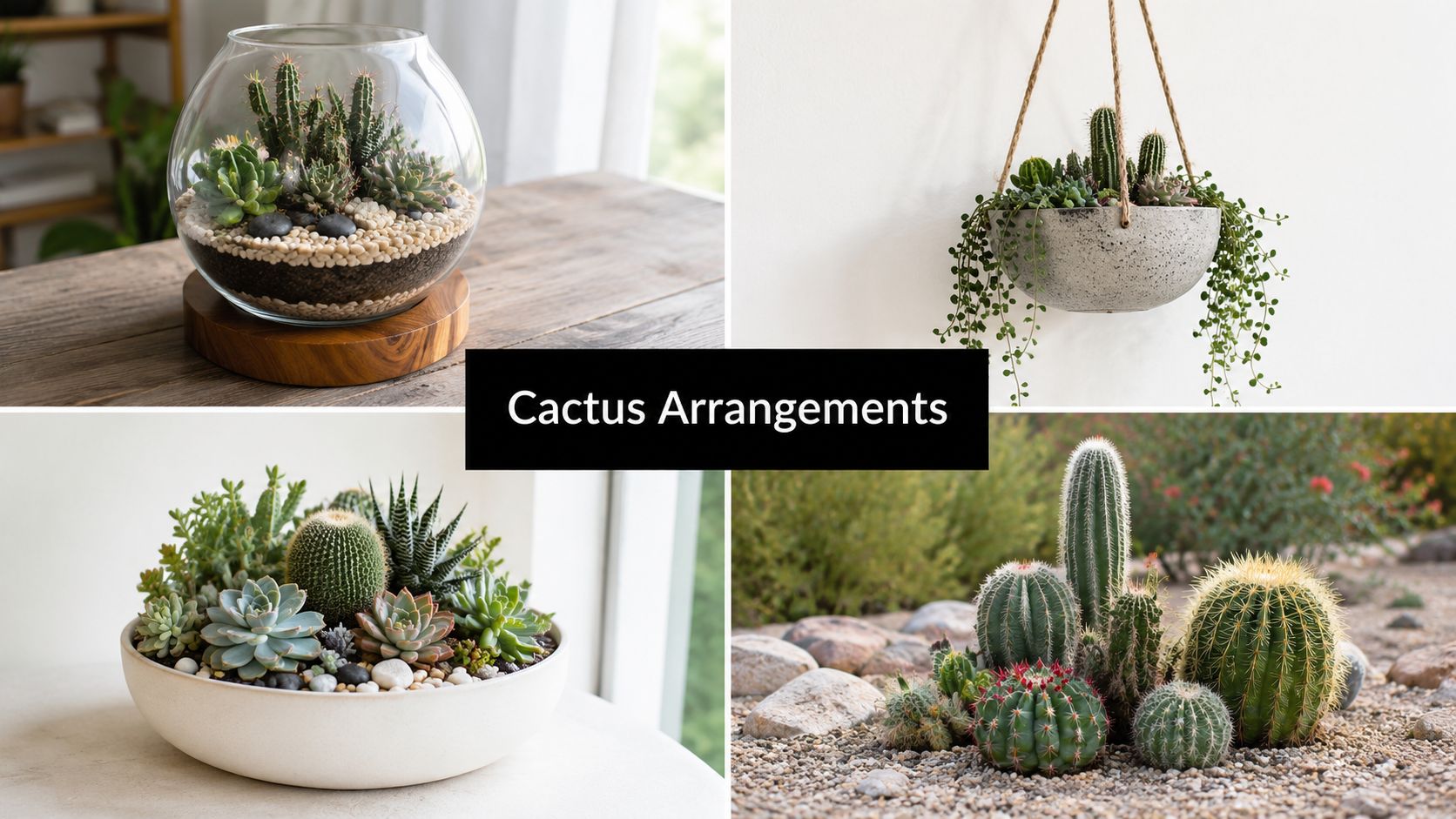

A blank side table, a patio corner that feels unfinished, a shelf that needs one strong sculptural element. That's usually where cactus arrangements start. You don't need a huge collection or a desert climate to make them work. You need a layout that fits your space, the right container, and plants that won't fight each other underground six months from now.
Cacti have become a bigger part of home decor because they bring shape, texture, and presence without asking for daily attention. The broader cactus market is projected to grow from $3.86 billion in 2021 to over $23.15 billion by 2033, with a projected CAGR of 16.1% between 2025 and 2033, and the United States is expected to account for nearly 40% of global share in 2025 according to this cactus plants market report. That lines up with what decorators and gardeners already know. People want plants that look bold and don't create a fussy care routine.
If you're updating a room, cacti pair especially well with wood, leather, stone, and clean-lined upholstery. If you're already working on a room refresh, it helps to complement your furniture with plants instead of treating greenery like an afterthought.
Here are eight cactus arrangement ideas that go beyond inspiration. Each one includes plant pairing suggestions, soil guidance, container advice, and setup details you can apply.
1. Desert Landscape Terrarium Arrangement
A desert terrarium works best when you treat it like a miniature composition, not a random bowl of cute plants. Use an open glass vessel, not a closed one. Cacti need airflow, and trapped humidity is one of the fastest ways to turn a sharp arrangement into a mushy one.
For the container, choose a wide glass bowl or low cylinder with enough opening space to place plants without scraping spines. A shape like the one shown in this glass terrarium bowl guide is easier to plant and maintain than a narrow-neck vessel.
Best plant pairing
Mix three forms, not five or six. That keeps the arrangement readable.
- Vertical accent: A small Fairy Castle cactus or a young columnar cactus
- Rounded contrast: A Golden Barrel type cactus in a smaller size
- Low textural edge: Haworthia or a compact Gasteria if you want a succulent companion with similar restraint
Use a cactus mix amended with extra pumice, perlite, or coarse sand. Skip the classic terrarium layering myth where pebbles at the bottom “fix” drainage. In a container without drainage holes, excess water still stays in the vessel. Effective protection is achieved by using a gritty mix and watering lightly.
How to build it
Start with a thin base of gravel for visual finish, then add your soil mix. Plant the tallest cactus slightly off-center, place the rounded specimen near it, and tuck the lowest grower toward the rim. Finish with top dressing like decomposed granite, small lava rock, or pale sand.
Practical rule: In cactus terrariums, empty space is part of the design. If every inch is planted, it already looks overgrown.
Place the bowl in bright indirect light or a very bright window with some gentle sun. Water only when the mix has gone dry well below the surface. For desk styling or apartment shelves, this is one of the strongest cactus arrangement ideas because it delivers a lot of presence in a compact footprint.
2. Mixed Height Statement Planter Grouping
This is the arrangement I recommend most often when someone wants impact without forcing incompatible plants into one pot. Grouping separate containers gives you the layered look of a planted composition, but each cactus keeps its own root space and watering rhythm.
Major retailers saw stronger demand for smaller, desk-friendly cactus and succulent arrangements starting in February 2024, and that compact-display category is estimated at about USD 1.2 billion in 2024 and projected to reach USD 2.5 billion by 2033, with a projected CAGR of 8.9%, according to this compact cactus arrangement market report. That trend makes sense indoors. Small and medium individual pots are easier to style, move, and maintain than one oversized mixed planter.

Strong combinations from The Cactus Outlet style of inventory
A reliable grouping uses one tall plant, one broad plant, and one to three smaller companions. Think in silhouettes.
- Tall anchor: Saguaro or Peruvian Apple cactus
- Mid-level architectural plant: Agave or Euphorbia with bold lines
- Low companions: small barrel cactus, Mammillaria, or compact Aloe
Keep pots related, not identical. Matte black, weathered terracotta, off-white ceramic, and cast concrete work well together. Matching everything can look sterile. Mixing every finish in the room can look accidental.
What works and what doesn't
What works is spacing pots so each plant keeps its outline. Use a bench, console, or low stand and vary height with risers or stacked books under saucers if needed.
What doesn't work is clustering plants so tightly that the spines overlap and airflow disappears. You also don't want every plant centered at the same height. Staggering is what gives this display its gallery feel.
Separate pots solve a lot of long-term problems before they start.
If you want a styling arrangement that still respects plant health, this is one of the most forgiving cactus arrangement ideas you can build.
3. Drought-Tolerant Garden Bed Integration
Outdoor beds need a different mindset. Indoors, you style around furniture and light. Outside, you style around drainage, exposure, and mature size. A cactus garden bed fails when it's planted like a flower border.
For a strong foundation, use one specimen cactus as the anchor. A Saguaro, Peruvian Apple cactus, or large Euphorbia can carry the whole bed. Around it, add lower drought-tolerant companions with clean forms, such as Agave, Aloe, or trailing ice plant where climate allows.
Setup that lasts
Start by checking drainage after irrigation or rain. If water sits, raise the bed or mound the planting area. Cacti don't want rich soil. They want mineral soil that sheds water fast. In many situations, adding coarse sand, pumice, or small gravel does more good than adding compost.
Use rock mulch instead of bark. Bark holds moisture near the crown and can make the bed feel visually heavy. Gravel, decomposed granite, or a mix of larger stone near specimen plants looks cleaner and suits the plant forms better.
For patios and backyards, this style also works well within a larger guide for North Georgia homeowners who want more structure in outdoor living areas.
A practical planting sequence
- Place the anchor first: Set the largest cactus where it can be seen from the main approach or seating area.
- Build the middle layer: Add Agave or Aloe in offset positions, not symmetrical pairs unless the property is very formal.
- Finish with ground plane materials: Use gravel, boulders, or low spreading drought-tolerant plants to connect the composition.
A good real-world version is a front-yard xeric bed where one columnar specimen rises behind a drift of agaves and a field of pale gravel. It reads clearly from the street and still looks composed when the rest of the garden is quiet.
4. Vertical Living Wall Succulent Display
Vertical displays look dramatic, but they're less forgiving than they appear in photos. They suit small cacti and succulent relatives with shallow root systems. They do not suit heavy specimen cacti or any plant you're going to neglect for long stretches.
Use a purpose-built modular wall system with drainage management behind it. Felt pockets can work in some settings, but rigid modular pockets usually make maintenance easier and give roots more stable support over time.
A finished wall can look like this when the plant spacing and silhouettes are handled well.

Best plants for this format
Choose compact plants that stay proportionate in shallow profiles.
- Good candidates: small Opuntia pads, compact Mammillaria, Haworthia, Gasteria, and small Aloes
- Use carefully: trailing succulents that can soften the edges
- Avoid: fast-growing plants that quickly swell out of pockets and distort the design
The biggest mistake is mixing growers with very different speed and root behavior. Long-term structural stability is where many mixed cactus displays break down. One analysis of recent content notes that most mixed arrangements lose cohesion within 3 to 6 months due to growth disparities and root conflicts, and only 12% of recent 2025 to 2026 content includes replacement protocols or modular solutions, according to this discussion of succulent and cactus arrangement stability.
Installation priorities
Waterproofing matters more than plant selection. If water has nowhere controlled to go, the wall behind the display will eventually tell you.
Use a shallow, fast-draining mix with added pumice. Give each plant enough space to be itself. A wall packed too tightly may look full on day one, but it becomes a maintenance problem fast.
If you want to see the general build style in motion, this video gives a helpful visual reference before you mock up your own layout.
5. Potted Specimen Cactus Solo Display
Some spaces need one plant, not a collection. A specimen display works when the cactus has enough character to hold attention on its own. That might be a branching Euphorbia, a mature Peruvian Apple cactus, a clean single-column cactus, or a sculptural Agave.
This style depends on proportion. The pot should support the plant visually without becoming the main event. If the container is louder than the cactus, the display starts feeling like decor inventory instead of a living focal point.

Pot and placement decisions
A solo display gets stronger when the pot shape echoes the plant form. Tall columnar cacti look good in simple cylinders. Broad agaves often sit better in low, heavier bowls. If you want a starting point for matching shape and material, this guide to the best pots for cactus is useful.
Use a gritty cactus mix and a pot with drainage. Set the plant where light supports its form. Near a bright south- or west-facing window is often ideal indoors, but acclimate slowly if the plant has been greenhouse-grown or shipped.
Why this arrangement works so well
A solo specimen gives the eye a place to rest. In minimalist rooms, that's often better than filling corners with several small plants.
A strong specimen cactus can do the job of a floor lamp, sculpture, and plant all at once.
Try this in an entry, beside a low media console, or at the end of a dining room sideboard. One good plant in the right container usually outperforms three average ones competing for attention.
6. Colorful Pot Medley Container Garden
If your space feels flat, use color in the containers instead of chasing unusual cactus colors. Glazed pots, painted planters, and warm clay tones can carry the personality while the plants provide form.
The trick is restraint. Pick a palette before you buy anything. Two or three main colors, plus one neutral, is usually enough. Cobalt, sand, white, and rust work beautifully together. So do olive, cream, and charcoal.
Building the medley
Use individual pots rather than one shared trough. That lets you group by care needs and shift the arrangement seasonally. A medley might include a blue-glazed pot with a Golden Barrel cactus, a terracotta pot with a clustering Mammillaria, a cream ceramic with a Haworthia, and a darker pot with a small Aloe.
Group them at different levels. A low stool, a step, or a narrow bench helps avoid the flat row-of-pots look. Keep some breathing room between containers so each color and shape registers clearly.
Trade-offs to know
This is one of the most flexible cactus arrangement ideas, but it can become cluttered fast. Too many pot finishes and the eye stops knowing where to land. Too many similarly sized plants and the arrangement feels accidental.
- Use repetition: Repeat one pot color at least twice so the grouping feels intentional.
- Balance matte and gloss: A fully glossy setup can look busy. A mix of glazed and raw materials feels better.
- Group by care rhythm: Keep thirstier succulent companions together and true cacti together when possible.
A colorful medley works especially well on porches, breakfast nooks, and sunrooms where playful styling feels welcome.
7. Minimalist Rock Garden or Xeriscape Bed
Minimalism with cacti isn't about doing less work. It's about editing harder. The best rock gardens use fewer plants than commonly expected, and they place each one where shadow, spacing, and stone all matter.
Choose two to four sculptural plants at most. A columnar cactus, a barrel form, and one dramatic Agave can be enough. Then shape the ground plane with gravel, larger rock, and empty space. The voids are what make the plants look important.
For composition ideas and material direction, this collection of DIY rock garden ideas is a good planning reference.
Layout principles that make it look designed
Set the main specimen off-center. Symmetry often feels too stiff in a xeric composition unless the architecture is formal. Use one or two larger rocks that look anchored in the site, not sprinkled on top as decoration.
Keep the gravel depth consistent and choose one dominant stone color. Mixing too many rock colors weakens the whole effect. If the cacti are blue-green or gray-green, pale gravel often looks calm and crisp. If the plants are deeper green, warmer desert tones can help.
In rock gardens, every extra plant has to earn its place.
A strong real-world example is a small front courtyard with one Peruvian Apple cactus, one Agave, two large boulders, and a field of decomposed granite. It feels finished because nothing unnecessary is competing with the main forms.
8. Tiered Shelf or Plant Stand Collector's Display
Collectors usually hit the same problem. The plants are good, but the display starts looking like storage. A tiered setup solves that when each shelf is arranged for visibility, airflow, and access.
Use a sturdy shelf or stepped plant stand near a bright window. Arrange the tallest plants on the top or back positions and the smallest in front. That sounds obvious, but many shelves fail because broad pots in front hide everything behind them.
For indoor styling, a dedicated stand can also help with stylish plant organization when you're trying to keep a growing collection contained.
A display formula that stays manageable
Try one category per level. Put columnar or upright forms on top, globular cacti in the middle, and small offsets or slow growers on the lower tier. This keeps the shelf from looking random.
Use saucers under every pot and leave space between specimens. Air movement matters more than people think indoors, especially on shelves near windows where heat can build during the day.
Shelf styling without crowding the plants
- Use one unifying element: similar saucers, repeating pot colors, or one material family
- Add only small accents: one stone, one small book, or one simple object is enough
- Rotate positions: if one shelf gets better light, swap plants periodically so growth stays balanced
This works particularly well for collectors with mixed The Cactus Outlet plants, such as small cacti, aloes, euphorbias, and agaves that need to be displayed individually rather than forced into one planter. It gives the collection structure without losing personality.
8-Way Cactus Arrangement Comparison
Choosing between eight cactus display styles gets easier once you compare them by effort, materials, and how they age in real conditions. Some setups look strong on day one but become harder to maintain as roots expand, light shifts, or irrigation habits slip. This side-by-side table helps you pick an arrangement that fits your space and your maintenance tolerance, not just your taste.
| Arrangement | Implementation Complexity 🔄 | Resource Requirements ⚡ | Expected Outcomes 📊 | Ideal Use Cases 💡 | Key Advantages ⭐ |
|---|---|---|---|---|---|
| Desert Landscape Terrarium Arrangement | Low. Simple layering and planting, but condensation and overcrowding need watching | Low. Glass vessel, gritty substrate, small cacti, minimal water | Attractive indoor focal point with limited root room and modest long-term growth 📊 | Small apartments, gifts, beginner plant owners 💡 | Compact footprint, low routine care, good way to combine several small species ⭐⭐⭐ |
| Mixed Height Statement Planter Grouping | Moderate. Pot selection, spacing, and visual balance take some editing | Medium. Multiple pots, varied specimens, risers or stands | Strong visual contrast with flexibility to swap plants as they mature 📊 | Entryways, living rooms, designers, galleries 💡 | Architectural impact, separate care by plant, easy to refresh over time ⭐⭐⭐⭐ |
| Drought-Tolerant Garden Bed Integration | High. Site grading, drainage correction, and long-range planning matter | High. Larger specimens, mineral soil amendments, possible irrigation work | Durable, water-saving garden with strong curb appeal and better long-term stability 📊 | Xeriscaping, public spaces, arid-region homes, outdoor design professionals 💡 | Lower water use, sustainable planting, room for mature specimens to develop properly ⭐⭐⭐⭐⭐ |
| Vertical Living Wall Succulent Display | High. Structural support, waterproofing, and irrigation setup require skill | High. Wall system, irrigation, lighting in some sites, installation materials | Dramatic planted wall with higher maintenance and quicker drying at root level 📊 | Urban apartments, commercial feature walls, hospitality spaces 💡 | Uses vertical space well, high visual impact, turns a blank wall into a planted feature ⭐⭐⭐⭐ |
| Potted Specimen Cactus Solo Display | Moderate. Success depends on choosing the right plant, pot, and placement | Medium–High. Premium specimen, larger container or pedestal, strong light | One clear focal point with slow growth and straightforward routine care 📊 | Luxury interiors, collectors, statement entryways 💡 | Sculptural presence, simple upkeep, lets one exceptional plant carry the display ⭐⭐⭐⭐⭐ |
| Colorful Pot Medley Container Garden | Moderate. Color control and scale matching matter more than people expect | Medium. Several containers, mixed finishes, varied plants | Lively, changeable display that stays flexible as plants outgrow their pots 📊 | Patios, balconies, eclectic interiors, creative gardeners 💡 | High personalization, modular maintenance, easy to expand one pot at a time ⭐⭐⭐⭐ |
| Minimalist Rock Garden or Xeriscape Bed | Moderate. Restraint, spacing, and rock placement determine whether it looks intentional | Medium. Stone, select specimens, grading materials, fast-draining soil | Quiet, gallery-like garden emphasizing plant form, texture, and negative space 📊 | Modern yards, minimalist enthusiasts, small contemporary outdoor spaces 💡 | Low maintenance, clean visual structure, strong focal clarity without crowding ⭐⭐⭐⭐ |
| Tiered Shelf or Plant Stand Collector's Display | Low–Moderate. Shelf spacing and plant placement are simple, but light management matters | Medium. Sturdy shelving, many small pots, optional grow lights | Organized collector display with good access for inspection, rotation, and care 📊 | Apartments, offices, collectors, retail displays 💡 | Efficient vertical use, easy maintenance access, shows individual specimens clearly ⭐⭐⭐⭐ |
A quick rule helps. Choose separate-pot formats if you want easier maintenance and room to adjust. Choose shared-planter or built-in formats if the visual statement matters more and you are prepared for stricter setup and upkeep.
Your Next Step to a Stunning Cactus Display
The best cactus arrangement ideas don't start with trends. They start with the space in front of you. A narrow console needs a different approach than a full patio bed. A bright office shelf wants something different than a warm courtyard wall. Once you match the arrangement style to the site, the rest gets much easier.
If you want the simplest win, start with a grouped set of separate pots or a solo specimen. Both are easier to maintain than a densely mixed planter, and both let you adjust the composition as your plants grow. If you want something more immersive, a terrarium, rock garden, or tiered collector's shelf can create a stronger design statement without demanding constant work.
The main trade-off is always the same. Arrangements that look lush on day one often become the hardest to keep healthy over time. That's why I favor designs that respect root space, mature size, and light exposure from the beginning. Separate containers, modular systems, and edited plant lists usually age better than crowded bowls packed for instant fullness.
Material choice matters just as much as plant choice. Terracotta dries faster. Glazed ceramic slows moisture loss. Concrete gives visual weight but can be heavy to move. Gravel top dressing sharpens the finished look and helps keep the plant crown cleaner than bark mulch. Small choices like these are what make a display look intentional instead of improvised.
If you're shopping for the plants themselves, The Cactus Outlet is one relevant place to explore because it carries a range of cactus and succulent types, including larger specimen plants and architectural varieties that suit statement arrangements. That's especially helpful when you already know the form you want, such as a columnar anchor, a broad agave, or a compact shelf plant.
Start with one arrangement that fits one real space in your home or garden. Build it well, leave room for the plants to grow, and let the shapes do the work. Cacti don't need much fuss. They need the right stage.
If you're ready to build your own display, browse The Cactus Outlet for specimen cacti, succulents, and care guidance that can help you choose plants for shelves, patios, rock gardens, and statement containers.