

You love the look of succulents. Then you look around your home and see a north-facing window, a dim apartment corner, or an office that never gets much sun. That's where a lot of people give up before they start.
I see this all the time. Someone assumes succulents are only for bright window sills and sun-blasted patios, so they skip them entirely. It's actually simpler and more encouraging. Some succulents struggle in low light, but others handle it far better than often expected.
The trick is choosing the right plant and adjusting your care to match the light you have, not the light you wish you had. If you've wondered whether indoor succulents are realistic in your space, this guide on whether succulents can grow indoors is a helpful companion to what you're about to learn.
Bringing Succulents Home to a Dimly Lit Space
A customer once described her apartment to me in one sentence: “It's bright enough for me to read, but not bright enough for Instagram plants.” That's a perfect low-light plant problem.
Initial impressions of succulents often come from online sources. The sight of crisp rosettes sitting in sunny windows, glowing in afternoon light, often leads to the thought, “Well, that rules me out.” But indoor plant success doesn't start with copying someone else's conditions. It starts with a realistic assessment of your own room.
What low light really means in daily life
Low light doesn't always mean dark. It often means:
- A room with no direct sun where the light is soft all day
- A spot several feet from a window instead of right on the sill
- An office with artificial light and little natural daylight
- A home with east- or north-facing exposure that never gets harsh afternoon sun
That kind of space can still support succulents. You just need the ones built for it.
The good news most beginners miss
Not every succulent wants the same thing. Some are sun-lovers that stay compact only in strong light. Others are much more forgiving and can stay attractive in gentler conditions. Those are the plants that make low-light growing possible.
A dim room doesn't mean you can't grow succulents. It means you need to match the plant to the room, then match the care to the plant.
That second part matters just as much as the first. In lower light, plants use water more slowly. That's why the care routine has to change. If you keep watering as if the plant were sitting in bright sun, trouble starts underground long before you notice it above the soil.
Understanding Why Most Succulents Crave Sun
Succulents store water, but they still run on light. The easiest way to think about it is this. Light is food for the plant. Water is important, but water alone can't power growth.
A succulent in strong light can make energy efficiently. A succulent in weak light has to stretch, slow down, and conserve. That's why two identical plants can behave very differently depending on where you place them.

Think of light as the plant's meal plan
Photosynthesis sounds technical, but the daily meaning is straightforward. The plant uses light to create the energy that supports firm leaves, compact shape, root activity, and new growth. Without enough light, it can stay alive for a while, but it won't grow well.
If you want a simple primer on how much light different indoor desert plants need, this guide on how much sunlight a cactus needs helps put things in perspective.
A simple way to understand foot-candles
You may see plant guides mention foot-candles. That's just a way to describe light intensity.
For low-light succulents, the key benchmark is that some can tolerate 50 to 100 foot-candles in indoor conditions, and low-light succulents often show darker green pigmentation because they carry higher chlorophyll concentrations to capture light more efficiently in spaces with only 3 to 4 hours of indirect sunlight, as explained by Retro Den's low and high light succulent guide.
You don't need to memorize the term. Just remember the principle. A plant beside a bright window gets more “food” than one on a bookshelf across the room.
What etiolation looks like
When a succulent doesn't get enough light, it often etiolates. That means it stretches toward the nearest light source.
You'll usually notice:
- Longer stems than normal
- Wider gaps between leaves
- A leaning shape toward the window
- Paler or weaker growth
Beginners often get confused, thinking the plant is “growing fast,” but it's really reaching desperately for more light. Healthy succulent growth is usually compact and balanced, not lanky.
Practical rule: If your succulent looks like it's climbing out of its pot to find the window, it isn't happy with the light it has.
The 7 Best Succulents for Low Light Conditions
Making the right plant choice simplifies your life. The best succulents for low light aren't the flashiest sun stress colors you see online. They're the ones that stay stable, attractive, and manageable indoors.
A quick note before the list. Two of the strongest low-light performers have clear documented benchmarks. Snake Plant tolerates light as low as 25 foot-candles and needs watering every 10 to 14 days in low light, while Haworthia thrives in 30 to 50 foot-candles and has been commercially grown for indoor decoration since the 1920s, according to aSucca4u's low-light succulent guide.
Quick Comparison of Low-Light Succulents
| Plant Name | Light Tolerance | Watering Frequency | Pet Safe? |
|---|---|---|---|
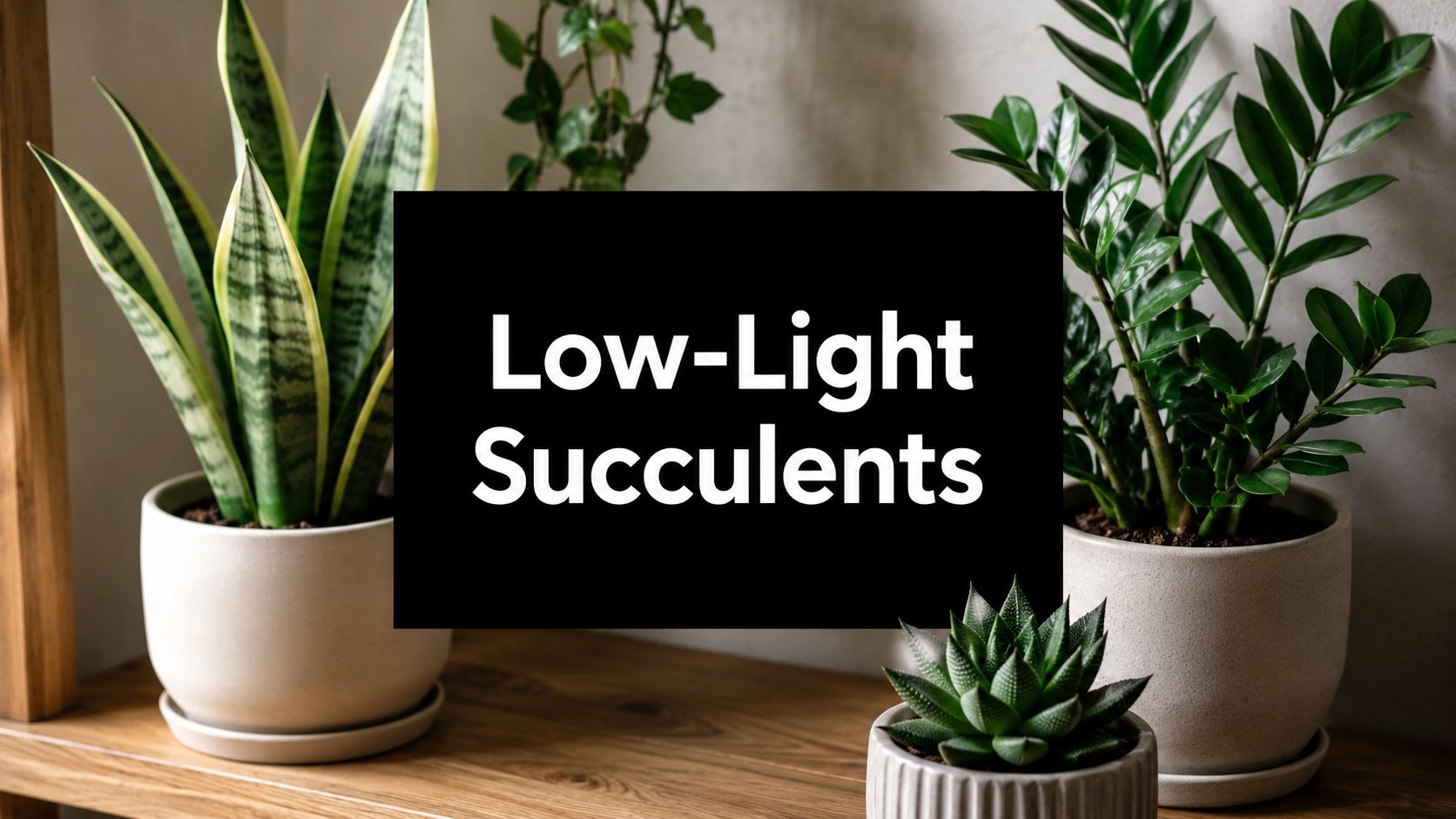
| Snake Plant | Very tolerant of low light | Every 10 to 14 days in low light | No |
| ZZ Plant | Tolerates dim indoor spaces well | Water only when fully dry | No |
| Haworthia | Strong low-light performer | Less often than weekly watering | Generally considered non-pet-safe to assume caution if unsure |
| Gasteria | Likes filtered or indirect light | Water only when soil is fully dry | Best to verify before placing around pets |
| Holiday Cactus | Prefers bright indirect light over hot direct sun | Water when the mix has dried appropriately | Best to verify before placing around pets |
| Rhipsalis | Adapts well to indirect indoor light | Let the potting mix dry between waterings | Best to verify before placing around pets |
| Panda Plant | Handles bright indirect light better than harsh low corners | Water sparingly after drying | No |
Snake Plant
Call this the nearly indestructible one.
Its upright sword-like leaves make it useful in homes where you need height without a fussy care routine. It's one of the few succulent-type houseplants that can handle very low light. That doesn't mean no light forever, but it does mean it stays presentable where many other succulents would collapse or stretch badly.
For beginners, the main danger isn't underwatering. It's overwatering because the plant looks so sturdy that people assume it can “take a little extra.”
ZZ Plant
This plant often surprises people because it doesn't look like a classic desert succulent. But it stores water in thick underground rhizomes and glossy stems, which is why it behaves like a drought-tolerant indoor workhorse.
I recommend ZZ Plant for offices, hallways, and rooms where you want a plant that still looks polished in average indoor light. It isn't a true rosette-style succulent, but in real homes it fills the same role. It tolerates low light well and asks for restraint with water.
Haworthia
This is the tidy desk plant.
Haworthia stays compact, often with striped or textured leaves that look decorative even when the plant is small. It's one of the safest choices if you want that classic succulent look without demanding direct sun. Because it handles lower light better than sun-hungry types, it's a favorite for apartment shelves and office desks.
Its size is part of the appeal. It fits where larger plants don't, and it usually tells you quickly if the conditions are working by staying firm and compact.
Gasteria
Gasteria has thick, arching leaves and often a speckled or mottled pattern. It's less commonly mentioned than Snake Plant or Haworthia, but it deserves more attention.
This plant suits people who want something sculptural without the need for a blazing window. It tends to be forgiving, especially when given filtered or indirect light and a dry-down period between waterings. If your room gets soft morning light instead of intense afternoon sun, Gasteria often settles in nicely.
Holiday Cactus
Holiday Cactus is a good reminder that not all succulents come from harsh desert settings. Its flattened segments and seasonal blooms make it look very different from the chunky, geometric succulents many people picture first.
For indoor growers, it's appealing because it prefers gentler light than many classic succulents. If you've got a bright room without direct scorching sun, this one often feels more natural there than a sun-hungry rosette would.
Some of the best low-light succulent choices don't look like desert icons at all. That's fine. The goal is a healthy plant in your actual home.
Rhipsalis
Rhipsalis has a softer, trailing habit. It looks casual, modern, and a little wild in the best way. If you like hanging planters or shelf edges with some movement, this is one to notice.
It handles indirect light well and doesn't demand the sharp brightness that many compact succulents prefer. I like it for readers who want a succulent with a less rigid look and a little more visual flow.
Panda Plant
Panda Plant is the wildcard in this group. Its fuzzy leaves and silvery texture are charming, but it's less tolerant of very dim corners than the strongest low-light performers above.
I still include it because many homes described as “low light” have bright indirect light, and Panda Plant can do well there. If your room is softly bright for much of the day, this plant can work. If the room is plainly dim, choose Snake Plant, Haworthia, or Gasteria first.
How to Adjust Your Care Routine for Dimmer Spaces
The biggest beginner mistake is simple. They buy a low-light succulent, then care for it like it's sitting in hot summer sun.
That's where plants get lost. In dimmer spaces, growth slows down. The soil stays wet longer. The roots take up water more slowly. When that extra moisture hangs around, root rot becomes the main threat.

Water less because the plant is spending less
A plant in strong light is active. A plant in low light is conservative.
That's why “water less” isn't just a rule. It's the logical response to a slower plant. Expert benchmarks note that even shade-tolerant succulents still need 2 to 3 hours of bright, indirect light daily, and to prevent root rot, the main cause of failure in low-light conditions, growers should use a well-draining succulent mix with pH 6.0 to 7.0 and let soil dry completely between waterings, according to this succulent care discussion on Reddit.
If you're unsure, wait another day or two and check again. A succulent forgives drought far more often than it forgives soggy roots.
Soil has to move water fast
Low light and dense potting soil are a bad combination. If the mix holds too much moisture, roots sit in a cold, wet pocket with little air. That's exactly what rot needs.
Use a gritty succulent or cactus mix that drains quickly. Drainage holes matter too. A decorative pot without one may look nice, but it removes your margin for error.
Fertilizer should be light or skipped
People often think fertilizer will “help” a struggling plant. In low light, it usually doesn't solve the actual problem.
If the plant isn't getting enough energy from light, feeding it heavily won't create healthy growth. It can push weak, stretched growth instead. In dim spaces, I'd rather see a plant grow slowly and stay firm than grow quickly and get soft.
In low light, success often comes from doing less. Less water, less feeding, less fussing.
Smart Placement and Simple Lighting Solutions
Placement can rescue a plant before any other care change does. A move of a few feet often matters more than a new pot or fertilizer.

Read the window before you read the plant tag
A bright east-facing window usually gives gentle morning light. A south-facing window is often strongest. West-facing windows can be intense later in the day. North-facing windows are usually the softest.
For low-light succulents, your best indoor spot is often:
- Near the brightest window you have
- Out of harsh all-day scorch if the plant prefers indirect light
- Close enough to benefit from the window, not stranded across the room
- Rotated weekly so growth stays even
Dust matters too. A dusty leaf catches less light. Wiping leaves occasionally is a small job that can make a noticeable difference over time.
Grow lights make more plants possible
Many guides stop at “buy only low-light species.” That's useful, but it leaves out a modern option that has changed indoor gardening for a lot of people.
From 2024 to 2025, renter-driven indoor gardening households using artificial light solutions increased by 37%, and low-wattage LED grow lights can substitute for 4 to 6 hours of natural light, which can make even traditionally high-light species like Echeveria more realistic indoors, as noted by Spider Farmer's indoor succulent lighting article.
That matters because it expands your choices. If your room is dim but you're willing to add a simple LED grow light, you don't have to limit yourself as much.
A short visual walk-through can help if you're new to this setup:
Keep the setup simple
You don't need a complicated plant lab. A clamp-on LED grow light with a suitable spectrum can turn an unusable corner into a workable plant spot.
Start with one shelf, one lamp, and one or two plants. Watch the growth. If the plant stays compact and balanced, you've likely solved the biggest issue.
Fixing Common Low Light Succulent Problems
When a low-light succulent struggles, it usually gives visible clues. The key is acting early, before a minor issue becomes a dead plant.

Leggy growth
What you see: stretched stems, wider leaf spacing, a plant leaning hard toward light.
What to do: move it closer to the brightest suitable window or add supplemental light. Turn the pot regularly so new growth develops more evenly. Don't expect stretched old growth to shrink back. The goal is healthier new growth.
Soft or mushy leaves
This is the warning sign many people miss because they assume soft leaves mean thirst. In low light, soft leaves often point the other direction. The roots may be staying too wet.
Try this checklist:
- Check the soil first and don't water automatically
- Remove the plant from the pot if the base feels weak or smells sour
- Trim any black, mushy roots with a clean tool
- Repot into dry, fast-draining mix before watering again
If a low-light succulent looks sick, check the roots before you blame the leaves.
Yellowing from the bottom or base rot
A few older bottom leaves aging out is normal. A collapsing base is not.
When the stem base darkens or turns mushy, act quickly. Unpot the plant. Inspect the root system and stem. If rot has moved upward, you may need to cut above the damaged area and reroot healthy tissue, depending on the plant type.
Pests on stressed plants
Mealybugs and similar pests often show up when a plant is already under stress. A weak, poorly lit, overwatered plant is easier for pests to take hold on than a firm, balanced one.
Look in leaf joints, at the crown, and near the soil line. Isolate the plant if you spot a problem so it doesn't spread. Then improve the growing conditions, because treatment works better when the plant isn't still struggling with light and moisture at the same time.
Buying Healthy Low Light Succulents Online
When you buy online, shop with your eyes first. Product photos can tell you a lot if you know what to look for.
Choose plants with compact growth, not stretched stems. Look for firm leaves, even color, and a shape that looks balanced instead of lopsided. If the soil in every product photo looks soaked, I'd be cautious. For most succulents, slightly dry is safer than wet during shipping.
A good online seller also matters. Strong packaging protects leaves and roots from damage in transit, and clear care information helps you match the plant to your home before you buy. If you're comparing shops, this guide on the best place to buy succulents can help you evaluate your options.
Buying healthy low-light succulents online isn't about chasing the rarest plant. It's about starting with a sturdy specimen that already shows the growth habits you want to maintain at home.
If you're ready to bring home low-light-friendly succulents or explore larger statement plants for brighter spaces, take a look at The Cactus Outlet. They offer a wide selection of cacti and succulents, detailed care information, and shipping designed to help plants arrive healthy and ready to settle into your space.