
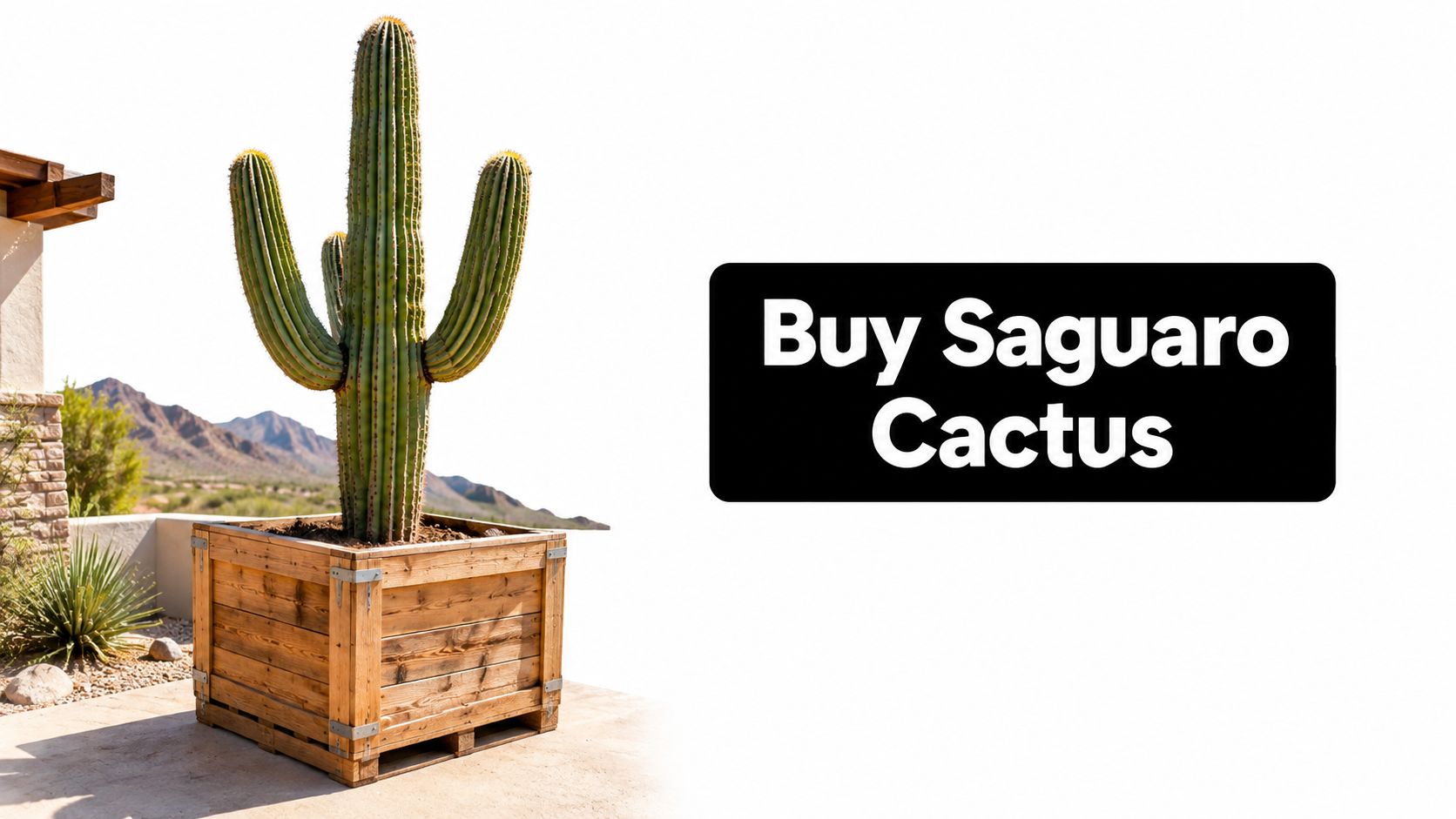

You've found the property, chosen the planting area, and decided that a saguaro is the statement piece your outdoor space needs. Then two practical questions stop the order: is it legal to ship this cactus to me, and will it arrive ready to establish?
Those questions matter more for a saguaro than for an ordinary nursery plant. This is a protected native species with an unusually slow growth profile, and a large specimen carries years of biological development, specialized handling, and transport complications. A responsible online purchase starts with the plant's origin, not just its height or silhouette.
The Cactus Outlet serves buyers looking for large cacti and desert plants delivered to homes, patios, commercial areas, and job sites. Whether you want a manageable container specimen or a dramatic feature, you should evaluate propagation, paperwork, size, climate, freight, and planting access before placing an order. The right saguaro is a long-term investment, not an impulse purchase.
Introduction to Buying a Saguaro Cactus Online Today
A homeowner searching to buy saguaro cactus online usually has a clear visual goal. They want a tall, unmistakably Sonoran Desert form beside an entry, pool, driveway, courtyard, or outdoor seating area. Online shopping makes that search possible even when a specialist nursery isn't nearby, but the purchase still requires more planning than adding a standard patio plant to a cart.
The first filter is lawful origin. Saguaros aren't listed as threatened or endangered, but they are protected, and moving, harming, or destroying native plants can require permits under state rules. Conservation sources also identify habitat loss, invasive buffelgrass, wildfire, and drought as threats, which makes documented provenance important for both the plant and the buyer. The Desert Museum's saguaro fact sheet is a useful starting point for understanding why legal sourcing matters.
The second filter is delivery condition. A large cactus isn't handled like a boxed houseplant. Its height, weight, spines, root condition, shape, and destination access all affect how a nursery prepares and transports it. A professional seller should be able to discuss the actual plant or size category, origin, paperwork, packaging approach, and the steps you'll take after delivery.

The purchase questions that deserve clear answers
Before you compare photos, ask:
- Where was the saguaro grown? Nursery-propagated stock is treated differently from a native specimen moved from its original site.
- What documents accompany the plant? A seller should explain applicable permits, tags, seals, and interstate certificates.
- What size fits the site? A dramatic specimen is only a good purchase if your property can receive, place, and establish it safely.
- What happens after delivery? Your planting location, drainage, sunlight, frost exposure, and handling plan should be ready before the truck arrives.
The rest of the buying decision becomes much easier once those questions are answered in order.
Why Saguaro Size and Age Drive Value and Availability
A saguaro's height represents time. The National Park Service reports that saguaros in Saguaro National Park typically grow only 1 to 1.5 inches during their first eight years, and branches usually don't appear until 50 to 70 years of age. At some low-precipitation sites, arms can take up to 100 years to form. See the National Park Service explanation of saguaro growth for the underlying growth profile.
That timeline changes how you should read an online listing. A mature, ready cactus isn't just a larger version of a fast-growing nursery crop. It represents decades of biological development, careful sourcing, and a more demanding move from seller to site. Buyers are paying for rarity, age, form, and transport complexity, not just for the amount of plant material.
Height is a commercial decision, not only a design decision
The National Park Service gives an average mature height of around 40 feet and describes a full-height timeline of roughly 200 years in its saguaro overview. Those figures explain why large online specimens can have limited availability and why a listing should be judged by more than its photograph.
A tall plant also creates more exposure to transplant stress. Replanting data cited by the National Park Service found 71% survival among replanted saguaros overall. Survival was 63% for cacti 12 feet and taller, compared with 75% for those up to 12 feet, according to the same source. The practical conclusion is direct: if you want a better establishment outlook and simpler logistics, choose a smaller, nursery-grown plant unless the site and installation plan justify a larger one.
How to compare listings intelligently
Use these questions while reviewing a product page:
- Is the size appropriate for the destination? A patio container, residential entry, and commercial site require different handling plans.
- Does the form justify the premium? Arms, branching, symmetry, and overall character affect visual value, but condition remains more important than drama.
- Can the seller explain the plant's origin? A vague description is a reason to pause.
- Does the delivery plan match the specimen? Tall, heavy, or unusually shaped cacti need more than ordinary parcel packaging.
For a deeper look at the species' juvenile growth and long-term development, review The Cactus Outlet's guide to saguaro cactus growth rate. The key buying principle is simple: buy the largest specimen your property, budget, and installation plan can support without forcing the plant into a risky move.
Legal Rules for Buying and Moving a Saguaro
Legal compliance is part of the product. Arizona law requires a permit, tag, and seal to move or salvage a native saguaro more than 4 feet tall from a location other than its original growing site. The statute also says that saguaros propagated by humans are exempt from that subsection. Read the Arizona statute on protected native plants before arranging a purchase involving native or salvaged stock.
That distinction gives online buyers a practical screening tool. Ask whether the plant is nursery-propagated or was moved from a native growing location. If it was salvaged or relocated, ask which agency issued the documentation, whether the tag and seal remain attached, and which party handles movement paperwork.
A buyer's compliance checklist
- Confirm the origin: Get a direct answer about propagation versus salvage. Don't accept “legally sourced” without an explanation of what that means for the specific plant.
- Request required documents: For a regulated native specimen, verify the applicable permit, tag, and seal before payment.
- Check the route: Arizona rules state that protected native plants leaving the state must bear a certificate of inspection issued by the department. Imported protected native plants entering Arizona have additional movement steps, including direct transport to a department field office for a movement permit and seals.
- Check destination rules: Federal guidance warns against shipping plants from quarantined areas, so “we ship nationwide” isn't a complete compliance answer.
- Keep the paperwork: Save the invoice, origin information, permits, tags, seals, and inspection documentation with your records.
Arizona agriculture guidance lists a $7 permit fee and $8 tag fee for each saguaro, although the responsible party and applicable process should be confirmed with the relevant department before purchase. The guidance also states that plants can't be removed from land without the owner's permission and a Department of Agriculture permit. Review the Arizona agriculture fee and permit information for those mechanics.
Practical rule: If the seller won't explain the plant's legal origin and transport documents before you order, choose another seller.
Moving a cactus also demands a physical plan. The handling principles in this resource on moving a tree on the Central Coast apply broadly to route planning, clearance, equipment, and protecting the root zone, even though a saguaro requires cactus-specific packing and safety procedures.
Choosing the Right Saguaro Size for Your Space and Goals
The best saguaro size depends on what you want the plant to do. A small specimen can anchor a container collection or patio without dominating the space. A medium plant creates a stronger entry statement, while a large mature cactus can function as a focal point or privacy-screen accent, provided the property can receive and plant it safely.
Size also changes establishment risk. The National Park Service survival figures cited earlier favor smaller replanted specimens, especially when compared with cacti 12 feet and taller. That doesn't make every large plant a poor choice. It means height should be treated as a biological and logistics decision, not just a visual upgrade.
| Size Range | Best Use Case | Shipping and Handling Note | Establishment Outlook |
|---|---|---|---|
| Smaller, container-manageable specimen | Patio, container display, compact courtyard, collector setting | Simplest category to position and protect, but confirm the seller's actual packaging and delivery method | More forgiving choice when the site and acclimation plan are sound |
| Medium landscape specimen | Entry statement, driveway edge, residential desert garden | Requires careful unloading and a clear route from delivery point to planting area | Balanced option for buyers seeking impact without the highest handling burden |
| Large or mature specimen | Commercial focal point, expansive landscape, architectural installation | Expect more complex freight coordination, clearance planning, and professional handling | Greater transplant exposure, especially as height increases |
| Branched or arm-bearing specimen | High-impact visual centerpiece | Irregular shape makes bracing, wrapping, and orientation more demanding | Select only when the seller can document condition and the site supports careful installation |
Match the plant to the destination
For a patio or container, prioritize manageable dimensions, stable placement, drainage, and the ability to move the plant away from dangerous frost. For an in-ground planting, evaluate the planting zone, sun exposure, drainage, irrigation pattern, overhead clearance, gate width, and truck access before choosing a larger specimen.
A privacy-screen role needs more than height. Consider the saguaro's eventual silhouette, nearby paths, sightlines, and whether its spines create a conflict with circulation. An entry planting should be visible without forcing visitors or delivery crews into a tight route.
Buy for the site you have, not the photograph you saved.
If you're comparing a saguaro with other large desert plants, browse the relevant large cactus collection and compare columnar form, mature scale, placement, and climate fit. Don't assume that another columnar cactus has the same legal status or cold tolerance. Each product page should supply the facts you need before you decide.
How Reputable Nurseries Source Pack and Ship Large Saguaros
A serious online nursery treats shipping as part of horticulture. The process begins with lawful stock and continues through inspection, preparation, protection, bracing, freight coordination, and delivery instructions. A seller that only shows a dramatic image and a low price hasn't answered the questions that matter most.
Nursery-propagated stock is usually the cleaner purchase path because the origin can be explained without presenting the buyer with a wild-removal story. For native or salvaged plants, documentation has to follow the specimen and the shipment. Out-of-state movement may require inspection certificates and destination-specific compliance, as outlined in Arizona's protected-plant rules.

What happens before the crate closes
A dependable packing workflow should account for both plant health and physical movement:
- Selection: The nursery confirms the specimen, its dimensions, shape, condition, and legal origin.
- Inspection: Staff examine the plant and root area for damage or weakness before it leaves the growing site.
- Preparation: The root zone is prepared for transport in a way that avoids unnecessary moisture and movement.
- Protection: Padded, breathable material protects skin and spines from abrasion without trapping damaging moisture.
- Bracing: Tall or irregular plants need secure support so the specimen doesn't shift during freight handling.
Packaging should match the plant. A compact cactus may need a different shipping solution from a tall arm-bearing specimen. The seller should tell you whether delivery is parcel or freight, what tracking information you'll receive, whether the plant must remain upright, and what you should inspect before signing for it.
Vet the seller before you buy
Look for a product description that identifies the species and provides meaningful size information. Ask for current photos when the listing represents an individual specimen rather than a general size category. Review customer feedback for comments about packaging, communication, plant condition, and delivery resolution.
Red flags include:
- No origin explanation: The seller uses broad ethical language but won't say whether stock is propagated or salvaged.
- No paperwork discussion: They can't identify which permits, tags, seals, or inspection certificates apply.
- Unrealistic shipping promises: They offer a single generic shipping claim for every size and destination.
- Suspicious pricing: A price that ignores age, handling, freight, and documentation deserves scrutiny.
- No delivery instructions: The buyer receives no guidance for unloading, inspection, acclimation, or planting.
For a closer look at the physical process, read The Cactus Outlet's guide to how large cactus plants are shipped. The standard you want is transparency. A trustworthy nursery won't treat freight details as a secret.
Costs Permits and What to Expect After Delivery
The delivered cost combines more than the plant price. Age, size, form, paperwork, inspection, packing, freight, and site access all influence the final commitment. A small container purchase and a large outdoor installation belong in different budget categories, even when both are sold as saguaros.
Permit mechanics can also affect timing and responsibility. Arizona agriculture guidance identifies a $7 permit fee and $8 tag fee for each saguaro, while the applicable process depends on the plant's origin and movement route. Confirm current requirements and ask the seller which documents are included, which party files them, and whether destination rules add another step.
For a broader budgeting framework, review The Cactus Outlet's guide to how much a saguaro cactus costs. When freight is quoted separately, compare the complete delivered service rather than comparing a plant-only price with a delivered price. Buyers who are comparing freight options may also find this guide to compare auto shipping costs useful for understanding why distance, equipment, route, and handling affect transport quotes, although a cactus shipment requires plant-specific planning.
Prepare before the delivery appointment
Have the route from the delivery point to the planting area clear. Measure gates and access points, remove obstacles, confirm overhead clearance, and decide who will handle unloading. Don't improvise with a tall, spined specimen after it arrives.
Your climate is the next filter. Saguaro is widely listed for USDA hardiness zones 8–11, and one horticultural reference gives a tolerance benchmark down to 23°F, or -5°C. Check the saguaro hardiness information from Gardenia, then treat that figure as a planning threshold rather than a promise that every site exposure will be safe.
Unbox and establish deliberately
Inspect the cactus for movement damage before removing protective materials. Keep the plant stable, use fast-draining soil, and avoid immediate heavy watering if roots or planting conditions require recovery. Introduce intense sun according to the seller's guidance, especially if the plant has been grown under protected conditions.
For containers, choose a stable vessel with excellent drainage and enough weight for the plant's form. For in-ground planting, choose a sunny site that doesn't sit in irrigation runoff or collect water. Early care should emphasize stability, drainage, measured acclimation, and restraint with water.
Bringing Your Saguaro Home With Confidence
A successful online saguaro purchase follows a clear order. Start with lawful origin and documentation, then choose a size that fits the intended space and the delivery route. After that, evaluate the seller's inspection and packing process, confirm the climate fit, and prepare the planting or container site before shipment.
The strongest choice for most buyers is nursery-propagated stock with a clear description, dependable documentation, and a delivery plan suited to the specimen. Large mature plants can create immediate impact, but smaller saguaros often offer a more manageable path when establishment, access, and freight risk matter.
The Cactus Outlet provides an online route for buyers shopping for saguaro cactus and other large desert plants, including agaves, aloes, euphorbias, and succulents. Before ordering, contact support with your destination, intended use, desired scale, access conditions, and questions about origin and shipment documentation.
Browse The Cactus Outlet to review saguaro and large-cactus options for patio containers, residential gardens, and commercial planting plans. Choose your target size, confirm the legal and delivery details with the nursery, and prepare the site before your cactus leaves the growing area.