
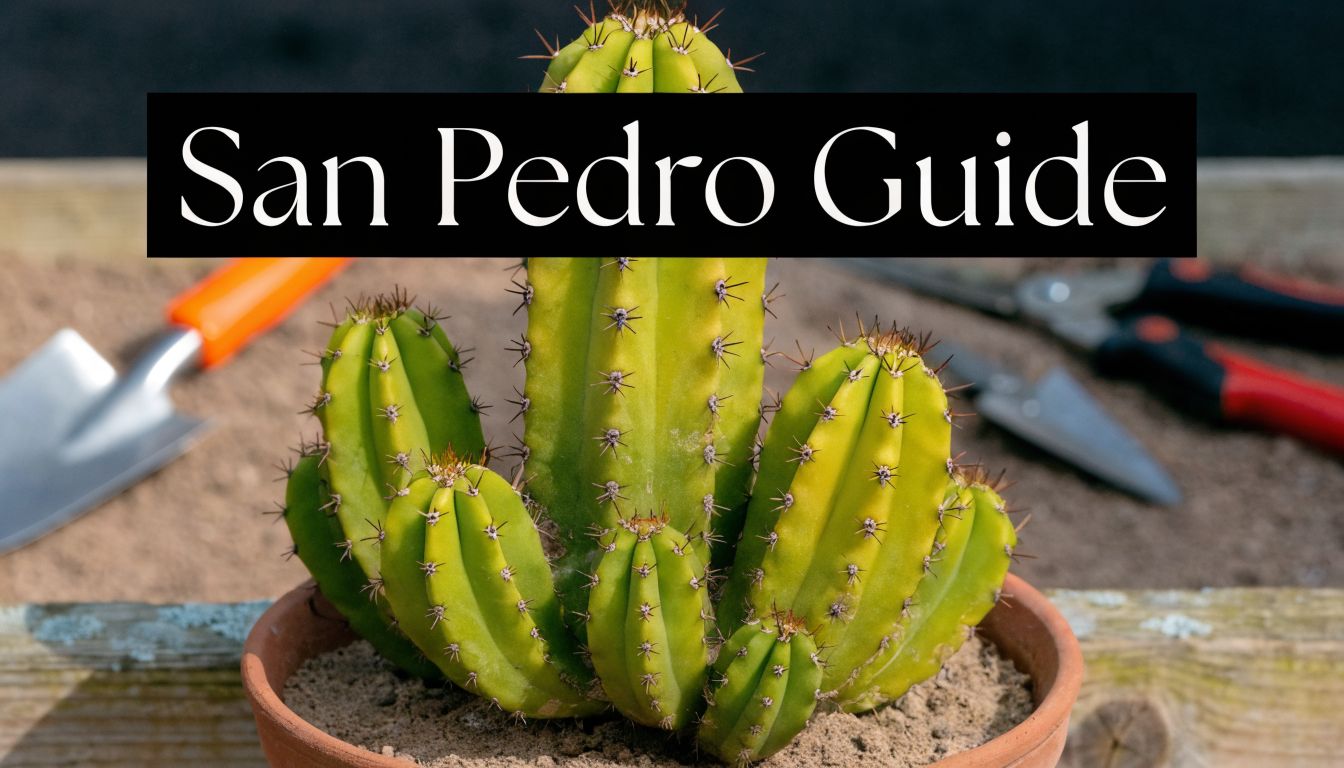

You’ve just brought home a tall green column, or you’re staring at a plant listing and wondering if this is the right cactus for your courtyard, patio, or collection. The tag says San Pedro, the stem looks clean and ribbed, and the plant seems almost too elegant to be a cactus.
That reaction is common. San pedro cactus trichocereus pachanoi has a way of pulling people in because it looks architectural without looking harsh. It can feel approachable for a beginner and still stay interesting for a serious collector.
Most confusion starts in the same places. People aren't sure how to identify true Trichocereus pachanoi. They don't know whether to treat it like a desert cactus or a mountain cactus. They also don't know why one San Pedro in a nursery looks smooth and symmetrical while another looks more irregular and wild.
A good grower solves those questions in the right order. First, learn what the plant is. Then learn how it grows. Then build the conditions that let it stay thick, firm, and balanced for years.
Your Introduction to the Majestic San Pedro Cactus
San Pedro often enters a person’s life subtly. You see one in a dry garden, standing above agaves and gravel like a green pillar, and it stays in your mind. Later, you spot another in a pot by a sunny wall, and suddenly you start noticing the ribs, the soft green skin, the way it catches early light.
That’s part of its charm. This isn’t a fussy plant with flashy variegation or dramatic thorns. It has presence because its form is strong and calm.
As a horticulturist, I usually tell beginners to think of San Pedro as a living column. If a barrel cactus is a stone bowl and an aloe is a fountain, San Pedro is a pillar. Once you see it that way, a lot of care decisions become simpler. You stop asking, “How often do cacti get watered?” and start asking, “What does this fast-growing column need to stay sturdy?”
That shift matters.
San Pedro also rewards attention. It tells you when the light is too weak. It tells you when the soil stays wet too long. It tells you, often by its shape alone, whether you’re growing a strong specimen or a stretched one.
Practical rule: Grow San Pedro for form first. A thick, balanced column is the clearest sign that your care is working.
If you’re new to this plant, don’t worry about mastering everything at once. Start by learning its story, then its features, then its care rhythm. Once those pieces click, San Pedro stops feeling mysterious and starts feeling readable.
The Enduring Legacy of the San Pedro Cactus
San Pedro is old in a way few cultivated plants are. Long before it became a collector’s plant or an ornamental column in modern dry gardens, people in the Andes knew it well.
Archaeological evidence places its use at 6800-6200 BCE, with fossil remains discovered in the Guitarrero cave of the Callejón de Huaylas valley in Peru, making it among the oldest ancestral psychoactive plants known to humanity, according to ICEERS’ San Pedro background.

That history changes how many growers relate to the plant. You aren’t looking at a novelty item. You’re looking at a species that has moved through thousands of years of human attention, cultivation, ceremony, and memory.
A cactus shaped by place and time
San Pedro’s homeland helps explain its character. It comes from the Andes, where light is strong, temperatures can swing, and drainage matters. Plants from those conditions often develop a kind of rugged refinement. They’re resilient, but they don’t look coarse.
That’s exactly what many gardeners notice first. San Pedro looks strong without looking brutal.
Its history also continued through colonial times, when Spanish writers documented Indigenous use of the cactus. The cultural thread didn’t vanish. It endured.
Why that legacy matters to growers
For modern gardeners, history isn’t just background information. It helps you grow the plant with more respect and more accuracy.
If you know San Pedro has a long Andean lineage, you stop treating it like a generic “desert cactus.” You start understanding why it appreciates a thoughtful setup, why identification matters, and why its name carries weight.
In 2022, the Peruvian Ministry of Culture formally declared the traditional use of San Pedro cactus in northern Peru as cultural heritage, as noted in the same ICEERS reference. That recognition matters because it affirms what growers and cultural historians already understood. This cactus has deep meaning beyond ornament.
A living tradition in a modern garden
Today, many people first meet San Pedro in a nursery, online listing, or collector’s greenhouse. That modern route is different, but the plant still carries its older story with it.
I like to tell customers this: if you’re going to grow a plant with this much history, learn its name properly, observe it carefully, and care for it with patience. That’s part of good horticulture.
A plant can be ornamental and culturally significant at the same time. San Pedro is both.
Identifying Authentic Trichocereus Pachanoi
Many buyers frequently get stuck. They see “San Pedro” on a label and assume the question is settled. It usually isn’t.
In nursery trade, collector circles, and online listings, the name gets used loosely. If you want to buy carefully, you need to train your eye to read the stem the way a grower does.

Start with the overall look
A healthy Trichocereus pachanoi usually presents as an upright column with a relatively calm surface. The stems are green to bluish green, the ribs are broad enough to read clearly, and the spines are often short rather than dramatic.
When people get confused, they often focus on one trait alone. That’s a mistake. Identification works best when you look at the whole package together.
Look for these clues:
- Rib structure: San Pedro usually shows a tidy column with pronounced ribs rather than a cluttered or chaotic surface.
- Stem color: Many specimens have a soft green or glaucous cast instead of a very glossy finish.
- Spination: Spines are often modest. Some cultivated plants appear nearly spineless at a glance.
- Areole spacing: Areoles generally have some visual breathing room instead of being tightly crowded.
The PC and non-PC question
The biggest point of confusion is the difference between PC Pachanoi and non-PC, or wild-type, Pachanoi.
According to Sacred Buttons’ guide on key features for identifying the San Pedro cactus, true San Pedro often features distinct “eyebrows” or V-shaped notches above upward-pointing areoles and a wavier, less uniform rib profile, while PC Pachanoi typically has a smoother texture and a more symmetrical sawtooth rib profile.
That sounds technical, so let’s make it visual in plain language.
A non-PC plant often looks like a hand-built clay column. The ribs can feel a little uneven, a little more organic, and the notches above the areoles stand out more clearly.
A PC plant often looks more manufactured in outline. The ribs tend to repeat in a neater pattern, and the plant reads as smoother and more symmetrical.
PC vs. Non-PC San Pedro Identification
| Feature | PC (Predominant Cultivar) Pachanoi | Non-PC (Wild-Type) Pachanoi |
|---|---|---|
| Rib profile | More symmetrical, sawtooth look | Wavier, less uniform |
| Texture | Smoother overall | More varied and organic |
| Areole area | Less pronounced notch effect | Often shows clearer “eyebrows” or V-shaped notches |
| General impression | Clean, regular, landscape-friendly | Characterful, less standardized |
| Buyer appeal | Common in nurseries and landscaping | Often sought by collectors for authenticity traits |
Why PC is so common
PC dominates many nurseries for a simple reason. It grows well, looks orderly, and works nicely in outdoor settings. For a contractor or homeowner who wants a reliable columnar cactus, that regularity can be a benefit.
For a collector, though, common availability creates a different problem. People buy “San Pedro” without realizing they may be buying the predominant cultivar rather than a plant that shows more classic wild-type traits.
That doesn’t make PC bad. It just means you should know which plant you’re choosing and why.
If you can’t decide whether a specimen is PC or non-PC, don’t judge by one photo. Check the rib profile, the areoles, the texture, and the plant’s overall symmetry.
Practical buying habits that help
When you inspect a plant in person or through listing photos, ask yourself these questions:
- Do the ribs look smooth and highly regular, or more wavy and natural?
- Can I see the notch or “eyebrow” effect above the areoles?
- Does the plant look like a mass-market form, or something less standardized?
- Am I buying for ornamental planting, collecting, or both?
Young plants can be harder to read. That’s normal. Immature stems may not show all the traits as clearly as a larger, established specimen.
For that reason, patience helps. If a listing only shows a cropped top section or blurry side shot, ask for clearer stem photos. Good identification starts with good visibility.
A note on names
You’ll see both Trichocereus pachanoi and Echinopsis pachanoi used for the same plant. Many growers still prefer the older Trichocereus name in everyday practice.
That name difference is less important than the actual plant in front of you. The bigger issue is whether the specimen is being represented accurately.
Creating the Ideal Habitat for Your San Pedro
Good San Pedro care starts before the first watering can comes out. If the soil, pot, and light are wrong, the rest of your effort becomes damage control.
I like to compare setup to building a house foundation. If the foundation drains badly and gets poor sun, the structure above it won’t look right no matter how much you decorate.

Soil that behaves like mountain ground
San Pedro wants drainage, but not the kind of lifeless, dusty mix people sometimes imagine for every cactus. Think gritty and airy, not dense and swampy.
Heavy, water-retentive potting soil acts like a wet sponge around the roots. A better mix acts more like a coarse colander. Water moves through, air returns, and the roots can breathe.
For a deeper look at ingredients and drainage logic, this guide to cactus and succulent soil mix is useful if you’re building or choosing a blend.
A simple way to think about it:
- Bad mix: Mostly rich organic material that stays wet for too long
- Better mix: Mineral-heavy, fast-draining, and stable around the roots
- Best mindset: Build for drainage first, then adjust watering to match the season
Picking the right container
Pot choice matters more than many beginners expect. A tall column in a poorly drained decorative pot is asking for trouble.
Terracotta is often helpful because the pot walls breathe. That means excess moisture can leave the root zone more readily than it can in many sealed containers.
Look for:
- Drainage holes: Non-negotiable
- A stable base: San Pedro becomes top-heavy with time
- Enough room, not endless room: Too much extra soil can stay wet too long
If you’re planting in the ground, create the same effect with site choice. Avoid low spots where water lingers after rain or irrigation.
Light that builds a strong column
San Pedro likes bright conditions, but strong light and careless exposure are not the same thing. A sheltered plant moved suddenly into harsh sun can scar.
The goal is steady, appropriate light that keeps new growth thick. When light is too weak, the tip narrows and stretches. Once that happens, the thin section won’t bulk back up.
Watch the plant, not just the label:
| Sign | What it usually means |
|---|---|
| Thick, balanced new growth | Light levels are likely working |
| Narrow, stretched tip | Light is too weak |
| Bleached or scorched patches | Exposure changed too fast or sun is too harsh |
A plant grown indoors or under shade should be hardened off gradually before full outdoor sun.
Here’s a visual walkthrough that helps new growers see how placement and setup affect columnar cactus care:
Outdoor growing and cold weather
San Pedro surprises many people with its cold tolerance. Because of its Andean origins at 2,000–3,000 m, it can withstand brief exposure down to -7°C (20°F) if the soil is kept dry, and the mucilage in its cells acts as a natural antifreeze, according to Gardenia’s Trichocereus pachanoi profile.
The part beginners miss is the second half of that fact. Wet cold is the main danger. Prolonged cold combined with moisture can trigger rot because ice crystals can form and rupture cell walls.
Dry cold is far less risky than wet cold. If you remember one winter rule, remember that one.
Habitat checklist before you plant
Before you settle a San Pedro into its permanent spot, pause and check the basics.
- Drainage first: Water must leave the root zone quickly.
- Light second: Give the plant enough brightness to hold thick growth.
- Airflow matters: Stagnant, cramped corners stay damp longer.
- Winter exposure: If your climate gets cold, protect the plant from wet, chilly conditions more than from cool air alone.
When those pieces are right, San Pedro becomes much easier to grow. Most serious problems start in a bad setup, not in a missed feeding.
A Guide to Watering and Feeding Your Cactus
The biggest watering mistake with San Pedro comes from a half-true idea. People hear “cactus” and assume the plant wants tiny sips and long neglect. San Pedro doesn’t fit that pattern well.
This species is a rapidly growing columnar cactus capable of growing several feet in a single year under optimal conditions, and the tallest recorded specimen reached 12.2 meters (40 feet), according to NAISMA’s overview of Echinopsis pachanoi. Fast growth takes fuel.
How to water without guessing
Think in terms of a soak and dry rhythm. When the plant is actively growing, it usually responds better to a full watering followed by a meaningful dry period than to frequent shallow drinks.
Shallow watering creates a lazy root zone. The top inch gets damp, the deeper mix stays inconsistent, and the plant never settles into a strong rooting pattern.
I tell beginners to use three simple checks:
- Lift the pot: A dry pot feels noticeably lighter than a recently watered one.
- Touch below the surface: The top can look dry while the lower mix is still moist.
- Watch the ribs: Mild draw-in can suggest thirst, but soft tissue points to a different problem.
Seasonal rhythm matters
San Pedro doesn’t want the same treatment all year.
During active growth, water more generously. During cool or low-light periods, slow down. In winter, especially if the plant is resting, the safest approach is restraint.
A simple comparison helps:
| Season or condition | Watering approach |
|---|---|
| Warm, bright, active growth | Deep watering, then let the mix dry well |
| Cool weather | Reduce frequency |
| Newly rooted cutting | Start cautiously until roots are active |
| Winter rest | Keep much drier |
Signs you’re overdoing it or underdoing it
Overwatering and underwatering can both change a cactus’s appearance, but they don’t feel the same.
A thirsty San Pedro may look slightly drawn between the ribs while staying firm. An overwatered or rotting cactus often softens, especially low on the stem.
Look for contrasts:
- Thirst: Firm plant, slight shrinkage, recovery after watering
- Excess moisture: Softness, discoloration near the base, lingering damp soil
- Weak-light problem mistaken for water issue: Thin top growth rather than a hydration signal
A San Pedro with healthy roots can handle thirst better than stagnation. Wet soil is harder to forgive than a short dry spell.
Feeding for structure, not speed alone
Fertilizer shouldn’t be used like a booster rocket. It should support steady, attractive growth.
San Pedro benefits from sensible feeding during active growth, especially in containers where nutrients don’t renew themselves naturally. Many growers use a balanced or low-nitrogen cactus fertilizer and apply it lightly rather than heavily.
What matters most is timing and moderation:
- Feed when the plant is actively growing.
- Don’t fertilize a plant sitting in cold, wet soil.
- Don’t feed a stressed plant just because it looks pale.
- Water appropriately first, then feed on a normal growing schedule.
If a container plant begins to lose rich green color during the growing season, nutrition may be part of the issue. But always check the roots, drainage, and light before assuming fertilizer is the fix.
Expanding Your Collection and Managing Pests
One reason people stick with San Pedro is that it’s satisfying to multiply. A healthy plant can become several over time, and propagation feels less like a gamble than it does with fussier species.
At the same time, expanding a collection means learning how to spot trouble early. A good grower doesn’t wait for a cactus to collapse before paying attention.

Propagation from cuttings
San Pedro is well suited to propagation from cuttings. The basic idea is simple. Make a clean cut, let the wound dry and callous, then root the cutting in a suitable mix.
If you want a more detailed walkthrough, this guide on how to propagate cactus from cuttings covers the process step by step.
The biggest mistake is rushing the callousing stage. Freshly cut tissue planted into moisture is vulnerable to rot.
Keep the sequence clear:
- Choose healthy material. Avoid damaged or soft sections.
- Use a clean blade. A neat cut heals better than a ragged one.
- Let the end callous fully. Patience matters here.
- Plant in a gritty mix. Stability and drainage help.
- Hold back on heavy watering at first. Let roots start before treating it like an established plant.
What successful rooting looks like
Rooting is often subtle. You usually won’t get dramatic above-ground fireworks right away.
Instead, watch for small signs:
- the cutting stands more firmly in the pot
- the color stays steady
- the tip begins to show normal growth again
If the base softens or darkens, inspect it promptly. That usually points to trouble at the wound or in the rooting environment.
Common pests and simple responses
Most San Pedro pest issues can be managed with observation and quick action. The usual culprits are mealybugs, scale, and occasionally mites.
Check the plant where pests like to hide:
- Along rib creases
- Around areoles
- Near the growing tip
- At the base, where airflow is weaker
For light infestations, many growers start with physical removal. A cotton swab with isopropyl alcohol is a common first response for mealybugs and scale on small collections.
Rot is still the main enemy
Pests annoy. Rot destroys.
That’s why nearly every serious San Pedro care conversation circles back to the same principles: drainage, airflow, and appropriate watering. A scarred cactus can recover visually enough to remain attractive. A rotting base is a structural problem.
Check the newest growth for pests, and check the base for moisture trouble. Those two places tell you a lot.
If you manage a few plants this way each week, you’ll catch most issues while they’re still small.
Buying San Pedro Cacti Online with Confidence
Buying online gets much easier once you know what to look for. Instead of shopping by name alone, shop by condition, form, and clarity.
Start with the listing photos. You should be able to see the stem well enough to judge rib shape, color, and overall health. Blurry distance shots don’t tell you much.
What a healthy shipped plant should show
When a San Pedro arrives, inspect it before you get distracted by potting plans.
A good specimen should generally have:
- Firm tissue: Not soft or collapsing
- Good color: Healthy green rather than widespread dullness
- No suspicious wet spots: Especially near the base or damaged areas
- A believable form: Thick enough for its age and light history
Minor cosmetic marks from handling can happen with columnar cacti. Softness is a different matter.
Why PC can be a smart purchase
For many home gardeners and buyers for outdoor settings, PC San Pedro is a practical choice. The Predominant Cultivar is prized for superior cultivation performance, roots from cuttings in 4-6 weeks, and mature plants can grow 1-2 feet per year, according to San Pedro Source’s explanation of PC Trichocereus.
That combination makes it especially useful for buyers who want a resilient ornamental column that settles in readily.
PC also has a strong tendency to produce multiple offsets from the base, which appeals to growers who like clumping forms or want future propagation options.
Shop like a grower, not just a browser
Before you buy, ask:
- Is this rooted stock or a cutting?
- Do the photos clearly show the stem?
- Does the form match my goal, collector plant or outdoor display plant?
- Does the seller state what cultivar or type it is?
If you want to compare available plants, San Pedro cactus plants for sale is one example of a resource that shows current options and care context in one place.
Once the plant arrives, don’t rush it into extreme sun or heavy watering. Let it settle, inspect it, and acclimate it to your conditions.
Your San Pedro Journey and Frequently Asked Questions
San Pedro rewards steady habits. Give it draining soil, enough light to hold strong form, and a watering rhythm that follows the plant’s season instead of your impatience.
That’s the heart of it.
You don’t need perfect conditions on day one. You need a good setup, careful observation, and enough patience to let the plant teach you its pace. That’s how beginners become confident growers.
Frequently asked questions
Is it legal to grow San Pedro in the US?
Laws can vary by location and context. Check your local and state regulations directly rather than assuming that ornamental availability answers every legal question.
How do I encourage flowering?
Focus on maturity, strong light, healthy roots, and seasonal consistency. A plant usually has to be well established before flowering becomes realistic.
My cactus is getting thin at the top. What does that mean?
That usually points to insufficient light. New growth stretches when the plant can’t get the brightness it needs to build a thick column.
Can I grow San Pedro in a pot long term?
Yes, if the container drains well, stays stable, and matches the plant’s size. Many growers keep excellent specimens in pots for years.
What’s the biggest beginner mistake?
Treating San Pedro like every other cactus. It’s adaptable, but it still wants a setup that reflects its Andean background and its columnar growth habit.
If you’re ready to add a San Pedro to your collection, The Cactus Outlet offers cactus and succulent plants for home growing, collecting, and outdoor planting, along with care information to help you choose and grow them well.