


Starting a succulent garden is one of those projects that gives back way more than you put in. It's a fantastic blend of unique, almost sculptural beauty and incredible toughness, which is why everyone from total beginners to lifelong gardeners is getting into it. The whole trick is to pick a sunny spot, get the drainage right in your soil, and choose plants that play well together—like the incredible variety you'll find at The Cactus Outlet—to build a garden that sips water and looks amazing. You're basically recreating the dry, sunny places they call home.
Why Succulent Gardens Are More Popular Than Ever
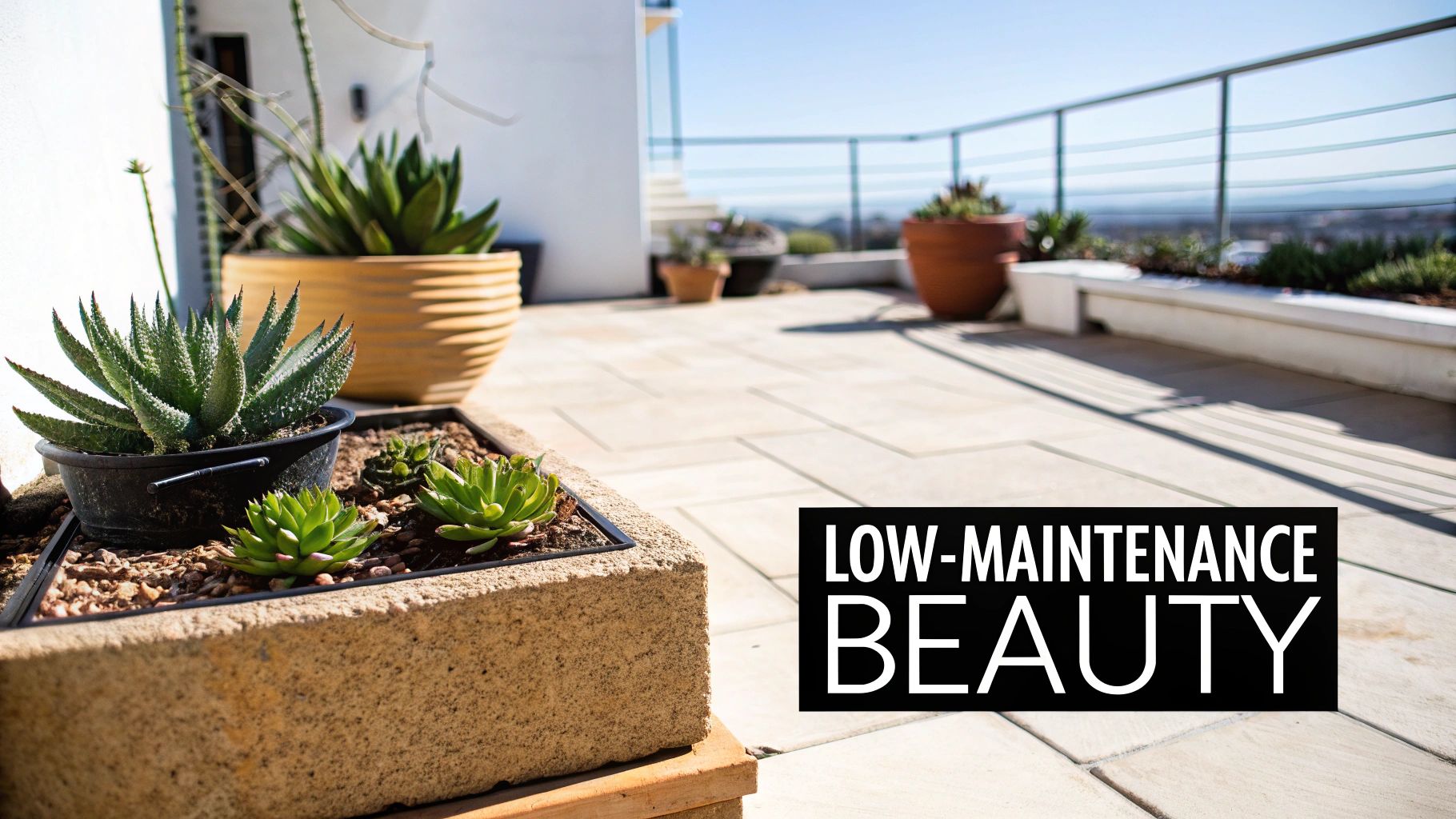
It’s no accident that you’re seeing more striking agaves and vibrant echeveria rosettes popping up in local yards and on sunny apartment balconies. Succulent gardens have exploded in popularity, becoming the perfect solution for homeowners who want something beautiful, modern, and practical. This isn't just a passing phase; it’s a smart response to modern life, where we all want a gorgeous space without a ton of work.
What's the secret? It all comes down to their amazing adaptability and chill, low-maintenance vibe. Forget the constant watering and fussing that other gardens demand. Succulents actually do better when you leave them alone a bit, making them a perfect match for anyone with a busy schedule or a self-proclaimed "black thumb."
The Appeal of Low-Maintenance Beauty
The biggest reason for this succulent wave is just how little they ask of you to look incredible. These plants are survivors, built to hold water in their leaves and stems, which means they can shrug off dry spells without a problem. For you, that means less time with a hose and more time actually enjoying your garden.
The market numbers back this up. The global succulent plant market is expected to jump from USD 12.2 billion to a whopping USD 18.2 billion by 2034. That growth is coming from people just like you, who want a touch of green that fits a hectic lifestyle and only needs a drink every few weeks.
Succulents offer a "plant-and-forget" quality that’s hard to find. Their natural resilience gives gardeners peace of mind and freedom from the daily chores that come with more fragile plants.
More Than Just Easy Care
But it's not all about practicality. The sheer variety in the succulent world is staggering, offering a palette of shapes, textures, and colors for you to get creative with. You can design a living masterpiece that’s entirely your own, mixing the sharp, architectural lines of an Agave with the soft, trailing beauty of a String of Pearls. Their versatility means they can shine anywhere, whether you have a huge yard to fill or just a few pots on a windowsill.
On top of being drought-smart and uniquely beautiful, a well-designed succulent garden can seriously upgrade your home's look, creating stunning curb appeal. Their clean forms and year-round color bring a polished, modern feel to any property. Starting with healthy, high-quality specimens from a specialist like The Cactus Outlet gives your garden the strong foundation it needs to thrive and turn heads.
Laying the Right Foundation for Your Succulents
A beautiful succulent garden doesn’t just happen. The real magic starts well before you even think about planting, with the groundwork you lay. If you get the location and the soil right from the beginning, you’ve won half the battle. These two things are crucial for a garden that doesn't just hang on, but truly flourishes.
Think like a location scout for your plants. While succulents are famous sun-worshippers, not all sun is created equal. Your main goal is to find a spot that gets at least six hours of direct morning sunlight. This is the good stuff—the light that fuels their growth and deepens their colors without being too harsh.
The intense afternoon sun, on the other hand, can be a real problem, especially in hot climates. Too much of it can actually scorch the leaves, leaving behind ugly bleached or brown spots. The perfect spot often has some built-in protection during the hottest hours of the day, whether it’s the shadow from your house, a nearby tree, or even a shade cloth you put up yourself.
Getting Your Hands Dirty: Soil and Drainage
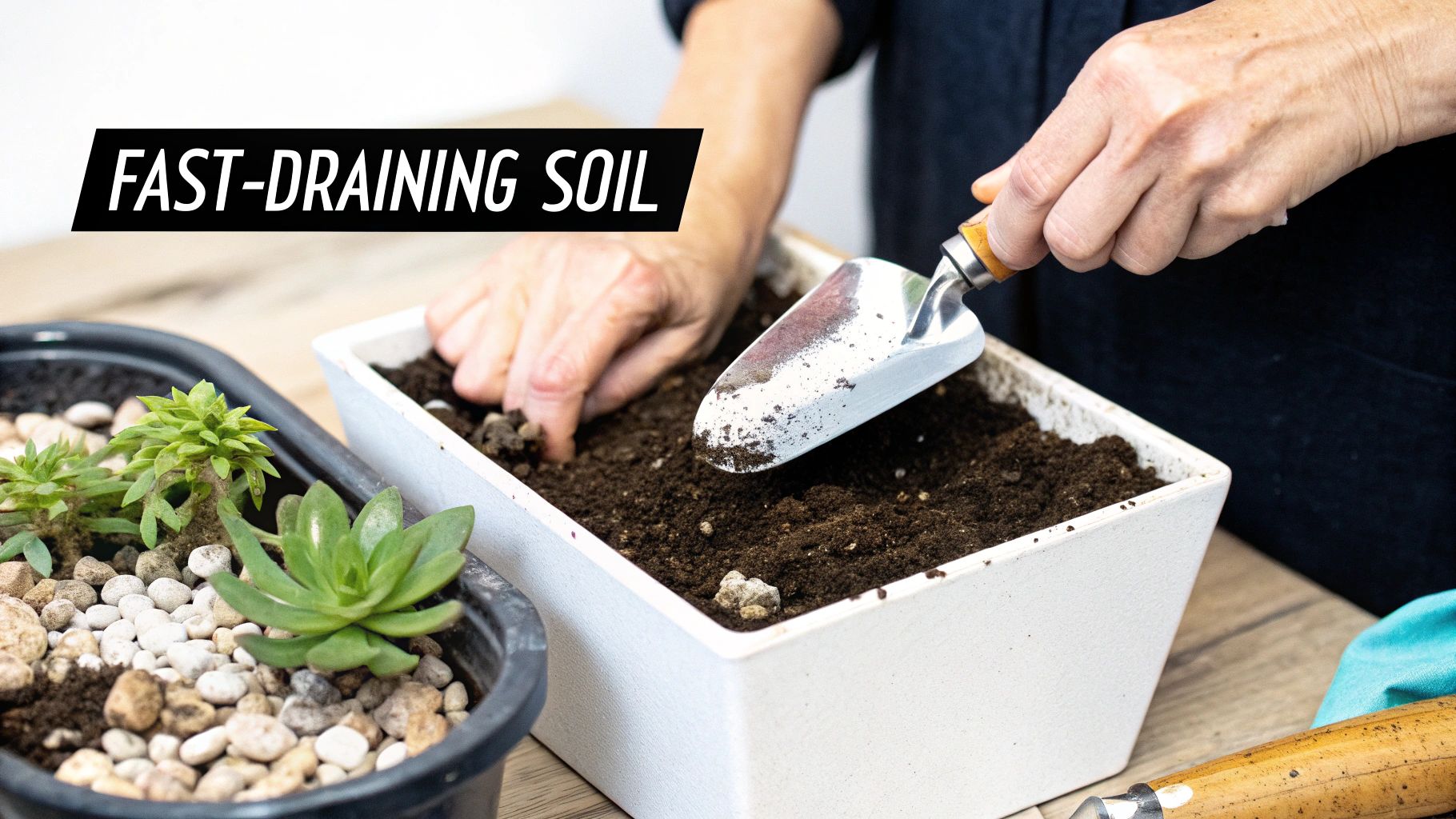
With your location picked out, it's time to focus on the soil. I can't stress this enough: the number one enemy of succulents is root rot, and it’s almost always caused by soil that stays wet for too long. Your typical garden soil or, even worse, heavy clay, is a death sentence because it holds onto moisture.
You want to create a growing medium that feels like their natural home—gritty, airy, and incredibly fast-draining. A simple way to check your soil is to dig a small hole, fill it with water, and watch. If there’s still water standing in that hole an hour later, you've got some work to do.
To fix poor drainage, you need to mix in amendments that create air pockets and help water move through quickly. Some of the best options are:
- Pumice: This is a lightweight volcanic rock that doesn't break down, so it provides fantastic, long-lasting aeration.
- Perlite: Another volcanic product, perlite is super light and does a great job preventing the soil from getting compacted.
- Coarse Sand: Make sure you use builder's sand or horticultural sand. Fine play sand will actually make compaction worse.
A reliable starting mix is about one part of your native soil, one part coarse sand or pumice, and one part compost for a little nutrient boost. For a more detailed recipe, learning about the ideal cactus and succulent soil mix can really help you nail the formula.
In-Ground, Raised Beds, or Containers?
Now, you have to decide how you'll plant: directly in the ground, in a raised bed, or using containers. Each approach has its own set of pros and cons, depending on your climate, your soil, and how much control you want.
Choosing Your Planting Method: In-Ground vs Containers
A quick comparison can help you decide the best approach for your space and climate, ensuring your succulent garden thrives from day one.
| Factor | In-Ground Garden | Container Garden |
|---|---|---|
| Soil Control | More challenging; requires amending a large area of native soil. | Complete control over the soil mix; perfect for poor native soil. |
| Drainage | Dependent on amending native soil and the site's natural slope. | Excellent drainage, as excess water escapes from holes. |
| Mobility | Permanent; plants are fixed in place for the season. | Highly mobile; can be moved to protect from frost or extreme sun. |
| Design Flexibility | Allows for large-scale, naturalistic designs that blend with the landscape. | Offers versatility in arrangement, height, and style. |
Raised beds are a fantastic compromise, giving you the excellent drainage and soil control of a pot with the expansive look of an in-ground garden. They are also great for landscaping on a slope. In fact, well-built residential sandstone retaining walls and garden beds can become beautiful structural elements that define your planting areas.
Ultimately, your local conditions will guide your choice. If you're dealing with heavy clay or live somewhere with a lot of rain, going with containers or raised beds is a smart move. It physically lifts your succulents' roots out of the soggy ground, giving them the best possible chance to thrive.
Selecting a Cohesive and Hardy Plant Palette
Choosing your plants is where the real fun begins. This is the moment your succulent garden starts to take on a personality of its own. But a truly stunning garden is more than just a collection of plants you find beautiful. The secret is to assemble a living collection where every member not only looks fantastic together but also thrives under the same conditions.
Think of it like casting a play. You need a star, a few supporting actors, and a chorus to fill out the stage. In the world of garden design, we have a simple yet powerful framework for this: the ‘thriller, filler, spiller’ principle. It's a method I've relied on for years to create breathtaking arrangements, whether in a pot or an entire garden bed.
The Thriller, Filler, Spiller Design Method
This classic concept is all about layering different growth habits to create a look that feels balanced, professional, and full of life. It’s an intuitive way to think about structure and visual impact.
- Thrillers are the showstoppers. These are your tall, architectural plants that provide a strong vertical element and immediately draw the eye. They’re the main event.
- Fillers are the supporting cast. Think mounding or rosette-shaped plants that nestle around the thriller, adding mass, texture, and color to flesh out the design.
- Spillers are the perfect finishing touch. These are the trailing plants that cascade over the edges of containers or soften the borders of a garden bed, connecting the whole arrangement to its surroundings.
Let's imagine a real-world example. You could start with a striking Peruvian Apple Cactus from The Cactus Outlet as your central thriller. Its incredible height and column-like shape create instant drama. To fill in around it, a cluster of Echeveria 'Lola' rosettes would add a beautiful contrast with their pale, ghostly colors. To complete the picture, a curtain of String of Pearls (Senecio rowleyanus) spilling over a rock would add a soft, whimsical feel.
Creating Cohesive Plant Pairings
Beyond their role in the design, the plants themselves need to get along. Harmony is key, but a little bit of intentional contrast is what really makes a garden interesting.
You could go for a serene, monochromatic look by sticking to a single color family. Picture pairing the silvery-blue tones of an Agave parryi with the powdery leaves of Blue Chalksticks (Senecio mandraliscae). The subtle variations create a calm, sophisticated vibe.
Or, you can crank up the drama with high contrast. Try placing the smooth, almost-black leaves of a 'Black Rose' aeonium next to the fuzzy, textured foliage of a Panda Plant (Kalanchoe tomentosa). The deep, dark aeonium makes the silvery-green of the kalanchoe absolutely pop.
A critical piece of advice I always give: plan for the mature size of each plant. That tiny agave in a 4-inch pot might eventually dominate a three-foot space. Giving everyone enough room from the start prevents a crowded, unhealthy garden down the road.
The succulent market is booming for a reason—gardeners love these plants for their resilience, especially in setups where a little neglect is common. Success comes down to mimicking their native arid habitats. This means gritty soil and plenty of sun. For instance, favorites from The Cactus Outlet like the Peruvian Apple Cacti are perfectly happy in gardens that get just 4-6 hours of direct sun daily.
Building Your Starter Palette
If you're just getting started, don't feel pressured to pick the most exotic species. It's much smarter to begin with a few tried-and-true options that are more forgiving while you learn.
Beginner-Friendly Choices:
- Agaves: Tough, architectural, and available in countless sizes and colors. They make fantastic thrillers.
- Aloes: Many varieties offer stunning winter blooms and interesting textures. They can work as both thrillers and fillers.
- Sedums (Stonecrop): Incredibly hardy and fast-spreading, many sedums are the perfect fillers or spillers.
- Sempervivums (Hens and Chicks): Extremely cold-hardy rosettes that multiply on their own, making them an ideal filler.
Once you’ve built some confidence, you can start branching out. The world of succulents is vast, from the otherworldly shapes of euphorbias to the intricate patterns on haworthias. For a deeper dive, our guide on the many types of succulents and cacti is a great place to start your treasure hunt.
Getting Your Succulents in the Ground
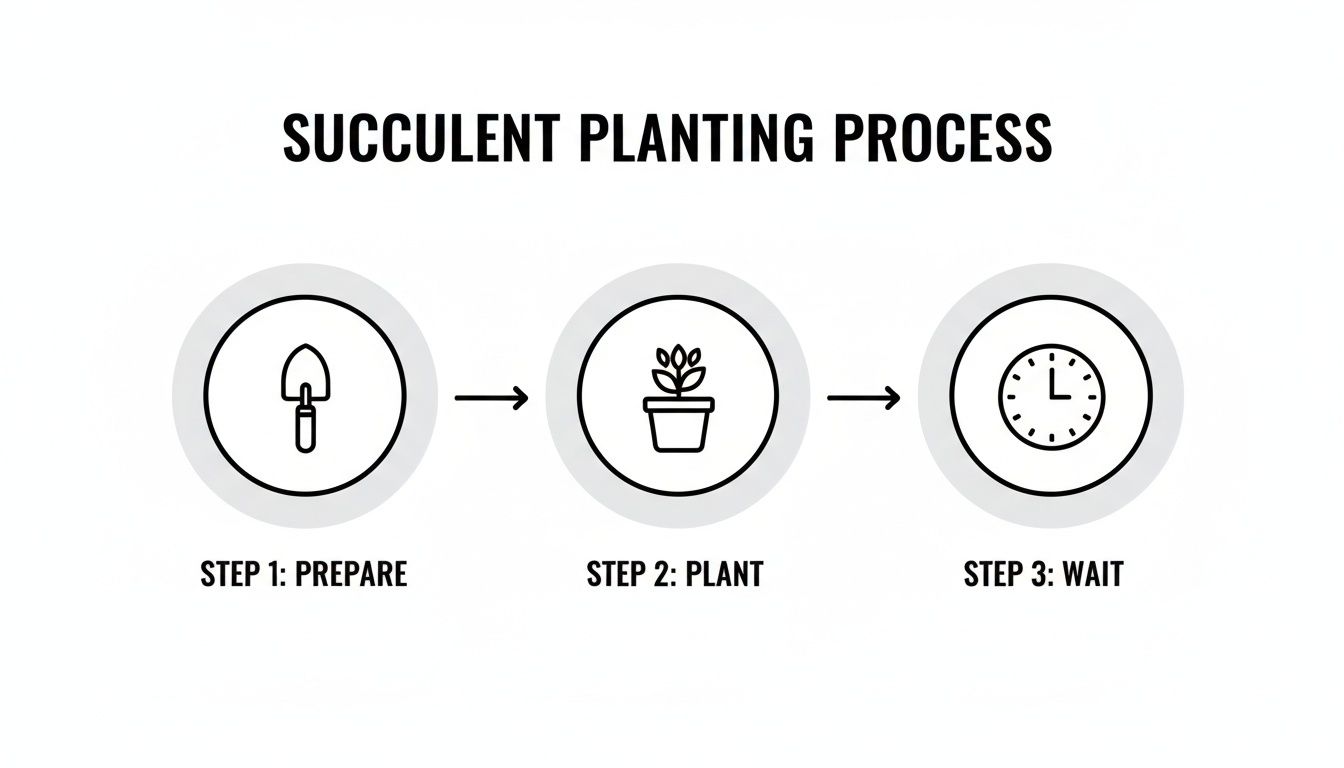
You've done the heavy lifting—the site is prepped, the soil is perfect, and you have an armload of beautiful plants. Now for the fun part: bringing your succulent garden to life. Getting your plants from their nursery pots into their new home is more than just digging a hole; a little technique here goes a long way in helping them settle in and start growing strong.
First things first, you need to get them out of those plastic pots. I always give the pot a gentle squeeze on all sides to loosen things up. Then, tip the plant into one hand while supporting the base and gently slide it out. Whatever you do, don't just yank it out by its leaves or stem—that's a sure-fire way to stress the plant out and cause damage.
Give Your Plants a Quick Check-Up
Once the succulent is free, take a good look at its roots. You're looking for firm, healthy roots that are white or light tan. Sometimes, you'll find a tangled, dense mat of roots circling the bottom of the pot. That's what we call being root-bound. If you see this, don't be afraid to get in there with your fingers and gently tease those roots apart. This little step is crucial because it encourages them to grow outward into their new home, instead of just continuing to strangle themselves.
This is also the perfect moment for a final pest and disease inspection. Check for any unwanted hitchhikers like mealybugs (they look like little bits of white cotton) or any spots that feel soft and mushy, which is a classic sign of rot. It's so much easier to deal with these problems now than when the plant is already in the ground.
Pro Tip: If the soil from the nursery feels heavy and peaty, try to gently knock off as much as you can without tearing the roots. That old soil can act like a sponge, holding way too much moisture right at the base of your plant, which completely defeats the purpose of the fast-draining mix you worked so hard to create.
The Art of Spacing and Planting Depth
Now, let's talk placement. Before you even pick up a trowel, arrange your succulents on the surface of the soil according to your plan. The key here is to think about their mature size. That tiny Agave might look a bit lost right now, but giving it a three to four-foot radius to itself will prevent it from completely swallowing its neighbors in a few years. Crowded plants don't just look chaotic; they also have poor air circulation, making them more susceptible to fungal problems.
When it's time to dig, the hole should be a bit wider than the root ball but no deeper. This is where a lot of people go wrong. The crown of the plant—the spot where the leaves emerge from the root system—needs to sit just above the soil line. If you bury the crown, you're essentially sending an open invitation for rot, as water will pool at the base of the leaves.
Pop the plant in the hole, and backfill with your succulent mix. Gently firm the soil around the roots to get rid of any big air pockets. I like to create a very slight mound right at the base, which helps guide water away from the sensitive crown.
The Hardest Part: Just Wait
Here’s the single most important—and most counterintuitive—piece of advice I can give you: do not water your newly planted succulents right away.
I know, it feels completely wrong. But trust me on this. When you unpot and handle a plant, you inevitably cause tiny, microscopic tears in the delicate root hairs. If you add water immediately, you're introducing moisture to those open wounds, creating the perfect breeding ground for fungus and bacteria. This is how root rot starts before a plant even has a chance to get established.
By waiting five to seven days before their first drink, you give those little wounds time to callous over and heal. This short dry spell also gives the roots a little motivation to start spreading out in search of moisture, which helps them anchor in faster and stronger. It takes a bit of patience, but this step is your best insurance policy for a healthy, thriving succulent garden.
Mastering Long-Term Succulent Garden Care
A stunning succulent garden is wonderfully low-maintenance, but it's not zero-maintenance. Once your plants are in the ground, the real secret to a vibrant, long-lasting display is getting the hang of the ongoing care that keeps these hardy plants happy. This is where you graduate from simply planting a garden to becoming a true succulent steward.
The single most important skill you'll develop is proper watering. It sounds simple, but it’s where most people go wrong. Succulents are built to store water in their leaves, which means they absolutely despise sitting in soggy soil and are incredibly prone to root rot if overwatered. This is where the "soak and dry" method becomes your mantra.
The Art of Watering Succulents
When it’s time to water, do it deeply and thoroughly. You want to completely saturate the root zone, mimicking the rare but heavy downpours these plants get in their native deserts. For in-ground gardens, that means watering long enough for the moisture to penetrate several inches down. If your succulents are in containers, keep watering until you see it flowing freely from the drainage holes.
After that deep soak, the "dry" part of the equation is non-negotiable. You have to let the soil dry out completely before you even think about watering again. A huge mistake is sticking to a rigid schedule, like watering every Sunday. A succulent’s thirst changes constantly based on the season, temperature, and humidity.
The best tool you have for checking soil moisture is your own finger. Stick it a good two inches into the soil. If you feel even a hint of coolness or moisture, back away from the watering can. It’s not time yet. This simple test is far more reliable than guessing and is your best defense against killing your plants with kindness.
Getting this balance right is everything. If you want to dig deeper, our detailed guide on how to properly water succulent plants breaks down the techniques that will keep your plants perfectly hydrated without drowning them.
Adjusting Care Through the Seasons
A succulent garden isn't a static thing; its needs shift dramatically with the seasons. Your care routine should mirror their natural growth cycles.
- Active Growing Season (Spring & Summer): This is when your succulents are putting out new leaves and roots. They’ll use water more quickly and might need a good soak every two to four weeks, depending on how hot and dry your climate is. This is also the only time you should even consider fertilizing.
- Dormant Season (Fall & Winter): As the days get shorter and cooler, most succulents hit the pause button and go dormant. Their growth slows to a crawl, and their water needs plummet. In winter, you might only water once every six to eight weeks—or even less.
It is absolutely crucial to cut back on watering in the winter. Giving a dormant succulent a summer-sized drink is one of the fastest ways to invite root rot, as the plant simply isn't using that moisture.
Feeding, Pruning, and Pest Control
Beyond watering, a few simple maintenance tasks will keep your garden looking sharp. These don't take much time but make a huge difference in the health and appearance of your plants.
When it comes to feeding, remember that less is more. Succulents are not hungry plants. A single dose of a balanced, low-nitrogen fertilizer—diluted to half-strength—at the beginning of the growing season is plenty. Over-fertilizing just encourages weak, stretched-out growth that’s more vulnerable to pests.
Pruning is mostly about good grooming. Grab some clean, sharp shears to trim off any dead, dried-up leaves from the base of plants like Echeverias. It’s also a good idea to snip off spent flower stalks after the blooms fade; this redirects the plant's energy back into growing healthy leaves. If a plant gets too tall and "leggy," don't be afraid to snip the top off. Let the cut end dry and form a callus for a few days, and then you can stick it back in the soil to root a new, more compact plant.
Finally, keep an eye out for pests like mealybugs and aphids. These little nuisances love to hide in the tight crevices of rosette-forming succulents. If you see anything that looks like tiny bits of white cotton, that’s your first sign. Just grab a spray bottle with some isopropyl alcohol and spritz the affected areas. Catching them early is the key to stopping a small problem from becoming a full-blown infestation.
Common Questions We Hear From Gardeners
Even the most detailed guide can't cover every question that pops up when you're out there with your hands in the dirt. So, I've put together some quick answers to the questions we get asked all the time. Think of this as having an expert in your back pocket.
Getting these details right from the start can be the difference between a garden that just gets by and one that truly thrives.
How Do I Protect My Outdoor Succulent Garden From Frost?
This is a big one. A sudden frost can do serious damage, but protecting your plants is easier than you think. For a light, overnight frost, a simple frost cloth or even an old bedsheet works wonders. Just drape it over your plants before sunset and pull it off in the morning so they don't miss that crucial morning sun.
If your succulents are in pots, you've got the best tool of all: mobility. Simply move them to a sheltered spot for the night—a covered patio, inside the garage, or even tucked up against a south-facing wall will do the trick. For those with in-ground gardens in colder regions, your best defense is a good offense: plant cold-hardy species like Sempervivums right from the get-go.
A Quick Tip from Experience: Never water your succulents if you know a frost is coming. Wet soil and roots freeze solid much faster than dry soil, which can be a death sentence for your plants. Keep them dry to keep them insulated.
What Are the Best Beginner Succulents for a New Garden?
When you're just starting, you want plants that are forgiving. Choosing tough, resilient varieties lets you learn the ropes without the stress of losing your plants. It builds your confidence and gives you a gorgeous garden fast.
Here are a few of my go-to, nearly foolproof choices:
- Echeverias: It’s hard to go wrong with these classic rosettes. They come in every color imaginable and are generally happy-go-lucky plants.
- Sedums (Stonecrop): Many Sedums are incredibly tough customers. They make fantastic ground covers and can handle a surprising amount of neglect.
- Sempervivums (Hens and Chicks): These are the champions of cold weather. They multiply on their own, filling in spaces with their beautiful, tight clusters.
- Aloes: If you want a bold, architectural look without a lot of fuss, Aloes are a fantastic choice. They're striking, resilient, and make a great focal point.
Starting with these gives you a solid, beautiful base. You can always branch out to more specialized varieties once you get the hang of things.
Can I Mix Cacti and Succulents in the Same Garden?
Absolutely! This question comes up all the time, and the answer is a big YES. Botanically speaking, all cacti are succulents, just a specific type. They evolved to thrive in similar conditions, and they look fantastic planted together.
The key to success is simple: group plants that like the same amount of water and sun. You wouldn't put a jungle succulent that loves moisture next to a desert cactus that needs to stay bone dry. A great pairing might be a dramatic barrel cactus next to a big Agave, since both appreciate a good, deep soak followed by a long dry spell. It's all about creating happy little communities where everyone's needs are met.
How Long Until My Succulent Garden Looks Full?
Ah, the million-dollar question. This is where a little patience comes in handy. How quickly your garden looks "finished" really depends on which plants you've chosen.
Some plants are sprinters. Fast-growing ground covers like certain Sedums can blanket an area in a single growing season, giving you that lush, established look pretty quickly. Others are marathon runners. A majestic Saguaro or a large feature Agave grows slowly and might take several years to reach its full, impressive potential.
If you're really after that full look from day one, you can cheat a little by planting things closer together than the tags recommend. Just know that this is a temporary fix. In a year or two, you’ll likely need to go back in and thin them out to prevent overcrowding.
Ready to create a garden that stops traffic? The foundation of any successful project is starting with healthy, high-quality plants. At The Cactus Outlet, we offer an incredible selection of robust cacti and succulents, from architectural Agaves to statement Saguaros, shipped directly to your door.
Explore our stunning collection and start building your dream succulent garden today!