


"So, how long do succulents really take to grow?" It's a question I hear all the time, and the honest answer is... it's a slow dance. There's no single, simple timeline.
A tiny succulent leaf might take up to a full year to become a small, established plant you can pop into a pot. On the other hand, a cutting can get there in just four to six months. It’s all about embracing the journey—growing succulents is a marathon, not a sprint.
The Succulent Growth Clock: What to Expect
To really enjoy the process, it helps to understand that succulents operate on their own unique, unhurried schedule. They're nothing like fast-sprouting annuals or leafy houseplants. Their patient pace is a huge part of their charm, letting you witness the slow, deliberate transformation of a single leaf or a small cutting into a stunning, mature plant over many months or even years.
Where you start makes the biggest difference. Think of it this way: building a piece of furniture from a pile of lumber is going to take a lot longer than assembling a pre-cut kit. It’s the same with succulents. Growing from seed is the long-haul project, while starting with a healthy cutting gives you a fantastic head start.
Timelines by Starting Method
To help you set your expectations, let's look at the typical timeframes for the most common starting methods. Each path has its own exciting milestones, from the first whisper of a root to a brand-new plant ready for its own pot.
Here's a quick overview of what to expect from each starting point.
Succulent Growth Timelines by Starting Method
| Starting Method | Time to See First Roots | Time to See New Growth | Time to Reach 2-Inch Pot Size |
|---|---|---|---|
| From Leaf | 4-8 weeks | 4-8 weeks (pups form) | 8-12 months |
| From Cutting | 3-6 weeks | 4-8 weeks | 4-6 months |
| From Seed | 2-12 weeks | 6-12 months (first true leaves) | 12-18+ months |
These timelines show just how much your starting point matters.
- From a Leaf: This is probably the most magical way to propagate. You’ll be waiting around 4-8 weeks to see the first tiny roots and baby plantlets (we call them pups) emerge. From there, it’s a slow and steady climb, usually taking about 8-12 months before the new plant is big enough for a 2-inch pot.
- From a Cutting: This is your shortcut! Cuttings give you a huge advantage. They generally root within 3-6 weeks and can grow into a well-formed little plant in as little as 4-6 months.
- From a Seed: Now, this is the ultimate test of patience. It can take several months just to see the seeds germinate, and a full year—or more—to get something that even resembles a tiny, recognizable succulent.
Of course, these are just ballpark figures. The real growth rate depends entirely on the care you provide—things like light, water, temperature, and soil all play a huge role. To get your conditions just right, our succulent plant care guide has everything you need to know.
Unlocking the Secrets to Faster Succulent Growth

While every succulent species has its own internal clock, you can definitely influence how fast that clock ticks. Think of yourself as a coach trying to get the best performance out of your plant. The secret isn't about forcing growth but about removing the roadblocks that are holding it back.
To understand how long succulents take to grow, you first need to get a handle on a few key environmental factors. Get these right, and you'll be rewarded with vigorous, healthy growth. These are the absolute fundamentals, and for succulents, finding the right balance is everything.
Mastering the Big Three: Light, Water, and Soil
The entire foundation for speedy growth comes down to three things: sunlight, water, and soil. Each one plays a unique role, and they all need to work in harmony.
-
Sunlight: The Power Source: You can think of sunlight as your succulent's food. Most varieties need at least six hours of bright, indirect light every day to photosynthesize properly. Without enough light, they start to etiolate—a desperate, leggy stretching toward the sun that results in weak stems and sparse leaves. It might look like growth, but it's the junk food version.
-
Water: The Lifeblood: This is where most people go wrong. Succulents don’t want small, frequent sips of water. They evolved for desert downpours, so they thrive on a "soak and dry" method. Drench the soil completely until water runs out the bottom, then let it dry out entirely before you even think about watering again. This simple technique encourages deep, strong roots instead of rot.
-
Soil: The Right Foundation: Your standard, dense potting soil is a death sentence for succulents. They need a gritty, fast-draining mix that doesn't let water hang around their sensitive roots. A good cactus or succulent mix lets air circulate and prevents the soil from getting waterlogged—a surefire way to stall growth and kill your plant.
Optimizing the Growing Environment
Beyond the basics, a few more tweaks to your succulent's home can make a surprising difference.
The size of the container is a bigger deal than you might think. A pot that’s too big will hold on to moisture for too long, creating a recipe for root rot. On the flip side, a pot that's too small will constrict the roots and choke off growth. A good rule of thumb is to pick a pot that’s only about 10-15% bigger than the plant's root ball.
Temperature also plays its part. Succulents hit their growth spurt when temperatures are consistently warm, usually somewhere between 65–80°F (18–27°C). When it gets too cold, they go dormant, which is a natural rest period where growth slows to a crawl or stops completely. And protecting them from frost is absolutely non-negotiable.
The global market for these plants, valued at around USD 9.36 billion, speaks volumes about their popularity. This demand is partly built on the fact that, with the right care, most commercial varieties reach a sellable size in just 3 to 6 months—a timeline you can definitely achieve at home.
Fueling Growth with Nutrients
Succulents aren't heavy eaters, but a little boost during their growing season (typically spring and summer) can go a long way. Using a balanced fertilizer made specifically for cacti and succulents provides key nutrients that their simple soil mix might be missing.
But it’s crucial not to overdo it. Fertilizing more than once a month can cause a burst of weak, flimsy growth or even burn the roots. To be safe, always dilute the fertilizer to half-strength. If you want to dive deeper, our guide covers the best fertilizer for succulents in detail. It's also interesting to see how larger-scale cultivation strategies, like sustainable farming practices, contribute to overall plant health and vitality.
Comparing Growth Rates of Popular Succulents
When it comes to how fast succulents grow, there’s no one-size-fits-all answer. Think of it like a family of runners: some are sprinters, some are steady joggers, and others are in it for the marathon. Figuring out which type you have is the key to setting the right expectations and not worrying if your plant is just taking its sweet time.
If you’re after that almost-instant gratification of a full, lush plant, some varieties will get you there in a flash. Others will teach you a valuable lesson in patience, rewarding you with slow, deliberate changes over months or even years. Knowing the difference means you won’t be second-guessing your care when a slow-grower is just moving at its own natural, leisurely pace.
The Sprinters: Fast-Growing Succulents
Some succulents just seem to be in a hurry. These are the ones that can turn a bare pot into a jungle in a single growing season, making them fantastic choices for beginners or for anyone wanting to quickly fill a hanging basket or patch of garden.
- Sedum (Stonecrop): Many of the trailing types, like the beloved Sedum morganianum (Burro’s Tail), are famous for their speed. Their stems can easily grow several inches in a season, creating that beautiful spilling effect over the edge of a pot.
- Graptopetalum and Graptosedum: These hybrids are growth machines. They shoot out offsets (pups) like there’s no tomorrow and can form a dense, mounding clump in under a year. It's not uncommon for a single cutting to fill out a 4-inch pot in just 6-8 months.
It's incredibly satisfying to watch these fast-movers, since you can often see visible progress from one week to the next. They're also a breeze to propagate, so you can expand your collection in no time from a single parent plant.
The Joggers: Medium-Paced Growers
This group includes many of the classic rosette-shaped succulents you probably recognize. They offer a great middle ground, showing you noticeable progress throughout the year without getting out of hand too quickly. Following how long these succulents take to grow is a truly rewarding journey.
Most Echeverias and Sempervivums (Hens and Chicks) fit perfectly in this category. An Echeveria started from a leaf or cutting might take around 9-12 months to become a solid 4-inch rosette. Likewise, a Sempervivum will steadily push out its "chicks," gradually filling its container over one or two seasons.
These medium-paced growers strike a perfect balance. They’re dynamic enough to keep you engaged as their rosettes widen and their colors shift with the seasons, but they won't demand a new pot every few months.
The Marathoners: Slow-Growing Succulents
And now for the marathon runners of the succulent world. These plants are for growers who appreciate the long game, as their progress is measured in years, not months. But what they lack in speed, they more than make up for with intricate patterns, fascinating shapes, and incredible longevity.
- Haworthia and Gasteria: Known for their stunning architectural leaves, these guys grow at a snail's pace. A small Haworthia might take 2-3 years—or even longer—just to double in size. They put their energy into building strong roots and perfecting those detailed leaf patterns.
- Agave and Aloe: While some of the smaller Aloe varieties grow at a moderate clip, the larger species and most Agaves are in it for the long haul. A single Agave ovatifolia (Whale's Tongue Agave) can take 5-10 years to reach its majestic mature size from a small pup.
Choosing a slow-grower is like making a long-term investment. You get the unique pleasure of watching a plant mature over a huge span of time, which makes its final form feel like a true achievement.
To give you a clearer picture, I've put together a quick comparison of some of the most common succulent types and what you can generally expect from them.
Comparing Growth Speeds of Common Succulent Genera
This table compares the typical growth speed and time to reach maturity for several popular types of succulents under optimal conditions.
| Succulent Genus | Typical Growth Rate | Time to Maturity (from cutting) | Growth Habit Notes |
|---|---|---|---|
| Graptopetalum | Fast | 6-8 Months | Prolific offset producers; quickly forms dense clumps. Ideal for filling arrangements. |
| Sedum | Fast | 6-9 Months | Especially trailing varieties; stems can grow several inches in a single season. |
| Echeveria | Medium | 9-12 Months | Forms a single, beautiful rosette that gradually widens and produces offsets. |
| Sempervivum | Medium | 1-2 Years | "Hens and Chicks" steadily produce offsets, filling pots over a couple of seasons. |
| Haworthia | Slow | 2-5 Years | Very slow, deliberate growth; focuses on root development and intricate leaf details. |
| Agave | Very Slow | 5-10+ Years | A long-term commitment; slow, steady growth leads to a dramatic, mature plant. |
Remember, these are just estimates! The exact timeline will always depend on the specific species and the care you provide, but this should give you a solid starting point for knowing what to expect from your plants.
Your Step-by-Step Propagation Timeline
There's nothing quite like watching a whole new succulent emerge from a single leaf or cutting. It's a slow but fascinating process that lets you turn one plant you love into a whole collection. Knowing what to expect at each stage is the key to making sure your propagation adventure is a successful one.
The very first, and most important, step is to let the cutting callus over. This just means you need to let the raw, open wound at the base dry out and form a protective seal. Give it 3 to 7 days—this part isn't optional. If you plant a fresh, wet cutting, you're practically inviting bacteria and rot.
From Callus to First Roots
Once your cutting has a nice, dry callus, the real waiting game begins. Just lay it on top of some well-draining soil in a spot with bright, indirect light. Now, you just have to be patient while it works its magic under the surface.
You should start seeing the first tiny, hair-like roots poking out within 3 to 6 weeks. This can change a bit depending on the type of succulent, the temperature, and the humidity. Fast-growing types like Graptopetalum might surprise you with roots in just a couple of weeks, while a slower species like Haworthia could easily take more than a month.
A Quick Tip: The goal here is to encourage roots, not rot. Resist the urge to douse it with water. A light misting every few days is more than enough to create a bit of humidity and coax those roots out without soaking the soil.
The Magic of New Growth
Seeing those first roots is a thrill, but the next part is where the real show starts. Shortly after the roots get established, a tiny rosette—a perfect miniature of the parent plant—will begin to form at the base of the leaf. This little plantlet, often called a "pup," usually shows up 4 to 8 weeks after you first laid the leaf down.
This is the moment your new plant starts its life. For a more detailed look at the different methods, our guide on how to propagate succulents breaks it all down step-by-step.
As the new pup gets bigger, it will pull all the water and nutrients it needs from the original "mother leaf." You'll see the mother leaf slowly wither and shrivel up as it gives everything to the new plant. Don't worry, this is exactly what's supposed to happen!
This timeline gives you a general idea of the growth rates for a few common succulent varieties.
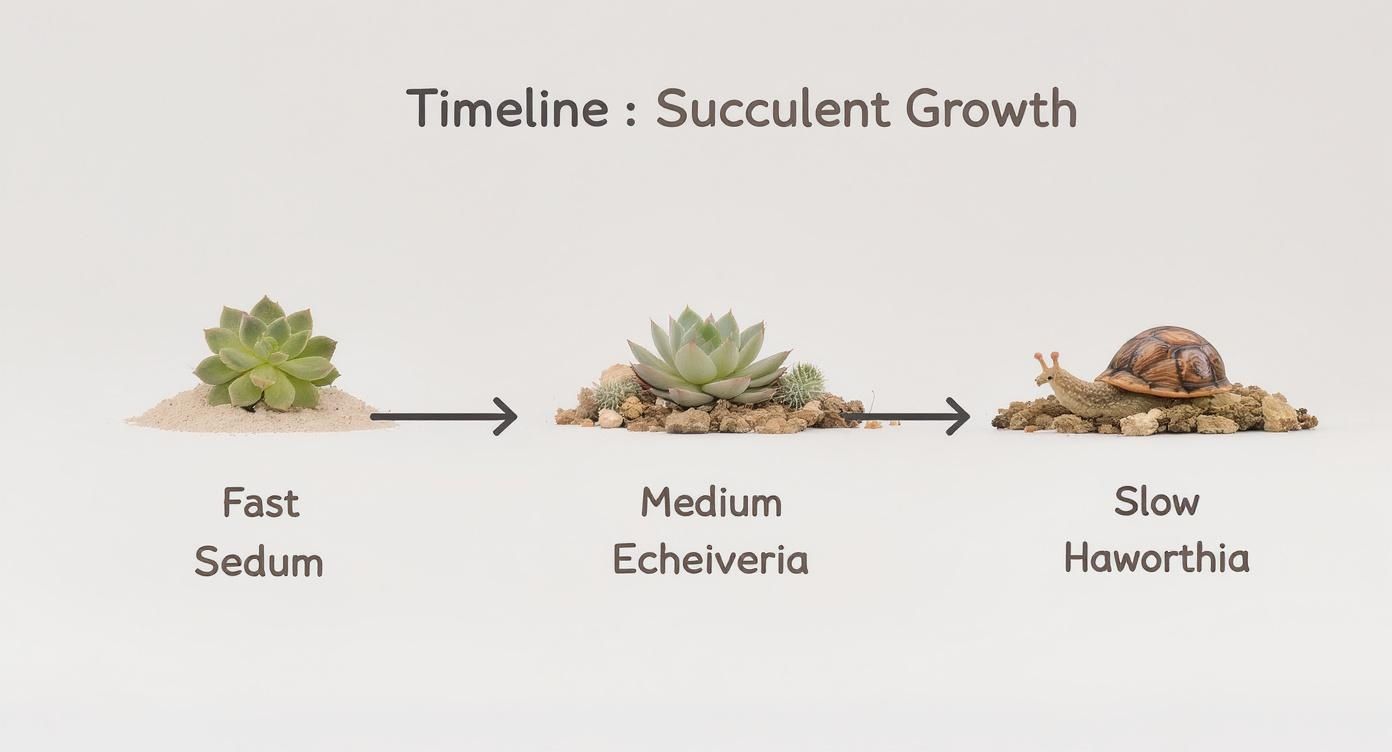
As you can see, plants like Sedum are often the sprinters, Echeveria grow at a more moderate pace, and Haworthia are famously slow. These speeds directly affect how long your propagation will take.
Becoming an Established Plant
Once the mother leaf has completely dried out and your new plantlet is about half an inch to an inch wide, it’s ready for its own pot. This milestone typically happens around the 3 to 5-month mark. You can gently wiggle the shriveled mother leaf off and plant your new baby succulent in its own small container.
From here, how long it takes to become a fully mature plant is all about the species. A speedy Sedum might fill out a 4-inch pot in under a year, whereas a slow-and-steady Haworthia could take several years to reach that same size.
How to Read Your Succulent's Growth Signals
Your succulents are constantly talking to you, but they don't use words. Their language is all visual, and learning to read their signals is the secret to understanding how they're growing and what they need from you. Instead of just guessing, you can look for specific physical cues that tell you if they're happy or struggling.
Think of it like a conversation. A thriving succulent with compact, colorful leaves is basically telling you, "Hey, whatever you're doing, keep it up!" But when something isn't quite right, the plant's appearance will change, giving you a clear heads-up that it’s time to adjust its care.
Healthy Growth vs. Stress Signals
One of the most common SOS signals a succulent sends is etiolation, also known as stretching. This is what happens when your plant isn't getting nearly enough sunlight. It will start to grow tall and lanky, with big gaps between the leaves, as it literally reaches for a better light source. It might seem like fast growth, but it’s actually a sign of weakness that leads to a fragile, unhealthy plant.
On the other hand, a happy, healthy succulent looks quite different:
- Compact Rosettes: The leaves grow close together in a tight formation, not spread out along a long, pale stem.
- Vibrant Color: In good light, many succulents show off beautiful "stress colors" like pinks, reds, and purples. This is a great sign!
- Firm Leaves: Healthy leaves feel plump and full of water, not soft, wrinkled, or limp.
A healthy succulent practices patience, channeling its energy into strong roots and dense foliage. Stretched, pale growth is the plant's way of shouting, "I need more sunlight to grow properly!"
Mastering these signals is what separates amateurs from pros. In fact, commercial growers in the booming Asian succulent market have this down to a science. They can get a plant from propagation to a sellable size in just 4 to 8 months simply by providing perfect conditions from day one. It's a huge industry, and you can learn more about the succulent plant market to see just how big it's become.
Understanding Dormancy and Major Milestones
It’s also crucial to remember that succulents have a natural ebb and flow. Most species go into a dormancy period, usually during the winter or the peak heat of summer. When this happens, their growth slows way down, sometimes stopping altogether. Don't panic—this is a completely normal rest phase in their life cycle.
Of course, one of the most exciting milestones for any plant owner is seeing it flower. A bloom is a sure sign of a mature, healthy plant. But patience is key here. An Echeveria might flower within 1-2 years, but a slow-growing Agave could take a decade or more before sending up its magnificent flower stalk. Knowing these long-term timelines helps you appreciate the journey and set the right expectations for your plant.
Got Questions? Let's Talk Succulent Growth
Even the most seasoned succulent growers run into head-scratchers now and then. It's totally normal to second-guess yourself, especially when a plant does something unexpected. Think of this as your go-to guide for those "Is this normal?" moments.
We'll walk through some of the most common questions that pop up, giving you clear, simple answers so you can feel confident and in control.
Why Has My Succulent Stopped Growing?
When a succulent that was growing like a weed suddenly stalls, the first thing to consider is dormancy. Most succulents hit the pause button during the year, usually during the hottest part of summer or the coldest part of winter. It's their natural rest cycle, and a slowdown is perfectly healthy.
But what if it's prime growing season? A sudden stop could point to trouble below the soil. The two biggest culprits are root rot from too much water or the plant becoming root-bound in a pot it has outgrown. The best way to know for sure is to gently slide it out of its pot. Healthy roots are firm and whitish, not brown and mushy.
Can I Use Fertilizer to Speed Things Up?
It's tempting to think fertilizer is like a turbo-boost for plants, but with succulents, it's a different story. These plants are tough survivors, built for soils that don't offer much in the way of nutrients. Giving them too much fertilizer is a classic rookie mistake and far more dangerous than giving them none at all. It can cause weak, stretched-out growth or even scorch the roots, bringing growth to a dead stop.
A good rule of thumb is to use a balanced succulent fertilizer, diluted to half-strength, just once or twice during the peak growing season (usually spring). Treat it like a mild vitamin supplement, not a five-course meal.
How Can I Fix a Stretched-Out, "Leggy" Succulent?
That long, stretched-out look—officially called etiolation—is your succulent's desperate cry for more sun. While you can't magically shrink the elongated stems back to their original compact form, you can absolutely fix the situation and get your plant looking great again.
Here’s the game plan:
- More Light, Stat! First, move your plant to a much brighter spot where it will get at least six hours of good, indirect sunlight daily.
- Off With its Head! It sounds dramatic, but "beheading" is the best fix. Use a clean, sharp blade to chop off the nice, compact rosette at the top, leaving an inch or two of stem attached.
- Replant and Propagate. Let that top cutting sit out for a few days to callus over, then plant it in fresh soil. Don't toss the old, bare stem! You can pull off the remaining leaves and lay them on soil to propagate a whole new batch of baby succulents.
How Long Does It Take for a Propagated Leaf to Sprout?
This is where your patience really comes into play. Leaf propagation is incredibly rewarding, but it's not instant. Once you've let the leaf end callus over and have laid it on top of some soil, you should start seeing the first tiny roots or a baby rosette forming in about 4 to 8 weeks. Some plants are quicker, some take their sweet time, but that's a solid average to expect.
Ready to start a new succulent adventure or add a perfectly grown specimen to your collection? The Cactus Outlet offers a gorgeous selection of vibrant, healthy succulents and cacti that are ready to find a new home. Check out our collection and find your next plant obsession at https://www.cactusoutlet.com.