
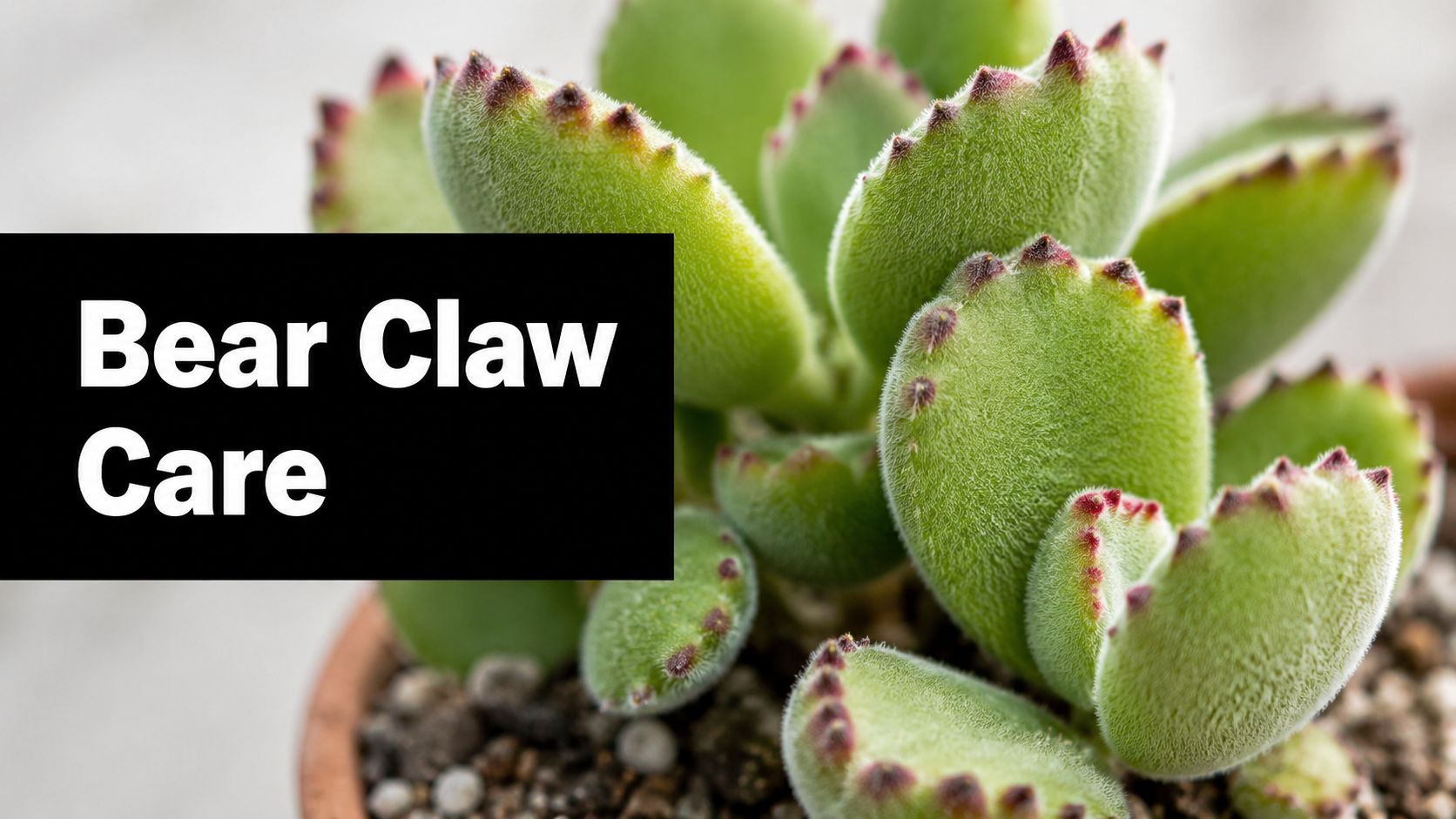

You spot it on a shelf and laugh a little. The leaves look like tiny green paws, each one tipped with little “claws,” and the whole plant has that soft, fuzzy look that makes people reach out and touch it. Then you bring it home, set it near a window, water it like a normal houseplant, and a few weeks later it starts looking mushy, stretched, or strangely bare.
That story is common with the Bear Claw plant, also called Bear's Paw succulent. It's one of the most charming succulents you can grow, but it also has one of the easiest care routines to get wrong. Most problems trace back to one issue. Wet roots for too long.
I've seen beginners do everything else right. Cute pot, decent light, good intentions. But if the soil stays damp, this plant can decline fast. The good news is that Bear Claw isn't mysterious once you understand where it comes from and why it behaves the way it does. It comes from the semidesert Little Karoo region of southern South Africa, where drainage is sharp, air is dry, and the plant has learned to treat water like a rare event, not a constant supply (Gardenia's Bear's Paw guide).
That's the lens to use for every care decision. Don't ask, “What do most houseplants like?” Ask, “What would help a fuzzy little succulent from rocky, porous ground stay dry between drinks?”
An Introduction to the Charming Bear Claw Plant
Some succulents win people over with dramatic color. Others do it with symmetry. The Bear Claw plant wins on personality.
Its leaves are thick, plush-looking, and shaped in a way that almost doesn't seem real. The tips form little notches that look like claws, so even people who don't know the botanical name usually remember it after one glance. It feels more like a tiny creature than a plant.
That playful look is a big reason collectors love it, but it can also mislead beginners. Fuzzy leaves make people think “soft and thirsty.” Compact growth makes people think “slow, so it doesn't need much light.” Both instincts can cause trouble. This is still a succulent, and it follows succulent rules first.
Practical rule: If a Bear Claw plant looks cute enough to baby, resist the urge. It does better with restraint than fuss.
It also helps to know that this plant has rhythms. It isn't trying to grow hard every month of the year. It slows down at times, then picks back up when conditions suit it. If you expect steady growth all year, you may keep watering when the plant has already shifted into a slower phase.
What makes Bear Claw rewarding is that it gives clear signals once you learn its language. Firm leaves mean things are on track. Rich color at the tips can mean the plant is getting conditions it likes. Mushiness, stretching, and leaf drop are not random. They're messages.
If you've struggled with one before, don't take that as a sign you're bad with succulents. Take it as a sign that this plant needs a more desert-minded routine. Once you understand the why behind the care, it gets much easier to keep those little paws full, compact, and healthy.
How to Identify the Real Bear Claw Plant
You're at a nursery, holding a small fuzzy succulent with red-tipped leaves, and the tag says “Bear Paw.” Before you bring it home, it helps to know what you're looking at. A correct ID does more than satisfy curiosity. It gives you the first clue to the plant's biggest care rule: keep water moving, because this type is especially vulnerable to root rot if it stays wet too long.

A genuine Bear Claw plant, usually sold as Bear Paw, has a shape that stands out once you know the pattern. The leaves are thick and plump like tiny pads. The surface has a soft fuzz, almost like suede. At the end of each leaf, you should see little claw-like notches. That combination matters more than any single feature on its own.
The key features to check
Start with the leaf texture. Bear Claw leaves should look velvety, not slick or waxy. That fuzzy coating helps slow moisture loss, which fits a plant built for dry, rocky conditions rather than damp potting soil.
Then check the leaf shape. A Bear Claw leaf is short, swollen, and rounded through most of its length, with the “claws” grouped at the tip instead of running along the edges. The Missouri Botanical Garden's profile for Cotyledon tomentosa also notes the hairy leaves and toothed tips that give the plant its common name (Missouri Botanical Garden plant finder).
Look for these traits together:
- Velvety leaves: fine fuzz across the surface
- Paw-like shape: thick, rounded, and compact rather than thin or flat
- Toothed tips: small notches at the end of the leaf that resemble claws
- Branching habit: a low, shrubby succulent rather than a single rosette
Color can confuse beginners, so here's a useful checkpoint. Red along the tips often means the plant is getting strong light, not that it is sick. Healthy color should come with firm leaves and sturdy growth. If the plant is red, wrinkled, and soft at the same time, that is a different story.
Why these features matter for care
Bear Claw's appearance is like a care label written on the plant itself. Thick leaves mean stored water. Fuzz means protection against drying out. Compact growth means it expects strong light and fast drainage, not frequent drinks.
That is why correct identification matters so much. Beginners often see the fuzzy surface and assume the plant wants gentle, regular watering, almost like an herb on a kitchen sill. In practice, that instinct causes the most common failure. Wet soil around these roots acts like a sponge wrapped around a water tank. The leaves can look fine at first while the roots begin to fail underneath.
This is also where the recovery window matters. If a Bear Claw has been overwatered for only a short period, often a few days to about a week in soggy soil, you may still have time to dry the mix, improve airflow, and save healthy roots. If the base turns mushy and the stem starts collapsing, the window gets much smaller. By then, your best option is often to cut and try to reroot any firm, healthy growth.
For a broader foundation on soil, drainage, and watering rhythm, our succulent plant care guide helps explain the basics. If watering is the part that still feels tricky, this beginner's guide to succulent watering is also useful.
A quick reality check when shopping
Pause if the label says Bear Paw but the plant has smooth leaves, long pointed leaves, or no clawed notches at the tips. Those are common signs you're looking at a different succulent.
Also check the base of the plant before buying. A healthy Bear Claw should feel firm where the stems meet the soil. If that area is dark, soft, or loose in the pot, skip it. That kind of damage often starts below the surface first, and by the time you see it, rot may already be well underway.
A good specimen looks compact, fuzzy, and solid, with plump “paws” that feel gently firm. That is the version worth bringing home.
The Essential Bear Claw Plant Care Guide
You bring home a healthy Bear Claw, give it a drink, and a week later it still looks fine. That is what makes this plant tricky. Root rot usually starts below the surface, long before the leaves warn you.
Bear Claw stores water in its fuzzy leaves like a small reserve tank. That storage is helpful, but it also fools beginners into watering on a houseplant schedule. The safer approach is simple. Give it strong light, fast-draining soil, and long dry spells between waterings.

Light that keeps the paws compact
Light is what keeps Bear Claw short, chunky, and well-shaped. In a dim room, it stretches because it is trying to reach a stronger energy source. The result is wider gaps between leaves, softer growth, and less defined "claws."
Indoor growers do better with measurable targets than with vague advice like "bright light." For artificial lighting, a useful benchmark comes from PictureThisAI's Bear Paw lighting summary, which reports better compact growth under 3,500+ lux for 14-hour daily cycles than under weaker, shorter light exposure.
That gives you a practical test. If your windowsill cannot provide steady brightness for most of the day, a grow light is usually the better tool.
A simple indoor setup works well:
- Use a real grow light: Standard room bulbs are often too weak.
- Run it on a timer: Consistency helps more than occasional extra hours.
- Adjust based on the plant: Stretching means the light is too weak, too far away, or on for too few hours.
Watering that prevents disaster
Watering is where Bear Claw plants are won or lost.
Use the soak-and-dry method. Water the soil fully, let excess water drain out, and then wait until the mix is dry all the way through before watering again. The top inch is not enough to check. A pot can look dry near the surface while the lower root zone still stays damp.
That lower damp zone is where trouble starts. Roots need both moisture and air. If the mix stays wet too long, the roots lose access to oxygen and begin to decay, much like a sponge left soaked in a closed container.
Bear Claw also changes pace through the year. It usually grows more actively in spring and fall, then slows down in hot summer periods and in winter. During those slower phases, it uses water much more slowly, so the same watering schedule that worked a month ago can suddenly become too much.
A dormant Bear Claw works like a parked car. It uses very little fuel while sitting still, so adding more does not help.
The recovery window matters here. If the soil has stayed soggy for only a few days, sometimes up to about a week, you may still be able to save the plant by stopping water, improving airflow, and moving it into a faster-drying setup. If the stem base turns soft or dark, recovery becomes much less likely and action needs to be immediate.
If reading dry soil still feels uncertain, this beginner's guide to succulent watering explains the cues well. For broader basics on drainage, soil, and watering rhythm, our succulent plant care guide for soil and watering fundamentals is a useful reference.
Soil and pot choice
Bear Claw needs a mix that dries quickly and leaves air pockets around the roots. Regular potting soil usually holds too much moisture for too long. A cactus or succulent mix is a better base, and many growers improve it further with extra pumice, perlite, or coarse mineral grit.
The goal is not just drainage at the bottom. You want the whole root zone to dry at a healthy pace.
A drainage hole is required. Without one, extra water collects in the pot and turns the lowest roots into the first place rot begins.
| Part of setup | What works best | Why it matters |
|---|---|---|
| Pot | Terracotta with drainage | Helps moisture escape faster |
| Soil | Grit-heavy succulent mix | Reduces soggy pockets around roots |
| Top layer | Loose and airy surface | Helps the mix dry more evenly |
Temperature and air
Bear Claw prefers warm rooms, dry air, and steady conditions. Sudden cold, trapped humidity, or a damp corner can keep the soil wet longer than expected, which raises the risk of rot even if your watering habits look reasonable on paper.
For beginners, the easiest rule is this. Keep it in a bright, warm spot with decent airflow, and keep it away from steamy bathrooms, cold drafts, and crowded plant shelves where moisture lingers.
If your home feels comfortable and dry, Bear Claw usually will too.
Propagating and Repotting Your Paws
You snip a healthy Bear Claw, tuck it into soil, give it a little water, and a week later the base turns mushy. That pattern is common with this plant. Fresh cuts and disturbed roots are at their most vulnerable before they seal, so propagation and repotting succeed or fail based on how well you avoid trapped moisture during that short recovery window.
When to propagate
Spring and fall are usually the easiest seasons for Bear Claw propagation because the plant is more ready to produce new roots. During slow periods, a cutting can sit in soil too long before rooting, which raises the chance of rot.
Repotting usually makes sense every few years, or sooner if the mix has broken down. The exact calendar matters less than the condition of the roots and soil. The University of Wisconsin-Madison Extension notes that succulents are best repotted when actively growing and that cuttings need time to dry and callus before planting in a well-drained medium.
Why does timing matter so much? Active growth works like a plant waking up hungry and ready to move water where it needs to go. Dormancy is the opposite. The plant is conserving energy, so repairs happen more slowly.
How to take cuttings without inviting rot
Stem cuttings are usually the safer choice for beginners because they carry more stored energy than a single leaf. Leaf propagation can work, but it tends to be slower and less predictable with Bear Claw.
Use this order:
- Choose firm, healthy growth. Skip any piece with translucent tissue, bruising, or soft spots.
- Make a clean cut. A sterile blade leaves less damage for the plant to heal.
- Let the cut end dry fully. Wait until it feels dry and slightly sealed.
- Set it into a fast-draining mix. Keep the cutting upright and stable, but do not bury it too far.
- Delay watering. Give the cut end time to stay dry while the first root tips begin forming.
The callous works like a scab on scraped skin. Planting too early leaves a raw opening pressed against damp soil, which is one of the fastest ways to lose a cutting.
If you want a more detailed method, this guide to propagating succulents from cuttings walks through the process clearly.
Repotting without overpotting
Repotting is really root-zone maintenance. Fresh mix dries more evenly, holds more air, and lowers the chance that old compacted soil will stay wet around the crown.
Watch for a few signals:
- Roots circling the pot: The root ball has filled the container.
- Soil staying wet longer than it used to: The mix may have compacted or broken down.
- Water running off the top instead of soaking in: Old soil can turn dense and uneven.
- Slowed growth in the active season: The roots may need fresher media and more air space.
Choose a pot only one size larger.
A much bigger pot creates a wide ring of unused soil that stays damp longer than the roots can handle. For Bear Claw, that extra moisture acts like a wet blanket around the root system. A shallow pot is often the better fit because the roots sit in a smaller volume of mix that dries at a safer pace.
After repotting, keep the plant dry for several days before resuming light watering. That pause gives tiny root injuries time to seal. If you water immediately, damaged roots can absorb moisture unevenly and start the rot process before the plant has a chance to settle.
Troubleshooting Common Bear Paw Problems
A Bear Claw rarely declines at random. In most cases, the roots have been stressed first, and the leaves are the part you can see.
Root rot and the recovery window
Root rot is the number one killer of Bear Claw plants. It starts below the soil line, often days before the plant looks dramatic above the pot.
For beginners, the hard part is timing. A Bear Claw can still look salvageable while the roots are already failing. One summary of Cotyledon root-loss research notes that plants can lose 60% of viable root mass within 7 days of continuous soil saturation, with recovery odds dropping below 15% after 10 days (https://www.succulencare.com/blog/bear-paw-succulent-care-guide). Use that as a reminder to inspect early, not as a reason to panic over one mistaken watering.
Root rot works like a sponge left sealed in a plastic bag. The roots lose airflow, damaged tissue breaks down, and microbes spread fastest in that wet, stagnant zone. By the time the leaves turn mushy, the recovery window may already be narrowing.
Use this quick triage table:
| What you notice | Likely stage | Best response |
|---|---|---|
| Slight softness, damp soil, no smell | Early trouble | Unpot the plant, inspect roots, let the root zone dry, and replace the wet mix |
| Mushy leaves, black roots, collapsing base | Advanced rot | Remove all dead tissue and try to save healthy cuttings above the damage |
| Sour smell, stem turning translucent or black | Severe decline | Recovery is unlikely unless firm, healthy tissue remains above the rot |
If some roots are still pale and firm, act the same day. Remove soggy soil, trim off anything black or mushy, and let the plant sit out long enough for cut surfaces to dry. Then replant in a gritty mix and wait before watering. That pause matters because damaged roots absorb water unevenly, which can restart the same problem.
Stretching, leaf drop, and thirsty-looking paws
Several problems can mimic each other. A wrinkled Bear Claw may need water, but a soft yellowing one may have roots that can no longer take water up. Checking the soil and the stem base gives you a better answer than looking at the leaves alone.
- Stretching or leaning: Low light is the usual cause. Indoors, aim for a grow light that delivers enough intensity to keep growth compact, rather than relying on the vague advice of "bright light." In practical terms, keep the plant under a quality full-spectrum LED for about 12 to 14 hours a day, close enough to prevent stretching but not so close that the leaf tips scorch.
- Wrinkled or deflated leaves: The plant has often used much of its stored moisture. If the mix is fully dry and the roots are healthy, water thoroughly and let excess moisture drain away.
- Leaves dropping suddenly: Sudden changes in light, temperature, or watering often trigger this. Bear Claw prefers consistency more than constant adjustment.
If your plant is shedding leaves and you want a broader checklist, this guide to succulent leaves falling off helps narrow down the cause.
Pests and surface problems
Mealybugs and spider mites are the two pests I watch for most often on fuzzy succulents. The leaf texture gives them places to hide, especially around tight joints and sheltered growth points.
Start simple.
- Isolate the plant: This keeps pests from reaching nearby succulents.
- Inspect the fuzzy leaf joints closely: Cottony clusters, webbing, or sticky residue are the usual clues.
- Use a gentle treatment: Insecticidal soap or neem oil is commonly used, but test a small area first since fuzzy leaves can hold residue.
If your plant has pests and soggy soil at the same time, deal with the root zone first. A Bear Claw can outlast a minor pest issue far more easily than it can survive a wet, airless pot.
If your plant sits near a bright window with strong afternoon exposure, light filtering can reduce stress while you troubleshoot. Joey'z Shopping's curtain styling tips offer ideas for softening harsh sun without turning the room dim.
Styling and Where to Place Your Plant
Bear Claw works best in rooms where the styling matches the plant's nature. It doesn't suit every spot, and that's part of its charm. This is a plant for bright, airy places, not dark corners or steamy shelves.
Terracotta is often the easiest pot choice because it supports the dry-fast routine this plant prefers. If you like ceramic, choose one with a drainage hole and pair it with a gritty mix. The pot should frame the plant, not swallow it. Bear Claw has a compact, sculptural look, so a simple container usually lets the fuzzy leaves do the talking.
Good placement ideas indoors
A few spots tend to work especially well:
- Bright windowsills: East or bright south-facing areas are often a good match if the light is strong but not scorching all day.
- Desk or side table near a bright window: Good if you want the plant at eye level where the paw shape stands out.
- Small succulent grouping: Pair it with other dry-loving plants, not tropicals that want frequent watering.
The visual trick is to place it where people can notice the leaf texture up close. Bear Claw is a conversation plant. It earns a closer look.
Use decor to support the plant, not fight it
If your room has strong afternoon sun, sheer window treatments can soften the light while keeping the space bright. For anyone working on a plant-friendly room setup, Joey'z Shopping's curtain styling tips can spark ideas for balancing light control with decor.
A Bear Claw plant also looks great in spaces with natural textures. Clay pots, wood shelves, stone accents, and neutral ceramics all echo its semidesert roots. The more your setup feels dry, open, and simple, the more natural the plant looks in it.
The best placement is the one where beauty and care line up. If a spot looks perfect but stays dim or damp, it's the wrong stage for this plant.
Frequently Asked Questions for Owners
A lot of Bear Claw owners reach this stage after one unsettling moment. The plant still looks cute from above, but one leaf drops, the soil stays damp longer than usual, and you start wondering whether you still have time to fix it. In many cases, you do. With Bear Claw, the key question is often not "what color are the tips" or "is it dormant," but "how wet have the roots stayed, and for how long?"
How quickly can a Bear Claw recover from overwatering
There is usually a recovery window, but it is short.
If the soil stayed wet for only a few extra days and the leaves are still firm, the plant often bounces back once you let the mix dry fully and improve airflow and light. If the pot has stayed wet for a week or more, especially in low light, the risk rises fast because the roots begin to suffocate. Roots need tiny air pockets in the soil the same way lungs need open space. When those spaces stay filled with water, decay can start below the surface.
A practical rule is simple. Firm leaves and a solid stem mean you still have a good chance. Mushy leaves, a soft stem base, or a sour smell from the pot mean you need to unpot and inspect the roots right away.
What kind of grow light does Bear Claw actually need indoors
"Bright light" is too vague for a plant that can rot in dim corners.
For indoor growing, aim for a full-spectrum LED grow light in the daylight range, roughly 5000K to 6500K. A small fixture in the 20W to 40W range is often enough for one plant if the light is close enough to matter. Place it about 6 to 12 inches above the foliage, then run it for about 12 to 14 hours a day. If the plant starts stretching or the spaces between leaves widen, the light is too weak or too far away.
The goal is compact growth, not speed. Stronger light helps the plant use water properly, which lowers the chance of root rot.
Can I keep Bear Claw in a decorative pot with no drainage hole
You can, but it raises the difficulty level.
Bear Claw is much safer in a pot with a drainage hole because you can water thoroughly, then let excess moisture leave the container. A cachepot setup works better. Keep the plant in a plain nursery pot with drainage, then slip that pot into the decorative container. It gives you the look you want without trapping water around the roots.
That one choice prevents a surprising number of losses.
Why does my newly purchased Bear Claw decline a week after I bring it home
The plant may be reacting to a hidden shift below the soil line. Many store-bought succulents are sold in peat-heavy mixes that hold water longer than Bear Claw prefers. Under greenhouse conditions that may be manageable. In a home, especially one with lower light and less airflow, that same mix can stay damp too long.
This is why a Bear Claw that looked fine at purchase can suddenly slump later. The problem often started before you noticed it. Check the soil texture, the root health, and how long the pot stays moist after watering.
Is flowering a realistic goal indoors
Yes, but it should be treated as a bonus, not the scorecard.
A healthy Bear Claw is defined more by tight, sturdy growth and healthy roots than by blooms. Indoor plants sometimes flower when they get strong light, a proper seasonal rhythm, and enough maturity. If yours never blooms, that does not mean you failed. A compact plant with plump leaves is already a success.
How do I buy one responsibly
Choose a seller that propagates plants in cultivation and can tell you how the specimen was grown. Healthy cultivated stock usually has cleaner roots, more predictable adaptation to indoor life, and fewer surprises after purchase. That matters because stressed, poorly sourced plants are harder to establish and more likely to collapse when watering is even slightly off.
If you're ready to add a healthy, well-grown succulent to your collection, browse the selection at The Cactus Outlet. They offer a wide range of cacti and succulents, along with practical growing information that helps you choose plants with confidence.