
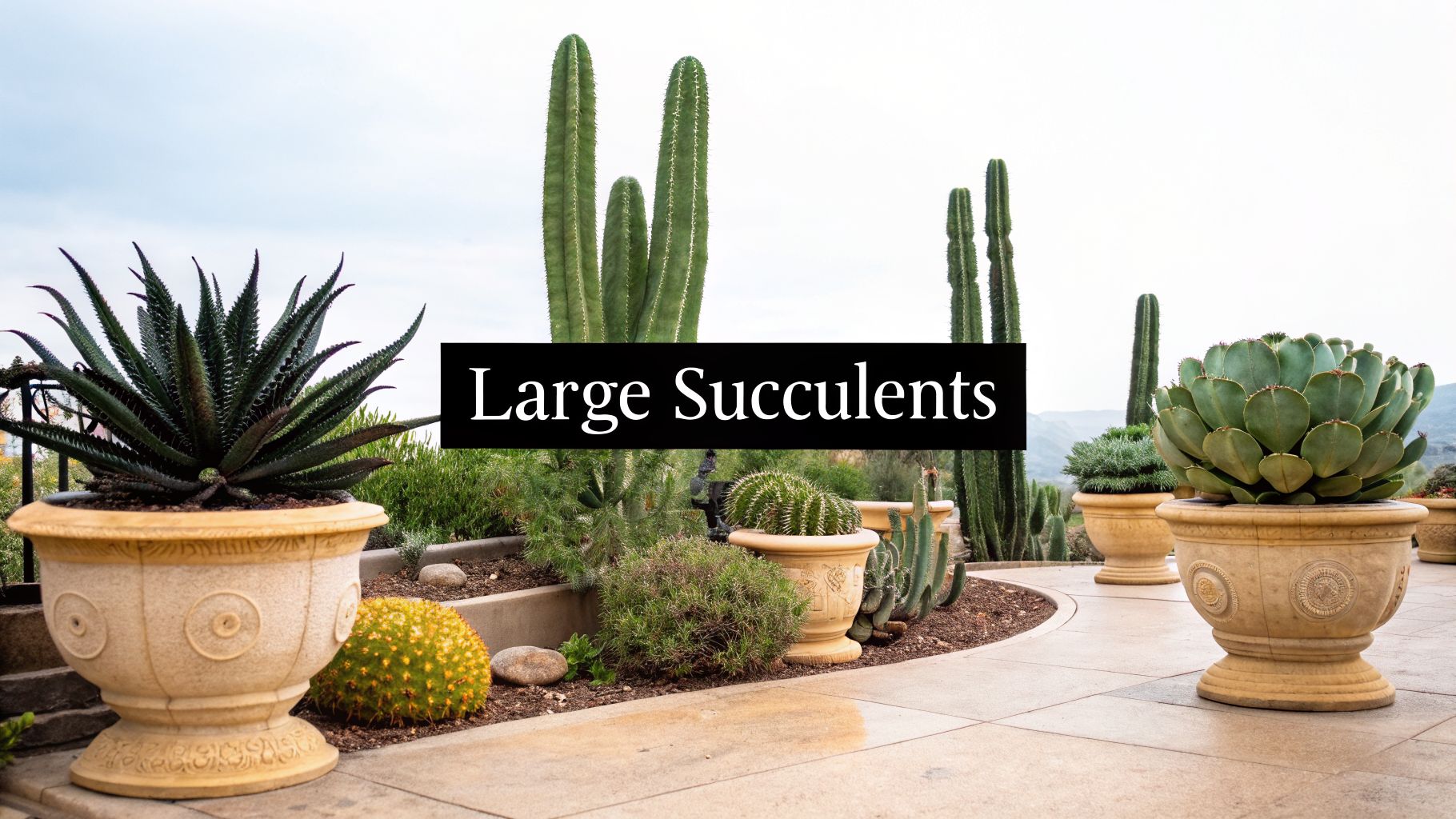

Imagine turning a corner in your home and coming face-to-face with a living sculpture. That's the power of a large succulent. The most popular choices—think dramatic Agaves, medicinal Aloes, architectural Euphorbias, and iconic columnar Cacti—are selected for their jaw-dropping forms and surprisingly easy-going nature. They aren't just plants; they're enduring design elements.
The Allure of Statement Succulents in Modern Spaces

Large succulents are more than just greenery; they're architectural wonders that infuse our lives with a sense of natural grandeur. Their striking shapes, fascinating textures, and sheer presence can instantly turn a forgotten corner into a dynamic focal point. Whether it's the fierce symmetry of an Agave or the towering silhouette of a columnar cactus, these plants are truly living art.
But their appeal isn't just skin deep. In a world where our time is stretched thin, the low-maintenance character of large succulents is a huge plus. These plants evolved to survive in tough, arid climates, meaning they become incredibly self-sufficient once they get settled in. This built-in resilience makes them a perfect match for busy homeowners and landscape designers who want maximum beauty with minimal fuss.
Bringing Nature Indoors and Out
One of the best things about these magnificent plants is their sheer versatility. They look just as good in a minimalist living room as they do anchoring a sprawling desert garden. This adaptability opens up a world of creative possibilities, no matter your space.
- Indoors: A single, well-chosen large succulent can define a room's entire aesthetic, adding a splash of organic sophistication. A Foxtail Agave or a Peruvian Apple Cactus in a stylish pot can introduce vertical height and a calming vibe.
- Outdoors: In the landscape, these plants create incredible visual impact. They are the backbone of water-wise gardening, providing the structure for a beautiful and sustainable yard. For anyone looking into sustainable design, exploring some backyard xeriscape ideas is a great way to see how these plants can anchor a low-water landscape.
Think of large succulents as enduring design elements. Unlike trendy decor that comes and goes, a well-placed statement succulent grows with you, its form evolving slowly and deliberately over years, adding a timeless quality to your space.
An Introduction to the Giants
This guide is your introduction to some of the most impressive large succulents out there, each with its own personality and appeal. We'll dive into four major families, all packed with spectacular options for your home or garden:
- Agave: Known for their dramatic, spiky rosettes.
- Aloe: Famous for their medicinal value and graceful, fleshy leaves.
- Euphorbia: Often mistaken for cacti, these plants offer unbelievable structural diversity.
- Cacti: The iconic titans of the succulent world, from the classic Saguaro to faster-growing columnar types.
By getting to know their individual needs and what makes them visually unique, you'll be ready to find the perfect living sculpture to elevate your own space. Let's start the journey.
Discovering the Architectural World of Agave Plants

If you're after a plant that brings pure drama and structural beauty to a garden, the Agave is a true icon among the many types of large succulents. With their bold, symmetrical rosettes and sculptural leaves, agaves simply command attention. They grow with a slow, deliberate grace, much like a living sculpture taking shape over years.
Agaves are absolute masters of water conservation, storing every drop they can in those thick, fleshy leaves. This makes them a perfect fit for xeriscaping and low-water gardens, where they provide year-round interest with minimal fuss. Their powerful silhouettes can anchor an entire landscape design, creating a focal point that is both rugged and elegant.
The genus is incredibly diverse, with over 200 species that vary wildly in size, color, and texture. While some stay small and tidy, many grow into formidable giants that can define an outdoor space. To get a better sense of this variety, you might want to dive into our dedicated post on the wonderful world of Agaves.
The Grand Agave Americana
When most people picture a massive agave, they’re usually thinking of Agave americana, famously known as the Century Plant. Now, that name is a bit of an exaggeration—it doesn't quite live for 100 years. But with a lifespan of 10 to 30 years, it certainly brings a sense of permanence to the garden.
The sheer scale of a mature Century Plant is breathtaking. It can form a massive rosette reaching 6 feet tall and up to 10 feet wide, with formidable leaves often tipped with sharp spines. These leaves can be a beautiful gray-blue or even variegated with stripes of cream or yellow, adding a splash of color to their powerful form.
Think of an Agave's growth like a slow, deliberate architectural project. Each new leaf adds to a grand, symmetrical design that builds over decades, culminating in a single, spectacular flowering event that serves as its final masterpiece.
This species is a true sun-worshipper, demanding at least six hours of direct sun each day to thrive. It's incredibly drought-tolerant once established and insists on well-draining soil to keep its roots healthy. Given its impressive size and sharp spines, it’s best planted away from paths and patios where it can be admired from a safe distance.
The Elegant Agave Attenuata
In stark contrast to the fierce Agave americana, the Agave attenuata, or Foxtail Agave, offers a softer, more refined look. This species is beloved for its spineless, pliable, pale green leaves that form a graceful, open rosette. It’s one of the most user-friendly types of large succulents, especially for gardens where children or pets play.
Over time, the Foxtail Agave develops a thick, curving stem, often reaching 4-5 feet in height. This gives the plant an elegant, swan-like appearance, as if the rosette is floating above the ground. It looks fantastic planted in clusters or standing alone as a specimen in a large container.
Unlike its sun-loving cousins, Agave attenuata actually prefers partial shade, especially in hot climates where its soft leaves can scorch in the intense afternoon sun. It still needs excellent drainage but is a bit more forgiving of regular watering than other agaves.
The Dramatic Lifecycle of an Agave
Agaves are monocarpic, which is a botanical term meaning they flower only once in their lifetime. This grand finale is a truly spectacular event. After years of storing up energy, the plant sends up a massive flower stalk that can soar up to 30 feet into the sky, looking like a giant asparagus spear.
This stalk then branches out, producing clusters of yellow or cream-colored flowers that are a magnet for pollinators. After this incredible display, the main plant begins to die, having spent all its energy on this final reproductive push.
But the story doesn't end there. Most agaves produce offsets, or "pups," around their base throughout their lives. These pups are tiny clones of the mother plant that you can separate and replant, ensuring the plant's legacy continues in your garden for generations to come.
Exploring the Sculptural and Diverse Euphorbia Genus
Walk into a garden with towering, architectural succulents, and you might immediately think, "cactus." It’s an easy assumption. What you're likely seeing is a classic case of convergent evolution—where totally unrelated plants living in similar harsh climates end up looking like twins. They both developed thick, water-hoarding stems and sharp spines as survival tools.
But Euphorbias are in a league of their own. This is one of the most sprawling and diverse plant families out there, boasting over 2,000 species found all over the world. While many are small, about 10% of them mature into impressive trees and shrubs, creating some of the most dramatic silhouettes you can find in the succulent world.
These plants have become absolute stars in modern biophilic design, where their strong vertical lines and unique textures act as living sculptures. The numbers tell the same story: large euphorbias are a major player in the $12.2 billion succulent market, which is expected to grow at a 4.1% CAGR through 2034. A huge 22% jump in U.S. sales since 2019 has been fueled by decorators and homeowners, with 65% of designers specifically choosing them for textural pop.
The Towering Euphorbia Ammak
One of the true showstoppers of the family is Euphorbia ammak, often called the Candelabra Spurge. Hailing from the Arabian Peninsula, this plant makes an incredible vertical statement. In the wild, it can reach a staggering 25 to 30 feet. In your landscape or a large container, you can expect a beautifully branched, tree-like form hitting a more manageable 10 to 15 feet.
Its upright, four-sided stems are a brilliant green, sometimes showing off a stunning yellow-green variegation. The stems are ribbed and lined with small, sharp spines that add to its cactus-like vibe. Euphorbia ammak is a true sun-worshipper and needs bright, direct light to keep its color vibrant and growth strong. It’s an amazing choice for a bold focal point in a xeriscape garden or a bright, airy room.
A critical safety note for all Euphorbias: These plants produce a milky white sap that is toxic. It can be a serious irritant to skin and eyes. Always wear gloves and protective eyewear when handling, pruning, or repotting. If you get any sap on your skin, wash it off right away.
The Iconic Euphorbia Ingens
Another giant in the genus is Euphorbia ingens, the famous Candelabra Tree. This African native looks like it was lifted straight from a savanna, eventually forming a dense, branching structure that can grow up to 40 feet tall in its natural habitat.
Euphorbia ingens has a deep green color and that classic candelabra shape, with new branches constantly reaching up from the main trunk toward the sky. It's a fantastic choice for adding instant height and a sense of established grandeur to a garden. Just like its relatives, it loves full sun and needs very little water once it's established, making it a surprisingly low-maintenance giant.
If you're curious to learn more about the incredible variety within this group, our comprehensive guide on different types of Euphorbia takes a deeper dive into species both large and small.
Care and Placement for Large Euphorbias
Taking care of these living sculptures is refreshingly simple—they are built to thrive on a bit of neglect. Here’s what they need to succeed:
- Light: Give them as much direct sun as you can. A south-facing window is perfect for indoor plants, while a wide-open, sunny spot is best for the garden.
- Water: The "soak and dry" method is your golden rule. Water them deeply, then let the soil dry out completely before you even think about watering again. Overwatering is their number one enemy.
- Soil: Excellent drainage is non-negotiable. A dedicated cactus or succulent mix is great, or you can make your own by adding plenty of perlite or pumice to regular potting soil.
With their striking forms and minimal demands, large Euphorbias are a powerful tool for any designer or plant enthusiast looking to make a seriously bold statement.
Meeting the Giants of the Cactus World
When you picture a truly massive succulent, what comes to mind? For most of us, it’s the towering, statuesque form of a columnar cactus. These are the true titans of the desert, the very same ones that create those iconic skylines in classic Westerns and dramatic landscape photos. Their vertical presence is so powerful it can define an entire outdoor space, yet they are surprisingly simple to care for once they get settled in.
These giants are more than just plants; they're living monuments, slowly reaching for the sky over decades, sometimes even centuries. Within this impressive group, two species stand out for very different reasons: the legendary Saguaro and the fast-growing Peruvian Apple Cactus. Getting to know them is the first step in understanding the sheer scale and gravity a large cactus can bring to your landscape.
The Legendary Saguaro Cactus
No cactus is more famous than the Carnegiea gigantea, the majestic Saguaro. It’s an icon of the American West, a symbol of resilience and incredible longevity. Native exclusively to the Sonoran Desert, these giants are a masterclass in slow, steady growth. In fact, it often takes them 50 to 75 years just to grow their first arm.
The Saguaro has captivated cactus lovers and landscape designers for generations, especially in arid regions. They can soar to astonishing heights of 70 feet and live for over 200 years—some specimens have even been dated back to 1830 using carbon dating. To give you a sense of their numbers, U.S. National Park Service surveys estimate there are around 1.6 million saguaros in Saguaro National Park alone, and that’s just a fraction of the total population. For more on the succulent market, you can find insights at MarketReportAnalytics.com.
The Saguaro is a profound lesson in patience. Growing one in a landscape isn't just planting a cactus; it's making a multi-generational commitment. Its presence connects a garden to the deep, slow-moving time of the desert itself.
Because of their protected status and unbelievably slow growth, bringing a Saguaro into a private landscape is a major commitment. They must be sourced from reputable, licensed growers who legally salvage them from development sites. Planting a mature Saguaro isn’t a DIY job—it requires heavy equipment and real expertise to ensure the cactus survives the transplant.
The Practical Peruvian Apple Cactus
For those of us who love that classic columnar look but want to see results in our lifetime, the Cereus repandus is a fantastic choice. Commonly known as the Peruvian Apple Cactus, this South American native is one of the most popular and practical types of large cactus plants for landscaping. Unlike the Saguaro, it grows relatively fast, often adding a foot or more of height each year under the right conditions.
This quick growth means you can get a dramatic vertical accent in your garden in just a handful of years. It typically grows multiple upright stems, forming a beautiful candelabra-like shape that can reach 30 feet or more. Its bluish-green stems are deeply ribbed, giving it a fantastic texture that adds a strong architectural feel to any space.
But one of its most spectacular features has to be the flowers. On warm summer nights, the Peruvian Apple Cactus produces enormous, fragrant white blossoms that can be up to 6 inches across. They put on a magical and fleeting show, opening at dusk and closing by morning, perfectly timed for nocturnal pollinators like moths and bats.
After the flowers fade, the cactus produces an edible, apple-like fruit. These round, reddish fruits are spineless and contain a sweet, white flesh dotted with crunchy black seeds. It’s a wonderful bonus, turning this ornamental giant into something productive, too.
Planting and Sourcing Columnar Cacti
Bringing one of these titans home isn't an impulse buy—it requires careful planning. Whether you're dreaming of a Saguaro or a Peruvian Apple, responsible sourcing and proper planting are what will make or break their long-term health.
- Source Wisely: Always buy your large cacti from a trusted nursery like The Cactus Outlet. This is your best guarantee that the plant is healthy, pest-free, and legally obtained.
- Plan for Size: Remember, you’re planting for the future. That small columnar cactus will eventually become a massive specimen, so give it plenty of room to grow without crowding buildings, power lines, or walkways.
- Sun and Soil: These cacti are sun-worshippers and demand full sun and exceptionally well-draining soil. To prevent root rot, you’ll almost always need to amend your native soil with plenty of sand or pumice.
Choosing a large columnar cactus is a powerful design move. It adds a sense of scale, history, and sculptural beauty that very few other plants can hope to match, instantly turning a simple garden into a memorable landscape.
Choosing Your Perfect Statement Succulent
So, you've seen the giants of the succulent world. Now comes the fun part: picking the right one for you. Think of it like matchmaking. It's not just about looks; it's about finding a plant that will truly flourish in your unique space.
The single biggest decision you’ll make is where your living sculpture will live—indoors or outdoors. That choice alone will filter your options from the many types of large succulents out there and set the stage for a long, healthy life. Each environment plays by a different set of rules.
Selecting Large Indoor Succulents
Placing a large succulent inside your home can create an incredible focal point, but it's a commitment that requires some real thought. The truth is, not all big succulents are cut out for indoor living. Many of them crave more direct, intense sunlight than most homes can offer.
Your best bet for indoor spaces will be species known for handling lower-light conditions. A younger columnar cactus, like a more manageable Peruvian Apple Cactus, or even certain tree-like Euphorbias can often adjust quite well to a spot with bright, indirect light.
For indoor success, focus on these three things:
- Light Proximity: Get that succulent as close to your brightest window as possible, which is usually one that faces south. Even moving it a few feet back can slash the available light.
- Pot Size & Drainage: A big pot is non-negotiable for anchoring a top-heavy plant, but it must have drainage holes. Waterlogged roots are the number one killer of indoor succulents, period.
- Air Circulation: Stagnant air is a welcome mat for pests and fungus. Make sure your plant has some breathing room and isn't wedged into a stuffy corner.
Planning for Outdoor Landscape Succulents
If you’re planting outside, the game changes. You’ll worry less about light intensity and more about your local climate and the plant’s final, full-grown size.
The most critical factor here is cold hardiness. A magnificent Saguaro might look invincible, but it simply can’t handle a deep freeze. Before you fall in love, always check a plant’s USDA hardiness zone and compare it to yours. This one step can save you from heartbreak after the first cold snap. You'll find that certain Agaves and Yuccas are often much tougher in cooler climates.
Sun exposure is another big one. Yes, most large succulents are sun worshippers, but even they have their limits. A plant like the Foxtail Agave (Agave attenuata) can actually get sunburned in scorching afternoon sun. Take a day to watch how the light moves across your yard before you start digging.
This flowchart offers a simple way to start thinking about which cactus fits your goals, whether you want something that grows fast or are in it for the long haul.

As you can see, choosing between a slow-grower like a Saguaro and a fast-grower like a Peruvian Apple Cactus puts you on completely different timelines for planning and results.
Finally, always think about the future. That cute five-foot Candelabra Tree (Euphorbia ingens) has ambitions. It could easily grow into a 15-foot behemoth with a massive canopy. Plan for its mature size now so it doesn’t end up blocking a walkway, swallowing a window, or tangling with power lines down the road.
To help you visualize the options, we've put together a quick comparison of some popular large succulents. This can help you narrow down the perfect match for your space and skill level.
Large Succulent Quick Comparison Guide
| Succulent Type | Mature Size (Height/Width) | Best Location (Indoor/Outdoor) | Light Requirement | Water Needs |
|---|---|---|---|---|
| Saguaro Cactus | 40-60 ft / 3-5 ft | Outdoor Only | Full, intense sun | Very Low |
| Peruvian Apple Cactus | 15-30 ft / 5-10 ft | Outdoor / Indoor (Young) | Full to partial sun | Low |
| Golden Barrel Cactus | 2-3 ft / 2-3 ft | Outdoor / Indoor | Full sun | Very Low |
| Foxtail Agave | 4-5 ft / 6-8 ft | Outdoor / Indoor | Partial sun / Bright indirect | Low |
| Candelabra Tree | 15-20 ft / 10-15 ft | Outdoor / Indoor (Young) | Full to partial sun | Low |
| Spineless Yucca | 15-30 ft / 5-10 ft | Outdoor / Indoor | Full sun / Bright indirect | Low to Moderate |
This table is just a starting point. Every plant is an individual, but these general guidelines will steer you in the right direction as you explore the amazing large succulents available at The Cactus Outlet.
Choosing a large succulent is a long-term relationship. By honestly assessing your environment—whether it's a sun-drenched patio or a bright living room—you give your statement plant the best possible chance to become a magnificent, living landmark in your space for years to come.
How to Care For and Style Large Succulents

Bringing a large succulent into your space is a big moment. It’s not just another houseplant; it’s a living sculpture. To get that stunning, focal-point effect you're after, a little bit of planning goes a long way to make sure your new giant doesn't just survive, but truly shines.
The whole process starts with getting it home safely. A good supplier like The Cactus Outlet will make sure your plant is healthy on arrival. When it shows up, be ready. Grab some thick gloves for the spiny ones, and maybe enlist a friend—these beauties can be heavy.
Essential Care for Thriving Giants
The key to long-term success is to mimic the desert conditions these plants evolved in. It’s less about constant coddling and more about setting up the right environment from the start. Give them a solid foundation, and they’ll take care of the rest.
- Planting: Pick a pot that's just a bit bigger than the root ball, and make absolutely sure it has excellent drainage. If you're planting in the ground, mix plenty of sand or pumice into the native soil to keep water from pooling around the roots.
- Watering: The golden rule is "soak and dry." Give the plant a deep watering until you see it run out the bottom of the pot. Then, and this is the important part, let the soil dry out completely before you even think about watering again. For a big outdoor succulent, this could be as little as once a month.
- Sunlight: Most of these giants crave the sun. Aim for at least six hours of direct sun each day. Just be aware that some, like the Foxtail Agave, appreciate a little shade during the most brutal afternoon heat.
"The biggest mistake I see people make is treating these large succulents like tropical houseplants. They are built for neglect. You are far more likely to kill them with kindness—specifically, overwatering—than by forgetting about them for a while. Root rot is swift and unforgiving."
Styling Your Statement Piece
Okay, with the practical stuff out of the way, now for the fun part: making your succulent a core part of your home or garden's design. The unique shapes and textures are your tools for creating visual drama and flow.
If you're keeping it indoors, a simple, modern planter often works best. It lets the plant’s architectural form be the star of the show. For outdoor spaces, you can go bigger. Think about how a towering Peruvian Apple Cactus or a dramatic, wide-spreading Agave can anchor a whole seating area. You can arrange furniture to create a functional outdoor retreat with your new plant at its heart, establishing a natural and inviting spot to gather.
Frequently Asked Questions About Large Succulents
When you start thinking about bringing a massive, architectural succulent into your home or garden, it’s only natural for questions to pop up. We get them all the time from fellow plant enthusiasts. Let's walk through some of the most common ones to get you feeling confident about choosing and caring for these incredible plants.
How Fast Do Large Succulents Actually Grow?
This is a huge one, and the answer really depends on the plant you pick. The growth rate is what separates a plant that will be a fixture for generations from one that will give you that satisfying feeling of seeing real progress each year.
- The Slow and Steady: Think of giants like the Saguaro (Carnegiea gigantea). These are the definition of patience, sometimes taking 50 years just to grow their first arm. They are truly a long-term commitment.
- The Moderate Pace: A lot of Agaves and some types of Euphorbia fit in here. You'll notice steady, visible growth from one year to the next, but they won’t suddenly take over your patio.
- The Fast Movers: If you're looking for height sooner rather than later, the Peruvian Apple Cactus (Cereus repandus) is a fantastic choice. When it's happy, it can easily put on a foot or more of new growth in a single year.
Can I Grow Large Succulents Entirely Indoors?
You absolutely can, but there are a few big "ifs." The truth is, most large succulents are sun-worshippers, and the average living room just doesn't offer the intense light they crave. Success really boils down to picking the right plant and the right spot.
To make it work, stick with species that are a bit more forgiving with light levels. A young Spineless Yucca (Yucca elephantipes) or a Foxtail Agave (Agave attenuata) can do quite well. Your best bet is to place them right in front of your sunniest window—usually one that faces south. And, of course, make sure the pot has excellent drainage and you let that soil dry out completely before you even think about watering again.
One of the most common pitfalls we see is people overestimating how bright their home is. A corner that looks well-lit to our eyes can feel like a dark cave to a desert plant. If you notice your succulent stretching and leaning desperately towards the window, it's literally screaming for more sun.
Are There Edible Types of Large Succulents?
It might come as a surprise, but yes! A few large succulents are not only beautiful but also produce food. Before you even consider taking a bite, though, you must be 100% certain you've correctly identified the plant and know how to prepare it.
- Prickly Pear (Opuntia): This is the most famous one. Both its young pads, called nopales, and its sweet, jewel-toned fruits, or tunas, are cornerstones of Mexican cooking.
- Peruvian Apple Cactus: After its gorgeous flowers bloom at night, it produces a spineless fruit. The inside is a sweet, white pulp dotted with crunchy seeds.
- Dragon Fruit (Hylocereus): This vining cactus gives us that stunningly vibrant pink fruit with the speckled, mildly sweet flesh that’s become so popular.
A crucial rule of thumb: only harvest from plants you know are free from pesticides. Never, ever experiment with a plant unless you are an expert or have confirmed its identity and safe preparation with one.
Ready to find the perfect living sculpture for your space? Explore the stunning collection of statement plants at The Cactus Outlet and discover a wide range of healthy, beautiful specimens ready to be shipped directly to your door. Start your journey today at https://www.cactusoutlet.com.