


Thinking about growing a saguaro? Good. It's one of the most rewarding things you can do as a plant enthusiast, but let's get one thing straight from the start: this is a long-haul commitment. Forget everything you know about fast-growing houseplants. Successfully raising a saguaro is all about patience, understanding its slow rhythm, and creating a tiny slice of the Sonoran Desert wherever you are.
It all starts with a choice: are you going to start with a handful of tiny seeds or adopt a young, established seedling?
The Saguaro Journey: An Introduction to an Iconic Plant

Caring for a saguaro is less like gardening and more like becoming the custodian of a living monument. And if you do it right, that monument will probably outlive you. This isn't a project for instant gratification. The saguaro is a symbol of endurance for good reason—its growth is famously measured in inches per decade, not weeks or months.
My goal here is to help you get started on the right foot, framing this as the decades-long partnership it truly is.
Understanding the Saguaro Growth Timeline
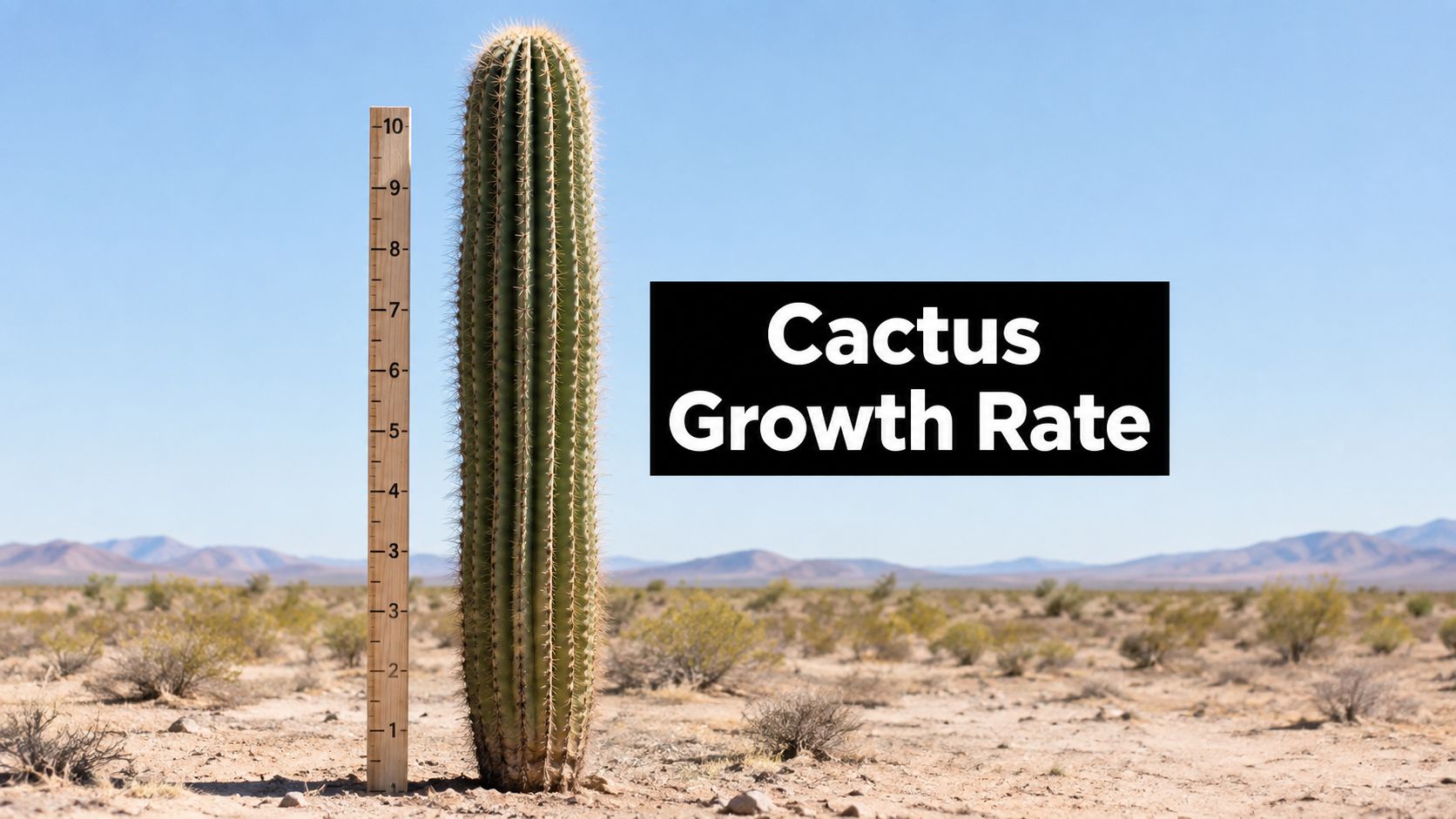
The first thing that surprises most people is the saguaro's incredibly slow growth rate, especially when it's young. It's not being stubborn; it's a survival strategy. For the first several years of its life, a saguaro pours all its energy into developing a massive root system. This is what allows it to find water and anchor itself in the harsh desert, but it means you'll see almost no change above the soil.
Just how slow are we talking? Research from Saguaro National Park is eye-opening. A young cactus might only grow 1 to 1.5 inches in its first eight years. Think about that. After a decade, your plant might still be less than two inches tall. You can dig into the specifics of their life cycle by reading the full research from the National Park Service.
The key is to embrace the pace. When you plant a saguaro, you're planting it for the next generation. Success isn't measured by its height, but by its health and resilience.
What to Expect From This Guide
To get you there, we'll walk through everything you need to know. I've structured this guide to give you practical, actionable advice that helps you sidestep the common mistakes I've seen people make time and time again.
Here's a quick look at the ground we'll cover:
- Getting Started: We'll weigh the pros and cons of seeds versus seedlings, so you can decide which path makes sense for you.
- The Perfect Home: I'll share my field-tested recipe for the ideal soil mix and show you how to nail the tricky balance of sun and shade these cacti need.
- Watering and Feeding: You'll learn how to avoid the number one killer of saguaros—overwatering. We'll also establish a "less is more" feeding schedule to support slow, steady growth.
- The Long Game: We'll look at major growth milestones, how to handle common problems, and even touch on the legal side of owning one of these protected giants.
By the time you're done reading, you'll have the confidence and the know-how to take on this incredible horticultural challenge. Let's begin.
Choosing Your Path: Seed or Seedling?

So, you’re ready to grow a saguaro. The very first decision you’ll make is a big one, and it sets the stage for your entire experience: will you start from scratch with a tiny seed, or get a head start with an established seedling?
There’s no right answer here. It really boils down to your goals, your budget, and most importantly, your patience. Let's dig into what each path looks like so you can decide which one feels right for you.
The Ultimate Challenge: Growing From Seed
Embarking on the journey of growing a saguaro from seed is not for the faint of heart. This is the path for the dedicated grower, the one who finds immense satisfaction in watching life unfold from a speck the size of a pinprick. It’s a true test of patience, but the reward is unparalleled.
First things first, you'll need to get your hands on high-quality, viable seeds from a trusted source. From there, your job is to mimic the perfect conditions of a Sonoran Desert monsoon season. This means creating a sterile, gritty soil mix and maintaining consistent warmth and humidity—a simple sealed plastic bag or a germination chamber with a heat mat can work wonders.
The seeds are sown right on the soil's surface, misted gently, and kept warm. Germination can happen in as little as a week, but this is where the real work begins. These baby cacti are incredibly fragile and highly susceptible to fungus (damping-off) and drying out. It's a meticulous process, but seeing those first tiny spines emerge is a moment you won't forget.
The Head Start: Buying a Seedling
If waiting years for your cactus to grow a couple of inches sounds like a deal-breaker, then buying a young saguaro seedling is an excellent alternative. Honestly, this is the most common and practical approach for most people. You get to bypass the entire delicate germination stage and start with a plant that has already proven its will to live.
When you're at the nursery, you need to be picky. I've learned that a healthy seedling should feel firm and turgid—never soft or squishy. Look for a vibrant green color, not a bleached yellow or pale green. Be sure to inspect it for any signs of pests like mealybugs or scale.
Here are a few things I always check for:
- A solid base: Gently wiggle the cactus to see if it feels well-rooted.
- Good color: A healthy, even green is what you want.
- No pests: Check the crevices between the ribs for any white, cottony fluff (mealybugs) or tiny bumps (scale insects).
- Firmness: Squeeze it very gently. It should feel solid, not spongy.
The nursery you buy from is just as important as the plant itself. A reputable seller will know their stuff and can give you a history of the plant's care. If you need help finding a good source, our guide on where to buy a healthy saguaro cactus is a great place to start.
Expert Tip: Don't get fixated on size. A smaller, firm, deeply colored seedling with a strong root system is a far better choice than a taller one that looks weak or discolored. Health is always more important than height in young cacti.
Saguaro Growth Starting Method Comparison
To help you decide, let's look at a side-by-side comparison of the two methods. This table breaks down the key differences in time, cost, and effort.
| Factor | Growing From Seed | Buying a Seedling |
|---|---|---|
| Time Commitment | Very High (Years for small growth) | Moderate (Focus on established care) |
| Initial Cost | Low | Moderate to High |
| Difficulty Level | High (Requires precision) | Low to Moderate |
| Success Rate | Lower (Vulnerable to many factors) | High (Plant is already established) |
| Satisfaction | Immense long-term reward | Instant connection with a plant |
Ultimately, whether you choose to raise a saguaro from a tiny seed or adopt a young plant, you're starting a unique and rewarding horticultural adventure. One path demands extreme patience and a delicate touch, while the other gives you an immediate, tangible connection to this iconic cactus.
Creating the Perfect Saguaro Habitat

To grow a saguaro successfully, you have to think like one. Your job is to recreate a little slice of the Sonoran Desert, whether it’s in a container on your patio or a spot in your yard. Getting this habitat right from the start is everything, and it all comes down to the big three: soil, light, and temperature.
If there’s one secret to keeping a saguaro alive, it's drainage. These cacti are programmed to expect their roots to dry out fast. Their absolute worst enemy is "wet feet," which is a fast track to deadly root rot. Never, ever use standard potting soil straight from the bag—it holds way too much moisture and is a death sentence for any desert plant.
My Go-To Saguaro Soil Recipe
I’ve spent years dialing in the perfect soil blend, so you don't have to guess. This recipe gives you the ideal mix of structure, aeration, and the rapid drainage saguaros need to thrive.
For the perfect gritty mix, combine these ingredients:
- 50% Inorganic Material: This is the heart of your drainage. I use a combination of coarse sand (not the fine stuff from a playground), pumice, and perlite. These create essential air pockets and stop the soil from turning to concrete.
- 30% Cactus & Succulent Soil: A quality bagged cactus mix serves as a good base, providing a little structure and organic material.
- 20% Coco Coir or Peat Moss: This part is key. It holds just enough moisture for the roots to drink before the whole pot dries out again.
When you're done, the soil should feel loose and gritty in your hands. A quick test is to water it—the water should pour through the pot’s drainage holes almost immediately. That’s how you know you've nailed it.
The Tricky Balance of Sunlight
It's a common mistake. People see saguaros standing tall in the desert sun and assume they need to be blasted with light from day one. While mature saguaros are true sun-worshippers, their younger counterparts are surprisingly sensitive and can get nasty sunburns from intense afternoon sun.
Out in the wild, baby saguaros almost always start their lives tucked under the safety of a "nurse plant," like a palo verde or mesquite tree. This natural canopy gives them bright, but filtered, light and protects them from the worst of the heat. You need to be that nurse plant.
A young saguaro does best with full morning sun followed by partial or dappled shade during the hottest part of the day, roughly from 1 PM to 4 PM. Positioning it on the east side of your house or beneath a taller plant usually works perfectly.
Dealing with Temperature and Frost
Saguaros are tough, but they aren't invincible, especially when it comes to the cold. They can handle incredible heat, but a hard frost can easily kill a young, vulnerable plant. Remember, they come from a region where a true freeze is a rare and short-lived event.
-
Outdoor Plants: If you live where temperatures dip, you have to play defense. On nights when a frost is coming—around 32°F (0°C) or lower—cover your cactus. A frost cloth, or even an old blanket propped up so it doesn't touch the plant, works well. Just make sure to uncover it first thing in the morning to let it breathe.
-
Indoor Plants: Growing indoors simplifies things. Your main concerns are keeping it away from drafty windows during winter and giving it as much light as you can, ideally from a south-facing window.
Getting these three elements—soil, light, and temperature—right is the foundation for everything that follows. By building a proper home for your saguaro now, you're setting it up for decades of slow, steady, and healthy growth.
Getting Saguaro Watering and Feeding Just Right
If there’s one secret to successfully growing a saguaro, it’s this: master the watering can. I’ve seen more saguaros lost to overwatering than all other issues combined. You have to forget everything you know about watering typical houseplants and start thinking like the desert.
Your cactus actually has a built-in water meter you can learn to read. Look at its accordion-like ribs. When they are plump and the folds are wide, your saguaro is full of water. When the ribs look thin, pinched, and sharply defined, it's telling you it's getting thirsty.
My personal mantra has saved countless cacti: when in doubt, let it drought. A saguaro is a champion at recovering from being too dry, but root rot from soggy soil is often a death sentence.
The Drench-and-Dry Watering Method
The best way to water a potted saguaro is to mimic the intense, infrequent monsoon rains of its home. We call this the "drench-and-dry" method.
When it's time to water, be generous. Pour water over the soil until it streams out of the drainage holes. This deep soak ensures every single root gets a chance to drink. But here's the crucial part: after that drench, you must let the soil dry out completely. Don't even think about watering again until the soil is bone-dry deep down in the pot.
Never, ever let your saguaro sit in a saucer of water. After a good watering, give it 15 minutes to drain, then dump out any water left in the tray. This is the single fastest way to invite fatal root rot.
For a deeper dive into different approaches, our comprehensive guide to watering cactus plants covers techniques for all sorts of species.
A Seasonal Watering Schedule
A saguaro's thirst changes dramatically throughout the year. Your watering schedule needs to follow the sun and the heat.
-
Summer (Active Growth): During the hottest months, your saguaro is in its growth phase. Plan on a deep watering every 2-4 weeks, but only after the soil has completely dried. During an intense heat wave (over 100°F or 38°C), you’ll likely be watering closer to every two weeks.
-
Spring & Fall (Shoulder Seasons): As the weather cools, the saguaro's growth slows. Stretch the time between waterings to every 4-6 weeks. Always check the soil first—don't just water because the calendar says so.
-
Winter (Dormancy): This is where growers often go wrong. Saguaros go dormant in the cold and use almost no water. Watering in winter is incredibly risky. For most, watering just once or twice over the entire winter is plenty. In many climates, you can stop watering entirely from November to March.
As the experts at the Arizona-Sonora Desert Museum will tell you, the saguaro’s ribbed structure is designed for storing water through long droughts. Your job is to provide those deep, infrequent soaks during the summer and then back off completely.
A Minimalist's Guide to Fertilizing
When it comes to feeding your saguaro, less is always more. These cacti evolved in nutrient-poor desert soils, so they are very light feeders. Pushing them with too much fertilizer leads to weak, unnatural growth and can even scorch their roots.
Stick with a specialized, low-nitrogen cactus fertilizer and dilute it to half-strength. Only feed during the active growing season in late spring and summer. Fertilizing just once or twice during this entire period is perfect. Never feed in the fall or winter when the plant is resting.
Your goal is to encourage slow, strong, and steady growth—not a sudden, lanky growth spurt.
The Long Game: Saguaro Care for the Decades Ahead
Bringing a saguaro into your life is a true long-term commitment, one measured in decades, not seasons. As your cactus slowly matures from a tiny, fragile seedling into a robust juvenile, your job as its caretaker will change. It’s less about constant fussing and more about patient observation and providing a stable environment.
The first few years are notoriously slow. After this initial crawl, your saguaro enters its "juvenile" stage. During this time—which can last for decades—all its energy goes into gaining height and girth. It won't even think about growing its famous arms or flowers for a very long time.
Major Growth Milestones to Watch For
A saguaro’s life story unfolds on a different timescale than almost any other plant you'll grow. You'll need a calendar and a real appreciation for slow, steady progress to mark its milestones. While the exact timeline depends heavily on water, sun, and soil, we have a pretty good idea of the general age ranges for its key life events.
Seeing the first flowers is a huge moment. This typically happens when the saguaro hits maturity, usually somewhere between 30 and 50 years old. By then, the plant is often around 6 to 10 feet tall. Those iconic arms? They come much, much later.
In Saguaro National Park, branches normally begin to appear when a saguaro reaches 50 to 70 years of age under favorable conditions. However, this timeline extends dramatically in harsher environments, with some saguaros in areas of lower precipitation requiring up to 100 years before developing their first arms. With optimal growing conditions including adequate water availability and right sunlight exposure, saguaros can eventually grow to impressive heights of 40 to 60 feet tall. Discover more insights about the saguaro's impressive growth rate on The Cactus Outlet blog.
As it grows, your watering strategy will need to adapt to the seasons year after year. This is probably the most critical part of long-term health.

This rhythm—from deep summer soaks to a nearly dry winter—is crucial for preventing the rot that can kill even mature saguaros.
Troubleshooting Common Saguaro Problems
Even the most carefully tended saguaro can run into trouble. The trick is to spot the signs early and know what your cactus is trying to tell you.
-
Stretching (Etiolation): If your saguaro starts looking thin, pale, and seems to be reaching for the sky, it's etiolated. This is a classic sign it's not getting enough direct, intense sunlight. The fix is to gradually move it to a sunnier spot. Don't go from deep shade to full sun in one day, or you'll trade one problem for another: sunburn.
-
Discoloration: A bleached, yellowish look on the sun-facing side is sunburn. Young plants are especially vulnerable, so you might need to give them some shade during the hottest afternoon hours. On the other hand, a reddish or purplish tint in winter is perfectly normal. It's just a mild stress response to the cold and nothing to worry about.
-
Pests: Mealybugs and scale are the usual suspects. Mealybugs look like tiny flecks of white cotton, often tucked deep into the cactus ribs. Scale insects are small, hard brown bumps that latch on. For either pest, your best weapon is a cotton swab dipped in 70% isopropyl alcohol. Just touch the swab to the pests to remove them.
The Legal and Ethical Side of Owning a Saguaro
This is incredibly important: the saguaro is a protected species. In Arizona, it is illegal to dig one up or move one from any public or private land without a state-issued permit. These laws are in place to shield wild populations from poaching.
The only right way to own a saguaro is to buy it from a reputable, licensed nursery like The Cactus Outlet. This guarantees your plant was either grown responsibly from seed or legally salvaged from a construction project with the proper permits. By supporting licensed growers, you help protect these desert giants for generations to come. When you buy a saguaro legally, you're not just an owner—you're a steward. You might be interested in learning more by exploring our detailed article on saguaro cactus growth rates and timelines.
Common Questions About Growing Saguaros
No matter how much you read, growing a saguaro will have you scratching your head at some point. It's just part of the journey! You'll notice little quirks or wonder about the long game.
Let's walk through some of the questions that pop up most often. These are the real-world problems and "is this normal?" moments that every saguaro grower eventually faces.
How Often Should I Repot My Saguaro?
Saguaros hate being repotted. Seriously. They have sensitive roots and thrive on stability, so moving them is a major shock to their system. Unlike your leafy houseplants that might need a new home every year, a saguaro is perfectly happy staying put.
As a rule of thumb, you should only consider repotting every 4 to 6 years, and only if you see clear signs that it’s necessary. What are those signs?
- It's root-bound. If you can see a dense mat of roots at the drainage hole or the soil is completely filled, it’s out of room.
- It's getting top-heavy. As the cactus grows taller, its small pot might not be enough to keep it stable. If it looks like a slight breeze could knock it over, it's time for a heavier base.
When you do repot, choose a new container that's only 1-2 inches wider in diameter. A pot that's too big holds excess soil and moisture, creating the perfect environment for deadly root rot.
Can I Grow a Saguaro Indoors Year-Round?
The honest answer? It’s incredibly difficult and generally not a great idea if you want your saguaro to truly thrive. The biggest obstacle, without a doubt, is light. These cacti evolved to soak up the intense, unfiltered sun of the Sonoran Desert, something a windowsill just can't match.
Even in front of your sunniest, south-facing window, the plant will likely suffer. It will grow painfully slow and is at a huge risk of etiolation—where it stretches out, looking pale, skinny, and weak as it desperately searches for light. For healthy, natural growth, nothing beats being outdoors in direct sun.
If you're determined to try growing one inside, you absolutely must supplement with a high-powered, full-spectrum grow light. Even then, remember that it's a substitute, not a replacement for the real thing.
What Are These Black Spots on My Saguaro?
Seeing spots on your cactus can send you into a panic, but don't worry just yet. The cause can be anything from a normal part of aging to a genuine emergency. The key is to check the texture of the spots.
Go ahead and gently touch them. What do they feel like?
- Dry and Hard Spots: If the spots are dark, dry, and feel calloused or scaly, you're almost certainly looking at cactus corking. This is the plant's natural way of creating "bark" as it gets older and stronger. It can also be a scar from a past bump or scrape. It's not a health issue at all.
- Soft and Mushy Spots: This is the one to be concerned about. If the black areas are soft, squishy, spreading, or have any fluid seeping out, you're dealing with bacterial necrosis, or rot. This is a serious infection that can kill a saguaro fast.
If you suspect rot, it’s time for plant surgery. Grab a clean, sharp knife (sterilize it with rubbing alcohol) and carefully start cutting away all the infected black tissue. Don't stop until you see only healthy, solid green flesh.
Is It Legal to Own a Saguaro Cactus?
Yes, owning a saguaro is legal, but there’s a huge catch: it must be from a legal source. The saguaro is a protected species, and states like Arizona have very strict laws about them.
It is highly illegal to dig one up from the wild—whether it's on public or private land—without special permits. Poaching saguaros is a serious crime with hefty penalties.
The only right way to get a saguaro is to buy one from a reputable, state-licensed nursery. These nurseries either grow their plants from seed or legally salvage them from construction sites with all the required paperwork. This ensures you're not contributing to the decline of wild populations.
At The Cactus Outlet, we provide legally and ethically sourced cacti, ensuring you can grow these magnificent plants with peace of mind. Explore our collection of healthy, nursery-grown saguaros and more at https://www.cactusoutlet.com.